




Skip navigation
Previous searches
    Suggested searches
      ""

      A sn6gk peek into what’s next

      Laying the foundations for a 6G-led tomorrow

      6G

      6G will go far beyond faster network speeds, reshaping industries, economies, and everyday life. As artificial intelligence (AI) and cloud innovation accelerate, networks must evolve into intelligent, adaptive platforms that take connectivity to the next level, creating an intelligent fabric that connects people and machines through mobile, cloud, and AI so they can work together seamlessly in real time. Now is the time to ready networks, rethink business models, and reframe ecosystems for a future defined by pervasive intelligence and limitless connectivity.

      Step into the 6G era

      6G is the next leap in mobile technology, turning today’s 5G Standalone (SA) and 5G Advanced networks into an intelligent fabric that is built on the convergence of mobile, cloud, and AI. It is designed to deliver a step change in performance, reliability, and resiliency, while adding new spatial, compute, and data services and making the network more programmable. This will allow building AI- and extended reality (XR)-driven experiences, richer industrial applications, and new services powered by connectivity.

      At the same time, 6G is evolutionary rather than disruptive. A new standalone 6G radio will work with a 6G core network evolved from 5G Core (5GC), enabling smooth migration that protects existing investments and helps introduce new capabilities, improve energy and cost efficiency, and scale coverage and capacity for a wider range of device types.

      Ericsson is a major contributor to defining this future, driving 6G research, standardization, and concept validation to lay the foundations for initial commercial deployments around 2030 and 6G’s continued evolution into the 2035+ timeframe.

      Imagine a reality where human, physical and cyber worlds interact in real time

      What 6G will unlock

      Marking the next wave of network evolution, 6G extends today’s mobile broadband, fixed wireless access, and Internet of Things (IoT) with a step change in user experience and an intelligent, AI-native fabric that connects mobile, cloud, and AI. From differentiated connectivity, integrated sensing-based spatial awareness, and application programming interfaces (APIs) to energy-efficient design and sustainable-by-default operations, it will create a platform for new use cases and business models across industries and society in the 2030s and beyond.

      icon
      AI-native networks

      Being fully AI-native from day one, 6G will bring intelligence embedded across features, software architecture, hardware acceleration, and automation. With AI at the center, networks can learn, predict, adapt in real time, and operate more autonomously to deliver tailored, guaranteed experiences while managing performance, resilience, energy, and spectrum efficiency, as well as new services.

      Check when AI-native networks will move from vision to reality

      Icon
      Connectivity with precision and reliability

      6G will deliver a step change in connectivity performance, bringing the precision, reliability, and resiliency needed for new traffic patterns and device segments such as AI- and augmented reality (AR)-driven experiences. It will deliver better uplink, coverage, and capacity, as well as improved network resilience, security, and predictable latency, giving users dependable performance wherever they are.

      Explore how 6G will enhance connect

      Icon
      Value creation beyond connectivity

      Advanced features, including programmable network capabilities and standardized APIs, will help unlock value beyond connectivity, making it easier to expose functions such as sensing, time synchronization, compute, data, and AI services. These will provide the building blocks for innovation across a broader ecosystem of telecom platforms, AI agents, and cloud-native applications, turning the network into a service platform rather than just a data pipe.

      Discover what 6G makes possible beyond connectivity

      Quadcopter
      Integrated Sensing and Communication

      Integrated sensing and communication (ISAC) is a flagship 6G capability that will turn mobile networks into spatially aware platforms, combining high-speed connectivity with radar-like environmental sensing. By analyzing radio-frequency signal reflections, networks will be able to detect, locate, and track objects, enabling real-time spatial awareness for use cases such as drone airspace monitoring, autonomous vehicle safety, industrial automation, and immersive XR experiences.

      Learn about ISAC

      Icon
      Built-in efficiency and sustainability

      With a leaner radio access network (RAN) and overall system design, higher levels of automation, and native intelligence across networks, 6G will improve energy and cost efficiency and support more autonomous operation regardless of traffic growth. By shaping energy performance across time, frequency, and spatial domains, and enabling networks and devices to enter deeper sleep states when demand is low, coverage and capacity can be sustainably scaled while reducing opex.

      Discover how 6G RAN boosts network

      Icon
      A scalable technology with global reach

      6G will support a broad range of use cases and device types through one scalable access technology, from low-complexity asset-tracking sensors and massive IoT to high-end AI/XR glasses, autonomous robots, and non-terrestrial networks (NTNs). Terrestrial networks and NTNs will work together to extend global coverage and scale capacity so users and their devices will get the coverage, data rates, and latency they need, wherever they are, without fragmenting the ecosystem across multiple radio technologies.

      Read how 6G transforms massive IoT

      Gustav Wikström, Ericsson research
      6G – connectivity and beyond for the 2030’s

      Take a closer look at how 6G is being shaped today: from early research and ecosystem alignment, through standardization and spectrum decisions, to initial deployments and continued evolution throughout the 2030s. Our experts present Ericsson’s core idea of 6G as an intelligent fabric that combines connectivity, spatial services, and compute and data services, while answering why AI-native design, open APIs, and energy-efficient architecture are central to turning that vision into real networks, new services, and business opportunities.

      6G timeline

      6G is moving from vision to reality through a clear industry timeline.

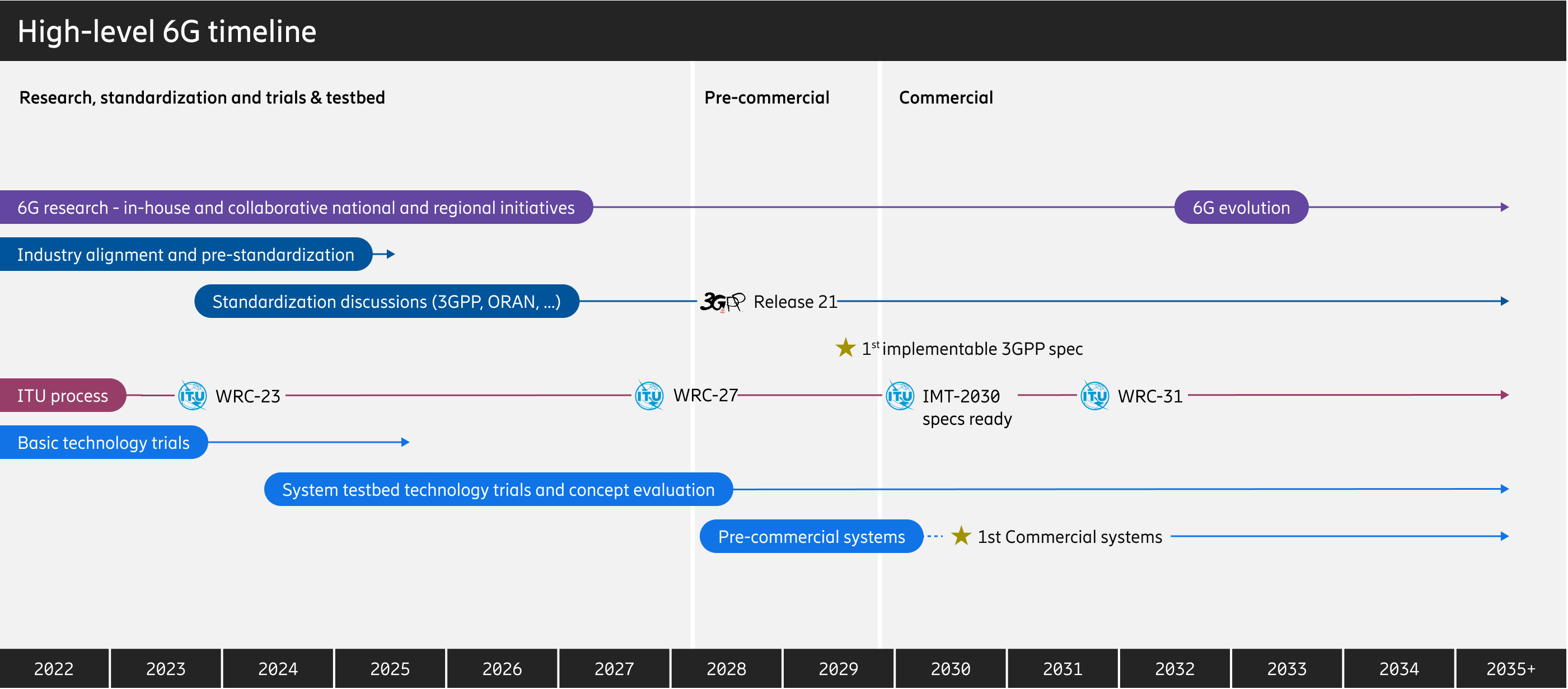
      Several years of research by individual companies, academia, and national and regional research programs, along with industry alignment, will provide a strong, common foundation for the 6G system. With early proofs of concept already in place and the pre-development phase in full swing through technology trials and testbed development, we are on the right track to prepare for commercial offerings.

      6G research will continue beyond the first commercial release of 6G in 2030, paving the way for future 6G advanced networks.

      High-level timeline

      Global standards bodies are now working toward the first 6G specifications in the late 2020s, enabling pre-commercial systems and paving the way for initial deployments and commercial networks around 2030.

      The path to 6G adds new capabilities at each evolution stage, preserving and extending existing investments, and showing how networks progressively scale performance, introduce new services, and become more autonomous and programmable over time.

      The 6G evolution

      Today: 5G SA
      AI-powered networks connecting the digital world

      5G SA is the foundation of the 6G journey, delivering a cloud-native, programmable network that moves beyond best-effort connectivity. It enables new use cases and business models through differentiated connectivity, network APIs, and automation, spanning enhanced mobile broadband and fixed wireless access to private networks and advanced enterprise services.

      Tomorrow: first 6G deployments
      AI-native operations, scaling and expanding 5G

      By 2030, initial 6G deployments will establish a new baseline for performance and capabilities, building directly on existing 5G SA and 5G Advanced networks. In addition:

      • Multi-radio access technology spectrum sharing (MRSS) and a 6G core evolved from 5GC will enable smooth migration.
      • New centimeter-wave (cmWave) band spectrum and energy-efficient signaling will boost capacity and coverage.

      A scalable, AI-native radio access technology (RAT), designed to support the most relevant use cases and relying on intelligence embedded across all layers, will serve both human users and AI workloads at scale.

      Beyond: 6G after 2035
      Intelligent fabric with full 6G capabilities

      After the first deployments, 6G networks will continue to evolve into a truly intelligent fabric, ready to meet accelerated AI needs and enable fully autonomous networks. In this phase:

      • Solutions will be enhanced for selected verticals and high-value use cases.
      • Spatial services will gain greater precision and coverage.
        The system will adapt to new devices and agents, from digital twins to semantic communication and future network topologies, strengthening how mobile, cloud, and AI work together across the cyber-physical world.

      Inside the 6G standardization journey

      Standardization will provide the technical foundation for future 6G networks, as it has for earlier generations, ensuring global interoperability and economies of scale. On top of this shared baseline, commercial 6G networks will be differentiated through implementation choices and unique features from technology vendors such as Ericsson.

      As with previous generations, 3GPP will be the main specification body for 6G, working alongside other forums such as the Open Radio Access Network (O-RAN) Alliance on selected interfaces according to the following timeline:

      • 2024 (Release 19): Work on the first 6G standard started, focusing on use-case and requirement studies
      • Q3 2025 (Release 20): technical study phase
      • Q4 2028 (Release 21): delivery of the first implementable 6G specifications
      • Early 2029: specifications are frozen

      In parallel, the IMT-2030 process, led by the International Telecommunication Union (ITU), defines performance requirements and evaluates candidate technologies. Additionally, global spectrum discussions, including new cmWave bands around 7 to 8 GHz on top of existing 5G bands, help shape where 6G will operate.

      Together, these activities aim to enable the first commercial 6G systems by 2030, with a smooth migration from 5G and a long runway for continued evolution beyond.

      Shaping 6G with smart spectrum choices

      With a well-prepared spectrum strategy, it will be possible to unleash 6G’s immense power by adding new frequency bands and extending the value of existing bands in a way that keeps coverage, capacity, and costs in balance. New spectrum in the midband and cmWave frequency ranges will be essential for 6G, complemented by existing low-, mid-, and millimeter-wave (mmWave) bands to support advanced use cases and increasing traffic. For an overview of the frequency options and their role in 6G deployments, explore our dedicated 6G spectrum page.

      Explore our dedicated 6G spectrum page.

      An essential enabler of 6G

      CmWave bands, primarily in the 7 to 8.5 GHz range, can provide good wide-area coverage with large contiguous bandwidths, unlocking new capacity without rebuilding the existing grid. Deployed adjacent to today’s mid-bands, cmWave can unleash substantial wide-area spectrum to support demanding 6G use cases such as AI-driven services, XR, integrated sensing, and massive digital twinning, while keeping site counts, costs, and power consumption under control.

      See why cmWave is the ideal spectrum for 6G coverage and capacity

      spectrum sharing

      The transition to 6G in existing bands

      Reusing today’s low- and mid-band (FR1) spectrum efficiently enables efficient coexistence between 5G and 6G without building entirely new site grids. Multi-RAT spectrum sharing (MRSS) lets 5G and 6G operate dynamically within the same carrier with very low overhead, so networks can add 6G capacity and performance while continuing to support existing 5G services and long-lived IoT deployments.
      Discover how MRSS enables 5G and 6G to coexist efficiently

      spectrum sharing

      A potential future

      Low band spectrum is essential for nationwide coverage, including rural areas, and for deep indoor penetration in urban areas. Access to low bands, such as 600 and 700 MHz, can bridge the digital divide and help close the connectivity gap.

      Sub-THz spectrum was initially suggested as a potential frequency range for 6G. However, it is not part of current discussions on 6G spectrum in regulatory groups because of, for instance, challenging propagation conditions.

      Learn more about sub-THz 

      6G fragements of time

      6G architecture

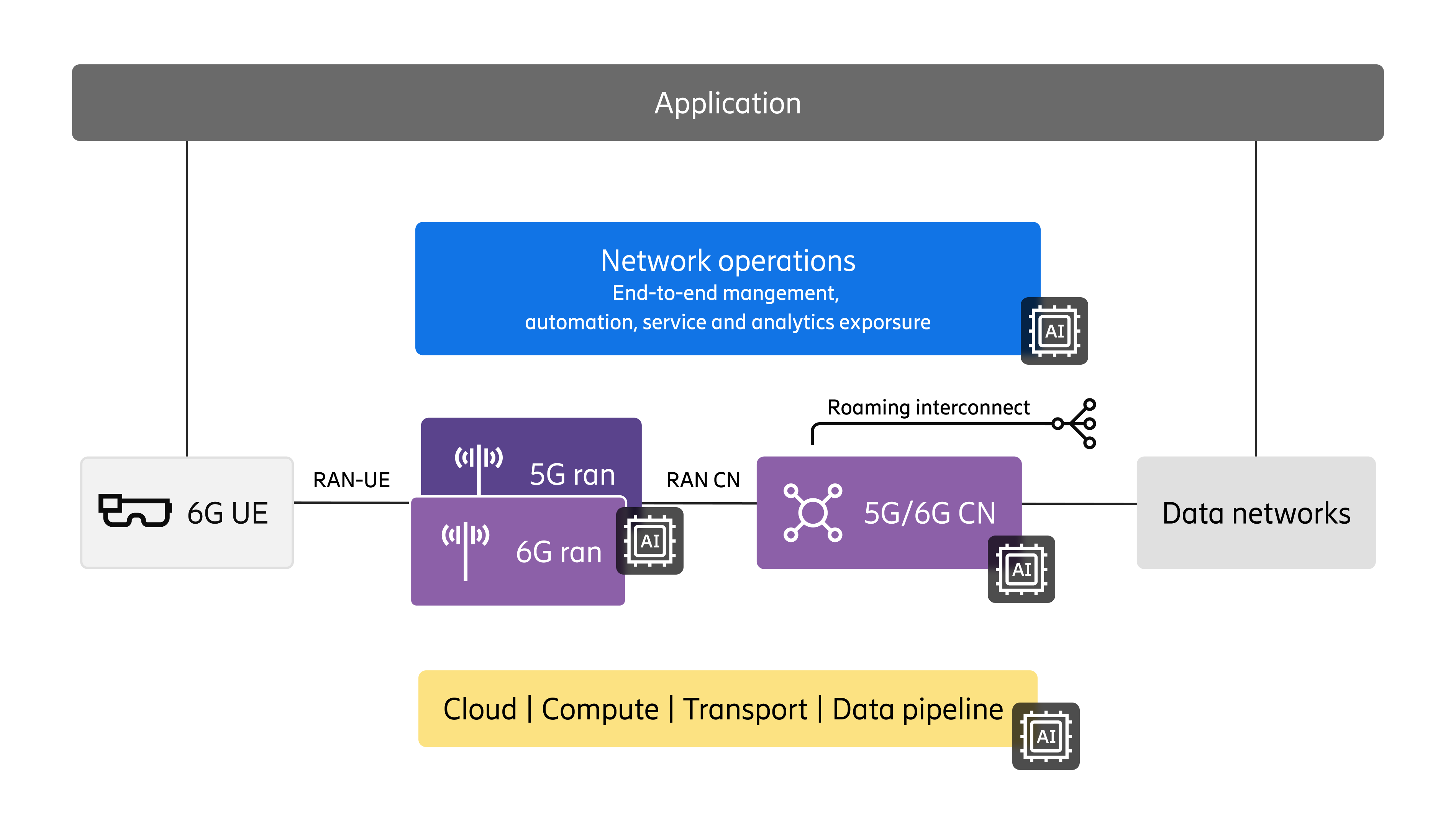
      6G’s proposed network architecture is envisioned as open, AI-native, and cloud-native, so the network acts as an intelligent fabric rather than just a connectivity layer. A new standalone 6G RAT works together with a 6G core evolved from 5GC on shared cloud, compute, and data platforms, enabling advanced automation and key 6G capabilities.

      Evolutionary by design, this architecture reuses proven 5GC features such as slicing, exposure, and roaming, while adding new 6G functions and supporting spectrum sharing and common infrastructure for a smooth migration from 5G. Standardized interfaces and network APIs then make the network programmable, allowing applications and AI agents to consume connectivity, compute, data, and sensing services in a controlled way.

      ""

      6G architecture with the most important features highlighted below

      AI-native architecture

      The core network will have a unified AI framework that governs AI design, deployment, and lifecycle, supported by holistic data collection, observability, and management, as well as requests from user equipment, agents, or application functions supplied to the network as intents.

      Evolutionary by design

      A 6G core, evolved from 5GC, coexists with 5G, reusing slicing, exposure, and roaming while adding new 6G-specific functions and sharing spectrum with 5G to ensure a smooth migration path to 6G.

      Open and programmable

      Standardized interfaces and network APIs expose network capabilities, such as sensing, allowing applications and AI agents to consume network services beyond basic connectivity.

      Cloud-native foundation

      6G will help share cloud, compute, and data platforms to provide the scale, elasticity, and placement flexibility that support future service evolution, from near-edge processing to AI workloads and energy-efficient deployments.


      6G research: from idea to real-world solution

      Ericsson began 6G research  around 2018, with large-scale collaborative projects following suit in 2021. While this work has laid the foundation for today’s 6G standardization, the work will not end with the first standards or commercial release. Looking beyond 2035, 6G will continue to follow market demand and technological progress, with AI advancing especially fast. Beyond network technologies, research also explores how to enable and scale emerging 6G use cases and unlock new service and monetization models.

      Industry and academia should continue to look ahead to the enabling technologies of an evolved 6G system, reach new application domains, and strengthen the intelligent network. Key research topics include semantic communication, new network topologies, and self-synthesizing networks; sharper spatial services for greater precision and coverage; and valuable new services across the merged cloud-AI-mobile continuum.

      6G: resilient and secure by design

      In the 6G era, high-trust cyber-physical systems that connect people, devices, and intelligent machines will place high demands on security. 6G must not only deliver the right protective capabilities, but also give users, CSPs, and regulators clear assurance that those capabilities are in place.

      6G security builds on the strong foundation of 5G, extending it with new protections shaped by continuous threat analysis and grounded in zero-trust principles. It secures new capabilities such as ISAC, spatial services, and AI-native control loops, strengthens the intelligent fabric against evolving threats, and safeguards the identity and integrity of both human users and AI agents. Fine-grained policy control lets operators introduce new services and securely expose network capabilities through APIs, all without compromising trust.

      Protection on this scale calls for a holistic approach: one that combines standardization, secure hardware and software, regulatory compliance, supply chain security, and operations that can mitigate large-scale attacks. Much of this is automated and increasingly driven by AI, enabling faster, more consistent defense across the network.

      6G is designed to be quantum-safe from the start, building on standardized post-quantum cryptographic algorithms. Network exposure through APIs is secured by design, opening new value while preserving trust. ISAC is protected for both security and privacy. And security for non-terrestrial networks further enhances resilience across coverage and connectivity.

      Together, this holistic approach makes 6G a network that protects sensitive data, keeps essential services running under stress, and provides the confidence required to scale new digital services across critical national infrastructure, enterprises, consumers, and society at large.

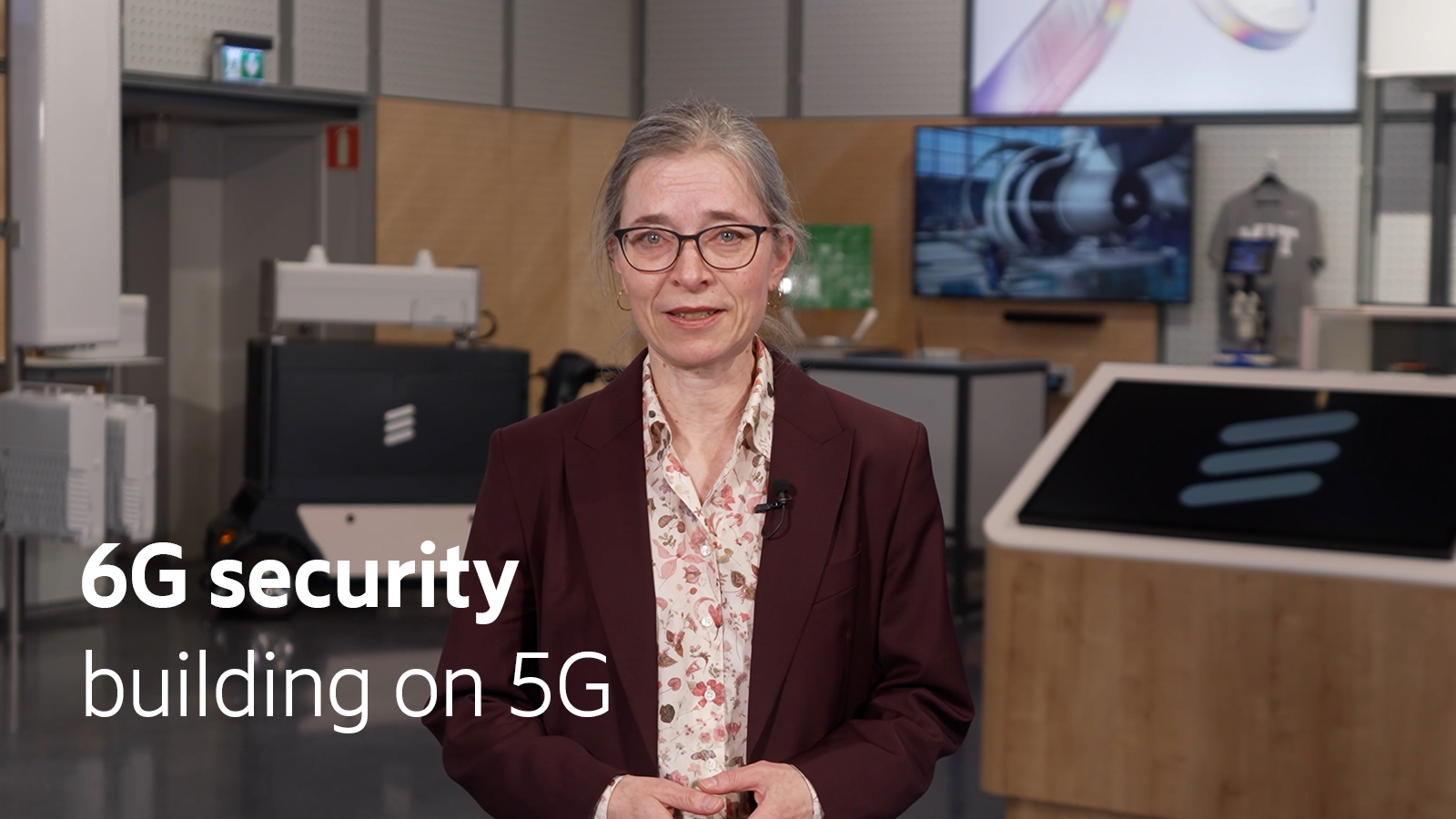
      6G security: Building trust for the networks of 2030 and beyond

      6G security will build on the strong foundation of 5G and evolve to address new technologies, use cases, and threats. Discover how zero-trust principles, AI-driven security automation, and quantum-resistant protection will help secure the next generation of mobile connectivity. Explore the additional security considerations emerging from technologies such as non-terrestrial networks and integrated sensing.

      Further 6G insights