










Getting more out of spectrum and hardware you already own: How AI-Native Scheduler for Link Adaptation is rewiring the RAN
- Proven performance gains in live networks, where traditional link adaptation struggles with dynamic interference and fast-moving UEs, real-world deployments show up to 10% average spectral efficiency improvement over conventional scheduling across sites, and up to 25% spectral efficiency and 50% downlink throughput gains in top-performing cases.
- No new hardware required, running as software on Ericsson's silicon (EMCA), the feature delivers these gains across the existing installed base of radios and basebands no dedicated AI hardware needed.

Customer Solutions Manager AI

Strategic Product Manager of AI RAN
Customer Solutions Manager AI
Strategic Product Manager of AI RAN
Customer Solutions Manager AI
Strategic Product Manager of AI RAN
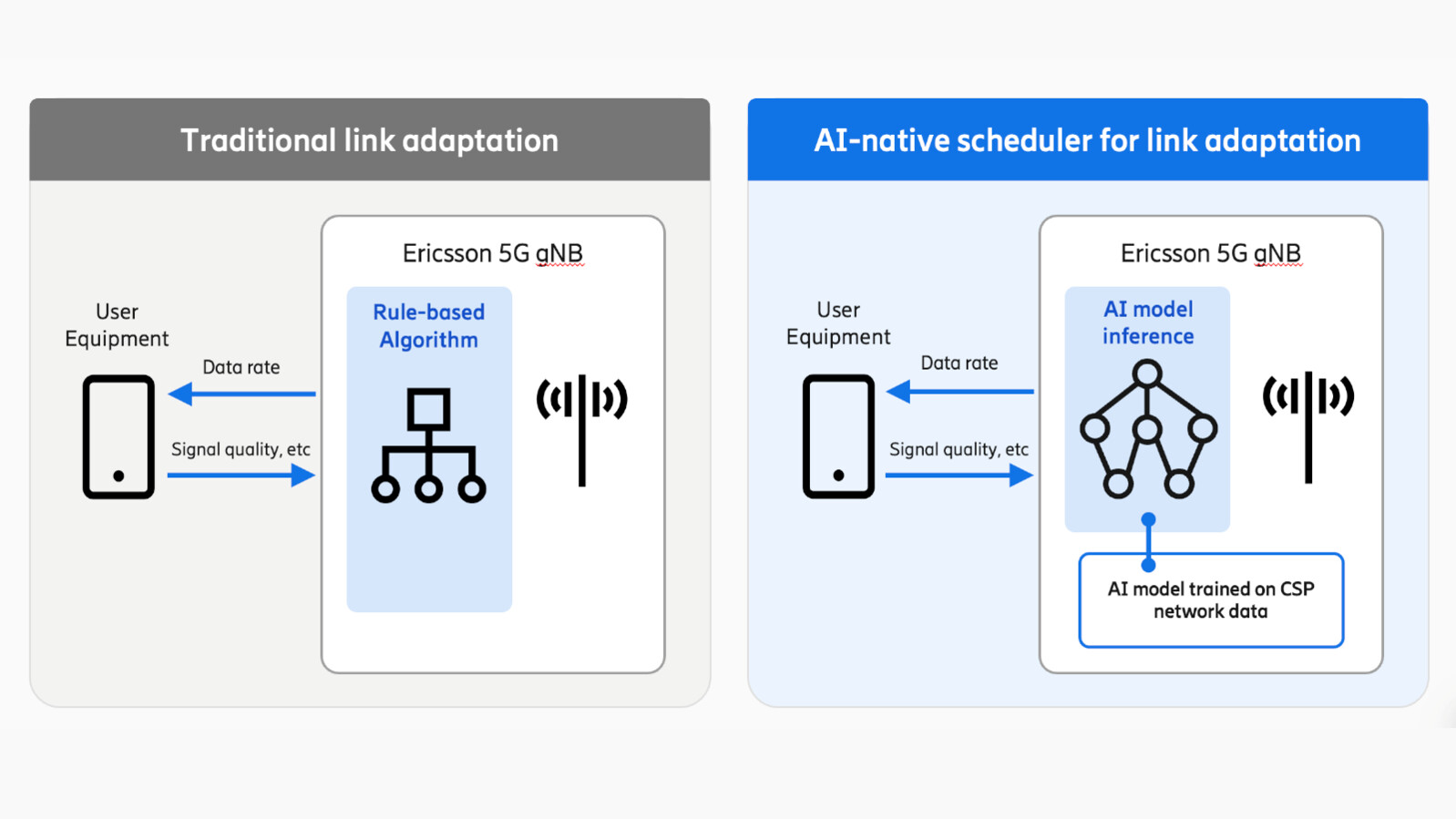
For decades, mobile networks were built around rules. Engineers studied how the network behaved, designed an algorithm, tested it, and shipped it. Once deployed, those algorithms were built around predefined targets and assumptions about what would work best across typical conditions. In certain conditions, that approach becomes limiting when each transmission faces a different mix of interference, mobility, feedback uncertainty, and rapidly changing radio conditions.
Every transmission decision today has to account for mobility, interference, traffic patterns, neighboring cells, beamforming behavior, feedback uncertainty, and radio conditions that shift constantly, all at once, in real time. The hard part isn't gathering that information anymore. It's making the right call with it fast enough.
AI-native Scheduler for Link Adaptation is a shift from networks built to react toward networks built to learn, and it fits squarely into Ericsson's broader move of augmenting rule-based systems and evolution toward networks that keep improving on their own.
Wireless spectrum is finite and expensive
Spectrum is the physical-layer medium that governs a network's capacity, propagation, and spectral efficiency. It's also finite, bound by physics, which means securing the right mix of low-, mid-, and high-band frequencies takes enormous capital. It's typically the single most expensive asset on a carrier's balance sheet. Recent annual reports from major North American carriers show combined spectrum acquisition spend running well into the hundreds of billions of dollars. You can't manufacture more of it, so the only lever left is squeezing more value out of what you already hold.
The hidden decision behind every user experience
Users judge a network by download speed, video quality, gaming responsiveness, and reliability. But every one of those outcomes starts with a single low-level decision made millions of times a day: what modulation and coding scheme (MCS) should the next transmission use? Get it wrong and you lose throughput, lose spectral efficiency, and rack up retransmissions. Get it right and you're on the right track for pulling the maximum value out of every MHz you own.
Why traditional link adaptation has reached its limits
The conventional approach, Outer Loop Link Adaptation (OLLA), uses device feedback on channel quality and adjusts a correction offset against block error rate (BLER) targets. It's robust, predictable, and well understood. But it struggles when inter-cell interference swings wildly or UEs are moving fast, and it is further affected by UE feedback errors, neighbor-cell traffic, and other factors. None of that means the algorithm is wrong .It just means a fixed BLER-target loop can miss the best transmission choice when channel capacity, interference, mobility, feedback uncertainty vary from one transmission to the next.
The shift from rules to learning
Traditional network design turns domain expertise into fixed rules, thresholds, and policies. It works, but it's boxed in by static assumptions, manual tuning, and a limited ability to respond to changing conditions. AI-native networks pair that same domain knowledge with operational data, so the system can learn from behavior, adapt to local context, and keep improving instead of standing still. Link Adaptation is one of the earliest practical examples of this in action: it draws on ongoing insight into channel quality, mobility, traffic, interference, and device behavior to keep optimizing transmission decisions and, with them, spectral efficiency, reliability, and the experience users actually feel.
AI gains on existing installed base hardware
Traditional approaches lean mostly on current channel measurements to decide what to transmit next. That's often not enough. In dynamic environments, what's happening right now and what happened last time under similar conditions both shape whether a transmission succeeds. An AI-native system learns from radio measurements, traffic patterns, and historical performance to find the deeper relationships between what it observes and what actually happens. So the question stops being "what's the signal quality right now?" and becomes "given everything happening and what's worked before in conditions like this, which choice is most likely to land?" That's really the whole idea behind AI-native networking: trading reflexive reaction for prediction grounded in context.
AI-native Scheduler for Link Adaptation delivers its biggest wins at the edges of coverage and in interference-heavy environments, where average network stats mask what users actually experience. Field-validated results across multiple global service providers, spanning North America and Asia-Pacific, confirm:
- Across a wide range of sites, approximately 10 percent improved spectral efficiency versus legacy rule-based link adaptation, with results reaching 25% increase at certain sites based on large-scale commercial trials on live 5G Advanced traffic.
- The high-end of the results from trials show throughput increase reaching 50% while up to 20% increase observed across sites.
- The proof of concept running on the Cloud RAN architecture powered by Intel Xeon 6 processors showed consistent results with respect to purpose-build deployments.
These gains translate directly into network economics. Better spectral efficiency means more capacity out of the same spectrum investment. Higher throughput in tough conditions means better user experience when it matters the most and more value per MHz.
AI-native Scheduler for Link Adaptation runs as software on Ericsson’s silicon (EMCA) and does not require new or dedicated AI hardware. Operators can deploy the feature across their existing installed base, improving network performance without replacing the hardware already in the field.
Journey to Autonomous RAN
AI-native Scheduler for Link Adaptation is one of the first AI capabilities built directly into the radio software stack, an early milestone on the path to AI-native RAN. It's already commercially available and sits in Ericsson's AI in RAN roadmap alongside capabilities coming down the line, including AI-Managed Beamforming, AI-Powered Macro Positioning, and AI-powered Multi-Layer Coordination. Together, these lay the groundwork for radio access networks that get progressively more autonomous, capable of real-time decisions and closed-loop optimization that rule-based systems simply can't match. The direction here isn't ambiguous: networks will start translating CSP intent straight into radio behavior, without someone having to write a new rule for every new environment. AI-native link adaptation is where that journey begins.
Where it starts
AI-native Scheduler for Link Adaptation matters less because it uses AI and more because of what it changes: how the decisions get made in the first place. Networks used to run on expert-designed rules. Tomorrow's will increasingly run on expert-designed objectives paired with AI-learned strategies, learning from the environment continuously instead of waiting for an engineer to spot the next optimization. It's the first of many AI features coming out of Ericsson AI in RAN. A RAN that learns from every transmission is where you start if the goal is a network that eventually learns to run itself.