Skip navigation
""

Telecom AI

Mobile networks need AI, AI needs mobile networks.

As volumes of traffic and the amount of connected devices grow exponentially, relying on human capability alone to manage networks is no longer feasible. This need is only augmented by the boom in AI applications, which require a robust foundation of secure, reliable connectivity with more uplink capacity and consistent latency to deliver the right user experience.  Put simply: a greater convergence between AI and mobile networks is essential both now and for the future 6G era.

Harnessing AI for networks to manage operations not only opens the door to the greater efficiencies needed to meet customer expectations today, it is also a key enabler to underpin innovative new business models and the use cases of the future. Ericsson’s strategic transformation of telecom networks is creating AI-optimized infrastructure that is essential to delivering value and performance from AI applications.

Key AI technologies being applied in telecom

AI technologies are transforming network capabilities, delivering tangible value through measurable improvements in performance, energy efficiency, and automation.

Solutions like dynamic resource allocation and traffic prediction proactively optimize capacity and resource usage, resulting in more reliable connectivity and an enhanced end-user experience.

The dawn of agentic AI technology, unlocking a new level of intelligence and adaptability in how AI is applied, presents a number of opportunities for telecom. Enabling autonomous machine entities to ‘think’ and act independently is a significant step towards a world where networks can self-manage with specialized AI agents monitoring and improving network performance – for example through the use of rApps. 

Telecom AI technologies: a quick guide

Generative AI uses machine learning (ML) algorithms to create new content, including text, images, audio, or code. Large Language Models (LLMs) have reached human-level quality in generating text and answering questions. In telecom, this technology can be applied to both customer-facing solutions and advanced network solutions, such as conversational AI-based assistants.

Agentic AI refers to AI systems that can sense, think, adapt and act using planning algorithms and adaptive decision-making. Such systems can be implemented as a single agent or a coordinated multi-agent architecture where multiple agents collaborate towards defined goals without human guidance.

Orchestrates agentic AI entities, aligning their actions with overarching service intents and business goals for seamless coordination and execution.

Reinforcement learning refers to AI systems that learn how to make better decisions over time by interacting with their environment and optimizing for long term outcomes. These systems enable agents to adapt autonomously in dynamic network conditions, enabling networks to self optimize and deliver more intelligent, zero touch operations.

The conversational workflow: how it works

A conversational workflow ensures that humans remain in charge of business critical actions.

This allows AI to save time by doing the ‘heavy lifting’ while keeping the human in charge of what is ultimately implemented. If desired, a tunable level of autonomy allows the human “co-pilot” to gradually hand over more parts of the workflow as confidence in the machine learning grows.

Human input

A human operator makes a query in standard language that is translated into complex technical goals through an AI model.

AI agentic reasoning

AI agents gather context by studying live network data and other critical information before reasoning to determine the best solutions.

Human in charge

The human operator reviews, adjusts and implements the actions proposed by the AI agent.

The role of mobile networks in an AI-driven world

AI is now at the top of the digitalization agenda for both enterprises and society. It has moved from machine learning to generative AI chatbots, advancing further towards agentic AI that enables new ways to write software and unlocks previously unattainable services.

The mobile technology landscape is  undergoing a profound transformation, driven by the the rapid adoption of Generative AI applications and the evolution of 5G networks. We are entering a new wave of AI driven innovation, one that is reshaping how society and industries communicate and operate.

Networks for AI

This wave of innovation is driving entirely new demands and use cases. Many of them require much more uplink capacity, fundamentally changing the balance between uplink and downlink traffic. To support that shift, networks must go beyond traditional best-effort performance. They need to provide deterministic, reliable connectivity with sufficient capacity, consistent performance, and low, predictable latency, to ensure that AI applications run smoothly and at scale. The network is the road for AI to perform.

AI for networks

AI enhances the network’s ability to automate, simplify and perform at a high level by applying the right AI models in the right place – from BSS to radios and core networks.

High performance can now be guaranteed through increasingly AI-driven, autonomous and intent driven end to end network operations. This is driving reduced OPEX, optimized CAPEX and a competitive operational baseline for high-performance, differentiated network services.

From network performance to customer experience and more: the benefits of telecom AI

Man looking out the window from a taxi

AI offers the most effective path to automating network operations and managing growing complexity from increased traffic, devices, and use cases.

Strategically deploying AI in the network has a wide range of benefits that can make significant contributions to competitiveness and business value. In broad terms, AI helps networks to deliver consistency, future-proof to support a wider range of use cases, unlock value from core and cloud technologies, achieve more efficient operations, reduce energy consumption, and maximize the performance of existing infrastructure.

Working at a scale and pace that cannot be achieved by humans alone, in networks, AI reduces the time needed to pinpoint and resolve faults. It can even predict issues before they have the chance to disrupt end-user experience.

With a strong foundation aligned to the TM Forum’s ‘level 4’ autonomous networks vision, Ericsson enables intent-driven networks powered by AI, capable of adapting in real time without human intervention. This new paradigm resolves operational conflicts and prioritizes actions based on business value, ensuring consistent performance and agility.

AI RAN

Emerging AI‑native apps with real-time AI workloads will challenge networks in unpredictable new ways – driving new traffic patterns including surging uplink demands, stricter latency requirements and far more dynamic load across the RAN.

Embedding AI into every layer of the mobile network can transform how Communications Service Providers (CSPs) build, operate, and scale intelligent, energy-efficient, and revenue-generating networks.

Read more

AI business value

AI is taking automation to the next level. But AI implementation isn't just a one-off tech solution – it's a whole new way of working, which means its value is often hard to measure. To calculate how AI is driving growth in the telecommunications industry, we surveyed industry professionals about the role it plays in their organizations, using the insights to develop an industry-unique measurement framework.

Read more

Five key benefits that reveal the full value of AI

Gain a deeper understanding of the full value of AI for telecom, as our experts introduce our blog series and reveal the five key benefits of AI for networks, plus give unique insights and tips for how communication service providers (CSPs) can get started on their AI journey.

Read the blog post

Driving sustainability and energy efficiency with AI

We explore how AI can help CSPs to reach their sustainability goals while lowering operating costs. Join our experts as we look into the solutions helping to reduce energy consumption through the use of intelligent network optimization and the activation of energy-saving features.

Read the blog post

Best performance for unparalleled customer service

In this episode, we dive into performance - how AI can help CSPs manage increased complexity and improve network performance, as well as improve customer experience. Gain insights into how AI and its performance benefits can help you stay competitive in an increasingly demanding market.

Read the blog post

Trustworthy AI systems and a new era of security

In this post, we explore why trustworthy AI systems and ethics are central to the success of AI – and how AI can reduce security and compliance issues, detect threats like cyberattacks or fraud and improve customer data protection, driving a new era of security in telecom networks.

Read the blog post

Digital twins: a safe environment to test and experiment with AI

Jon Gamble, Ericsson, Imagine Studio, asks you to imagine a digital world beyond the screen.

Digital twins allow experimentation with and testing of AI models in a realistic digital environment which mirrors the network’s conditions without exposing the live network. This creates an ideal simulation for stress-testing new AI systems and observing their impact without the potential risks of running them directly on the network.

Learn more about digital twins

Blog: Digital twins and how they enable future networks

Digital twins may sound like science fiction, but they are already being leveraged in commercial solutions, using AI, data & digitalization to enable the networks of the future. Join us as we dive into these virtual realms of possibility, with insights from three real-world digital twin examples.

Read the blog post

Radio access network (RAN) digital twins eBrief

Radio access network (RAN) optimization has greatly advanced since the advent of “digital twins”. By creating simulated virtual testing environments, digital twins let us safely run “what-if” scenarios and analysis in risk-controlled RAN environments. Learn why Digital Twins are essential to optimizing RAN performance.

Download the eBrief

How and where telecom AI is applied

AI agents are replacing rule-based algorithms in telecom networks, adding new components with additional functionalities as well as adding AI-driven controls to existing components.

The agents leverage the masses of data generated by networks to predict outcomes, detect anomalies, allocate resources and optimize quality of service. From dynamic power management of the radio access network to save energy, to predicting network congestion, enhancing capacity in response for smoother performance: advanced AI network technologies are already delivering positive results from complex and diverse business goals today.

Ericsson harnesses AI across virtually every layer of our portfolio, from radio hardware to operations software, enterprise solutions, tools for AI developers and more. Our networks are not only developed with AI in their own architecture to deliver performance benefits, but also to provide the best possible platform for AI-driven services now and in the future.

Person overlooking city lights at sunset from hill

Continue exploring telecom AI application areas

Deepening AI integration in 5G and beyond

Aerial view of city lights at twilight.

The 5G era sees an ongoing deepening of the integration of AI into networks. We are moving from AI as an add-on tool to AI as a foundational part of the network itself, enhancing network intelligence and establishing a robust platform for future AI applications.

AI agents will soon be deployed across the whole network ecosystem, from baseband and RAN hardware to cloud software and operations platforms. Machine learning, generative and agentic AI are driving progress towards intent-driven, autonomous networks.

In complex areas like the RAN and network operations, AI embedded directly into the radio stack and orchestration layers can now optimize critical elements like beam forming, traffic steering or MIMO sleep modes, delivering improved throughput, spectral efficiency and energy savings.

Cognitive Software meanwhile is already leveraging explainable AI and tailored AI models on cloud-native architecture to improve planning and optimization, including forecasting traffic and identifying bottlenecks to reduce CAPEX.

This journey will culminate in the 6G era with AI as a key, native network component, shaping its architecture, capabilities and services.

The path towards autonomous networks

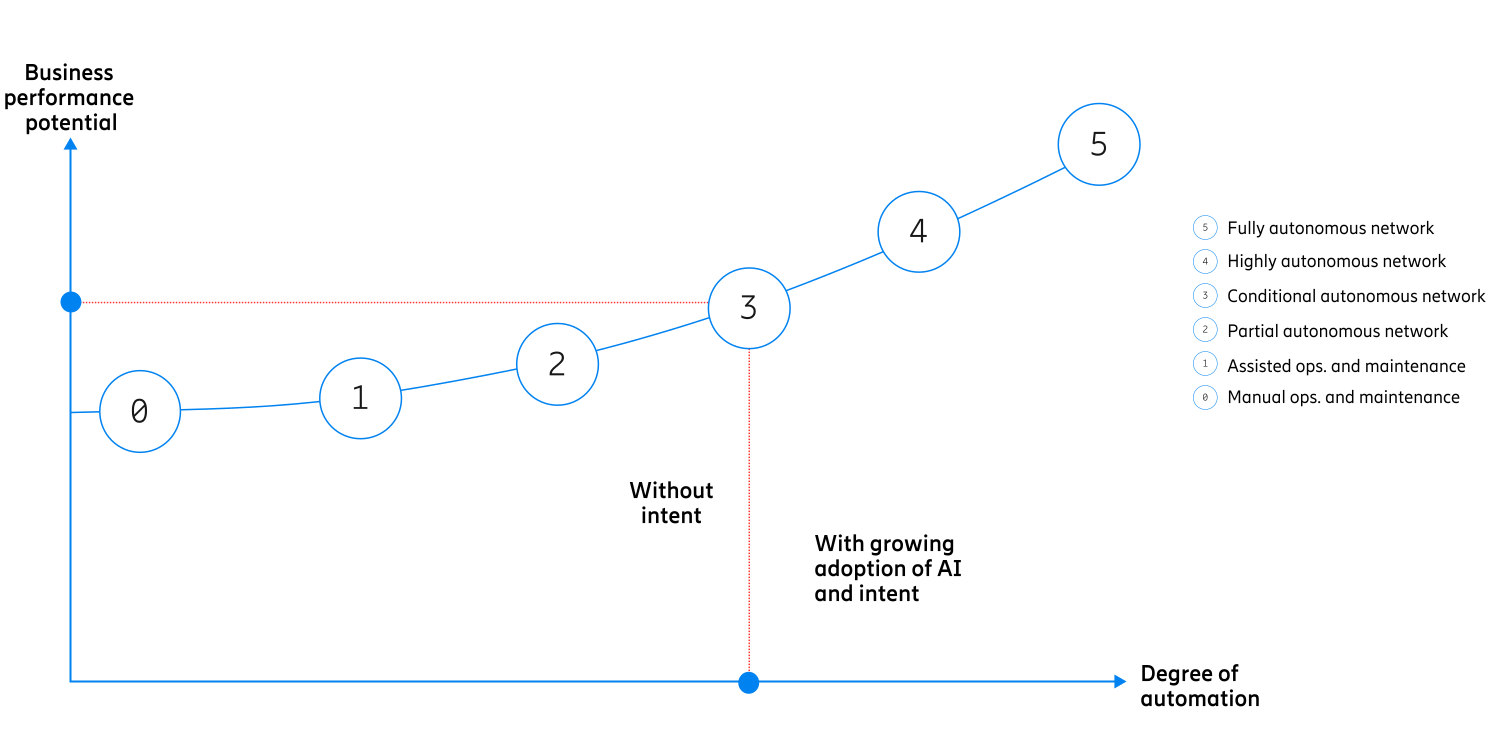
AI is a key enabler of the transition towards self-optimizing, self-healing, autonomous networks. In the future, a fully autonomous network would leverage closed-loop automation capabilities across multiple services, domains, and the entire network life-cycle, improving business agility and facilitating multiple go-to-market models for services that can be quickly provisioned and assured without human intervention.

The landmark arrival of intent-driven networking is a key step in the direction of truly autonomous networks, with operations shifting from task-based commands to outcome-focused goals. These goals are then interpreted as dynamic, utility-based goals allowing AI agents to determine and executive corrective actions.

Explore autonomous networks
The path towards autonomous networks

On the horizon: 6G and AI-native networks

6G will take advantage of further advancements in hardware, compute and AI technologies, combining these to create networks that plan and anticipate with AI at their center. 6G will be fully AI-native from day one: Radical gains in energy efficiency, spectrum efficiency and uplink levels will enable transformational AI applications for consumers, enterprise and beyond.

With AI embedded at every layer, these networks will be able to learn, predict congestion, and adapt in real time to deliver tailored, guaranteed experiences. The 6G era will be defined by dynamic, autonomous networks that enable a new generation of innovators to build on top of this intelligence.

The industry target for the first commercial deployments of 6G based on ready standards is around the year 2030, by which time there is expected to be a massive uptake of mobile connectivity demanding AI usage. This is expected to apply bot to consumer AI applications like personal assistants accessed through smart XR glasses, as well as for industrial and IoT applications such as autonomous vehicles, digital twinned industrial control systems, and smart cities.

Explore 6G

Ericsson is leading the evolution to AI-native networks

Erik Ekudden, CTO Ericsson

Ericsson is a pioneer in the research and development of AI in telecom, working closely with industry leaders and the wider ecosystem to shape future applications of AI technology that will improve network infrastructure, operations, energy efficiency, security, performance and customer experience.

Our next-generation AI features are already being proven in the field, with benefits ranging from 10% spectrum efficiency through AI native link adaptation, 33% energy savings from radio units through our Service Continuity AI App suite, and 25% better 5G coverage from AI embedded in RAN Compute software.

Ericsson is proactively developing infrastructure to serve external AI use cases, with R&D treating 6G as an AI-native application platform  that will see networks expose intelligence, compute and data to empower AI developers: offloading compute heavy AI tasks to the network, exposing capabilities and quality of service in AI-focused APIs, and much more.

Taking a leading role in standardization, we are not simply adding AI features on the surface , but rather, ensuring that AI applications can use networks consistently across vendors and countries, benefitting scalability and underpinning the viability of new use cases.

Voices from the industry

Unleashing the full potential of AI in telecom

Join Erik Ekudden and Bruno Zerbib, CTIO of the Orange Group, as they engage in an insightful conversation about network APIs and AI use cases in telecommunications.

AI Cloud and 5G: Innovation transforming the enterprise landscape

Join Erik Ekudden, CTO Ericsson, and Ryuji Wakikawa, VP and Head of the Research Institute of Advanced Technology at SoftBank Corp., as they explore the transformative potential of AI cloud and 5G in the enterprise world.

Revolutionizing networks with AI

Join Erik Ekudden, CTO Ericsson, and Enrique Blanco, CTIO of Telefonica Group, as they explore the future of the telecommunications industry.

Advancing the future through AI-powered innovation

Join Erik Ekudden, CTO Ericsson, and Sridhar Ramaswamy, CEO  at Snowflake, as they discuss the evolving landscape of technology, focusing on the pivotal role of data, resilient cloud platforms, and 5G in shaping the future of networks and enterprise innovation.