










What America’s mobile networks are made of: U.S.-based R&D, sensing and the path to 6G
- Ericsson’s U.S. based R&D is a crucial part of our global technology leadership – working in critical areas like AI, network security, semi-conductor design, 6G and open networks.
- Ericsson is deeply embedded in the US ecosystem, helping to ensure the U.S. is the technology leader for secure networks that will power the 6G-AI digital stack in decades to come.

Chief Strategy and Technology Officer
Chief Strategy and Technology Officer
Chief Strategy and Technology Officer
Through U.S.-based R&D, Ericsson is helping build secure networks that power America’s leadership in the 6G-AI future. -Explore how Ericsson’s U.S. R&D centers fuel innovation and strengthen U.S. leadership goals.

When most people think about mobile networks, they picture bars on a phone or a stream of data flowing quietly in the background. But as the United States looks ahead to 6G and AI-native infrastructure, what really matters is what those networks are made of – the research, engineering talent, and partnerships that determine how secure, resilient and innovative they will be.
For Ericsson, the US is our most important market, especially given the front runner status across technology and industry innovation. Our R&D investments, collaborations and demonstrations here are designed to ensure that America’s mobile networks are not only connected, but perceptive, trustworthy and ready for the next generation of applications, fueling the U.S. innovation engine.
A nationwide R&D footprint with deep American roots
Delivering the benefits of advanced wireless networks to consumers, businesses and the U.S. economy requires long-term commitment to research and development and close collaboration across private companies, universities, standards bodies and public private alliances.
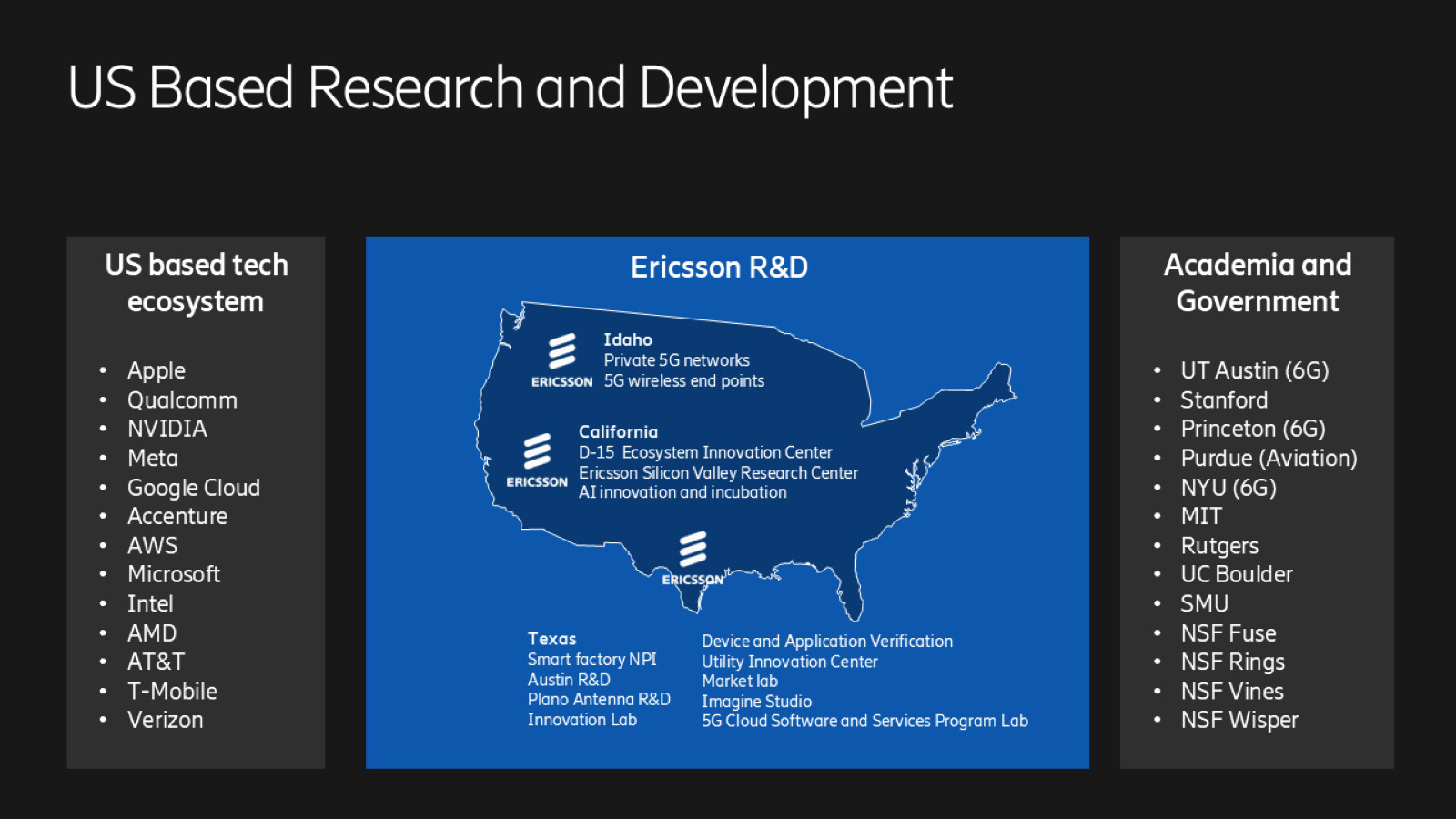
Figure 1: Ericsson US based Research, Development and Innovation hubs
In the U.S. today, Ericsson operates a dozen R&D sites across key innovation corridors, from Texas to Silicon Valley and beyond. These include:
- Our Austin R&D Center, where teams in semi-conductor, software and AI develop the advanced hardware and software that power the next generation of mobile networks – including foundational capabilities for 6G and beyond. In Austin our engineers and already working on the semiconductor designs that will power Ericsson 6G capabilities. Ericsson’s custom chips are key to making our radios and basebands lightweight, power efficient and easy to deploy. Austin has an extra focus on chip level security to ensure trust and security is built into the very fabric of the network.
- The Distributed Innovation Network in North Texas provides an end‑to‑end ecosystem and edge computing environment where customers and partners can run real‑world experiments in a secure, low‑risk setting. This network is the foundation of our ongoing 6G testing, enabling Ericsson to run the first ever live 6G trial from the U.S. early in 2026.
- Ericsson Silicon Valley and D-15 where Ericsson engages with the U.S. tech ecosystem to develop innovation within and on top of the network (more below) and where Ericsson researchers develop and support the standardization of future technologies.
- The North American antenna R&D center that designs and prototypes antennas for our Ericsson Antenna System portfolio, helping U.S. operators address capacity, coverage and performance challenges to deliver the best service to their customers. This center recently worked with a Tier One operator in the U.S. to develop an antenna specifically designed to extend coverage for fixed wireless access (FWA) deployments in rural America, helping to close the broadband gap and give rural communities more options for home internet services.
- The Ericsson Device and Network Testing lab that works across the ecosystem to test the chipsets, modules, smartphones, applications, IoT devices and connected drones/vehicles that leverage U.S. wireless networks – ensuring they are secure and certified to operate on the network.
- Our Global Utilities Innovation Center, where public sector and enterprise partners can validate solutions in realistic test environments and develop solutions for new use cases in the utility sector.
- Our Boise, Idaho development center where we design the next generations of wireless routers that bring vehicle connectivity to over 5000 public agencies across the country.
Beyond these labs, Ericsson is an active partner in more than 100 organizations across the U.S., providing equipment, funding and technical leadership to ensure that the networks of today and tomorrow meet national needs.
This R&D footprint is not abstract – it is directly connected to how we secure critical communications, protect airspace, modernize utilities, and enable new applications for defense, public safety and economic growth.
Innovating with customers and industry in Silicon Valley
Ericsson’s U.S. R&D footprint also includes co-development labs with customers and partners. In our Silicon Valley D-15 lab, we are building and co-inventing with the U.S. technology ecosystem to accelerate innovation across our networks. For example, with cloud infrastructure partners like AWS and Google Cloud, Ericsson is bringing new architectures and interfaces to market to support ecosystem growth and foster new capabilities for consumers and industries. Together with industry leaders we are exploring how advanced connectivity, AI, and next-generation devices can unlock new user experiences and create value across industries.
As we continue the journey toward 6G, Ericsson at D-15 is collaborating closely with our partner ecosystem to ensure that the intelligent digital fabric of the future, combining AI, cloud, and mobile technologies in the 6G-AI stack, is secure, trusted, and scalable. D-15 has also been at the forefront of driving differentiated connectivity experiences and ecosystem innovation. For example, D-15 worked with Ericsson’s Vonage team to pioneer developer access to network capabilities. Quality on Demand (QoD) provides a programmable interface for developers to request stable latency or prioritized throughput from the network. D-15 developed a testing plan to ensure the QoD API worked with Ericsson infrastructure, pioneering programmable network capabilities and creating a foundation for new developer experiences. Building on this work, D-15 is bringing together differentiated connectivity, AI, XR technologies, new device types, and collaborations across the AI and XR ecosystem to enable immersive, real-time applications that seamlessly connect cloud intelligence, devices, and networks for both consumers and enterprises.
Also at our Ericsson’s Silicon Valley labs, our AI innovation and Incubation Center spearheads AI projects from across Ericsson, ensuring the AI we develop for our own networks (Telecom AI or AI for Telecom) is secure, trustworthy and observable with the goal to deliver the best networks for AI. This means using AI across the network to optimize performance, spectrum efficiency, power use and reliability. In addition, we are evaluating models for running AI inference within the network, further improving performance for use cases that require inference closer to the edge devices. Our AI team is deeply embedded in Silicon Valley ecosystem and at the forefront of latest trends in AI, partnering with startups and tech giants, and developing prototypes that are jumpstarting innovation in global Ericsson R&D.
Integrated sensing and communication: networks that can see
One of the most exciting frontiers in wireless is integrated sensing and communication (ISAC). ISAC is a transformative technology that turns mobile network infrastructure into systems capable of both communicating and sensing their surrounding environment. By analyzing RF signal reflections, these systems can detect objects such as drones and vehicles for situational awareness.
Because ISAC leverages the scale of deployed mobile networks and Ericsson’s 5G technology leadership, it enables cost optimized detection and tracking at nationwide scale – a powerful capability for protecting critical infrastructure, transportation hubs and public events.
In February 2026, Ericsson was first to announce a live ISAC demonstration on our Plano, TX campus. Our U.S. and global development teams continued to refine the capability and on July 10, we took a second important step to show this capability to key stakeholders in U.S. government. Ericsson and AT&T showcased a drone detection use case highlighting how the network itself can act as a sensor to enhance airspace awareness and security around a major venue. Given that over 700 unauthorized drones were seized over U.S. stadiums during the 2026 World Cup, this is a growing threat to public safety and national security.
This demonstration was not a standalone experiment. It builds on a broader body of work, including Ericsson leadership in the ATIS Next G Alliance ISAC Data Initiative, authoring the 5G America’s ISAC White Paper and bringing Ericsson expertise to events such as the International ISAC Innovation Forum.
Collaborating to secure U.S. leadership in 6G and AI-native networks
Securing U.S. leadership in 6G and AI-native networks requires coordinated research, standardization and public private collaboration.
Ericsson is deeply engaged in these efforts:
- We are a founding member and Vice Chair in ATIS Next G Alliance, which is building the foundation for North American leadership in 6G and beyond, with a strong emphasis on technology commercialization and the evolution from research to market readiness.
- We contribute to multiple National Science Foundation programs, including RINGS, FuSe, VINES and WISPER, working with Universities across the country to advance U.S. technology leadership in research areas including resilient and intelligent NextG systems, semiconductor technologies, and vertical-enabling network architectures, AI and security.
- We are a founding member of the AI RAN Alliance, working with industry and academia to make radio access networks AI native – optimizing performance, asset utilization and enabling new services as networks increasingly serve as platforms for AI applications.
At the same time, we maintain deep collaborations with leading U.S. universities across the country – from programs like UT Austin’s 6G@UT, NYU WIRELESS, Stanford SystemX and Princeton’s NextG Initiative, to research initiatives at MIT, Rutgers, Purdue and more.
These partnerships ensure that fundamental research on bounded latency, spectral efficiency, ISAC, non-terrestrial (satellite) network integration, and intelligent network architecture is closely tied to practical deployments, testbeds and policy discussions here in the U.S.
Supporting leadership in 6G and AI
5G is already critical infrastructure for the U.S. – used in public safety, expanding access for residential broadband access, becoming a workhorse for industry and government missions and is an emerging solution for defense.
6G is the next evolution, bringing higher capacity, better performance and more advanced capabilities to better serve AI applications. As an industry, we have started the evolution to 6G, and Ericsson is already testing with key U.S. leaders like Apple and Qualcomm on the device side to ensure a smooth, secure and robust evolution to 6G. The U.S. must continue to lead and maintain competitive advantage – bringing new capabilities to U.S. consumers, businesses and public sector, and ensuring U.S. companies continue to lead global markets, exporting our trusted and secure technology.
Capabilities that will be built in the secure 6G-AI digital fabric of the U.S. infrastructure will enable innovation on top of the network – start-ups and large enterprises, cloud providers and device innovators, AI companies, network providers and governments, will all benefit from having this strong infrastructure, enabling them to deliver services to their customers wherever they are. Ericsson’s U.S. R&D footprint and investment ensure that we can play a crucial role in the ecosystem. The U.S. is already home to global leaders in AI, cloud and devices. We partner with those leaders to ensure the mobile network is designed to meet their requirements.
As we look ahead, 6G, AI-native RAN and integrated sensing will define what future networks are capable of. Just as importantly, they will define what America’s mobile networks are made of – the values, partnerships and capabilities that sit behind the bars on a device and the connectivity we increasingly rely on every day.
Learn more about our U.S. R&D here.