







Ericsson Technology Review Magazine 2022 – Spotlight on sustainable networks
The latest Intergovernmental Panel on Climate Change report has once again raised the alarm about the critical need for immediate and drastic climate action, highlighting the indisputable link between climate change and human activity. The science is clear: we must limit global warming to 1.5°C above preindustrial levels to minimize the damage and avoid reaching an irreversible tipping point. To do so, we need to halve global greenhouse gas emissions by 2030 and reach net zero before 2050.
Ericsson CTO Erik Ekudden’s view on sustainable networks
Fighting climate change with ICT innovation and enhanced energy performance
The latest Intergovernmental Panel on Climate Change report has once again raised the alarm about the critical need for immediate and drastic climate action, highlighting the indisputable link between climate change and human activity. The science is clear: we must limit global warming to 1.5°C above preindustrial levels to minimize the damage and avoid reaching an irreversible tipping point. To do so, we need to halve global greenhouse gas emissions by 2030 and reach net zero before 2050.
Addressing the climate crisis requires transformational changes that will rely on new and emerging technologies, ceaseless innovation and extensive collaboration across industry sectors. 5G has a fundamental role to play, particularly with respect to the rollout of digital technologies and the digitalization of industrial processes. The ability to support a variety of virtual reality and augmented reality use cases that can dramatically reduce business travel is just one of many examples of the broader impact that networks can have both today and in the future.
Today’s networks are already playing an outsized, multiplier role in tackling climate change by helping other sectors cut their emissions. The Exponential Climate Action Roadmap confirms this and estimates that ICT technology has the potential to reduce global carbon emissions by up to 15 percent by 2030. The growing use of advanced 5G-enabled technologies in smart factories and other industrial settings opens up the possibility that our positive impact can be even greater than predicted.
At Ericsson, we are keenly aware that energy efficient and sustainable networks are a necessity in the fight against climate change, and we are committed to using our specialist expertise to enable other industry sectors to transition toward a low-carbon economy. Our extensive experience of network operations and optimization is an invaluable asset to us in our work to continuously identify new opportunities to minimize energy consumption in mobile networks while maintaining a consistently high quality of experience.
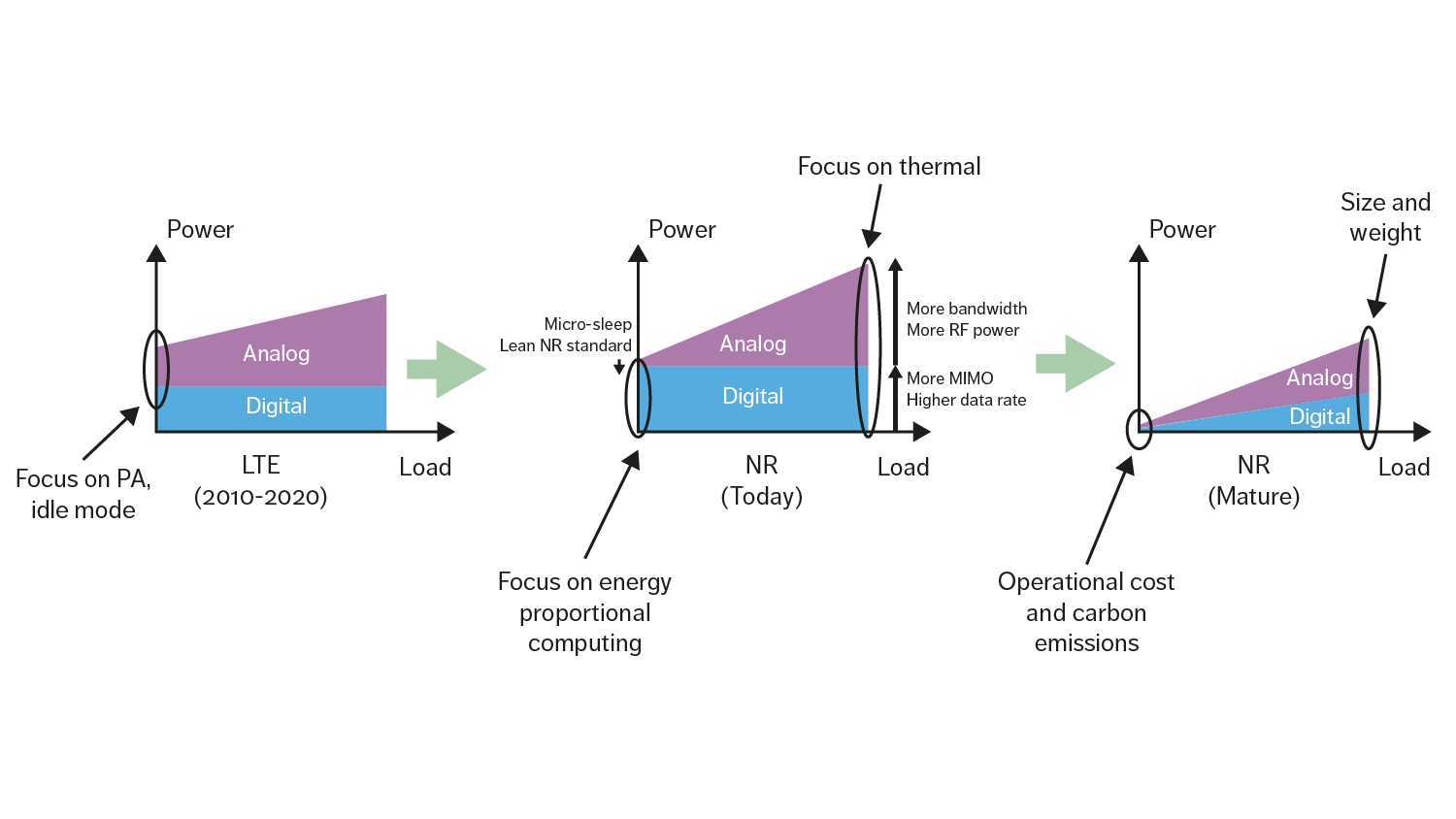
The lean design of the New Radio (NR) standard represents a major improvement compared with LTE, enabling unprecedentedly low energy consumption in live 5G networks. Lean design principles are the foundation for improving radio-access network energy performance in the years and decades ahead. It is of the utmost importance that the progress that we made in NR with respect to energy performance can be extended into future standardization and products.
Figuring out how to increase the use of renewable energy to power networks is a critically important aspect of our research. Most recently, we have been greatly encouraged by the results of a trial on Deutsche Telekom’s (DT) 5G-enabled network, in which we worked closely with DT to efficiently harness solar and wind energy, while simultaneously optimizing power supply and demand.
Looking ahead, we believe that the main energy performance challenge will be scaling processing with traffic to meet the digital processing needs of high-performing networks with larger antenna arrays and bandwidths, and shorter processing requirements. In the 6G timeframe, we are advocating for a further reduction in fixed idle-mode energy usage and peak power requirements – changes that will enable the use of smaller, lighter products and support novel deployment solutions in 6G networks.
We hope this special issue of our magazine helps you and your organization chart a more sustainable and energy-efficient path forward. Please share it with your colleagues and business partners to help us spread the message as widely as possible.

Erik Ekudden, CTO Ericsson