




Skip navigation
Previous searches
    Suggested searches
      6G_Narrative_Hero image

      Report: Empower the AI era with 6G

      Discover the demand for 6G, its potential for networks, and
the new use cases it will expose for you and your users.

      The road to the next generation of mobile connectivity

      New AI-driven use cases are set to push networks to their limits, and Communication Service Providers (CSPs) are looking for new ways to monetize networks, boost performance, drive innovation and satisfy customers. Soon, 6G will be essential for connectivity to continue evolving.

      Report

      In this report, we cover the past, present and future of mobile networks: discussing the ongoing shift in the purpose and capabilities of mobile networks, the trends and challenges making spectrum expansion a necessity, and the 6G use cases that will deliver new capabilities to users and greater revenues to CSPs. It gives an understanding of why 6G is needed and how you can start preparing for its arrival.

      From data to intelligence

      5G SA and 5G Advanced are the start of a shift in how networks function.

      For a long time, connectivity was focus in the data and information-driven era. Networks created value by enabling communication through the collection, storage, transport, analysis and delivery of data.

      The data and connectivity foundation of this new era is here, and 6G will build on it.

      Now, 6G will complete the transition, pushing networks into the intelligence-driven era. Here, networks will still carry data between users, but new value will be created by systems inferring, interpreting, sensing, deciding and acting autonomously in real time.

      Meeting new traffic demands with 6G

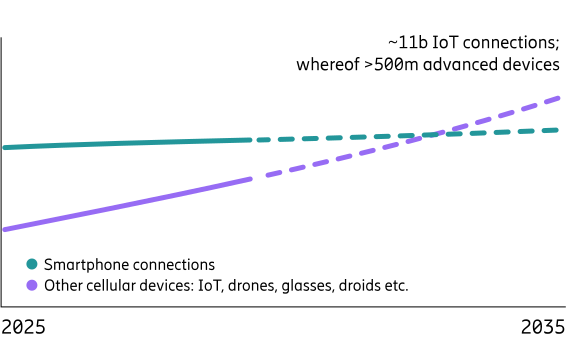
      Although growth in the smartphone market is plateauing, new intelligence-driven use cases fueled by advances in AI are expected to push the total number of connected devices to new heights. Over the next decade, we see devices like AR wearables, drones, robots, autonomous vehicles and diverse IoT devices increasing in number.

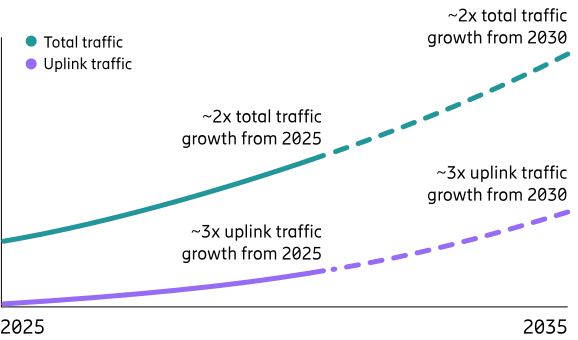
      Assuming this trend materializes, new traffic levels will put pressure on networks, with total traffic doubling and uplink traffic tripling every five years from 2025.

      Handling the sheer scale of these traffic levels and managing the complexity the device landscape creates is beyond many of today’s most advanced networks. The additional performance, resilience and intelligence of 6G will be crucial to support this evolution.

      AI-generated Robot dog walking on street among pedestrians

      # of Connected device

      Line graph

      Data traffic

      Line Graph
      2.00 X
      Total traffic growth rate every five years from 2025
      3.00 X
      Total uplink traffic growth every five years from 2025

      Unlocking more with 6G capabilities

      Through a combination of high uplink and downlink performance and low latency, 5G enabled a wealth of exciting new use cases. 6G will build on those capabilities and unlock even more opportunities with its own set of strengths.

      AI-generated Woman checking digital wallet balance at food stand in crowded venue

      With up to 10 times higher user throughput on the cell edge and up to 40 percent higher spectral efficiency on existing bands (three times higher on new bands with larger antennas), 6G has the performance needed to support the uplink-intensive use cases of the future.

      AI-generated Doctor conducting remote consultation via video call

      6G offers 70% downlink user throughput improvements on the cell edge and up to 8 percent higher spectral efficiency on existing bands (three times higher on new bands with larger antennas) to ensure fast speeds and satisfied users.

      AI-generated-autonomous-driving

      6G’s low latency will come not only from a faster radio connection, but from reducing delay across the whole network. The air interface will no longer be the main bottleneck, advancing use cases with the most demanding latency requirements, like industrial automation.

      AI-generated Security personnel monitoring data on screens in control room

      Through AI-powered security, 6G networks will be able to identify, categorize and resolve threats faster and more effectively than ever, and intent-based interfaces will enable network operators to cut through the complexity to create security measures tightly aligned to their business priorities.

      AI-generated Paramedic using laptop while monitoring patient on stretcher inside ambulance

      The ability of AI to rapidly handle huge quantities of data and identify patterns goes far beyond the capacity of traditional tools or human operators. With these powerful new capabilities, anomalies can be detected and resolved before they cause major problems, in a predictive approach to network reliability that boosts resilience and keeps users online.

       AI_generated_humaniod_folding_clothes_web

      6G networks will be able to not only transmit data, but also to to perceive and interpret their surrounding environment. With Integrated Sensing and Communication (ISAC), these networks will support high-speed communication and sensing of unconnected objects in physical space, enabling accurate spatial awareness in digital applications.

      What new opportunities will 6G enable?

      Ongoing usage trends, device evolution and network realities make the need for 6G clear. For the operators who will be responsible for rolling it out, a range of new monetizable use cases will open up that will make the transition worthwhile.

      With ISAC, the 6G network acts as a sensing array, detecting passive objects from drones in restricted airspace to crowds in packed stadiums. CSPs could provide sensing services for public safety and commercial purposes, with 6G offering them as native network capabilities.

      Advanced wearables like smart glasses have been around for over a decade, but with built-in AI and improved form factors, they’re now making an impact. Untethered 6G connectivity will help support more advanced and immersive wearable experiences, with 6G's uplink, downlink, latency, security, and spatial awareness key to widespread adoption.

      6G’s superior uplink and intent-based security will give operators new ways to create opportunities for AI-based enterprise offerings, including letting enterprises use edge compute capacity to run AI inference.

      Security, predictive reliability, precision positioning, latency and uplink make this use case well suited to next-generation mobile connectivity. 6G offers major gains in cell-edge throughput and spectral efficiency, even before new equipment upgrades. This is critical for enabling 6G-reliant smart drones, vehicles and robots to operate reliably in demanding environments.

      6G will be crucial for handling the scale and diversity of IoT devices, from devices with very low requirements currently served by 2G to high-performance use cases that mobile networks do not yet support.

      6G's superior uplink, intent-based security, reliability and spatial awareness make it well suited to mission-critical networks, particularly in defense and public safety. By 2035, 6G will play an important role in modernizing communications for first responders, defense and other critical operations.

      Get the full 6G report

      Empower the AI era  

      For the full story of 6G’s potential for users, networks and operators, get the report to learn more about:

      • The network realities driving the need for spectrum expansion
      • The full 6G capabilities that will open up new business opportunities
      • How 6G will drive value creation through efficiency and revenue gains

      The first 6G deployments are only a few years away. Now is the time to prepare for the change it will unleash.

      Get the full 6G report

      Related content

      6G - Follow the journey to the next generation networks

      6G is the name for the sixth generation of cellular networks, expected to be ready for commercial markets by the early 2030s. Delivering extraordinary performance and a multi-purpose platform, 6G will unleash new possibilities across telecom, technology sectors, wider industry and society.

      Integrated Sensing and Communication (ISAC)

      Integrated Sensing and Communication (ISAC) is one of the flagship 6G capabilities that transforms mobile networks from communication systems into spatially aware platforms – merging high-speed communication and environmental sensing into a single unified infrastructure.