




Skip navigation
Previous searches
    Suggested searches
      roadway between forest and sea

      Winning in the Philippines with differentiated connectivity

      Unlocking consumer value and monetizing moments that matter

      Picture Sinulog in Cebu, over 5 million people packed into the streets, all filming, posting and calling home at once. Or a packed UAAP Men’s Basketball Finals at the Araneta Coliseum, with fans sharing real-time photos, short videos and reactions. These are the moments where the network gets pushed hardest, and where reliable performance matters most. Ericsson ConsumerLab research shows that differentiated connectivity can elevate these moments for 5G users in the Philippines, while opening new value for service providers.

      0 %
      of Filipino 5G users identify these key moments
      0 %
      say they're willing to pay for guaranteed performance
      0 in 3
      consumers expect to use AI across multiple devices by 2030

      Filipino 5G users show strong interest in guaranteed network performance during critical moments, and a clear willingness to pay for it. This points to a commercial opportunity for service providers to develop performance-based offerings that align with evolving consumer needs.

      These findings come from Ericsson ConsumerLab’s global study of more than 43,000 respondents across 27 markets, including 34,000 active 5G users. In the Philippines, the study included 1,500 respondents, of whom 900 were active 5G users, statistically representative of 46 million Filipino smartphone users aged 15–69. 

      Throughout this report, the term differentiated connectivity refers to connectivity experiences that tailor network performance to the requirements of specific applications, services or user needs, helping deliver enhanced performance when and where it matters most.

      Five key questions for service providers considering differentiated connectivity
      The findings point to five practical questions for service providers considering differentiated connectivity, from the commercial upside and drivers of adoption to competitive differentiation and the role of assured performance as new applications and devices emerge. 

      What's the upside of moving toward differentiated connectivity for service providers in the Philippines?

      Consumer interest in performance-assured connectivity presents a significant growth opportunity for service providers in the Philippines. Survey outcomes suggest service providers could be missing up to two months of average revenue per user (ARPU) a year by not monetizing the moments that matter most.

      Find out more

      Beyond ARPU increases, what findings support the launch of differentiated connectivity?

      Differentiated connectivity builds brand equity, not just revenue. Customers report 46 percent higher brand perception scores and are twice as open to an upsell, and the gap holds even against subscribers on a rival network.

      Find out more

      What can be done to drive uptake, and is smooth adoption a given?

      Uptake is not automatic. In markets where differentiated connectivity is already available, about half of users report mixed network performance or say they lack clear proof that the enhanced connectivity is delivering the expected improvement. Making that improvement visible, for example through an enhanced network icon or real-time indication of connection quality, can help users understand the value they are receiving and build confidence in the service.

      Find out more

      How can differentiated connectivity help service providers compete in the Philippines market?

      Differentiated connectivity is a strategic lever against low-price competition. Tested across a full range of price points, an enhanced plan held stronger interest than baseline at every tier, and in a simplified plan test, 65 percent chose an enhanced option over best-effort 5G.

      Find out more

      Will service providers need differentiated connectivity for the next wave of apps and devices?

      AI usage in the Philippines is accelerating fast. Daily multimodal AI use is expected to double by 2030, weekly AI use will reach 88 percent within five years, and by then, 44 percent of AI usage time is expected to take place outside the home, across devices ranging from smartphones to smart glasses.

      Find out more

      What’s the upside of differentiated connectivity for Philippine service providers?
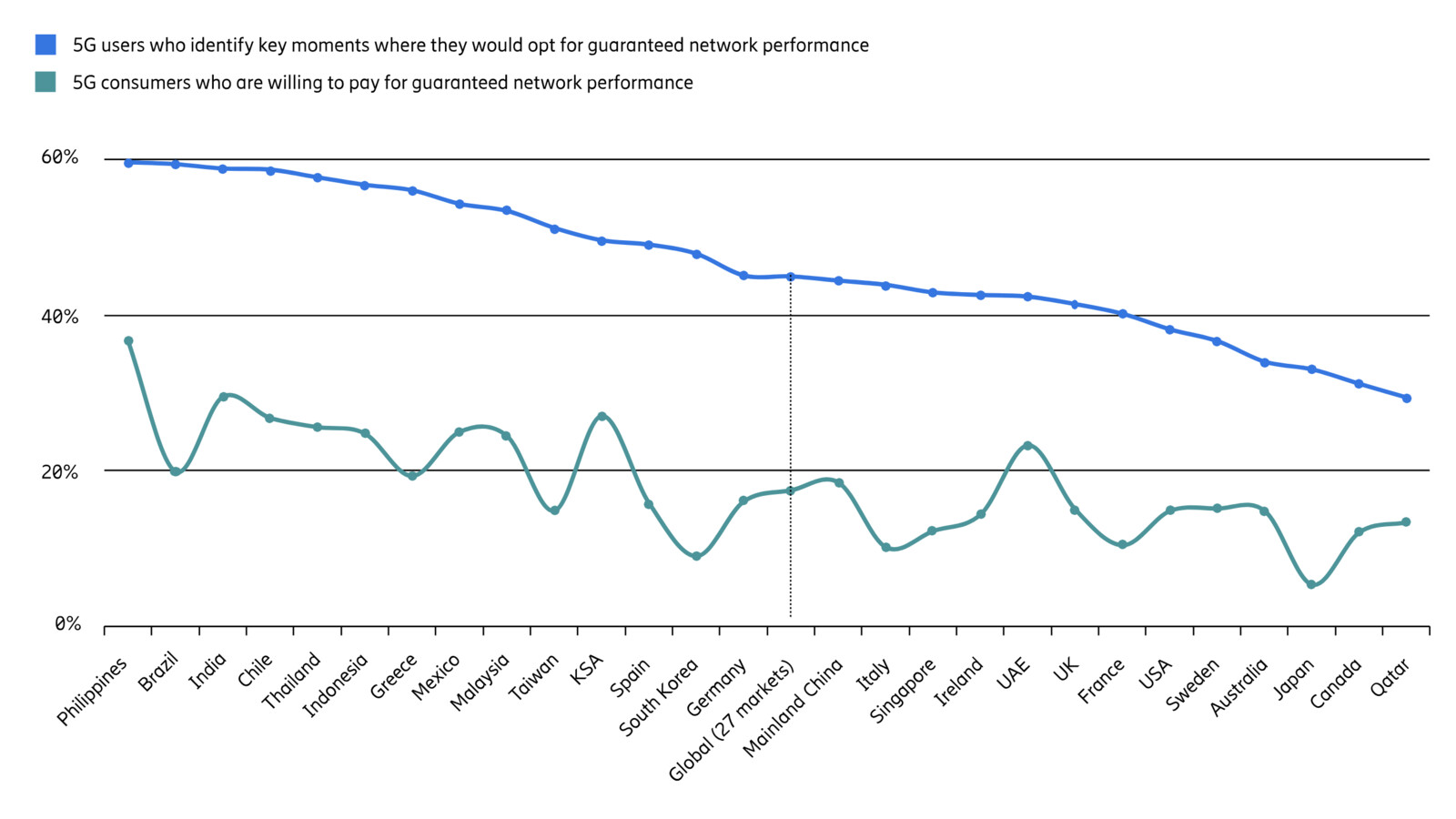
      5G willingness to pay and demand trends over time.

      Figure 1 Key moments identified vs. willingness to pay among Filipino 5G users
      6 in 10 5G users identify key moments for guaranteed performance

      As 5G adoption grows, consumers are placing increasing value on connectivity experiences that perform reliably during important digital moments. Across 27 markets, more than 40 percent of 5G users identify situations where guaranteed network performance would add value. In the Philippines, 60 percent of 5G users identify such moments, while 36 percent say they are willing to pay for enhanced connectivity experiences. Both figures are the highest recorded in the study. These findings highlight a significant opportunity for service providers to develop performance-based offerings that align with evolving consumer needs.

      Base: 5G users aged 15-69, in 27 markets (Australia, Brazil, Canada, Chile, China, France, Germany, Greece, India, Indonesia, Ireland, Italy, Japan, KSA, Malaysia, Mexico, Philippines, Qatar, Singapore, South Korea, Spain, Sweden, Thailand, UAE, UK, US)

      5G users in the Philippines who are willing to pay for assured network performance

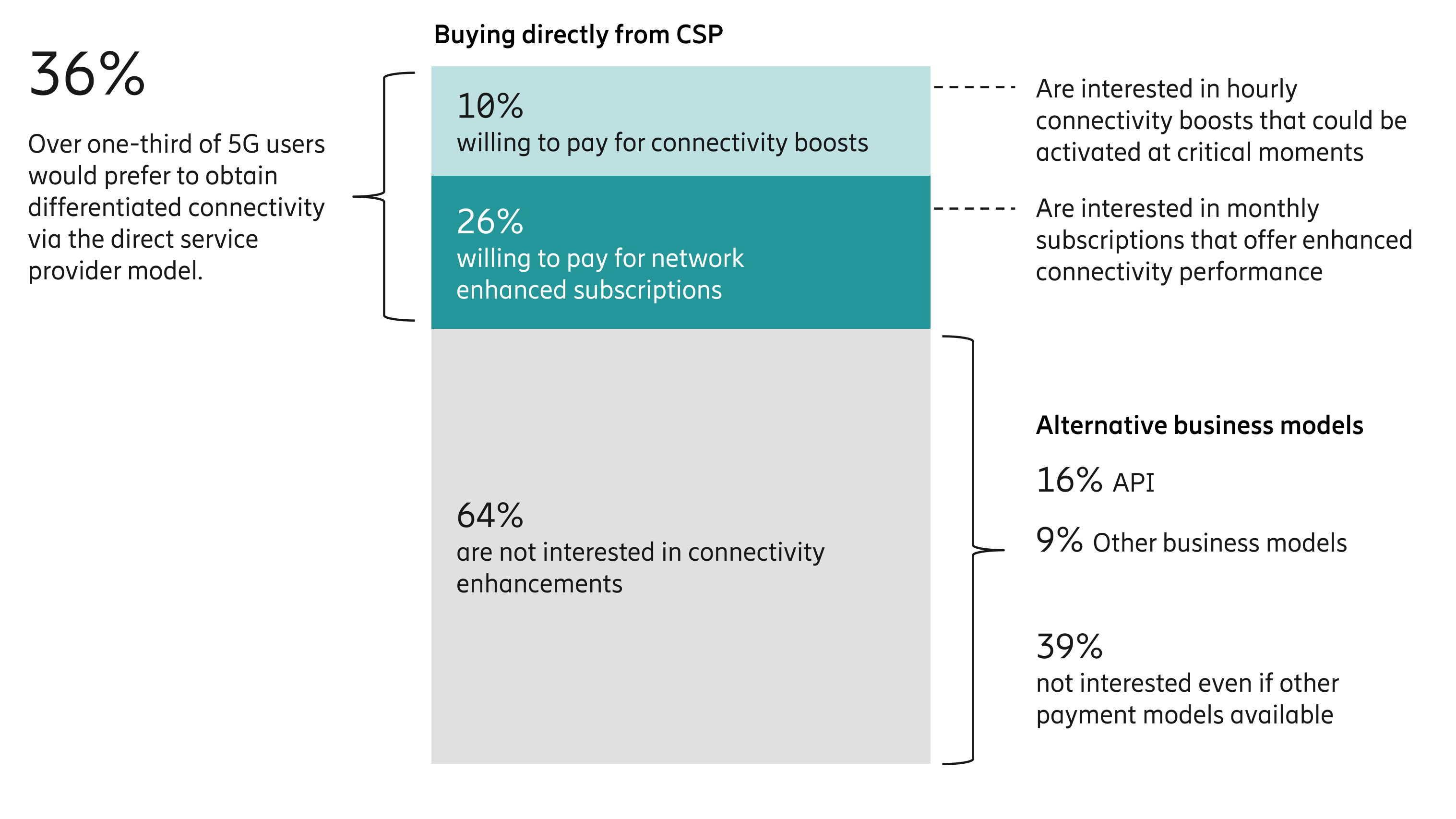
      Figure 2: 5G users in the Philippines who are willing to pay for assured network performance

      36% of Filipino 5G users are willing to pay for guaranteed performance

      26% prefer enhanced connectivity plans, while 10% would pay for connectivity boosts during important moments. The remaining 64% are not interested in the direct-CSP model, though 16% would consider API-enabled enhancements and 9% are open to other models like ad-supported access — leaving targeted propositions, not one-size-fits-all offers, as the way forward.

      For the 10%, high-value moments could include an OFW video-calling family after arriving at NAIA, families celebrating graduation results, or fans competing for concert tickets. These moments highlight where assured connectivity can add value.

      The opportunity is significant: willing-to-pay users could represent up to two months of ARPU annually, while 35% experience challenging connectivity moments at least weekly, creating opportunities for relevant, easy-to-activate offers.

      Beyond ARPU increases, what findings support the launch of differentiated connectivity?

      Differentiated connectivity goes beyond revenue - it can strengthen brand perception and customer loyalty. Across markets where these plans are offered, customers report 46% higher brand perception score, 18% higher satisfaction score and 2× greater openness to upsell versus other customers of the same provider, with stronger brand affinity and network satisfaction than rival-network subscribers.

      In the Philippines, key satisfaction drivers - video and voice calling, outdoor coverage and AI responsiveness - align closely with performance assurance, creating opportunities to tailor differentiated connectivity to everyday experiences where reliability matters.

      46.00 %
      5G users on differentiated connectivity plans have 46 percent higher brand perception scores, compared to users with the same provider but without enhanced performance offerings.
      18.00 %
      5G users on differentiated connectivity plans have 18 percent higher satisfaction scores with their provider, compared to users with the same provider but without enhanced performance offerings.

      What can be done to drive uptake, and is smooth adoption a given?

      Interest in differentiated connectivity extends well beyond direct payment. Alongside the 36% willing to pay directly, a further 25% would embrace it through alternative models like network APIs or ad-supported access, leaving only 39% genuinely uninterested.

      The value proposition should connect to real Filipino moments, from fiesta livestreams and live-selling with GCash to ranked gaming, where poor performance is immediately felt.

      Proof of performance is critical: around half of users in markets with differentiated connectivity say results are mixed or lack proof it works. Asked how they'd like this demonstrated, users highlighted:

      • 44% — visible enhanced-network icon
      • 35% — aggregated network-quality summaries
      • 21% — real-time connection observability

      Building these capabilities into the offer can make enhanced performance visible, credible and easier to understand.

      A woman checking her phone on public transport

      How can differentiated connectivity help service providers compete in the Philippines?

      A woman talking on the phone on the street

      Network quality can help CSPs move beyond price competition.

      Across tested price points, enhanced network plans attracted stronger interest than baseline plans at every tier, including the premium end, where baseline interest fell close to zero while enhanced plans retained double-digit interest.

      When given a choice, here's what consumers picked:

      • 35% opted for Best-effort 5G
      • 38% opted for a medium-priced plan with 2x network resources
      • 27% opted for a high-priced plan with 4x network resources

      So 65% chose an enhanced connectivity option over best-effort 5G.

      The test reflects real-world trade-offs

      The research varied not just price and performance, but also data volume, content bundles and perks, based on offers already available across 27 markets. This suggests differentiated connectivity can create monetization opportunities among higher-value customers, beyond competing on price alone.

      Differentiated connectivity: A strategic tool beyond pricing

      Quality commands a premium. Differentiated connectivity can be positioned as a strategic tool: protecting value against low pricing, differentiating the plan portfolio, and creating paths to retention and upsell. 

      In markets including the Philippines, differentiated connectivity customers are twice as open to an upsell from their provider compared with other customers of the same provider, highlighting the potential of performance-based offerings to strengthen loyalty and customer value.

      The Philippines insights frames three product segments for differentiated connectivity offerings: 

      ""
      QoS add-ons

      Pay-as.you-go performance boosts for o defined period or specific event.

      Ideol for:

      • Live streaming
      • Goming
      • Concerts, trovel and criticol work
      ""
      Tiered plan differentiation

      Subscription tiers structured by speed ond bandwidth.

      Ideal for:

      • Different tifestyles
      • Different usage needs
      ""
      Flagship 5G plans

      Premium SG SA plons with prioritised performance and advanced SG capabilities.

      Ideol for:

      • High-volue customers
      • Alwoys-on premium experience

      Together, these let providers serve everything from a one-off critical moment to an always-on premium experience.

      This opportunity is not limited to one or two national events. The Philippines hosts major festivals throughout the year that attract hundreds of thousands, and in some cases millions, of attendees. Sinulog, Ati-Atihan and Dinagyang are among the country's largest celebrations, bringing together dense crowds sharing photos, uploading videos, making video calls and accessing digital services simultaneously. These are exactly the types of high-demand moments where temporary QoS add-ons or premium connectivity experiences could deliver tangible value for both consumers and service providers.

      Will differentiated connectivity power the next wave of apps and devices?

      AI is creating new network demands in the Philippines.

      Looking ahead to 2030 and beyond, the ConsumerLab survey examines the importance of network performance assurances for the next wave of apps and devices in the Philippines, as AI becomes an integral part of society and transforms the world at an unprecedented pace.

      AI response time already has 2x greater impact on network satisfaction among AI users, and consumers tend to blame their provider for any lag, whether it's the network's fault or not. Daily multimodal AI use is expected to double by 2030, and use is going mobile too, with interactions outside the home rising to 44% and one-third of consumers expecting to use AI across multiple devices.

      As AI becomes more multimodal, mobile and cross-device, differentiated connectivity can help service providers deliver the latency, bandwidth, reliability, security and observability these experiences require.

      How Filipinos interact with AI is shifting by 2030
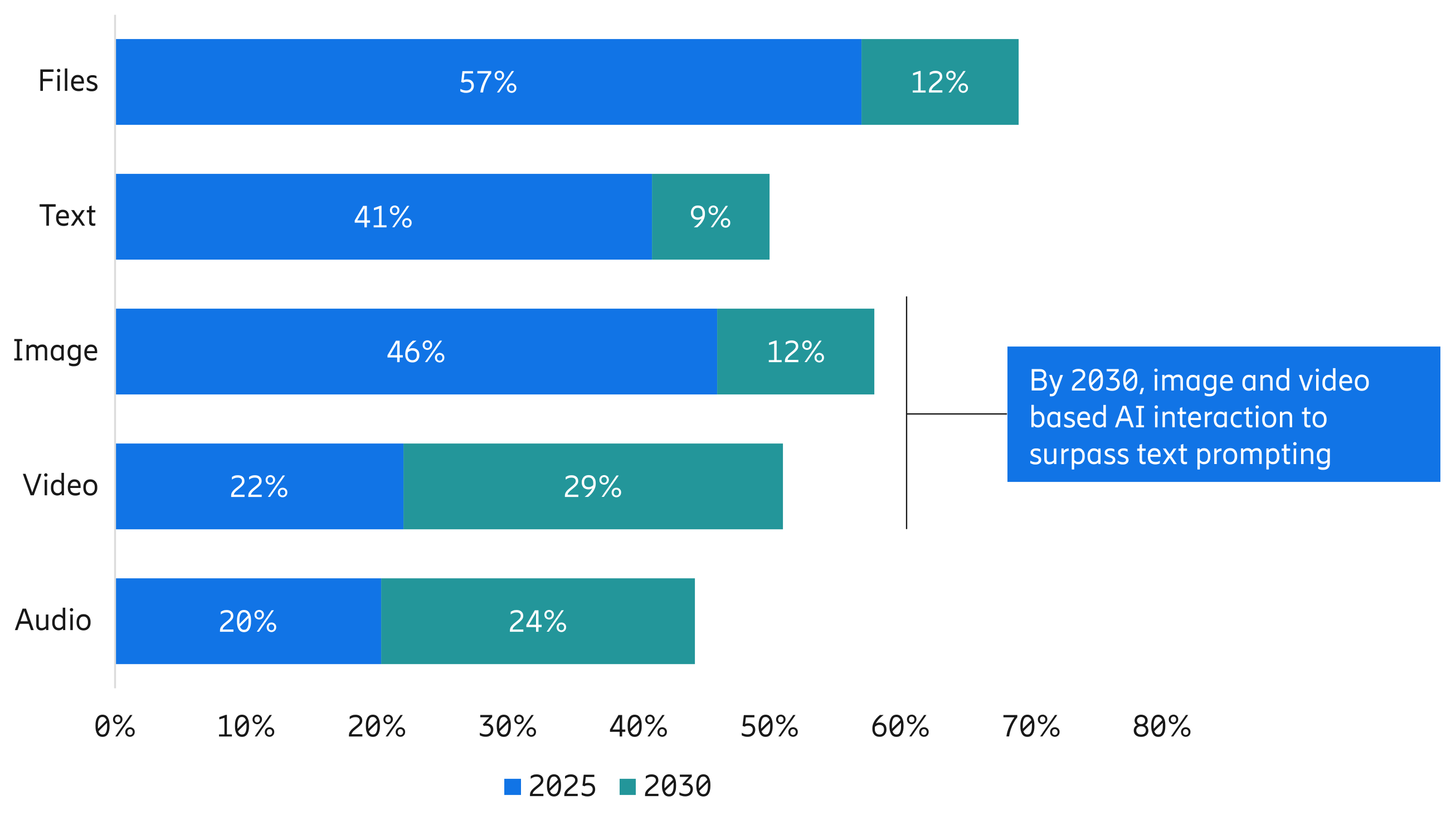
      Multimodal AI usage in the Philippines is set to double by 2030

      Figure 3: Share of smartphone users engaging with AI by content type, 2025 vs. 2030. Base: Smartphone users aged 15–69 in Philippines

      33.00 %
      One-third consumers expect to use AI across multiple devices by 2030
      2.00 x
      Daily multimodal AI use is expected to double, from 16% to 32% by 2030
      44.00 %
      Share of AI usage time is expected to happen outside the home by 2030

      Five key considerations for enabling differentiated connectivity in networks

      Differentiated Connectivity Handbook

      To know more about differentiated connectivity, including performance levels, network enablement and Ericsson's supporting portfolio, see the full Differentiated Connectivity Handbook.

      Expore now