









A formula for 5G!
One of the hottest research topics in our industry right now is this: How can we build the communication infrastructure that can fully support the Networked Society? Our answer is a 5G formula:
The networked society is our vision of what will happen when people, information, devices and knowledge are all connected and networked in real-time. Some scenarios that could become a reality are driverless cars, connected garbage cans, remote surgery. But there will be much more. In the networked society, connectivity is a starting point for innovation and transformation of society and business. There will be services no one has thought of yet.
It has already started! Let’s reflect on the tremendous growth in the wireless industry: The number of subscribers increases all the time. Smartphones have come down in price so that many, many more people can afford these lovely high-tech, portable computer devices, that are always carried along.
Someone said that a smartphone has more processing power than what NASA used to put the first man on the moon. I don’t know if that is true, but the most important feature of them all is that the smartphoneis always connected – giving the world’s population access to any imaginable information at their fingertips, and making it possible to share everyday life with friends and family, anywhere and anytime. Well, maybe that does not hold for the man on the moon. Yet.
I believe we humans will always adapt technologies and will be willing to invest if the technologies bring us value, for example by improving our daily lives.
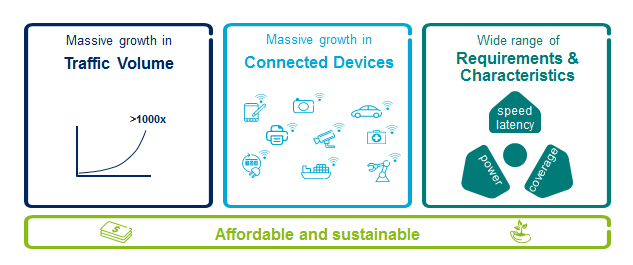
The limit for new services will be the performance of the networks. Functionality and capabilities of the networks will decide what is possible. For those of us working with the future communication networks, this brings exciting challenges. We’ll be facing massive growth in traffic volumes – 1000 times more than today. There’ll be an equally massive growth of connected devices – up to and beyond 50 billion – and ranging from ultra-low power sensors to entire cars. Industrial applications take off. Ultrahigh datarates, ultrashort latency, extreme coverage density will be required. In addition, there’s the spectrum issue.
Key challenges
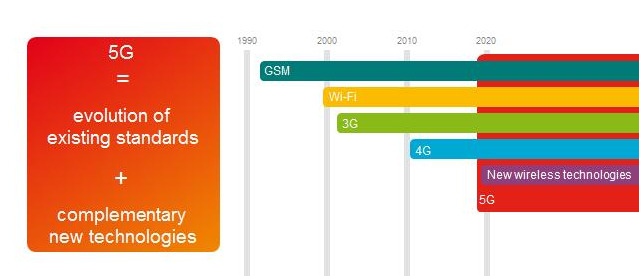
I think it is very important to build on and find a good evolution path from today’s systems – like GSM, WCDMA and LTE – to the networks that will be required in the 2020s.
New access technologies will be developed, existing standards like 4G and WiFi will evolve and together they form a set of technologies that will fulfill the requirements. 5G will not be a replacement of older generations, it will be a complement. That is the meaning of our 5G formula:
5G = evolution of existing standards + complementary new technologies.
5G Wireless access
Sara presented Ericsson’s view on 5G at the Johannesberg Summit back in May last year. Her talk is available for viewing, just click on the link.
If you’re still wondering about the term 5G – of course it stems from history: our wireless networks are usually divided into generations, with some 10 years between each generation. Mobile telephony was used on a small scale already in the fifties and sixties, but the first generation networks addressing mass markets were analog, voice-only systems like NMT, AMPS, or TACS. The first Ericsson commercial cellular networks were inaugurated more than 30 years ago, starting in 1981. After that, we got the second generation that gave us digital transmission, still mainly used for voice. Slightly different standards were GSM, D-AMPS, CDMA, and PDC. Eventually, GSM turned out the winner and today it provides virtually global coverage. The third generation with WCDMA and HSPA gave us high-speed, digital services, and finally, the fourth generation with LTE and LTE-A brings us a true mobile broadband experience. It is now due time to start developing the technologies required for the next – fifth – generation that will be needed for fulfilling our communication needs in the next decade.