










How to enhance indoor radio design with AI


Director Data Science
Director Data Science
Director Data Science
Reliable indoor wireless connectivity is a crucial component of the overall connectivity experience. Recent studies on cellular network usage show that indoor traffic takes 87 percent of usage time in the US and generates 70 percent of global mobile data traffic. Ericsson offers indoor solution called Radio Dot System (RDS) that has been in use since 2014 [1]. RDS is easy to install and has superior coverage, designed for large indoor areas such as offices, stadiums, shopping malls, or universities.
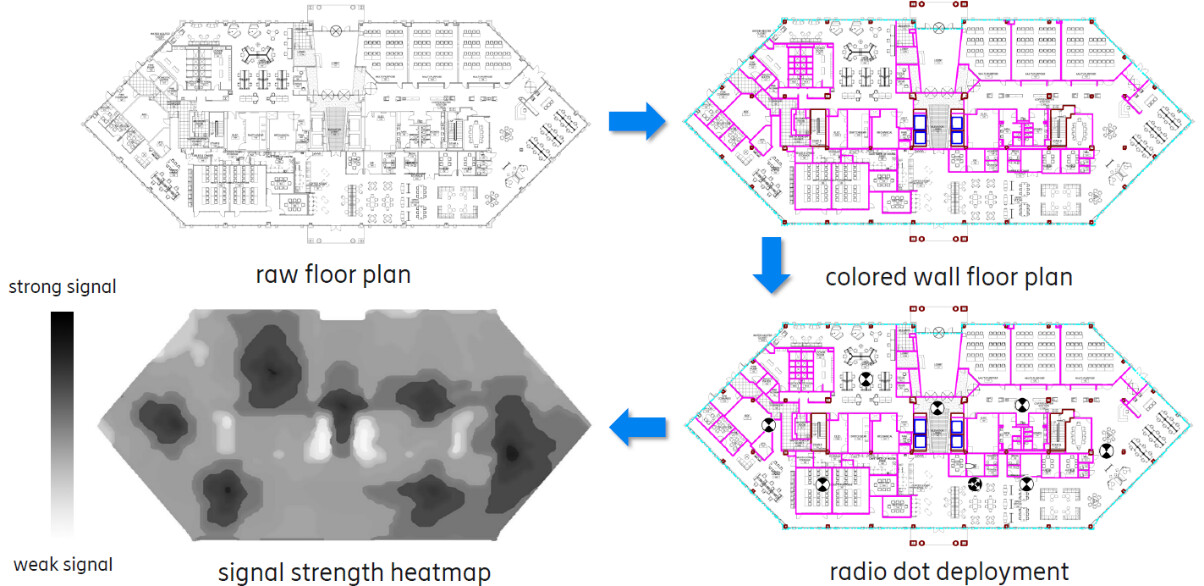
Traditionally the process of designing optimal dot layout for a floor requires many steps: the identification of a wall type of all the wall segments (for example, concrete, glass, metal), measuring macro-cell interference (the signal transmitted from nearby outdoor macro base stations), and several iterations of design and evaluation of a signal propagation heatmap. Figure 1 below shows steps of the design process from a given raw floor plan to its RDS deployment.
Ericsson Indoor Planner (EIP) fully automates optimal Dot placement design and greatly simplifies the design process. As part of further enhancements of EIP, a team of Ericsson’s data scientists proposed a novel technique based on machine learning that may provide even higher levels of dot placement prediction accuracy.
DA-cGAN: Generative Adversarial Networks for radio design
Instead of following the typical approach, which uses a ray-tracing algorithm to predict the signal strength heatmap, we proposed a novel approach for indoor dot placement by formulating the design process as an image-to-image translation problem, and applying Generative Adversarial Networks (GANs).
Specifically, we proposed a Dimension-Aware conditional GAN (DA-cGAN) to generate a heatmap of optimal dot layout from a given floorplan. GANs are well known for their capability of generating artificial images. GANs consist of two deep neural networks: a generator and a discriminator . They both compete and learn from each other, and in the end the generator can generate a fake image which cannot be distinguished from the true image by the discriminator, and (hopefully) by human eyes either.
Some interesting applications using GANs include colorizing cartoon characters from their sketch images, creating super-resolution images, transferring an artist’s style (Van Gogh, for example) to photos, repairing images by filling their missing parts, and even generating three-dimensional models given two-dimensional images of objects from multiple perspectives.
Among the various applications of GAN, the colorization is chosen as the starting point since it is most relevant to our problem. Colorization of a given sketch of floor plan not only needs to preserve its border shape, but also needs to learn from its internal structure to generate the desirable signal heatmap , since the structure of a floor plan highly correlates with its optimal dot layout and resulting heatmap. For example, a concrete wall has much higher signal attenuation than a dry wall, and therefore, the radio signal strength decays quickly around a concrete wall. To solve our image translation problem, we can adopt the conditional GAN (cGAN), which learns the mapping from an input image and a random noise to the corresponding output image. However, we drop the random noise in our architecture following the convention in cGANs, since we only focus on generating one heatmap with optimal radio dot layout.
The figure below is our proposed GAN consisting of a generator and a discriminator . In order to preserve most of the floor plan structure, we adopt the U-Net architecture as our generator. U-Net is a special encoder-decoder network such that it concatenates each layer in the encoder to the symmetric layer in the decoder.
A unique modification in the proposed generator is that it considers physical dimension vector as an additional input. Physical dimension is not usually considered in the previous GAN-related works, which assumes input data as pixels without physical dimension. We found that assumption is not enough for modeling radio signal propagation because, in a traditional physics-based simulator, a heatmap is derived based on its path loss which is dominated by two factors: 1) the distance between the radio dot and the current location, and 2) the environmental parameter known as path loss exponent. The path loss increases logarithmically as the physical distance increases from a radio dot, while the path loss exponent is a fixed value, measured based on different scenarios.
Another important feature of this generator is the macro-cell interference . We proposed to incorporate the measured Reference Signal Received Power (RSRP) heatmap from outdoor macro-cell into our model, so that it is guided to generate more radio dots to cover the highly interfered regions.
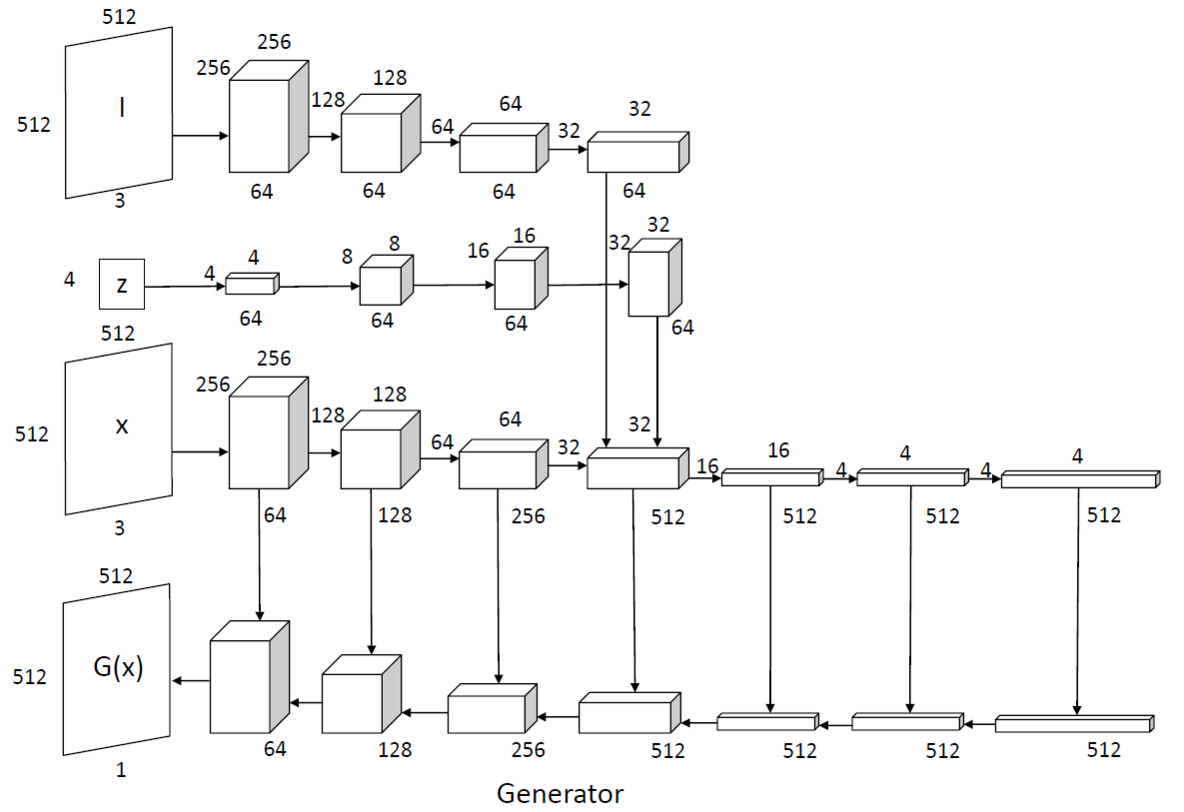
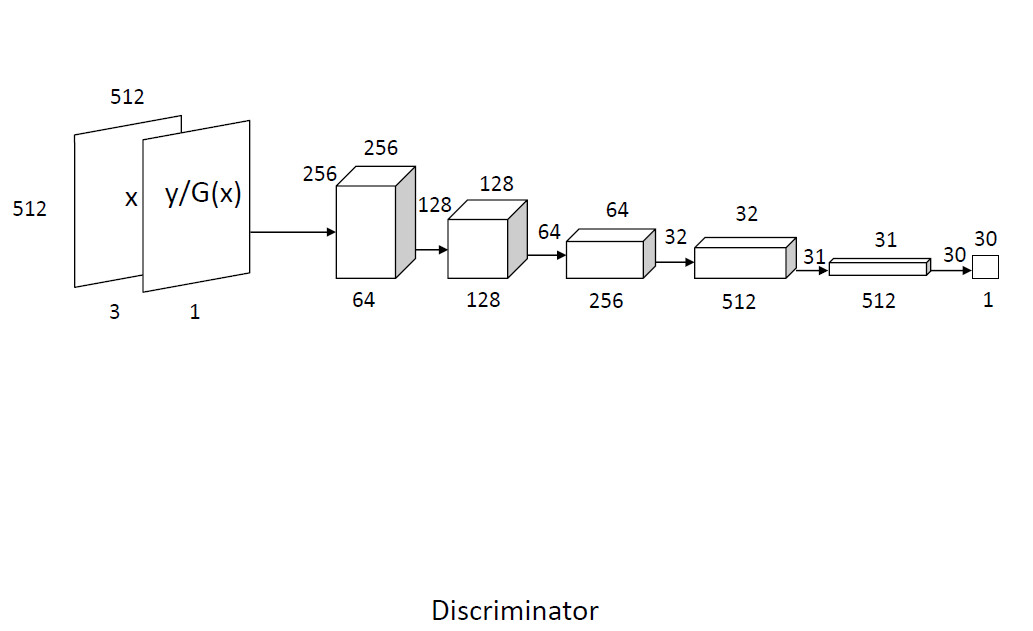
Figure 2: Our proposed GAN, the Generator and Discriminator.
Radio dot layout by AI designer
The figure below shows three qualitative results with the test set. The first row shows a regular size (8,440 sqft.) floor plan, while the last two rows are wide sized (63,056 and 85,998 sqft. respectively). For each row, the first column is the input floor plan image, the second column is the ground truth heatmap from human designers with dots in green, and the last column is the predicted heatmap from DA-cGAN with dots in red.
We observed that DA-cGAN tends to produce a dot layout and heatmap almost to the ability of human designers if a given floor plan has more open spaces and simple wall types – while complicated, blurred, or noisy floor plans with unseen or unusual tags cause its predicted heatmap to diverge from the ground truth, the best-effort design by human experts. For a very large floor plan, we segment such a wide floor plan into multiple parts with reasonable size (due to the physical limitation of GPU VRAM) and merge predictions.
With this case, DA-cGAN tends to predict more dots than human designs, probably because a wide floor plan does not necessarily have a large number of dots. However, we believe that such discrepancy in layouts between human designers and our model does not necessarily mean that the model’s predicted performance is inferior to the ground truth, because our model has the potential to explore the search space that human designers have not yet found.
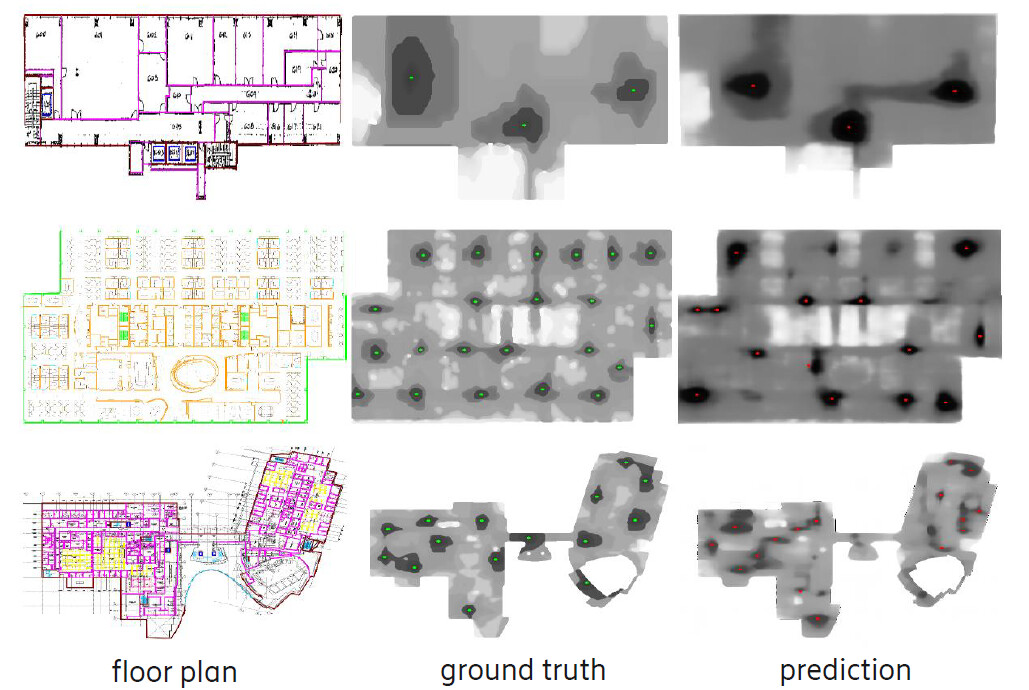
Figure 3: Examples of predictions with their respective ground truth
For more technical details of this work, please refer to our paper DA-cGAN: A Framework for Indoor Radio Design Using a Dimension-Aware Conditional Generative Adversarial Network (in CVPR workshops, June, 2020). Special thanks to the team members of GAIA working on this project: Taesuh Park, Chun-Hao Liu, and Hun Chang.
[1] Chenguang Lu, Miguel Berg, Elmar Trojer, Per-Erik Eriksson, Kim Laraqui, Olle V. Tridblad, and Henrik Almeida, "Connecting the dots: small cells shape up for high performance indoor radio", in Ericsson Review. Ulf Ewaldsson, 2014.
This blog post was updated November 2020.