










Exponential capability growth. Exponential potential

CTO Ericsson

CTO Ericsson
CTO Ericsson
Capabilities: a record of exponential growth
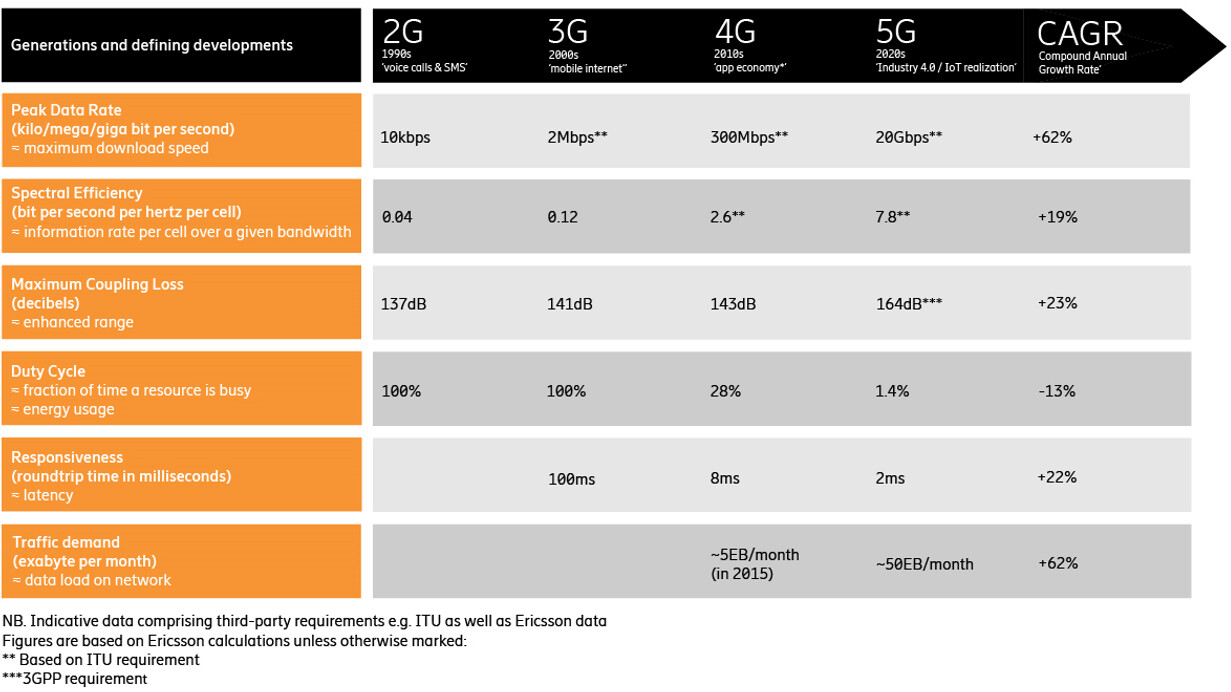
Since 2G in the 1990s, the network’s intrinsic capabilities, focused on the radio interface, have grown exponentially (see Figure 1).
Going from 4G to 5G, we see capabilities extending their growth:
- Peak Data Rate (≈ maximum download speed) increases > 60 times
- Spectral Efficiency (≈ information rate over a given bandwidth) increases 200 percent
- Maximum Coupling Loss (≈ enhanced range) increases 15 percent
- Duty Cycle (≈ energy usage) decreases 95 percent
- Responsiveness (≈ latency) improves 75 percent
- Traffic Demand (≈ data load on network) increases 10 times
Figure 1 – Intrinsic capability advancement through the generations:
Graph 1 – Peak data rate projection, Mbps:

2020 – 2030 extrapolation based upon data traffic projected 2025-26, Ericsson Mobility Visualizer, September 2021.
Mobile network capabilities, exemplified on this logarithmic scale by peak data rate, have advanced rapidly. It’s not just about peak data rate, we can expect other intrinsic capabilities to continue their forward march with traffic requirements continuing to be met.
It’s easy to overlook the exponential growth of network capabilities. Putting peak data rate growth in context, for example, means that where a 6GB film would take 1000+ hours to download in the 1990s, that same film could be downloaded in 2.4 seconds in the 2020s.
Increasing demands on capabilities
All capabilities have an important role to play, and their individual contributions become more pronounced depending on the scenario. For example, when it comes to safety-critical situations, such as in wireless industry automation in a factory or traffic safety features in autonomous vehicles, timing and thus responsiveness are paramount. However, if you’re exploring remote areas of the world, or you’re indoors, coverage bars on your phone are more important, and you’re more thankful for the enhanced range from network base stations.
With the network’s capabilities underpinning exponential technologies such as AR/VR, AI, IoT and various uses, expect intrinsic capabilities to be pushed fast and hard, spurring development.
So far, 5G networks are up to the task and this is evidenced in user behavior. Among consumers for example, early 5G users are, compared to 4G LTE users, spending more time on rich-media content such as VR; a technology that really benefits from 5G’s low latency and data rates. If we want consumers to widely adopt VR technology and for it to improve beyond current levels of visual immersion, then capabilities such as latency and data rates will need to continue developing.
Increase in time spent per week (hrs:mins) by 5G users on activities compared to 4G LTE users:

Source: Ericsson ConsumerLab report, May 2021.
Technologies’ evolution and advancement is not lost on policy makers. The US climate envoy recently announced that 50 percent of carbon emission reductions needed to reach net zero will come from technology “we don’t yet have”. If that’s true, I believe much of that technology will need to come from the 5G innovation platform and its capabilities.
To fight climate change with both known technology and technology we don’t yet have, network capabilities need to be enhanced and extended in various dimensions. Moreover, we need to continue developing capabilities without fully knowing which will be the most crucial and what they will lead to. Nobody foresaw how 4G’s capabilities would lead to the app economy. Therefore, we build the network from principles of flexibility and diversity, trusting that it will eventually be exploited. Given the benefits of 5G to enterprise and in delivering government’s green, digital agendas, I would suggest exploitation happens sooner, rather than later.
The fastest scaling technological phenomena
Given its strong performance and potential, 5G subscription uptake is expected to reach one billion subscriptions two years earlier than 4G achieved.
In fact, 5G is projected to reach one billion users faster than any other technological phenomena, including applications on top of the network such as social media. Not only is 5G scaling at speed, but we see in general network coverage has expanded to the point that globally more people have mobile coverage than universal health services, basic sanitation and even electricity.
That network capabilities can grow exponentially with coverage eclipsing other critical infrastructures and utilities is testament to the innovation in the network and its value.
What’s next for intrinsic capabilities?
Intrinsic capabilities remain firmly in focus. We want to see ever higher achievable data rates, sending a lot of data in bursts, freeing up the network. Responsiveness and sub-millisecond latency, critical in technologies such as VR, should continue to be pressed down. The exponential growth of devices, doubling from 2020 to 2026, as well the need to connect the unconnected, speaks to the need for expanded and cost-efficient deployment, where higher spectral efficiency and reduced maximum coupling loss need to feature.
Ever improving networks need to continue serving exponential traffic demands, without increasing data costs. The track record is strong, with the global average price of mobile data shrinking at a -15 percent CAGR from 2013-2019.
At the same time that costs need to be kept in check, so too does energy usage and we have demonstrated that a network-level approach can enable an exponential growth of data traffic without increasing energy consumption. Duty cycle advances help press down energy usage.
Emerging capabilities
Beyond intrinsic capabilities, other capabilities become important and stretch out into the emergent 6G era. As wireless networks increasingly become critical components of society, resilience and security capabilities are crucial. The network must be able to provide service when part of the infrastructure is disabled due to natural disasters or malicious attacks.
In terms of trustworthiness, networks should also be able to leverage new confidential computing technologies, improve service availability, and provide enhanced security identities and protocols with end-to-end assurance. These networks will need the capabilities of local compute integration, infrastructure enabling distributed applications and network functions to be swiftly developed and deployed, and services for data and compute acceleration can be delivered throughout the network with performance guarantees.
Finally, to power the full digitalization and automation of society, networks need high-precision positioning and detailed sensing capabilities from their surroundings.
5G: Planned capability enhancements
Network capabilities are advancing through 3GPP, a collaborative forum for standards organizations and companies. 3GPP’s releases comprise standardized features and specifications to be used by developers and there are several releases slated for 5G.
Release 15 is the first 5G New Radio standard, followed by Release 16 and both have been completed. Release 16, for example, which was completed in 2020 included enhancements to ultra-reliable and low latency communication, as well as 5G efficiency with aspects including interference mitigation, power consumption, and so on.
Looking ahead, Release 17, which is currently being developed, will include capability enhancements and will, among other things, introduce new features such as improved battery health, improved support for public safety use cases and satellite access.
Release 18 is still some way off, but it would not be unexpected to find enhanced support for eXtended Reality (XR), AR/VR, mobile relaying, connected high-speed railways, connected drones/UAVs, as well as wireless system performance enhancements via AI and machine learning.
End thought
Intrinsic network capabilities have demonstrated exponential growth for years and delivered among other things mobile internet in the 3G era, the app economy in 4G, and soon the full realization of IoT in 5G. Whether it’s peak data rates, spectral efficiency, maximum coupling loss, duty cycle or responsiveness, we expect intrinsic capabilities to continue their exponential march in step with emerging capabilities.
Moreover, growing demands and expectations motivate the enhancement of capabilities even more. Many are planned, more will be needed. Demand also means 5G is surpassing not just 4G in reaching one billion users, but other technological phenomena.
If you know of an industry that is innovating faster and having more of an impact than the mobile industry, let me know.
Learn more
Read Group CTO Erik Ekudden’s previous blog posts: High-performance networks allow us to reimagine the value of digital and CTO Focus: How to ensure 5G and edge become the innovation platform they’re meant to be
Learn more about 5G.
Read our CTO Technology Trends 2021 report.