









No network No problem. Network on Wheels delivers a 5G network wherever it’s needed.

Head of Ecosystem & Business Development

Director of 5G Technology Development, Verizon
Head of Ecosystem & Business Development
Director of 5G Technology Development, Verizon
Head of Ecosystem & Business Development
Director of 5G Technology Development, Verizon
I recently sat down with Abraham Arencibia, Director of Technology Development, Verizon, to discuss how Ericsson and Verizon teamed up to meet this unusual challenge and wound up creating the first portable 5G network, the Network on Wheels. Here are some highlights of our conversation.
BILL: We tend to think of cellular networks as very large and complex, but the Network on Wheels (NOW) fits all the technology of a 4G plus 5G network into a compact and pre-integrated package that can, literally, be put on a van or an airplane and wheeled to nearly anywhere a network is needed. This is a major departure from the traditional network deployment. Abraham, Verizon was there at the inception of this project. Can you tell us how it all began?
ABRAHAM: It all began about three years ago when a client of ours was holding an exhibition in Hawaii. They wanted a 5G network in their venue for live demonstrations. A common enough request. Except in this paradisaic spot, there was no network and little technology that the team could utilize. The space the client offered for the equipment was literally a closet. We weren’t going to be allowed to demolish the place to install a standard 5G network. And the network had to be up and running in just a few weeks.
5G in a cart. On wheels. Could it be done?
BILL: What led you to partner with Ericsson on this project?
ABRAHAM: We’ve partnered with Ericsson for a long time and it was natural to turn to you for help. The Ericsson team didn’t hesitate. They showed up with enthusiasm, with a lot of technology leadership. Together, we whiteboarded what the solution could look like. If it wasn’t for Ericsson and the partnership with Verizon, I don’t think I would be sitting here today seeing expanding demand for Network on Wheels and finding great new use cases for it.
BILL: When we got to the venue in Hawaii, I remember we took out our measuring tape and literally measured the width of the door. We needed something that could be wheeled down a hallway, carried up a staircase by two people and then fit through a narrow utility closet doorway. Together, we came up with the wild idea of putting a complete 5G network into a cart on wheels. What did your colleagues think about the plan?
ABRAHAM: This simply didn’t exist before. In fact, our biggest first challenge was convincing our peers and sister teams that we really were going to deploy this 5G network as a portable solution.
BILL: Necessity is the mother of invention, right? When we went back to the lab, we had the parameters: What size and weight it had to be. It had to be shipped on an airplane and be somewhat rugged. It had to plug into a standard wall outlet. We already knew how to build the 5G functionality, so using a bit of ingenuity, we squeezed it all into a small package, transported it to Hawaii, and installed it to support the event.
What is the Network on Wheels?
For those who aren’t yet familiar with Network on Wheels—we call it NOW, for short: A Network on Wheels is a fully functional 4G and 5G network, installed in a box with wheels. This box can be rolled into labs, into events and into customer locations and simply plugged into the wall to bring up a fully functional 5G network.
The system includes the Ericsson baseband, a router and servers running the software. A Network on Wheels provides the full, functional radio network, core network, transport network and the management system for the network. It can be customized for the specific requirements of the location, event and application.
Our senior manager of the 5G ecosystem, Blaze Vincent, was involved in building and installing NOW. He described it to me this way: “Building a network is a complex thing, but with Network on Wheels, we have pre-integrated all the necessary configurations and put them (literally) into a box on wheels. It's so easy to deploy. We can simply plug the Network on Wheels into a standard wall outlet and press the power button. And the network simply comes up, ready in a few hours.”
So not only did our joint team solve the immediate request, they came up with a solution that now has a wide range of applications. What factors do you think contributed to the success of our partnership?
The secret sauce for innovation: Partnership
ABRAHAM: The success of this effort comes directly out of the relationship between Ericsson and Verizon. Our teams checked their egos at the door and began working together as a unit. This wasn’t a just transactional. We said, “Let’s get our best engineers in a room together and try to design something new.” A true partnership.
And the success was evident immediately. The event organizer was so impressed with the performance, they immediately asked to book the NOW for their next event in Las Vegas, which happened to be one of the most significant consumer electronic shows in the world.
BILL: So, what began as a behind-the-scenes network became one of the stars of the show and gained a life of its own, you could say? How has the idea of a Network on Wheels helped Verizon bring new 5G solutions to your customers?
ABRAHAM: The evolution went from demo to an actual customer enterprise solution really quickly. After that consumer electronics show, we deployed NOW at entertainment and sports events, in a test facility for autonomous and smart vehicles, and in Ericsson’s own USA 5G Smart Factory in Lewisville, Texas, where you manufacture the 5G radios that make all these networks possible. One of the most dramatic use cases of NOW was at the 103rd running of the Indy 500. Team Penske enlisted us to deploy a Network on Wheels 5G network to help the track-side team track and analyze data and communicate instructions to the drivers in real time.
BILL: How did that work out?
ABRAHAM: Not too badly. One of their drivers, Simon Pagenaud, took home the victory!
BILL: Can you tell us more about where NOWs are deployed and how they are being used today?
Bringing the next wave of use cases to life
ABRAHAM: We have more than 35 NOW kits currently operational worldwide. These have been deployed at customer locations as well as testing and research facilities. Verizon’s Senior Manager Technology Mike Vasquez has been a leader of the NOW team since that first day in Hawaii. Mike’s a big evangelist for NOW not only because it lets us deploy a 5G network at a customer location, but because it allows us to create a private sandbox environment where we can explore different capabilities of the network and the applications. In Mike’s view—and he’s one of our top people in this area—Network on Wheels is critical for bringing the next wave of use cases to life and driving the innovation of 5G.
BILL: What’s the future for NOW, in your view?
ABRAHAM: We’re targeting many different verticals, from manufacturing to automotive to media and entertainment. For instance, Verizon is taking the lessons we’ve learned from NOW so far, and is commercializing it for private LTE and 5G networks.
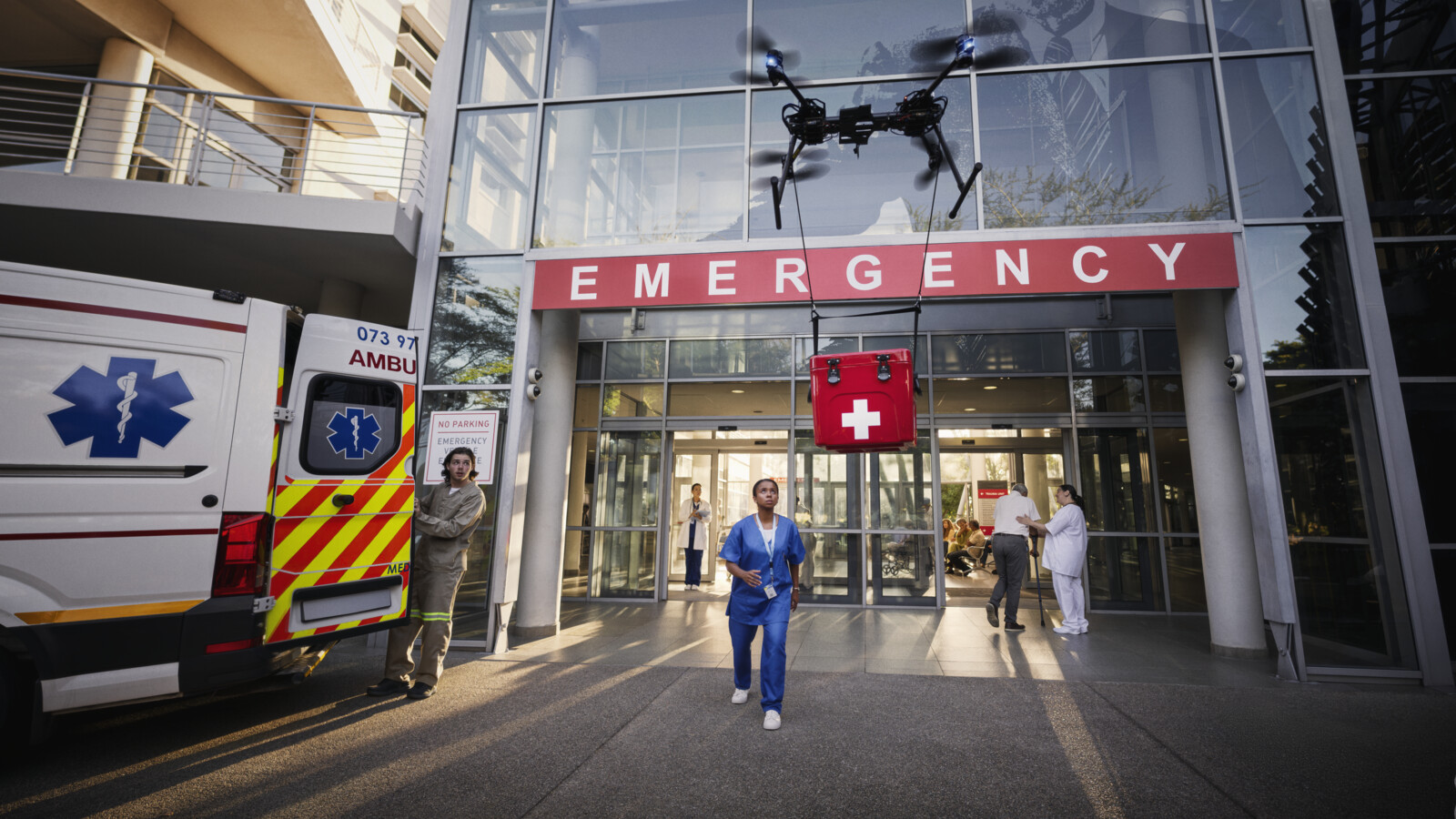
As you know, Verizon and Ericsson are currently exploring new technologies together and new use cases in the Verizon 5G labs. This co-innovation is bearing fruit in many ways. One exciting new way to deploy the Network on Wheels is in a vehicle fleet for first responders. We’ve built a fully functional vehicle that has all the bells and whistles first responders need. This solution, which we have named THOR for Tactical Humanitarian Operations Response, can be deployed in the middle of nowhere—giving first responders 5G coverage that lets them talk back to the macro network. It’s technology with purpose.
BILL: So in such a short time, we’ve gone from an experiment to demos to actual use cases that enhance lives in a lot of different ways. It has been a very rewarding journey.
ABRAHAM: Exactly. You could say that Network on Wheels is a technology that doesn’t stop giving. The potential for NOW is virtually unlimited.
The Network on Wheels brings connectivity wherever it’s needed
Watch the video and read the case to learn more.
Discover the case study