










WebRTC is now a global standard – how do users benefit today and in 5G?

Master Researcher, Networks

Master Researcher, Networks
Master Researcher, Networks
Web Real-Time Communications (WebRTC) recently became an official standard. A number of companies have worked with developing this technology over the past years, and the W3C and IETF standardization bodies announced on 26 January 26, 2021, that it is now an official standard (you can read more here).
At Ericsson, having had a very long history in building person-to-person communication systems, got involved in the early days of the development of WebRTC, to shape this technology for use in different mobile and fixed contexts. The news that WebRTC is now an official global standard means that a stable foundation for building and offering different communication solutions is available to everyone. Now we are taking the next steps to also utilize WebRTC in 5G networks.
What is WebRTC?
Simply put, WebRTC is a set of technologies that enable conversational audio, video and data communication between web browsers, or any other device or application equipped with support for these technologies. This enables the building of, amongst other things, rich person-to-person communication services where the client is supplied as JavaScript and Hypertext Markup Language (HTML) resources downloaded as part of a web application by the web browser, when the user visits a website.

Figure 1: High-level overview of WebRTC.
Figure 1 schematically illustrates a basic one-to-one communication scenario where the camera, microphone and screen can be used as sources for audio and video that are streamed to another browser for playout on the screen and loudspeakers, all under control of the web application. Efficient handling of more complex scenarios, such as multi-party or one-to-many communication, introduces the need for additional conference nodes in the network. It can be noted that WebRTC is also extensively used in non-browser implementations, such as mobile phone and desktop apps.
WebRTC can be further broken down into two main parts:
- Enabling secure, end-to-end encrypted and bandwidth efficient communication of audio, video and data directly between endpoints (web browsers, for example) with a latency that enables person-to-person communication.
- The browser’s JavaScript Application Programming Interfaces (API) that enable web applications to access and control input devices (for example, a microphone, camera and screen), to set up the communication channel carrying the audio and video communication generated by the input devices, as well as setting up data to another browser. It also controls the rendering (playing) of the incoming audio and video for the person using that browser.
The WebRTC APIs are modular and flexible. They enable the web developers to pick and choose from audio, video or screen share components, and to decide whether each included component should be used unidirectionally or bidirectionally.
How mobile networks benefit from WebRTC technology
The web browser has continuously evolved since its inception in the 1990s. Many of its capabilities build on standards developed by the World Wide Web Consortium (W3C). These standards ensure interoperability and include different generations of HTML, JavaScript APIs, as well as Cascading Style Sheets (CSS).
The first HTML version 5 (HTML5) drafts were published in the late -2000s and introduced new audio and video elements to enable web applications to use browser native functionality for playing audio and video content. As Ericsson had a very long history in person-to-person communication in telecommunications networks, we realized that it would be possible to combine the HTML5 audio and video elements with browser access to microphones and cameras, and an ability to set up connections, and enable developers to use this through an API. That could then be used to carry conversational audio and video between browsers, which would enable websites to offer rich person-to-person communication.
This would be a very attractive technology since it would make it much easier to develop and offer rich communication services, as much of the complexity would be handled by the browser. At the time when HTML5 was first published, browsers in desktops and laptops were getting more and more capable, while mobile phone browsers were lagging behind. We, however, predicted that mobile phone browsers would catch up, and we also predicted that the capacity of mobile networks would develop quickly. Combined, this would make such a technology even more attractive. Not only would it make it easier to develop and offer rich communication services, but those services would also be available to both mobile and non-mobile users.
Ericsson therefore started experimenting with different approaches to enable such communication and published some of the results. We were then approached by other companies with similar ideas, and as a result of the discussions that followed, an industry effort to standardize WebRTC was formed. Ericsson has been one of the main contributors to the standardization effort, in IETF as well as in W3C, since the work started. In addition to the work in the standardization bodies, we provided implementations and open-source components to facilitate experimentation, especially in a mobile perspective, and to promote adoption of WebRTC.
The rest is history: WebRTC is an official standard and is supported by all major web browsers on desktops, laptops, tablets and smartphones. Libraries supporting WebRTC makes it straightforward to add WebRTC support to a mobile phone or desktop app. WebRTC powers many communication solutions used by people every day. WebRTC is used in use cases that go beyond what was initially imagined. Today it’s used in smart doorbells, streamed games, and interactive broadcasts, for example. and mobile networks now have the capacity to offer these services to users.
How users benefit from WebRTC today
Supporting rich person-to-person communication involves a lot of complexity related to handling conversational media in the devices (mobile phone, desktop et c) used for communication by the users. This complexity includes methods to set up secure end-to-end encrypted communication channels, accessing the microphone, camera and screen, and the use of media codecs to be bandwidth efficient, It also includes handling of network jitter while maintaining a latency that enables conversation, suppression of audio echo, adaptation of send rate to available network capacity, and so on. With WebRTC this complexity is handled by the browser and the underlying system and is accessed via flexible and modular APIs. This means that the developer does not need to bother with these complex issues.
Combining this with the enormous spread of WebRTC support is bringing benefits to different users:
- Providers of services with person-to-person communication components can more easily develop solutions and offer their services to end-users with different types of devices, communicating over different types of network.
- Communication Service Providers (CSPs) can more easily provide tailored solutions to their customers (everything from private users, via micro businesses to large enterprises).
- Enterprises can develop communication services tailored to their needs or add communication to existing enterprise applications in use.
- End users can take advantage of many different services, often free of charge.
Finally, society at large benefits from WebRTC’s use in services, such as rich conferencing, education, gaming, healthcare, live streaming, and interactive broadcasts.
New WebRTC-based Ericsson solutions and 5G interactive calling
Using the benefits of WebRTC, we have started developing solutions for service providers to enable them to make communication offerings capable of new voice, video, and collaboration services for their consumer and enterprise customers. We expect the first solutions to become commercially available soon.
We are also working on improving the mobile voice service in 4G, which builds on VoLTE, for 5G voice. Both 4G and 5G voice use IMS (IP Multimedia Subsystem) and we have now standardized the “IMS data channel” concept in the 3GPP 5G release 16 standard. The IMS data channel and the WebRTC data channel use the same protocol stack and are compatible.
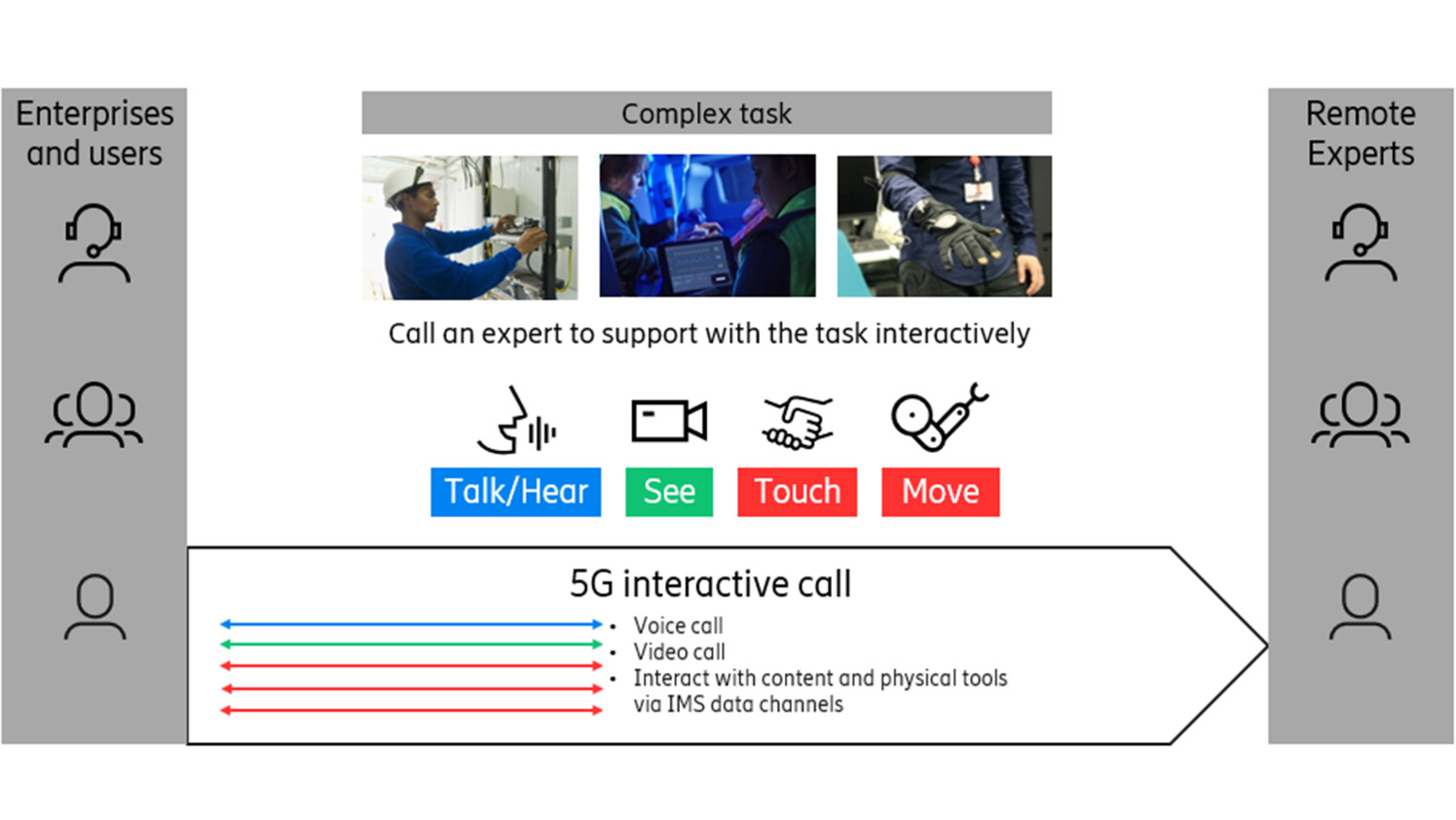
Figure 2: Example of how to bring in a remote expert easily – via a 5G interactive call.
This technology enabler is a foundation for evolving voice services in combination with the real-time interaction of content and other applications as part of a regular mobile 5G voice call. For enterprises, there could be hundreds of new use cases developed to include real-time collaboration, using the IMS data channels to transfer different streams of data between the users, using a 5G voice connection. The benefit of using IMS for these types of services, is to leverage the telecom values of mobile voice services, such as global find-and-connect with the phone number, authentication, mobility, session transfer, quality-of-service, security, and robustness.
Another example for enterprises and consumers, could be to share content via your 5G smartphone screen during a 5G voice call. Watch our 5G interactive calling video, which reveals how a future service could be developed to create the ultimate customer support experience on 5G smartphones.
To deploy 5G voice based interactive calling use cases in commercial services require cross-industry collaboration with infrastructure vendors, the device ecosystem, and service provider business development with their enterprise customers. It also requires benefits from 5G voice coverage. This is an opportunity for the telecom industry to leverage the installed base of IMS based mobile telephony networks, to provide additional value with 5G networks and enable interactive calling services in the future.
Find out more about how WebRTC can enable new and innovative communication services for consumers and enterprises in 5G networks with interactive calling: 5G voice.
Dig into related blog posts around 5G interactive calling, which uses WebRTC:
- We are one step closer to 5G interactive calling
- Interactive calling over 5G – how does it work?
- Evolve VoLTE to enable real-time interaction over 5G with IMS data channel
Read more about VoLTE