Help me SD-WAN, you’re my only hope!

Senior Solutions Marketing Manager OSS

Senior Solutions Marketing Manager OSS
Senior Solutions Marketing Manager OSS
Firstly, let me apologize for the Star Wars puns in this blog, but when we look at the enterprise market CSPs very much feel like the Rebel Alliance confronting the might of the Galactic Empire – but one that’s filled with hugely influential and well-established software giants, major systems integrators and the ubiquitous hyper-scalers or cloud providers that so many enterprises rely upon today.
If I can stretch the Star Wars analogy to the breaking point, CSPs wanting to succeed in the enterprise market need to be like the Rebel Alliance attacking the Death Star. Spoiler alert: For anyone who hasn’t seen Star Wars Episode: IV A New Hope (1977) – the rebels destroy the Death Star through agility and a bold and innovative plan. It’s possible for SD-WAN to provide CSPs with the same opportunity. Together, SD-WAN and SD-WAN orchestration provide agility and the ability to innovate and develop new services. This ability to enable new revenue streams is one of the key reasons so many CSPs have launched or are launching SD-WAN services. SD-WAN is a revenue multiplier.
What is SD-WAN?
SD-WAN stands for software-defined networking in a wide area network. Simply put, SD-WAN decouples the network hardware from the network control mechanism; simplifying operations and management and allowing companies to build highly scalable WANs with cheaper, more flexible connectivity. Traditionally, large corporates connected their national and international branches with expensive, dedicated multi-protocol label switching (MPLS) lines, which were highly resilient but sometimes very slow to install. SD-WAN allows companies to rapidly connect branch offices using standard broadband internet services, wireless 4G/LTE or 5G and MPLS if required. It also allows rapid scalability and the ability to create resilience.
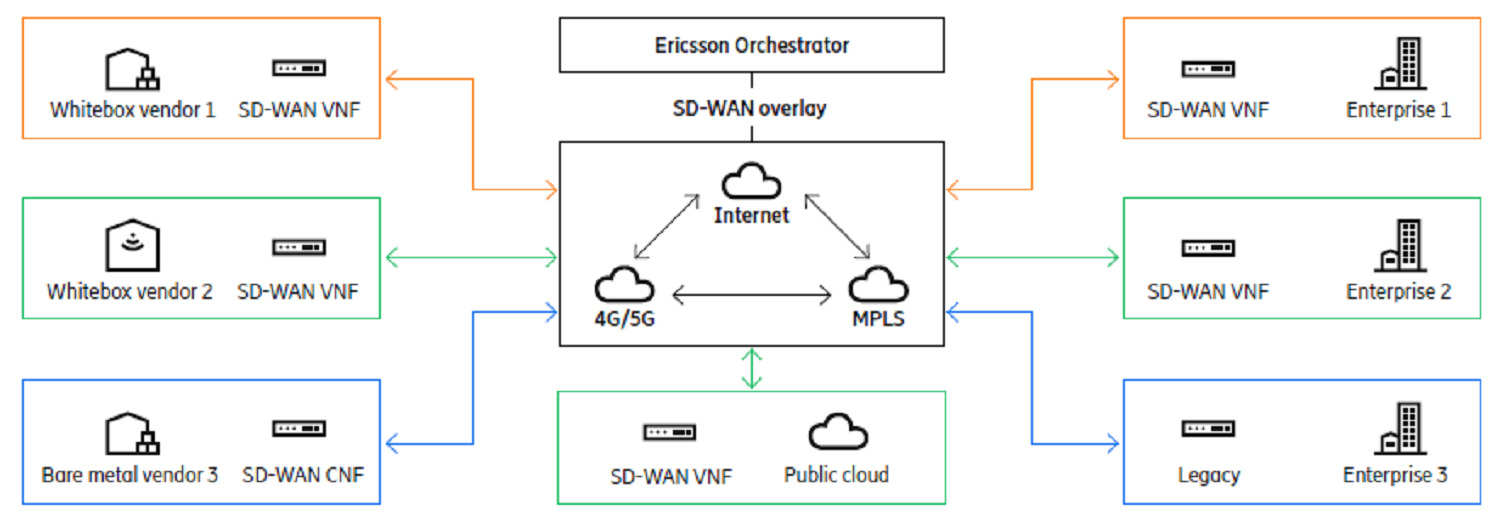
Figure 1: SD-WAN overview
Example: Instead of using MPLS to connect a new branch office, a corporate may connect the office using SD-WAN delivered over a standard business broadband link, which is much cheaper and faster to install and can add business resilience using a fixed wireless access (FWA) 5G connection as a back-up.
Why is SD-WAN important?
Global SD-WAN market revenue crossed the USD 1 billion mark in 2019, with revenue and customer sites growing more than 100 percent from 2018 to 2019 (Frost & Sullivan Frostradar™ Global SD-WAN Vendor Market report - 2020). Worldwide SD-WAN sales will see rapid growth during the next five years and are expected to exceed USD 4 billion by 2025 (Dell’Oro Group Report 24 Dec 2020). A massive 70 percent of medium and large US enterprises intend to implement SD-WAN within the next 2 years (IDC – US Enterprise Survey: SD-WAN SMB Uptake - 2020), and while SD-WAN growth in 2020 slowed slightly due to the global pandemic, it is expected to recover quickly. We are seeing a number of CSPs offering new SD-WAN services specifically for home-workers with a number of new customer premises equipment (CPE) devices being developed for the home-based corporate market as businesses look to increase security for a highly distributed home-based workforce. An Ericsson tier-one North American service provider saw a 30 percent reduction in connectivity costs with SD-WAN and a reduction in order fulfilment time from an average of 21 days to minutes. This combination of cost-reduction with improved agility is one of the reasons SD-WAN is such an attractive use case. To quote Star Wars (again) “the force is strong in this one”.
The Rise of Orchestrator
Orchestration (the ability to manage and automate the end-to-end service lifecycle) is one of the key reasons SD-WAN is both cost-effective and efficient. Orchestration allows SD-WAN services to work across multiple access technologies including internet broadband and 4G/LTE or 5G wireless connections. SD-WAN orchestration also supports dynamic path computation, the ability to calculate and recalculate the most effective route for the service for improved resilience as well as enabling load balancing. Some orchestration systems also support improved service design reducing time-to-market by up to 80 percent with systems that are intuitive, easy to manage, and heavily automated.
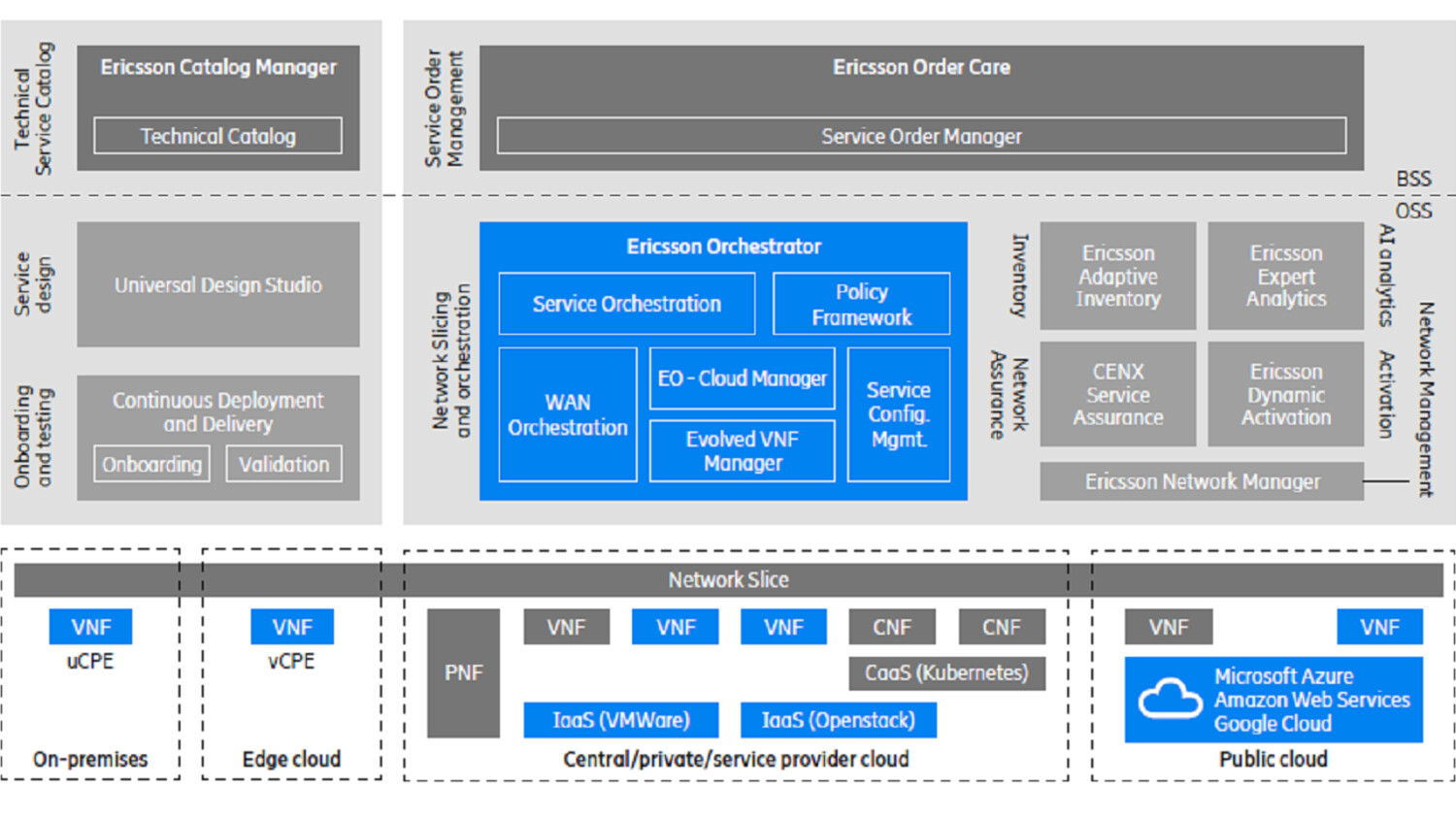
Figure 2: Ericsson Orchestrator provides SD-WAN orchestration
For CSPs wanting to offer SD-WAN and benefit from its cost efficiencies, its essential to implement an orchestration system to manage and automate the service, as well as selecting one or more SD-WAN vendors.
Importantly, SD-WAN acts as a springboard for a variety of other enterprise services, such as WAN optimization and security, as well as enabling access to high-performance cloud-based applications. The impact of SD-WAN is such that for every USD 1 of SD-WAN revenue generated, an advanced CSP can generate USD 5 to 10 of additional incremental enterprise service revenue effectively from SD-WAN enabled services. For some CSPs, SD-WAN is “more powerful than you can possibly imagine!”
Find out more
If you’d like to know more about SD-WAN please visit our Service Orchestration pages.
You can also read a short SD-WAN use case
Read our SD-WAN case study.
And apologies for all the bad Star Wars quotes. As the topic was enterprise, perhaps I should’ve done a Star Trek themed blog instead? For those of you that clung on (get it?) to the end all I can say is “it’s not my fault”.
The Endor