










How to estimate carbon emissions in mobile networks: a streamlined approach


“I want to do more for the environment, but I don’t know which action is best.” I’ve been hearing this a lot during discussions with friends. Because although most people want to live more sustainably, they need more help doing so. Consumers are struggling to find accessible and reliable information that details the impact different technologies have on the environment.
I have a strong interest in sustainability, but also a background in computer science. And the industry I’m very likely to work in – the ICT industry – releases devices and new technologies at a rapid rate. Market push for the latest technology can result in environmental assessments having a hard time keeping up with the development. After all, it takes a lot of time and labor to properly conduct an environmental impact assessment into all stages of a product’s lifecycle. This is why we need to find more efficient ways to assess their environmental footprint, so we can make informed decisions about how to minimize our own digital carbon footprints.
For my master’s thesis, I joined Ericsson Sustainability Research to research how to make environmental information about telecommunication networks more readily available. In this post I explore the outcome of my work.
Why is this important?
To make it possible for you to call, send text messages and browse the internet wherever you are, communications service providers (CSPs) have deployed large infrastructures that allow smartphones and other devices to communicate. The main building blocks of this infrastructure are radio base stations. Whether they are on the roof of a building, on top of a mountain or steel tower, the base stations send, receive and transmit the radio signal – 1G, 2G, 3G, 4G and now 5G.

Ericsson environmental sustainability
Read more about Ericsson’s circular economy approach to environmental sustainability.
These base stations need electricity to operate. Traditionally, this use of energy has caused the majority of emissions during a base station’s lifecycle. Fortunately, service providers are progressively shifting to low-carbon sources for this electricity. Therefore, once the carbon emissions related to the use of equipment reduce, the emissions related to the materials and production processes (the so called ‘embodied footprint’) represent a larger share of the overall carbon footprint. This footprint is what I’ve been focusing on.
How to measure the environmental footprint?
The traditional way to estimate the environmental impact of a product is called the ‘Life Cycle Assessment (LCA).’ It’s a rigorous protocol where we go through every process involved during the life of the product (from production and usage, to disposal). For each process, the associated environmental impacts are listed. In the end, we obtain a comprehensive picture of a product’s environmental profile – namely the percentage of greenhouse gas emissions, air and/or water pollution, human toxicity, and so on.
LCA is an accurate and widely recognized methodology, but it’s unthinkable to use it for every product and configuration in the industry. In fact, collecting data for an LCA is a complicated and time consuming process, since ICT manufacturers have suppliers all over the world and electronic products are in a constant state of development. Therefore, a new streamlined process needs to be created that more efficiently assesses the carbon footprint of a product as soon as it’s released to the market. This would allow customers, businesses and even designers to be better informed about how different technological products or services impact the environment.
The footprint of data and telecoms
What impact do your online activities have on the environment? Read our quick guide to your digital carbon footprint.
A tool to estimate embodied emissions
The tool I developed during my master’s thesis allows exactly that. I named it PEEC, for ‘Parameterized Embodied Emission Calculator.’ In its simplest form, it’s an Excel workbook that allows fast estimations to be made about the embodied carbon footprint of telecommunications network products (the base stations we talked about earlier).
How does PEEC work? A model, with parameters, helps to translate the physical properties of a product (including its use of materials and energy) into an associated footprint, by summing up the carbon emission contributions of each of the product’s component. The model is specifically built for telecommunications products, taking inspiration from the LCA methodology and standards for ICT [1].
The Excel workbook is self-contained, and provides transparency on data and assumptions. The data is obtained from a variety of sources: raw material compositions are calculated from the product’s full material declarations, manufacturing impact is estimated based on questionnaires to suppliers on production processes, and transport, assembly and other activities are allocated based on Ericsson’s annual sustainability reporting. For a more detailed explanation you can review my master's thesis report here.
The strength of PEEC is in its flexibility. It can be used by a wide variety of different users, for example:
- Ericsson’s customers (communications service providers) that are looking for environmental information on the products they buy, and have a limited knowledge of hardware characteristics.
- People working with sustainability within the company or external research partners, who are more interested in the details (like the relative impact of a specific material or manufacturing process).
- LCA experts maintaining and updating the tool by collecting new data.
All these users will use the tool differently. A service provider could simply use a high-level interface where users can enter a network configuration, but the tool also allows more advanced users to tune parameters and add new products.
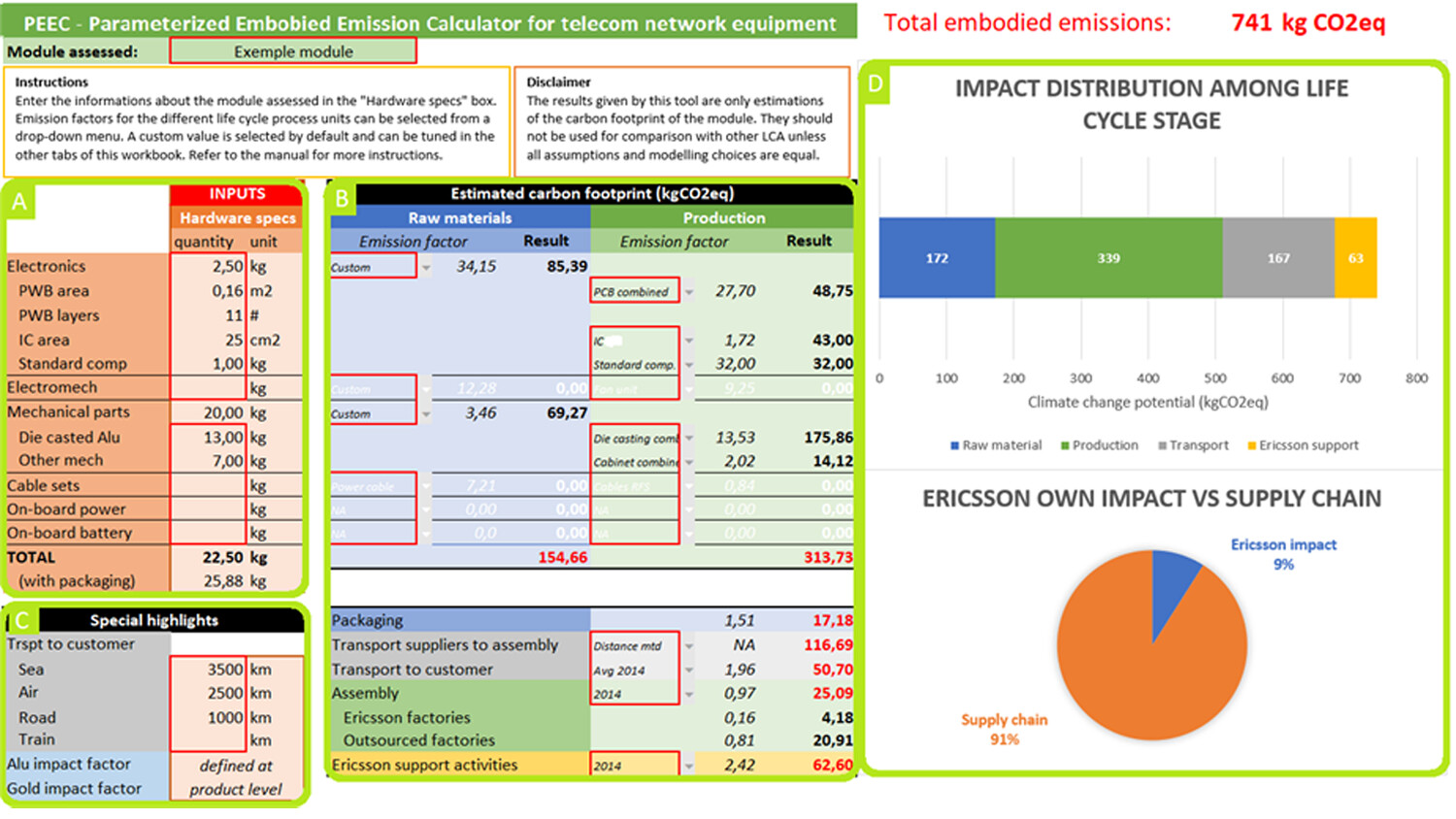
Figure 1: PEEC: In this sheet, the advanced user enters hardware characteristics of the module assessed (box A) and selects emission factors from drop-down menus of predefined values (box B). The carbon emission results (in CO2 equivalent) are displayed in box B and D by lifecycle phase (raw material in blue, production in green, transport in grey and support activities in yellow).
What do we learn?
As I mentioned before, radio base stations ‘emit’ the majority of greenhouse gases during their use phase. Indeed, a base station is powered permanently for around 10 years, which results typically in at least 85 percent of its carbon footprint occurring during operation (when assuming world average electricity mix). In comparison, this ratio could be as little as 10-20 percent for smartphones that consume little energy and are replaced often.
Yet, the embodied footprint for network equipment remains a ‘fixed environmental cost.’ And, as electricity becomes greener, it will become proportionally more important compared to the use phase.
I used PEEC on a classical configuration of the RBS 6201, one of Ericsson’s most sold radio base stations for 2G, 3G and 4G in the last decade. According to our model, the typical embodied emissions of this product in the configuration studied are 4.4 tCO2eq (tons of carbon dioxide equivalent). As a direct output of the PEEC tool (see graph below) we learn that 41 percent of these emissions occur during mining and transformation of the raw materials, 36 percent are associated to manufacturing and assembly of the product’s parts, 15 percent to transport along the supply chain and nine percent to other activities (R&D, marketing, employee commuting, and so on, called ‘Ericsson support activities”). As for all LCAs, such numbers can only be interpreted in relation to the assumptions behind them. We’ll come back to this later.
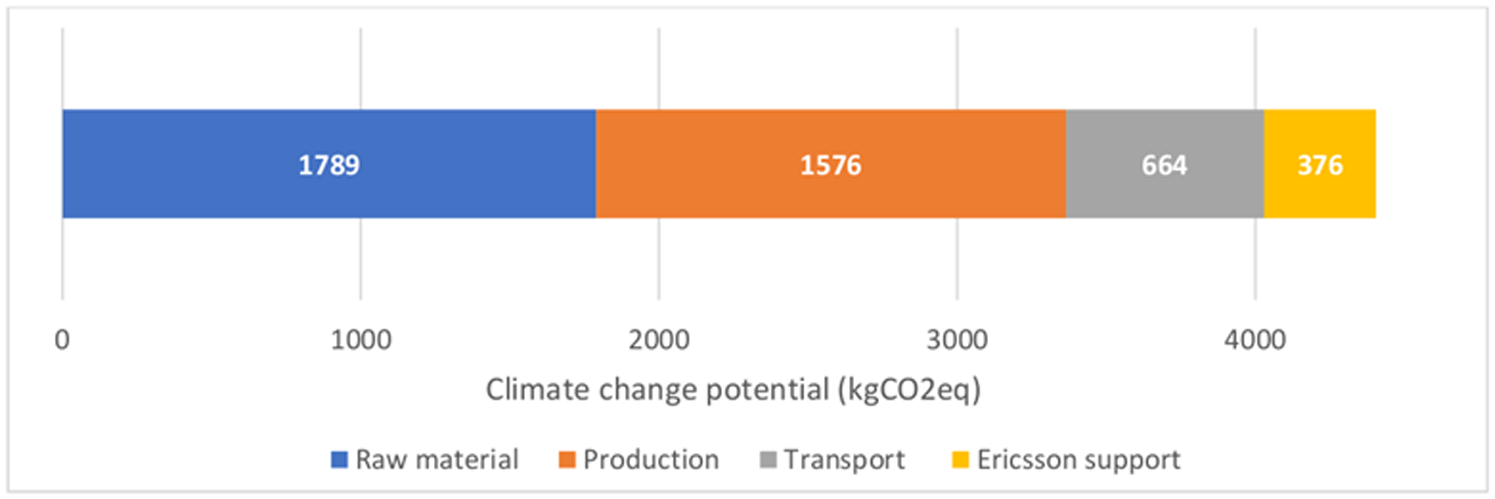
Figure 2: Distribution of the embodied emissions of RBS 6201 on the different life cycle stages. Disclaimer: these results are only estimations of the embodied footprint of the product. They should not be used for comparison with other studies unless all assumptions and modeling choices are equal.
Looking a ‘bit deeper’ inside the tool, we discovered a large portion of the embodied footprint was due to the die-casted aluminum frames of the radio and digital units, along with the production of electronics. By using PEEC to build a reliable information base, it helps us understand emissions in detail and identifies the measures that can be taken to reduce the environmental impact of the assessed products. In the future the tool could be expanded to various other products.
However, be careful. The estimations given by PEEC remain approximations that could be very far from reality. In fact, the real amount of emissions caused by a product over its lifecycle is impossible to gauge, as such impacts can only be modeled, never measured. This is a recurring problem when assessing an environmental impact: we have to make modeling choices, and every single source of data contains uncertainties, especially for complex products such as radio base stations. To deal with this situation, I spent a great deal of time trying to identify, limit and systematically discuss these uncertainties. This is further described in my thesis report.
What’s next?
PEEC is finally ready to be used, and my thesis report has been published. Overall, I’m very satisfied with this outcome, and it feels great to see the project being put into practice. However, for PEEC to continue to effectively estimate the impact of today’s 5G network solutions, the tool will need to be maintained with up-to-date data. But luckily, summer interns are about to take over and work on the addition of new products. I intend to stay in touch and provide assistance.
As for my personal experience at Ericsson, I’ve had a great experience, despite the pandemic. I thought big companies were not my ‘cup of tea,’ but I was able to discover the articulation between research and industry. This dialogue will be essential to face the challenges ahead. By simplifying the access to environmental information, I hope I contributed to bridge the gap between both.
The ecological emergency is real, and we need today's decision makers to tackle it seriously.
[1] See https://www.itu.int/rec/T-REC-L.1410 and ETSI Standard (ES)
Learn more
Read Maël’s full master’s thesis report
Read our quick guide to your digital carbon footprint.
Read our blog post How climate change can benefit from mobilization and digitalization
Explore 5G