










How to boost ROI & user experience with AI powered network planning & optimization

Principal Analyst, Telco IT & Operations

Principal Analyst, Telco IT & Operations
Principal Analyst, Telco IT & Operations
Principal Analyst, Telco IT & Operations
Principal Analyst, Telco IT & Operations
Principal Analyst, Telco IT & Operations

Strategic priorities for mobile network planning, design and optimization
When deploying new networks, mobile CSPs set coverage and capacity targets to meet customers’ expectations for high-quality service experience and ensure they are competitive with peers. Defining these targets depends on several factors including predicted traffic growth, as well as traffic and service type. This process has become challenging as mobile networks have experienced tremendous traffic growth since the advent of smartphones and 4G. The traffic profile of mobile networks has also transformed from circuit-switched voice and text messages to streaming video, web browsing, and gaming. The encryption of traffic by application providers has reduced the visibility into the traffic types, making network optimization an even greater challenge. The evolution of the mobile network adds more complexity as multiple Radio Access Technologies must co-exist in noncontiguous spectrum and various cell sizes. 5G adds to this, bringing new spectrum bands and new service types such as network slicing.
As CSPs deploy 5G, they aim to accelerate their Time To Market through better planning. They also aim to maximize their ROI through careful design and optimization. To achieve these objectives in the face of growing network traffic and complexity, CSPs need to increase the level of automation in their operations, for example, minimizing the use of drive tests.
Challenges CSPs will experience with 5G
Finding the right balance between managing costs and meeting customer expectations is a challenge for network planners, designers, and optimization engineers. This is especially true when deploying 5G given heightened consumer expectations and increased complexity due to the use of high frequency spectrum bands, and technologies such as massive MIMO and beamforming.
While there is plenty of spectrum available at these high frequency bands, the radio waves do not propagate as easily as at low frequencies. This restricts the ability of a high frequency 5G signal to reach inside buildings, where most cellular communication takes place. This drives the need for careful radio planning.
Network slicing is expected to be a key component of CSPs’ 5G strategy, enabling CSPs to move away from simply charging by the megabyte. Instead, they will be able to charge for highly differentiated “slices” of network capacity, moving their value propositions beyond connectivity to supporting a wide range of digital services for enterprises and consumers. To meet the service level commitments associated with network slices, particularly for enterprise customers, CSPs must plan for sufficient network capacity during the design phase.
Precision and speed in planning, design and optimization are critical to meeting these objectives. Unfortunately, current practices such as drive testing, propagation prediction using heuristics modelling and reliance on humans alone, make these operations slow, inaccurate, and costly. For example, planning is traditionally based on spreadsheets and is very time consuming, particularly data collection and processing. Only a few scenarios could be forecast given the manual nature of the work. And only a small number of KPIs were taken into consideration.
CSPs therefore need to take a different approach to performing these network operations to meet both business and network objectives.
Transform mobile planning, design and optimization using AI and modern IT practices
As CSPs look to increase the level of automation within network operations, they will require deep insights into network performance and its impact on customer experience. Given the increase in network data, high computational power needed to analyze them, and difficulties accessing these data sets, AI and other advanced IT practices such as cloud and DevOps can help.
AI techniques such as machine learning (ML) can generate granular insights about network quality and user experience. This analysis can be done across a broader range of data sets than is used in today’s operations and at much faster speeds. For 5G planning, for example, CSPs can leverage AI to model network behavior at the cell level. This will be based on historical analysis of traffic growth, network and service KPIs. Using these models, CSPs can make accurate predictions of network needs and plan accordingly.
Ongoing network optimization can also be facilitated using AI. Techniques such as deep learning can analyze multiple data sets such as network performance, configuration and alarms, to detect and cluster problematic cells based on parameters such as coverage, load, mobility, and uplink interference. Consequently, AI can identify common issues associated with problematic cells and suggest configuration changes.
AI can also enhance the accuracy for geolocating users which has become critical to planning and optimizing networks. Geolocation enables CSPs to understand quality of service at the individual subscriber level. AI can analyze call trace data, OSS data and crowdsourced data to improve the accuracy of geolocation which further enhances these operations.
Many CSPs including NTT Docomo, China Unicom, dtac Thailand and XL Axiata are leveraging AI in planning, design and optimization and have experienced multiple benefits as summarized in figure 1.
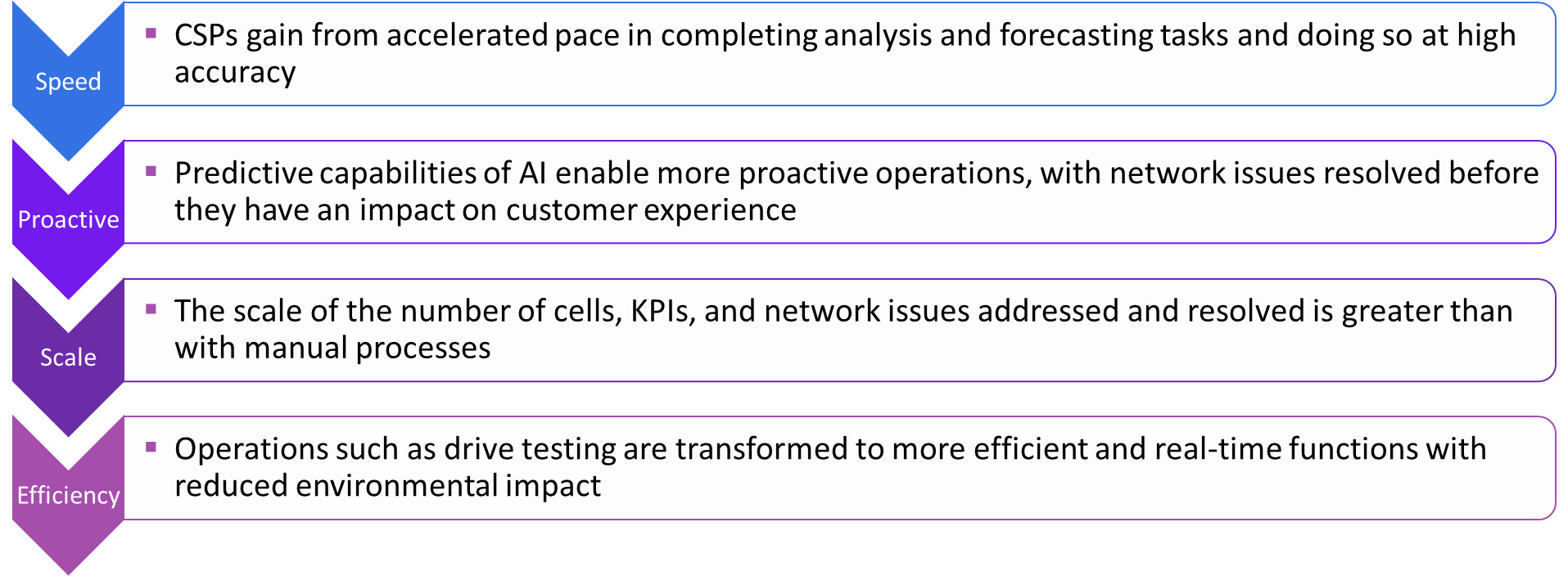
Figure 1. Benefits of AI
Source: Omdia
Network lifecycle automation will also require changes to team structure as well as architecture of tools supporting network planning, design and optimization. Adopting modern IT practices such as DevOps and use of cloud native tooling with open interfaces will enable CSPs to be more agile in running operations.
DevOps enables the different planning, design and optimization teams to collaborate, ensuring that the responsibility for network performance and user experience is shared by the entire team. It also increases efficiency (with less need for external resources) and eliminates duplication of effort. Having an open and centralized platform that hosts data and tools from each phase of the network lifecycle can facilitate the transition to DevOps.
As the state of the network changes, so does the need to upgrade supporting tools. Standard on-premises network design, planning, and optimization software lacks scalability and agility to respond to network changes. With cloud-native tools, CSPs can benefit from the simpler upgrade cycles associated with a microservices architecture.
CSPs need to act now
The complexity of CSPs’ networks is a given and will demand a transformed approach to network planning, design, and optimization. CSPs will need to act quickly to understand and take proactive steps in adopting new technologies such as AI and IT practices such as DevOps.
Potential drawbacks in adopting new operational practices need to be addressed. For example, while AI-driven automation comes with benefits, CSPs need to address challenges associated with skepticism around AI as well as data access and quality issues. CSP executives have noted difficulty convincing employees to use AI-based systems given their lack of confidence. For example, a director from a Europe-based CSP told us, “It is hard to get the operations team confident about AI as the tools cannot explain their decisions.”
CSPs and vendors have a role to play in addressing these concerns. With AI, CSPs need to take a stepwise approach to implementing AI-based systems to give employees more confidence in these systems. Vendors need to provide AI solutions with explainable AI to describe how decisions are generated. They also should demonstrate strong telco expertise and be flexible in addressing CSPs’ operational needs.
Most importantly, CSPs should take a collaborative approach when engaging with technology partners - this will be critical to advancing the use of AI.
Read more:
Learn how network slicing enables customized connectivity with assured performance for enterprise, consumer and industry-specific services.
Discover Massive MIMO solutions that increase capacity, improve coverage and enable high-performance 5G experiences at scale.