










Connected mangroves show how technology can scale nature-based solutions

Vice President of Sustainability and Corporate Responsibility

Vice President of Sustainability and Corporate Responsibility
Vice President of Sustainability and Corporate Responsibility
When it comes to addressing the climate crisis, this is the decade of action. The private sector must work alongside the government and society to deliver bold solutions to halve global emissions by 2030. Now is the time for collective efforts that make a real impact.
According to WWF, evidence increasingly suggests that nature-based solutions – natural systems or processes used to help achieve societal goals – could contribute significantly to minimizing climate change and its effects.
In fact, research shows that nature-based solutions and the broader land sector could contribute up to 30% of the climate mitigation needed by 2050 to meet the Paris Agreement’s objective of limiting global warming.
How mangroves can help mitigate climate change
In Malaysia – where we have operated for over 50 years – we understood that mangroves were absolutely critical to the ecosystem. Mangroves act as natural flood barriers for coastal communities, but they do so much more. They serve as habitats for fish and other sea creatures, an important source of local food and livelihood.
But perhaps most importantly, they mitigate climate change, as they are one of the most carbon-dense ecosystems in the world, with the potential to act as long-term carbon sinks. Mangroves are truly one of Earth’s most powerful natural protectors against the impacts of climate change.
Our project started back in 2015 when we discovered that there was a small village in dire need of revitalization after a massive flooding event earlier that year. We aimed to do something tangible, in partnership with our customers and community, that concretely benefited them and the environment. We believed the reforestation of the mangroves could be life-changing for the community.
Research helped improve planting success rate
During our research, we discovered that with traditional planting, the success rate of a mangrove sapling surviving to adulthood was only 40%. The majority of the saplings would have died, because of various issues, from lack of water to pollution brought in by the high tide.
We planted our mangrove saplings with sensors that monitored real-time information about soil, PH and salinity levels. We used this data to better manage the site, and then, two years after planting, the mangroves reached an 85% survival rate – a doubling of what we would have achieved without the sensors.
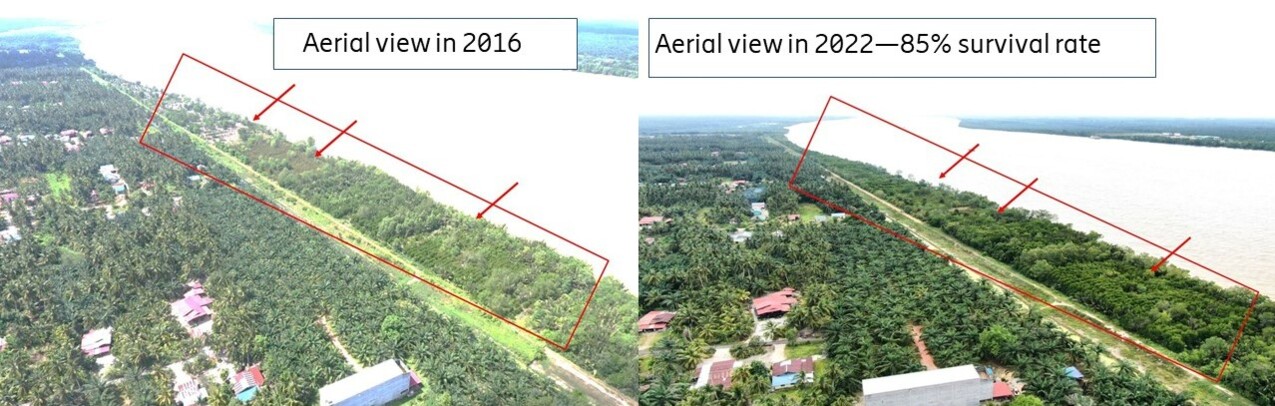
Above: The Connected Mangroves site 2015 and 2022. Source: Global Environment Centre.
Expanding innovative technologies
We have since begun working outside of Malaysia, with our second "Connected Mangroves" site in the town of Sasmuan in Pampanga, Philippines. As before, we started by installing soil and water sensors and a CCTV camera onsite. The data and the images from the site allowed the community to manage the area better, and it drew great public interest to these wetlands.
As the site's focus shifted to protection, we wondered: what other technology could we use? So, we helped the community with the annual migratory bird census. We worked with our AI team to train cameras to identify the species of birds from the protected site using test photos.
Innovative technology, which has been critical in the project, can also help with climate action in general. For example, the International Energy Agency notes that the decarbonization needed by 2030 is largely achievable with readily available technologies. Still, by mid-century, almost half of required emissions reductions will call for technologies that are not yet on the market.
Replicating success and scaling impact
Now is the time to look to other places in the world where the project can be replicated. We’ve reproduced the Connected Mangroves project in two countries now, and we continue to look to other countries where we can play a part. I encourage other companies to chart their own path, do the research, and find the unique sweet spot where their expertise can provide the concrete and scalable nature-based solutions we need worldwide.
Learn more
This article originally featured on the World Economic Forum. You can read it here.
Read more about the connected mangroves project on the UNFCCC website.
Learn more about the project’s history and solutions in our earlier blog post.
Learn more about Ericsson and sustainability.