










The 2022 Microwave Outlook reveals - the focus is on E-band and energy efficiency!

Head of Microwave Systems

Head of Microwave Systems
Head of Microwave Systems
You probably don’t need much to be convinced about the significance of mobile communications in society. Everything we do to connect with others – from a chat with a loved one to a meeting with an important client – is increasingly transferred to the digital world.
According to the Ericsson Mobility Report from June 2022, 5G subscriptions are expected to reach 1 billion, and the global mobile network data traffic has doubled in the last two years. By the end of 2022, the average monthly usage per smartphone is expected to surpass 15 GB and then grow to 40 GB by the end of 2027.
There is an expectation from society to have access to this connectivity anywhere and anytime. And not only that, but users also expect good quality and reliability in their connectivity.
It’s, therefore, important to ensure that the technology used to build cellular networks has the reach and capacity to fulfill connectivity needs. Fiber does this, but in many cases, it can take too long to build, or can be too expensive to deploy.
This is where wireless backhaul technologies come in.
Wireless backhaul uses microwave and millimeter wave (mmWave) bands to connect the sites that cannot be reached by fiber due to time or cost limitations. This way, wireless backhaul is not a replacement for fiber but a necessary complement. In fact, over 60% of the network sites today use wireless backhaul technology with traditional microwave bands or mmWave such as E-band. It means that over half of the mobile network radio sites and antennas you see on rooftops and antenna towers are actually connected by wireless backhaul rather than fiber. Depending on the country or geography, this happens in both urban and rural areas.
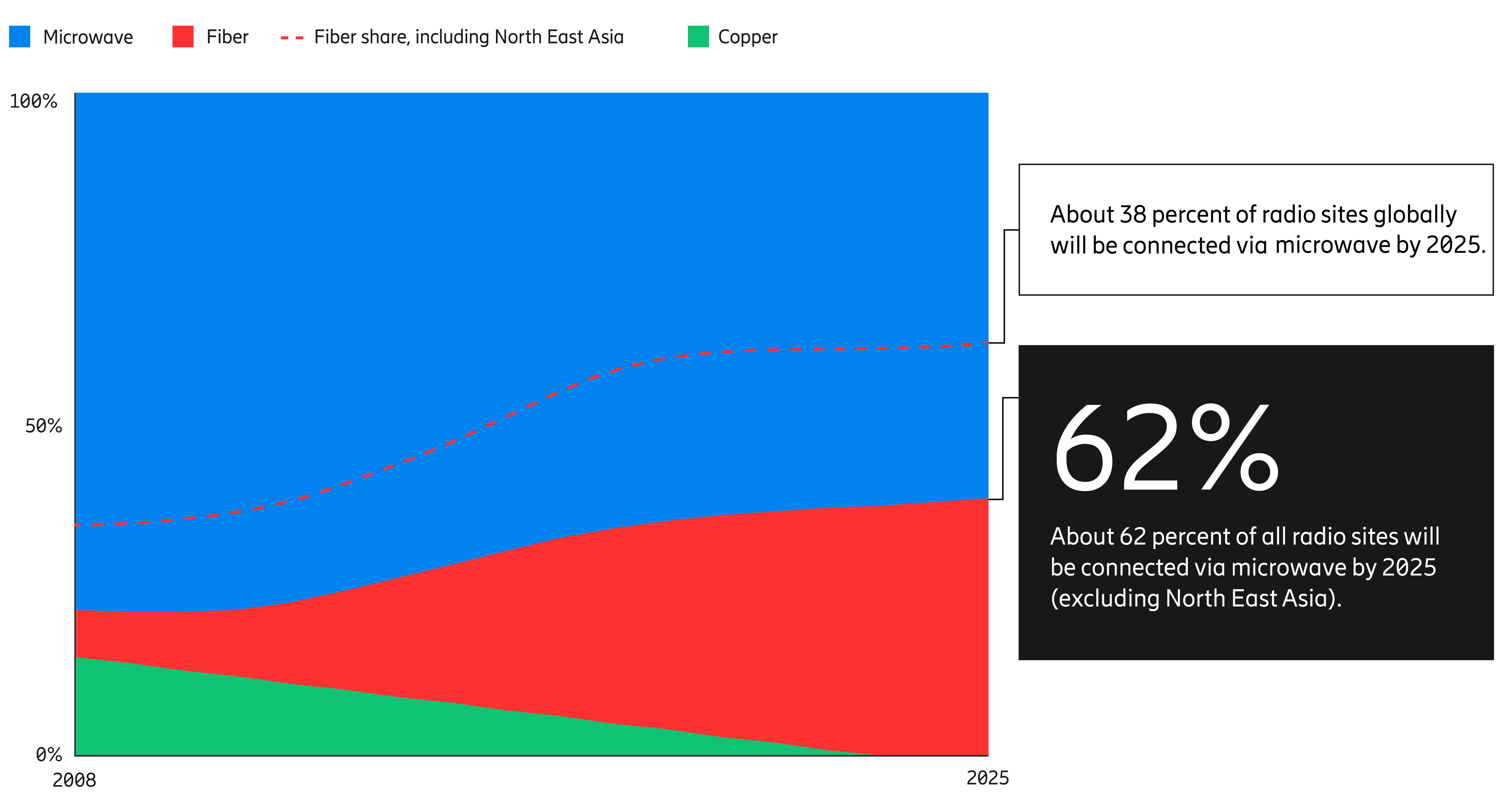
Source: Ericsson (2020)
The capacity magic of mmWave E-band technology
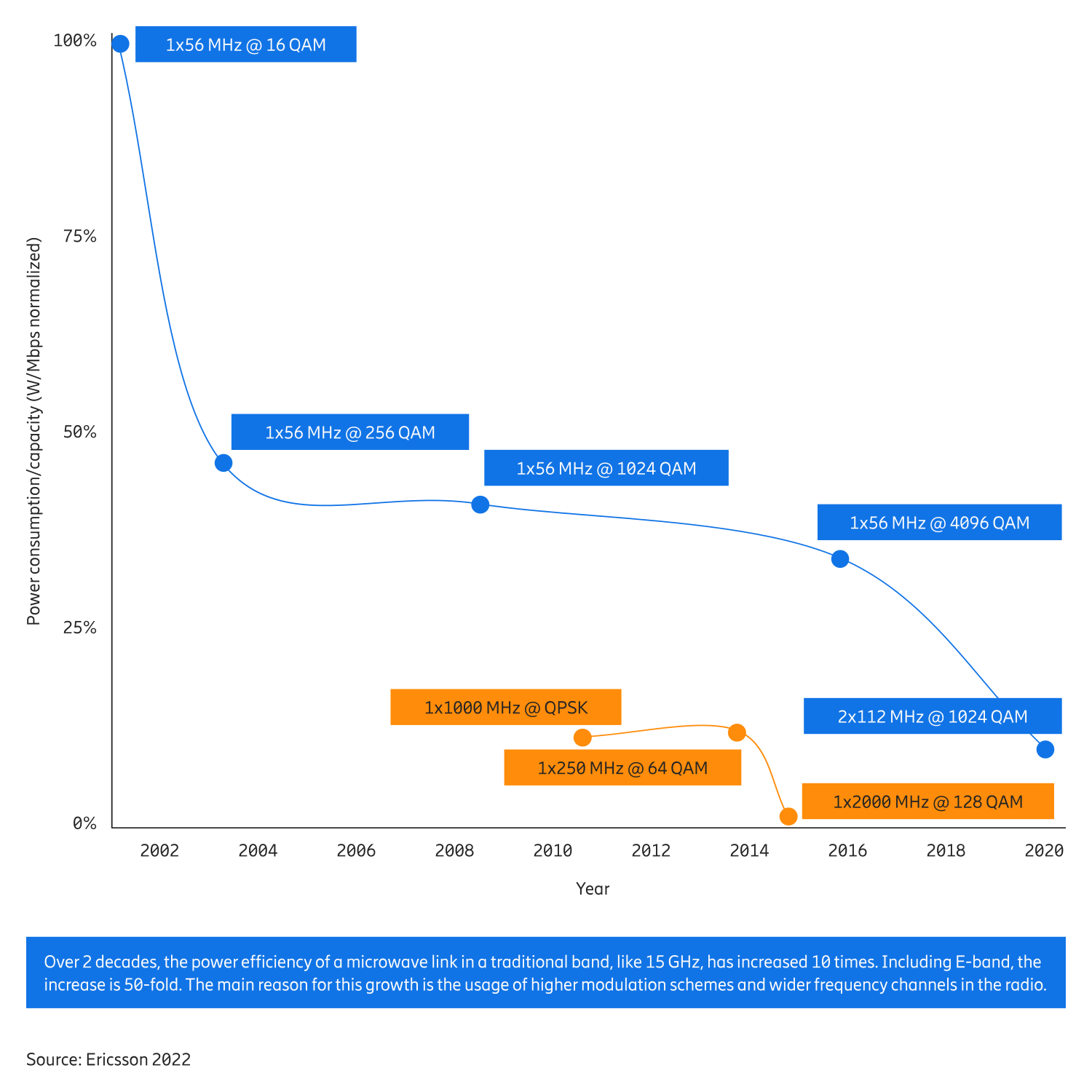
E-band frequencies can offer a much higher capacity than traditional bands due to the much wider spectrum channels in mmWave – 2000 MHz compared with 112 MHz in traditional bands. This means that much more traffic can be carried on an E-band channel than on traditional bands. As mobile traffic continues to grow, we need wireless backhaul technology that caters to the increasing traffic volume.
Since its introduction in 2011, E-band deployment has by 2022 grown to 6% of the total globally installed base. E-band will continue to grow rapidly, and it is estimated that by 2027 E-band will represent 25% of all new installations. For example, this summer, the 5G spectrum auction in India was concluded, and consequently, the Department of Telecommunication (DoT) will allocate E-band to mobile operators that hold 5G spectrum to meet their backhaul needs. This will allow high-capacity mobile access and quality of connectivity to reach even more places that couldn’t be reached feasibly until now.
Communication Service Providers will not only be able to use E-band as a standalone band. They can also use E-band in a multi-band booster combination, with traditional bands and hence, deliver high capacity, higher availability, and longer hop-length in a single hop.
Energy efficiency is a topic on everyone’s mind
The growth in network capacity drives greater equipment use, which in turn increases energy use. Considering the rising energy cost and the negative environmental impact associated with energy consumption, we need the infrastructure to be more power efficient.
Over the past 20 years, the industry has managed to increase microwave radios’ energy efficiency by a staggering factor of 50. This was achieved over three main strategies. First, the modulation schemes on traditional channel bandwidths were increased. At the same time, the channel bandwidths themselves have been widened, which also contributed to increasing data transfer capability. Finally, the adoption of higher frequencies like E-band resulted in even wider channels with additionally lower power consumption per bit.
Artificial intelligence (AI) and machine learning capabilities can further increase power efficiency by switching parts of the system on or off to align with actual traffic demand. For example, AI-powered deep sleep, combined with traffic-aware output power technologies, has the potential to reduce power consumption by up to 20% over five years.
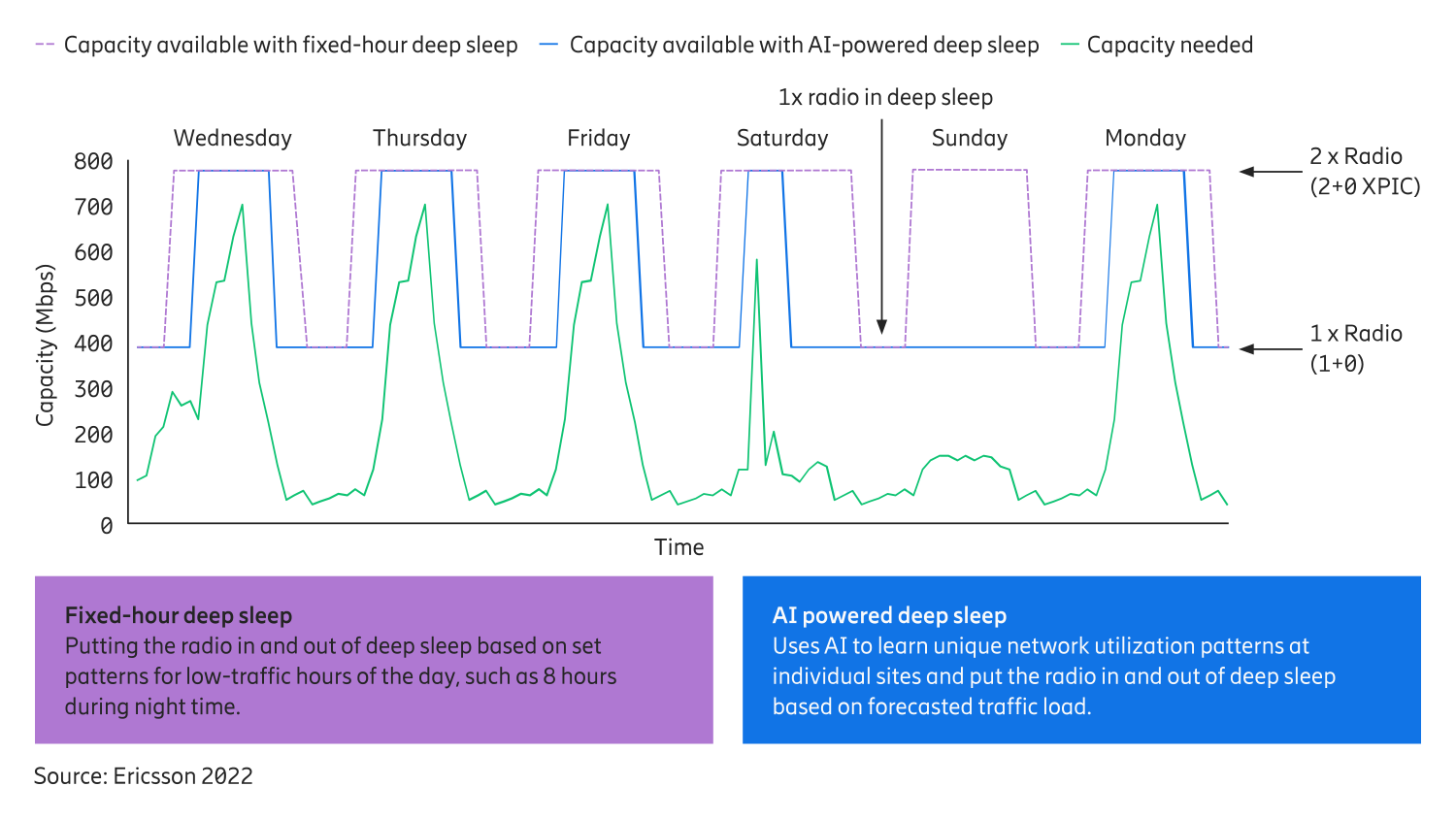
There is a great potential to apply these intelligent technologies across the network in multiple use cases, which will further decrease power consumption while making the networks much more efficient and high performing.
When I compare the maximum capacities of microwave hops at a couple of hundred Mbps a few years ago to the Gbps that exists today, I’m reminded of just how transformative the industry has become. I can hardly imagine what the future holds, but I look forward to seeing it.
Want to learn more? Check out the latest Ericsson Microwave Outlook Report