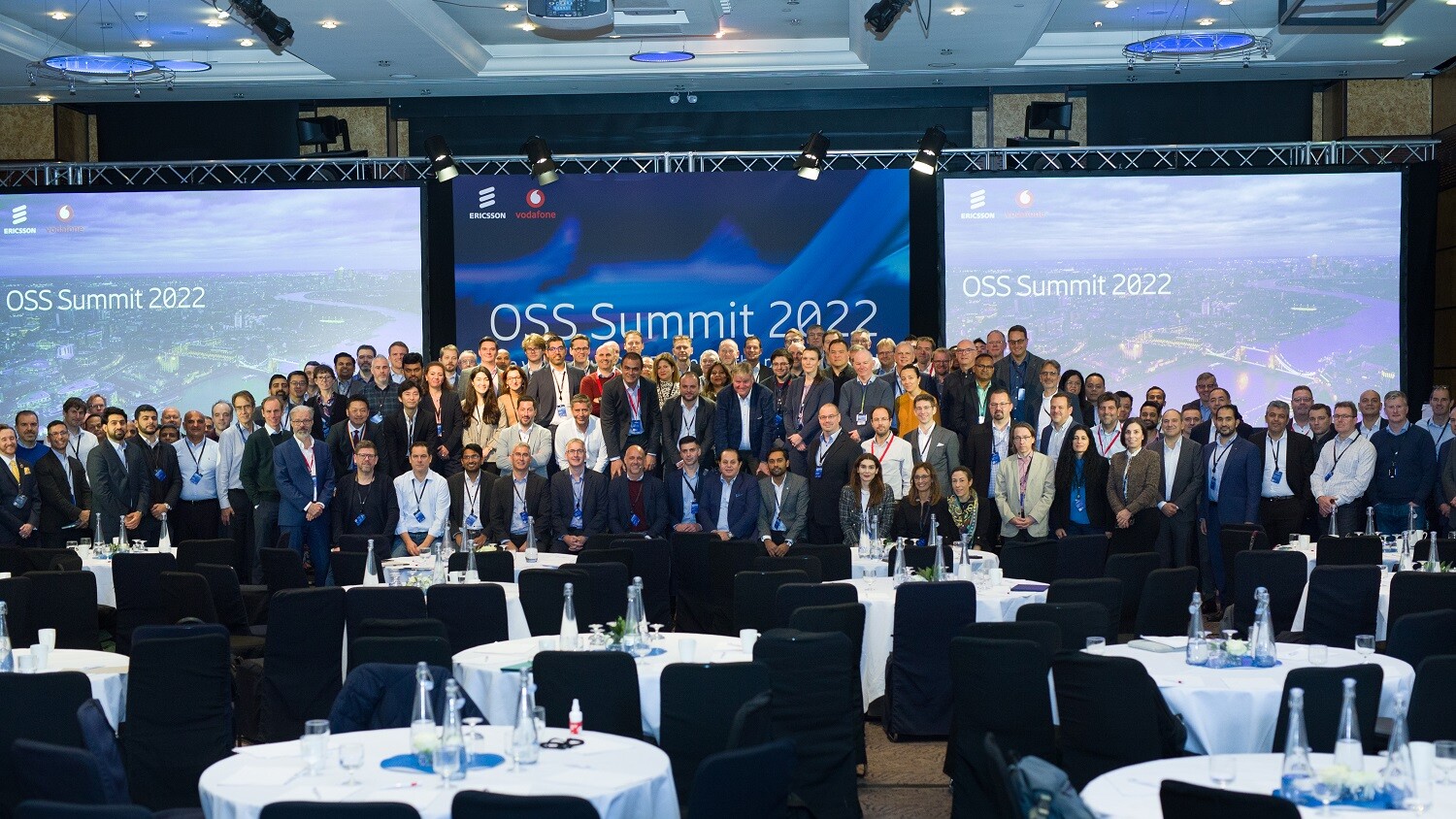
The industry is facing a unique paradigm of multis: multi-vendors, multi-domains, multi-technologies, multi-million 5G nodes. Bringing these together is arguably one of its biggest challenges. Two critical ingredients to the broader solution come from OSS: automation and its ability to expose key network assets to build businesses of the future. The Summit posed a critical question to the OSS industry: Are you ready to deliver on the promise of 5G? And if not, why not?
Here are our Top 5 insights from the event.
#1 Pick up the OSS transformation pace
A key point, introduced early in the Summit by our co-host for the event, Vodafone, was the need for speed. Andrea Donà, Chief Network Officer at Vodafone UK, summarized it simply as: “Notwithstanding the fact that we’ve done a lot, we still haven’t done enough to really bring the benefit of 5G.”
As a result, everyone– from customers to service providers and every stakeholder in between – continues to miss out on crucial opportunities that will increase revenue streams across the entire value chain. Throughout the Summit, delegates were challenged to pinpoint the root cause of this lag and ask themselves: how can we accelerate transformation and truly deliver on the promise of 5G?
Some key discussions included:
- Changing our view of OSS from “simple technology introduction” to fundamental business transformation that includes all facets of the organization, from business processes and technology to people, culture, and skillsets
- Understanding the different stages of OSS transformation and being brutally honest about why we are not taking the necessary steps
- Adopting a disruptive mindset to automation and, as much as possible, bringing in Artificial Intelligence (AI) and Machine Learning (ML) online and over the air to achieve a zero-touch future
- Being bold enough to unburden ourselves from legacy systems, while being very clear in direction at the same time
- Sweat the “unsexy stuff” like business models, ways of working, processes harmonization, and data strategy. This will prevent the telecoms industry from developing what initially seem like great tools, only to find that they don’t work from a practical perspective.
#2 Slow down, especially for strategic long-term change
While a clear case was made for accelerated transformation, the Summit also highlighted the importance of taking it slow and focusing on viable and responsible change.
Omdia’s James Crawshaw, for instance, warned against the viability of quick and sudden replacements of legacy systems: “A number of those have ended rather badly: cost more than expected, took longer than expected, and ultimately didn’t deliver.” Instead, making targeted and discrete upgrades to existing systems will collectively see the entire system moving forward. Over time, legacy will naturally be replaced or retired with minimum disruption.
In short, the message is to move as fast as possible, but to be smart about every step that we take to ensure a bright OSS future.
#3 It takes a village
An increasingly positive trend that was both highlighted during, and facilitated by, the Summit was cross-industry collaboration that goes beyond the traditional service provider and end-customer relationship. Instead, deeper collaboration is taking place where different stakeholders are working together. Critical questions are being asked like: “What can we learn from one another?” and “What can we do better to improve overall technology and networks?”
The value of this deep collaboration was best illustrated in a joint presentation by Vodafone and one of its key clients, UK Power Networks. Talking about their Project Constellation, they discussed how the collaborative innovation project was specifically launched to share experiences, insights, and resources regarding 5G as a means of addressing and finding solutions to some of the energy industry’s most pressing challenges. To date, the 18-month-old project has had many eye-opening moments, some of which were as simple as exposing the UK Power Networks team to what Vodafone would consider “standard functionalities.”
“My challenge to you is…put pressure on those networks like ourselves, those traditionalists, to see the light. Because when you demonstrate things like we’re doing in Constellation, engineers on my side of the fence are going: that’s interesting. WOW. It’s mad that you can do that! I’ve got some of the most traditional of engineers on this innovation project and it’s amazing the transformation I’ve seen in 18 months,” said Ian Cameron from UK Power Networks.
The call for collaboration was also heard strongly from the telecom side of the table. Singtel’s presentation, and examples of gathering actionable feedback from customers and developers outside telecoms, made it clear that for businesses individually, and the industry as a collective, working together is essential.
#4 Automation remains the name of the transformation game, but it’s not the only player
While automation most certainly sits at the heart of digital transformation journeys and will be vital in bringing out the full value of 5G network slicing, the Summit reminded us that there is much that can be done without the use of AI. Rule-based automation, for example, is a relatively straightforward implementation that can play an important role in kickstarting transformation journeys that are not yet at an AI or ML stage.
Adding AI and ML where they will provide value is, of course, key to the process as well. Our own Sam Keys Toyer spoke on Ericsson Managed Services’ digital transformation journey and how the team applied AI and ML use cases to add value from operational context. Key insights included:
- We don’t know everything. AI and ML is not the solution to every problem, but rather a technique that can be applied to various processes.
- AI and automation are as much about trust within the organization as it is about the technology.
- AI and ML have vitally important contributions to make from network performance and operational efficiency perspectives
#5 Think strategically about cloud native
Discussions encouraged a more strategic approach: taking a step back to truly understand what needs to be achieved in the next phase of transformation and the role that Cloud Native should play. In some projects, it could play a minor functional role. In others, it will be the driving force. Sudhindra Chada from Ericsson’s Product Line OSS team stressed the importance of Cloud Native automation as the foundational capability to unlock innovation in the service layer. This will, in turn, enable agile service management which is crucial for the monetization of services.
In summary, the Ericsson OSS Summit 2022 encouraged a series of thought-provoking discussions and challenged the industry to ask themselves: Are you ready? More than that, to be brutally honest in their answer and transparent in why the industry is not yet delivering on the promise of 5G. A key inspiration was to think different, think big, and do things differently to achieve an evolved OSS that can match the exponential momentum that 5G continues to build.
Learn more
Check out the recorded presentations from OSS Summit 2022
Find out more about Network Slicing with Ericsson
Find out how CSPs worldwide explore service orchestration for 5G
Discover how to monetize enterprise 5G with a simplified customer experience through BSS