










TEEEing up for next-generation communication services

Solution Marketing Manager

Senior Researcher, Human-Computer Interaction

Solution Marketing Manager
Senior Researcher, Human-Computer Interaction
Solution Marketing Manager
Senior Researcher, Human-Computer Interaction
Are we ready to TEEE up?
Well, the first question to answer is who do we mean by ‘we?’ In this blog post we look at 'we' from three different perspectives: consumers, enterprise users and communication service providers (CSPs)
So how do we improve today’s communication services? I believe there are four main areas that need to be refined. These are the ability to communicate and share:
- Trust
- Empathy
- Emotions
- Experiences
So, when I say it is time to TEEE up, I mean it is time to introduce technologies and services that can facilitate the communication of trust and empathy, as well as the sharing of emotions and experiences.
So, what's the solution? Well, there isn't one solution that fits all needs. Especially when we are talking about investment needs and market penetration, as well as maturity levels from both a technological perspective and societal aspects of technological acceptance.
Companies have experimented with 360-degree studios, avatars, holograms, and many other technologies that can help us TEEE up. At this year's Mobile World Congress (MWC), we demonstrated a different type of holographic technology: Holographic Communication. By combing augmented reality (AR) glasses, advanced compression techniques and a 5G standalone network with Ericsson Dynamic Slice Selection, a new form of communication was born!
This begs the following questions:
- Is this how our everyday communication will be? Probably not.
- But, can this give value to consumers and enterprises? Definitely yes
So, what is Holographic Communication? What value does it bring and how does it work?
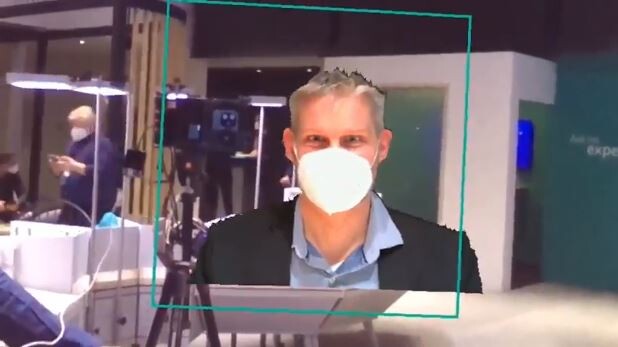
First of all, seeing is believing. Although you are using a 2D screen right now, click on the picture above to see our 2-minute demo from MWC where our head of Solution Area Communication Services, David Bjore, demonstrates Holographic Communication to Chelsea Andrews from Techmode. Here’s why I think this is really something special: this demo was done with commercial off-the-shelf hardware and software together with advanced compression. So, the only thing which isn't commercialized today is the high-quality, real-time compression and decompression of the holograms. This is really the secret sauce, bringing down the bit stream from some 2 Gbit/sec from the camera to around 30 Mbit/sec over the air. Coming back to TEEE use cases, although all four abilities are important to both enterprise and consumer use cases, we think the following are the main priorities:
- Enterprise: Trust and Empathy
- Consumer: Experiences and Emotions
For more details on our thoughts of the difference between enterprise and consumer priorities, read this article from Ericsson Technology Review.
One possible enterprise use case revolves around ’call elevation’. With that we mean with call elevation is that voice or chat interactions with a sales agent, customer support, hospitals, government agencies etc. are elevated to holographic communication in order to achieve additional trust and/or empathy.
The consumer use cases revolve more around sharing emotions and sharing experiences with those who are not physically there with us.
If you look on the use cases themselves, it is not particularly revolutionary for both consumer and enterprise – which is good. What Holographic Communication will do is increase both the experience and the value of the communication. It increases the value for businesses since the ability to convey trust is very important for customer success, and it increases the value for consumers since it enhances the communication thereby increasing the emotional impact of the communication.
So, to answer my question in the beginning of this post… Are we ready to TEEE up? I believe so: both enterprises and consumers are ready for Holographic Communication. But there is one question left to answer… are CSPs ready to TEEE up?
When to TEEE up?
A critical component for this immersive experience is the AR glasses. For businesses to provide call elevation services, or consumers to share experiences there needs to be a critical mass of people with AR glasses. So, how do we get there?
I think this is where we need to rely on the gaming industry, as well as the remote working model. Here is where there is a direct, tangible value which will lead to investments. Once that happens, AR glasses will penetrate the market and we’ll have TEEEd up and ready to play ball! The investments needed in 5G standalone networks with Ericsson’s Dynamic Network Slice Selection is happening. The addition here is further investments in compression services provided locally or as-a-service to secure an end-to-end high-quality service.
It’s time for the next-generation of communication services – a focus on trust and empathy and sharing emotions and experiences.
Learn more
Read the article: The spectacular rise of holographic communication