










How to design the most efficient transport network for the Cloud RAN?

Customer Solution Sales Director, 5G Transport
Customer Solution Sales Director, 5G Transport
Customer Solution Sales Director, 5G Transport

What is a Cloud RAN?
The term “Cloud RAN” or “Virtualized RAN” refers to the implementation of RAN processing functions on generic compute platforms, known as COTS hardware (commercial off-the-shelf). The RAN functions are “containerized” and run on an open-source container orchestration system (Kubernetes), which takes care of automating software deployment, scaling, and management. Cloud RAN is an open architecture where the cloud compute platform, the container orchestration, and the server hardware no longer need to be provided by one vendor on a monolithic purpose-built platform.
Another characteristic of Cloud RAN is that RAN functions can be disaggregated instead of being implemented on purpose-built basebands. This means that some functions can be implemented in the Radio Unit, some in the vDU (virtual distributed unit), and some in the vCU (virtual centralized unit). The operator has the flexibility to collocate or geographically separate these functions depending on the use case. It makes RAN processing more efficient and improves scalability.
However, an important, but often overlooked aspect is the radical changes needed in the transport network to implement such an architecture.
How does Cloud RAN differ from a traditional distributed RAN?
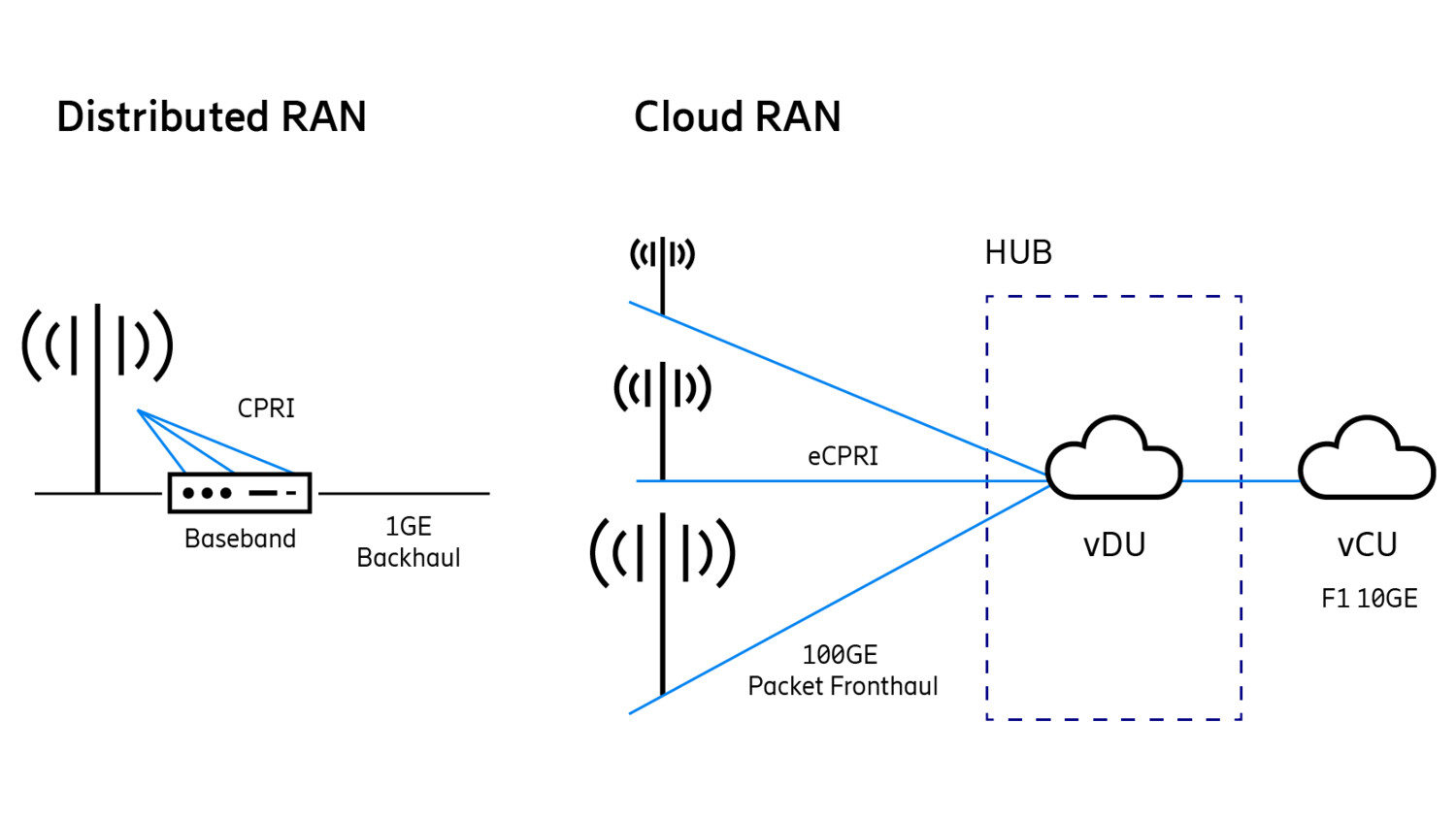
In a traditional distributed RAN network, each radio in the cell tower connects to a dedicated RI port (Radio Interface port) in the baseband at the foot of the tower. CPRI interface (Common Public Radio Interface) requires very high bandwidth (10Gbps) and very low latency. With the introduction of massive MIMO radios, with active antenna systems and beamforming, this interface had to be increased in capacity to a 25Gbps ethernet-based interface called eCPRI.
Cloud RAN will allow operators to replace the basebands with centralized vDUs running on servers in a “data center” like environment at a hub location. It means the transport network must now carry 25Gbps eCPRI interfaces from several cell sites to the hub. Such architecture is called Packet Fronthaul since the new eCPRI interfaces are ethernet-based.
Let’s not forget about the older CPRI radios!
But we cannot forget about the older CPRI radios that will be still in service for many years and must also be supported by the cloud environment. To support these radios, Ericsson provides a Fronthaul Gateway at the cell site to convert the older CPRI protocol to the new packet-based eCPRI. This reduces the bandwidth significantly and allows the data from the older radios to be merged with the eCPRI from the newer radios.
A typical vDU server at the hub will have a 100GbE network interface card (NIC), so the fronthaul transport network must aggregate and switch multiple 25Gbps eCPRI interfaces into 100GbE NIC cards. This is very different from CPRI fronthaul network, where each radio is mapped to a dedicated baseband port using the CPRI interface. Similarly, if the vCU is in a different location to the vDU, the transport network needs to be designed to support multiple vDUs, converging on one vCU with the appropriate supervision and QoS functionality to support the F1 interface. F1 is a 3GPP, a standardized interface for user plane and control plane data when using HLS (Higher Layer Split).
Another critical difference in the Cloud RAN architecture is that synchronization is implemented differently. Purpose-built basebands have built-in high-precision oscillators to provide very accurate synchronization to the radios, but COTS servers do not. Consequently, synchronization must be provided using PtP (precision timing protocol) from a PRTC (primary reference timing clock). This is a different approach to network synchronization and needs to be very carefully designed to avoid performance degradation of the RAN.
Use the 5G-enabled bandwidth to the maximum
In summary, service providers have spent billions of dollars investing in the 5G spectrum and new 5G technologies that provide never before seen performance and service improvements. The design of the RAN and transport network must be closely coordinated to avoid bottlenecks and to ensure that the transport network doesn’t diminish the significant bandwidth improvements that 5G will provide.
It is very important to design an integrated RAN (both purpose-built and Cloud) and transport solution, using a vendor who has expertise in all areas and can ensure that the transport network is optimized to support RAN, not just today but in the future as RAN evolves.
Not all 5G and Cloud RAN architectures will be the same. There are different strategies for network disaggregation, building and scaling, and optimizing the coexistence of legacy and cloud infrastructure.
For more information on how Ericsson can help you create an optimized solution for Cloud RAN network design and implementation, please refer to the links below.
Ericsson Cloud RAN. Virtually everywhere.
Mobile transport solutions to connect 5G services everywhere
Packet fronthaul for efficient 5G networks