









Pre-integration – lowering the barrier for deployment of Cloud RAN

Strategic Product Manager, Cloud RAN Solutions

Strategic Product Manager, Cloud RAN Portfolio

Strategic Product Manager, Cloud RAN Solutions
Strategic Product Manager, Cloud RAN Portfolio
Strategic Product Manager, Cloud RAN Solutions
Strategic Product Manager, Cloud RAN Portfolio
When deciding to use disaggregated virtualized RAN in their networks, integration is one of the biggest challenges faced by customer service providers (CSP). It can be costly both in terms of equipment, time and labor, and it can sometimes feel like a shot in the dark as configurations are teased out and tweaked to ensure that the result delivers the kind of performance that consumers demand.
Quite rightly, CSPs see moving RAN to the cloud as a daunting and complex task with several barriers that currently prevent them from making the move.
If we were to compare it to something many of us can relate to in our personal lives, it might be the process of building a house and eventually moving into it and maintaining it over time.
In the past we would have chosen an architect and then watched as it was built from scratch, brick by brick, during a long painstaking process that took months or even years.
Nowadays, advances in building technology mean that we can choose from a vast array of modular houses that can be erected in a matter of days, and often configured to suit our needs. There are of course unique parameters that we will want to influence – the colors on the walls, the tiles in the bathrooms, and so on – but effectively the lion’s share of the work is done quickly and efficiently, effectively built on what we have learned from generations of builders before us.
This is the future of network deployment, where communications service providers (CSPs) can decide the size and scale of their new network and then choose a solution that is pre-integrated with a set of cloud infrastructure components. There will always be fine-tuning to be done, but the time, labor and associated costs are drastically reduced.
Disaggregation challenges in Radio Access Networks
As CSPs introduce virtualization and disaggregation in their radio networks, they need to continue to optimize the total cost of ownership (TCO) related to their investments and capital expenditures (CAPEX), while also taking their operational network expenses (OPEX) into account. The requirements for telco-grade performance, reliability and availability in a solution relying on many independent layers make integration a complex topic when it comes to the virtualization of RAN network functions.
Radio introduces unique requirements on cloud platforms due to the nature of the workload, and the 5G RAN protocol stack (see picture below) outline the different parts where RAN processing is important. In summary, the 5G protocols contain the Control unit (CU) which includes the RRC (radio resource control) and PDC (packet data convergence) protocols, while the digital unit (DU) includes the RLC (radio link control) and MAC (multiple access control) protocols along with the physical layer. The CU and DU are connected through the standardized (3GPP) F1 interface.
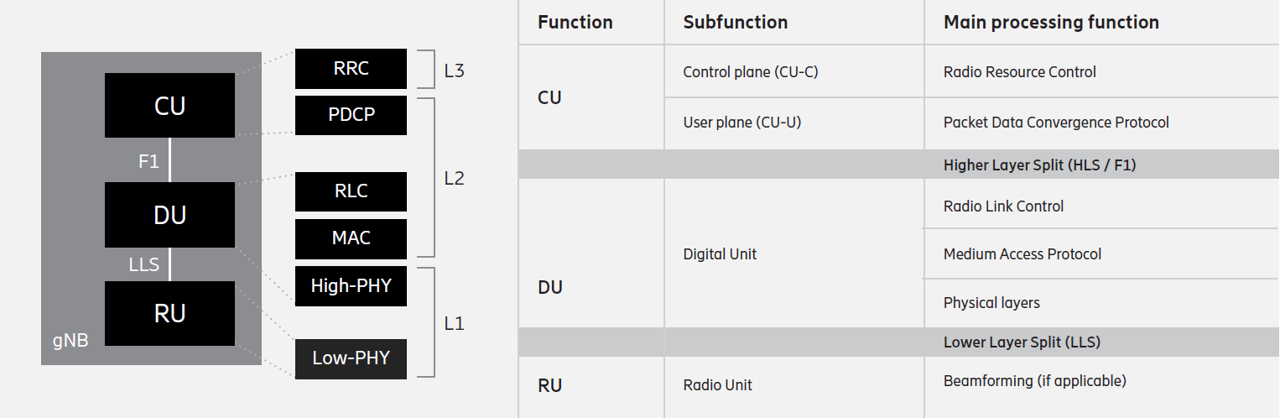
The lower you go in the protocol stack, the higher the demand on processing – Layer 1 & 2 combined comprise 90% of processing demands. The wide 5G mid and high bands together with massive MIMO technology exponentially increase the processing demand on L1 and beamforming. In order to address this processing, acceleration technology is required. The options are discussed in the positioning paper: Cloud RAN Acceleration Technology.
RAN data is processed & transmitted in short intervals, a typical pattern in 5G is 2000 intervals per second. Together with the data volume, this means that the operating system of the cloud infrastructure needs to handle the real-time requirements of RAN workloads – demanding high compute with very tight completion cycles.
Another unique requirement in RAN is the need for synchronization in cloud hardware and software, since radio transmissions need to be synchronized in both time and frequency. One way to enable sync is by using PTP 1588 (a protocol used to synchronize clocks throughout a computer network). A synchronized cloud fabric would contain hardware (switches, routers and server network interface cards etc.) capable of handling PTP. The operating system should be able to process PTP packets and provide sync services to DU, and this all constitutes new use cases for cloud infrastructures.
Most network deployments today are based on distributed RAN (D-RAN), in which baseband processing functions are deployed at antenna sites. This could mean as little as one compute node deployed at a physically isolated site, and this can put extra stress on the design of cloud platforms. Cloud platforms need to work on minimal processor and memory footprint, while meeting the requirements of a containerized DU workload.
For centralized RAN architectures, radios connect with DUs (distributed units) over fronthaul, and cloud infrastructures need to be able to handle the stringent requirements of fronthaul transport while leveraging a multi-node Kubernetes cluster with top of the rack switching.
Radio access network vendors need to ensure that cloud providers build and provide capabilities to support the critical needs of RAN applications, and then collaborate to perform the necessary hardware-cloud software-application integrations. Since cloud ecosystems for virtualized RAN are in their early stages with a journey towards mature capabilities, these integration efforts tend to be complex, time and resource consuming early on.
Finally, to overcome these disaggregation challenges and secure a successful integration of Cloud RAN applications with cloud and hardware, we need to always keep an eye out for key CSP objectives – high-performance networks, optimized TCO/time to market (TTM) and streamlined deployment and operations.
Adapting to an ever-changing cloud environment
A cloud-native ecosystem of Kubernetes (K8s, an open-source container orchestration platform that automates many of the manual processes involved in deploying, managing, and scaling containerized applications) and related Cloud Native Computing Foundation (CNCF) projects is evolving fast, and new features are being added at a fast pace. However, there is no guarantee of backwards compatibility, and integrations must be repeated to handle the life cycle of the underlying clouds. Consequently, integration is not a one-off activity. There will be a need for vigilant life-cycle management of the integrations for the foreseeable future.
With a software application that can be deployed in cloud environments ranging from datacenters to single node deployments adds new requirements on the operation and maintenance, e.g. zero-touch automated deployment in low- or no-skills environments is a must. Datacenters are staffed by engineers and other skilled staff, but with higher degree of distribution it’s not feasible to rely on staffing at each remote site, and this adds to the merits of a solution that functions well together.
Resource and application orchestration are key enablers for automation - if these components, together with the RAN and the cloud, are built with multiple vendors, each vendor interface would necessitate its own integration and life-cycle management.
Diversity brings different sources of innovation and new development possibilities when deploying a Cloud RAN network. The increased number of vendors involved in building out a disaggregated RAN, has a correlation to complexity, time and resources needed in the integration between hardware-cloud software-application and therefore creates a need for integration projects. For many cases in disaggregated RAN, a clear separation of concerns is hard to establish. RAN features are developed over multiple nodes and across integration boundaries, so exhaustive testing and validation may be required in integration projects.
The challenges for CSPs
CSPs could undertake all virtualized RAN integration themselves. They would need to bring software and hardware vendors together. In addition, they need to understand application and cloud infrastructure requirements, ensure compliance, resolve software architectures, and then conduct integration testing and verification activities. This is a time consuming and resource intensive process.
Is there a way to short circuit the integration journey?
One approach is to build a certain level of integration between vendors, and then use this integration as the basis to adapt the CSP’s own network. In this way, the CSP’s integration project gets a head start. The benefit of such an approach is that the CSP does not need to integrate from scratch, thus reducing the time and effort required to tackle disaggregated RAN integration. It may even be possible to substantially reduce integration project scope by using most of this pre-integration between disaggregated RAN and cloud infrastructure. One can easily propose that virtualized RAN and cloud vendors are in the best position to provide some fundamental level of integration since they best understand their hardware/software architectures.
What is pre-integration?
Pre-integration is where vendors get together and perform fundamental integrations between virtualized RAN application and a cloud platform comprising both cloud software and the hardware it runs on, for CSPs to use in their network as basis of CSP’s own integration.
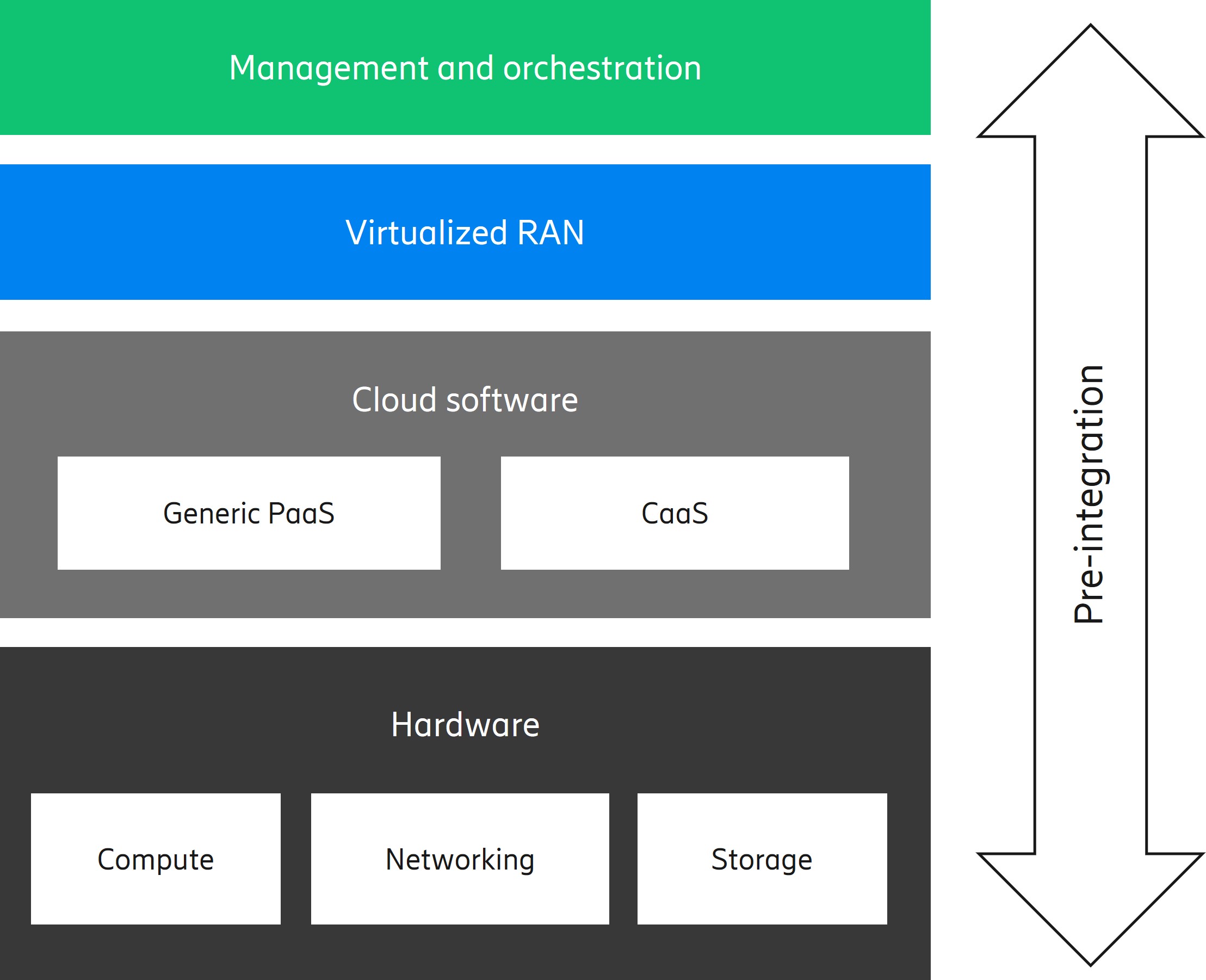
We talked earlier about modular houses - the networks of the future, especially those reliant on cloud technology, will work in much the same modular manner. The integration work performed for a specific solution towards a CSP or an entity, will be consolidated and included in the pre-integration process and the knowledge can then be applied in other solutions.
Cloud platforms offer an almost endless array of possibilities when it comes to designing, deploying, and testing various network configurations, all with the goal of finding the best-performing and most cost-effective solution. Cloud platforms is effectively the foundation that our new house is built on, and the pre-integrated RAN solution is the architectural plan or blueprint that we build upon that foundation.
The blueprints are based on work done by Ericsson with CSPs around the world and based on decades of experience in developing network technologies and innovative solutions in areas such as 5G and cloud computing.
That experience, combined with strong research, development, and testing efforts, mean that CSPs can leverage pre-integrated solutions that will soon be an integral part of Cloud RAN networks – they have already been tried and tested by Ericsson engineers, in lab and with our customers in live settings.
The result is a relatively simple, seamless, and speedy deployment of Cloud RAN technologies that can quickly be verified and validated offering predictability and flexibility in an environment that is ready for whatever the future may bring.
Time to market reduction
A valuable aspect of pre-integration is how it will shorten the time from the decision to the deployment itself - all such projects are different, but what is certain is that substantial amounts of time can be saved.
Pre-integration also offers predictability in terms of the deployment timeline, meaning that schedules can be kept as the risk for unforeseen problems is reduced, and in some cases eliminated completely due to comprehensive testing in the lab environment.
This simplifies the deployment of increasingly complex solutions and technology. Solutions and applications are already pre-integrated, resulting in shorter time to market (TTM), lower cost of integration and more reliable performance. These factors remove many of the major barriers to entry for CSPs and streamline network deployment, allowing them to be agile in response to customer needs.
Streamlined life cycle management
After the pre-integrated solution has been deployed focus intensifies on the continuation with regular upgrades and updates in the underlying cloud platforms as well as feature growth in the Cloud RAN application. This is the challenge of managing the life cycle of the deployed solution - regular updates & upgrades mean a recurring need to ensure solution integrity and interoperability.
Due to the disaggregation, these upgrades will be provided by different vendors and likely with differences in cadence between the layers. This means that there is a continuous need to ensure that such updates and upgrades remain on path for an effective Cloud RAN solution where components continue to work together including the right update & upgrade paths.
This is where the concept of pre-integration really drives value in terms of applying scale to the life cycle management process.
Summary
Pre-integration is a continuous process to assure the life cycle of the full solution, including interworking between all parts in the solution - ensuring CSPs investments in new solutions and businesses can be secured. The flexibility offered by the cloud accelerates innovation, while pre-integration offers a path to bring that flexibility into the field by adding speed and agility to the integration process. This combination of concepts executed in a continuous fashion ensures CSPs can quickly scale up to leverage the benefits for their business.
With more and more CSPs looking to the cloud for their futures, pre-integration will be helpful in lowering the barriers to entry and speeding up the time to market. Much like our new house, when pre-integration has become a solid feature of the network landscape of the future, we will soon wonder how we ever did without it.
Read more about Ericsson Cloud RAN vision, insights, and ecosystem partnerships here.