









How proper microwave planning can increase capacity and reduce costs

Technical Sales Support, Microwave
Technical Sales Support, Microwave
Technical Sales Support, Microwave
My background as microwave planner
When I started my training as a microwave planner, all of the focus was on propagation and different calculation methods - line of sight, Fresnel zones, k-factors, ITU-R methods, fading – and it was all done for a single frequency channel. It made perfect sense for TDM traffic, where the availability of the service is the same as the availability of the frequency channel. As TDM traffic is totally digital, static modulation was a given; on or off, up or down, all or nothing. Capacity was fixed, and so was the channel spacing.
And then packet happened
With the introduction of packet, things started to change, and although all channels in a multi-channel long haul system still used SDH/Sonet as the transport service, more and more channels were now used to carry Ethernet over SDH/Sonet.
Using that technology was very convenient, carrying the sync and the DCN in the overhead – but at an increasing cost of lower spectrum efficiency.
As packet traffic increased, there was a need for a more flexible and spectrum-efficient microwave transport; it was time to transport Ethernet natively over the radio link. It was time to “unwrap the packet”.
Doing so provided the flexibility to match the bursty nature of Ethernet; adaptive modulation combined with much higher modulations, wider channels, header compression, different service classes, all combined to utilize the available spectrum more efficiently and provide the needed capacity – packet simply makes microwave better!
Multi-channel long haul systems
With modern layer 1 radio link bonding techniques, all frequency channels are combined into one fat pipe with a common, single handling of quality of service. Each individual packet has its own priority marking and is sent in order of priority on whichever frequency channel has available capacity.
But although all the frequency channels now jointly carry an optimized volume of Ethernet, microwave planning remains as it has always been – looking at the individual frequency channel. In a multi-channel system, the only impact from a traditional planner’s view are the number of channels and the size of the insertion loss; that is, how many circulators the signal will pass on its way from transmitter to receiver. And although this is true for the individual channel, it is much too conservative for the fat pipe.
Selective fading
We are still expecting all frequency channels to have the same availability, and this is simply not true for a modern multi-channel long haul system. When you use low frequencies in the range 5-11 GHz to cover long hops, the dominant fading factor is multi-path or selective fading.
The word “selective” is a clue – the fading is caused by a very narrow notch caused by parts of the signal travelling on different paths due to reflections. But “very narrow” means that it won’t hit more than one or maximum two frequency channels at the same time! The notch won’t hit the two channels as much at the same time anyway - one will be hit more, and the other less.
This is a lot different to the flat fading caused by the signal travelling through the air, where rain, snow and fog etc. will impact all frequency channels in the same way, as the word “flat” implies.
Modern planning
Over the last few years, when I have been in discussions with customers about planning their long haul systems, I have seen a growing acceptance of how you can compare planned capacity going from an N+1 with fixed modulation for an SDH/Sonet system to an M+0 with adaptive modulation for a packet system using the same spectrum.
Here is an example of 7+1 Ethernet over SDH with 128 QAM static modulation vs. 8+0 native Ethernet with adaptive modulation, both using 8x28 MHz channels:
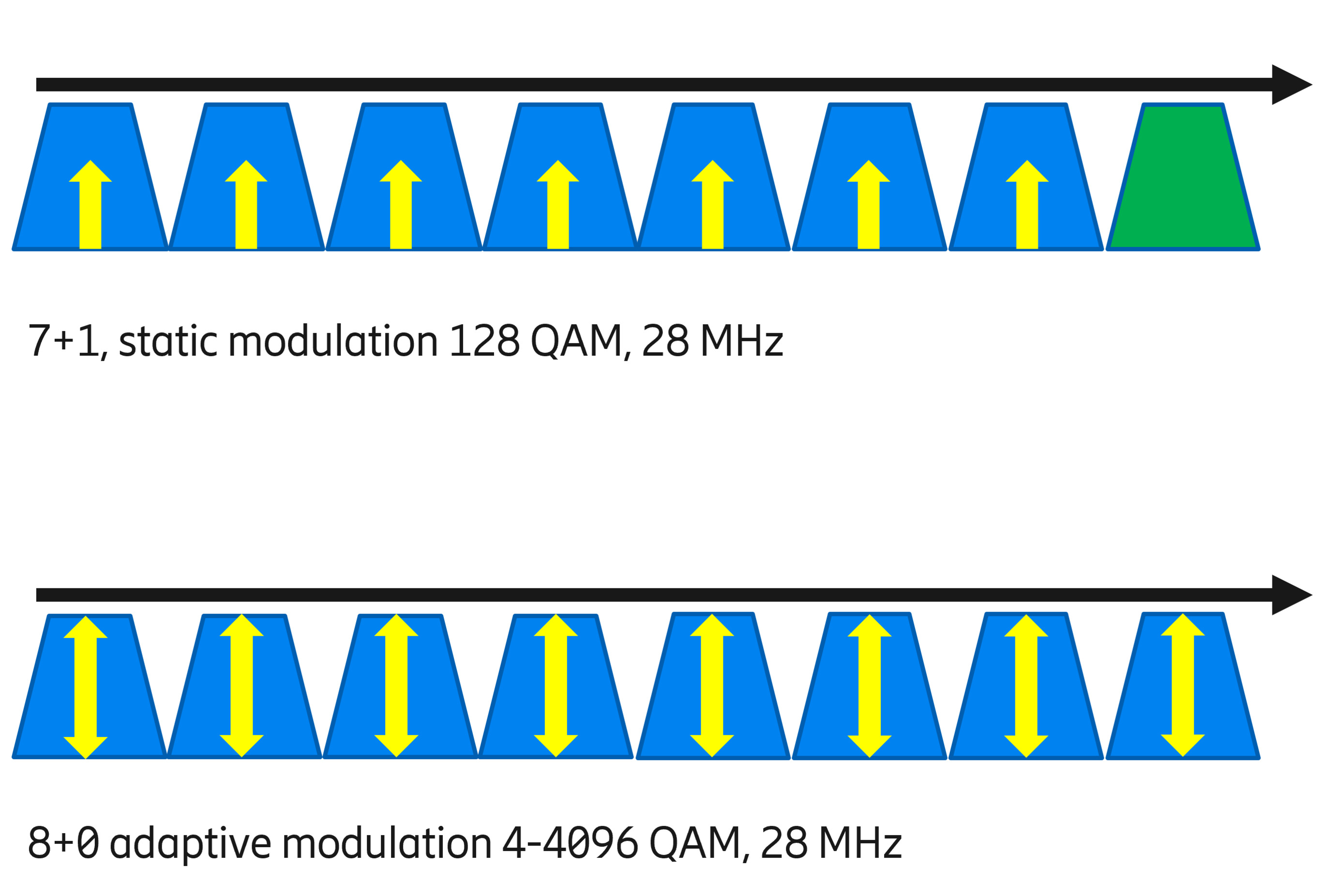
The increased capacity for the 8+0 solution is clearly visible by the size of the yellow arrows and the use of the 8th channel instead of a protection channel.
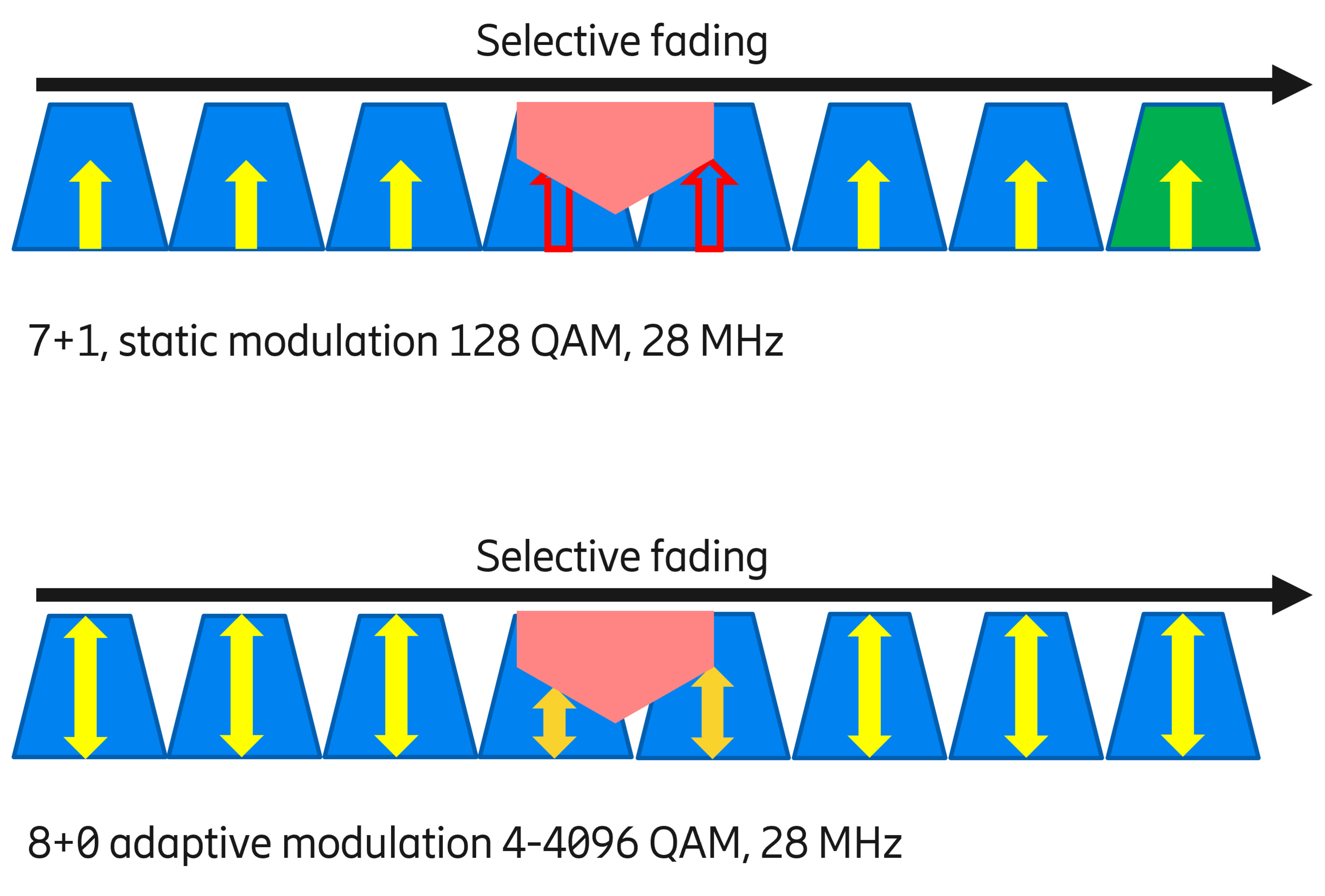
So how would these systems perform when hit by selective fading - in the worst case where two frequency channels are affected at the same time? In the case of 7+1 with static modulation, you would lose one channel as the protection channel steps in, while for 8+0 with adaptive modulation the two affected channels would reduce modulation, but still contribute to the fat pipe:
But why do we still calculate capacity as we did in the TDM era, with separate but identical channels instead of a fat pipe? Let’s look at a real planning example, this time for a 40MHz system. I have marked the yearly availability of 99.999% resulting from rain (flat fading) and the availability resulting from multipath (selective fading). And then there is the total, combined availability:
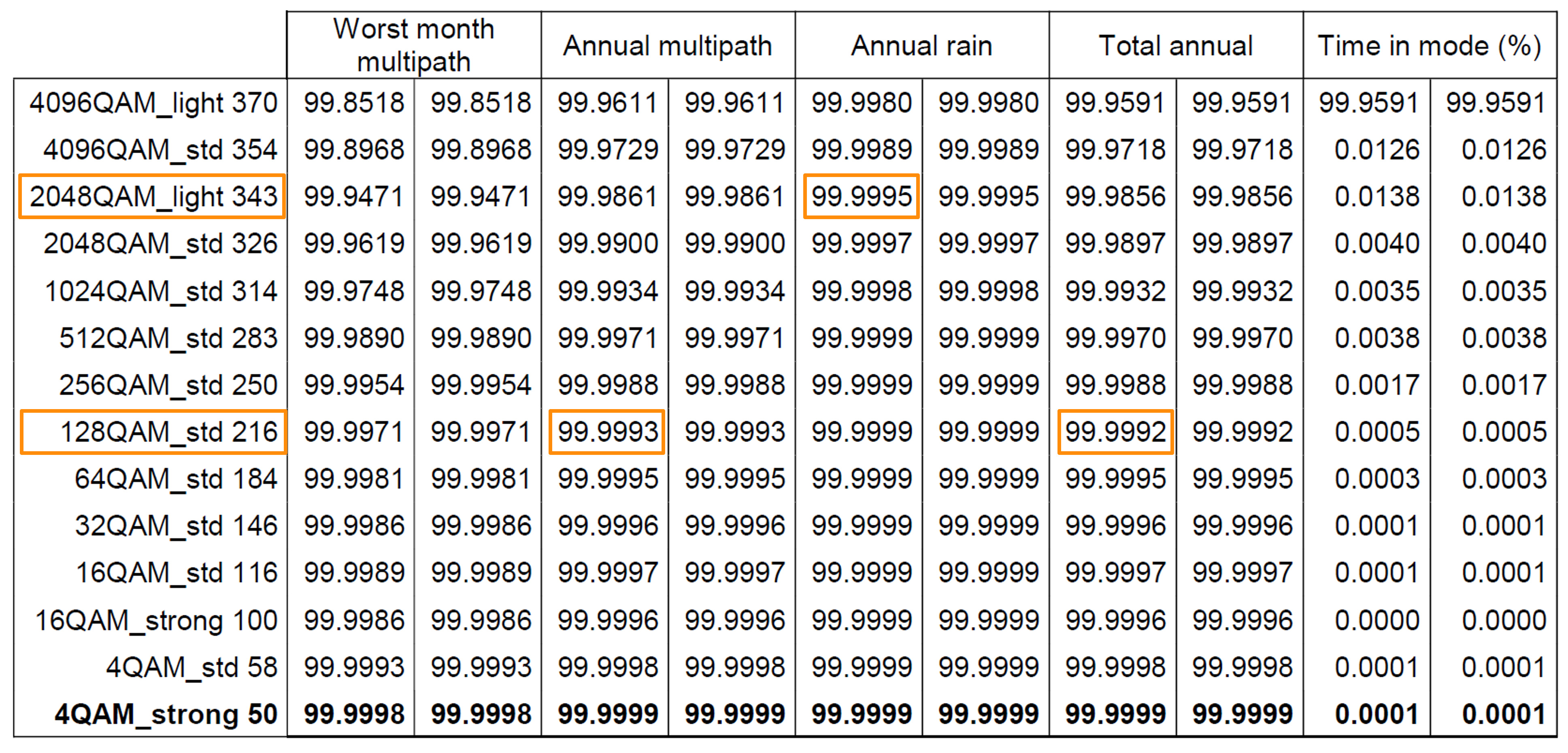
We can see what capacity to estimate for 99.999% availability for a frequency channel in this example:
- Annual rain corresponds to 2048QAM light providing 343 Mbps
- Annual multipath corresponds to 128QAM providing 216 Mbps
- Total annual corresponds to 128QAM – multipath is the dominant fading as expected
With our familiar 8+0 system and using the traditional way of estimating capacity, we would get 8x216 = 1.728 Gbps.
If we make the modern but safe assumption that two channels in the fat pipe are subject to multipath fading at the same time and to the same extent, we would get 6x343+2x216=2.49 Gbps - or almost 44% more capacity with 99.999% availability!
So where are we now?
The famous discussion about “five nines” availability (where a system is available 99.999% of the time) with the radio access network planners is all too often converted to a “five nines” requirement per frequency channel, when all they ask for is a “five nines” availability for a certain capacity. But will they say “no thanks" to even more capacity at 99.99%, or even 99.9% if they can be sure to have the “five nines” capacity?
Either way, be sure to calculate the capacity for “five nines” availability in a modern way for the complete fat pipe.
Whether you choose more capacity or a smaller cost-optimized solution, you are always doing it in a better-informed way. It is clear that modern long haul planning gives you more capacity!