










Sway compensation antennas, your E-band friend, with benefits

Master Researcher

Master Researcher
Master Researcher
The E-band spectrum (70/80GHz) is essential for supporting the ever-increasing requirements from the RAN for 5G and beyond. It offers fiber-like capacities and can be rolled out fast and efficiently. Unsurprisingly, the popularity of E-band has seen steady growth over the past years and is expected to grow even further to up to 25% of new deployments in 2027 being E-band links (see Microwave Outlook Report).
However, they come with a few challenges compared to lower frequencies: it is harder to generate high output power, receivers are more sensitive to noise, and the attenuation between transmitter and receiver is higher.
High-gain antennas – enablers for long-distance, high-capacity, reliable links
Luckily, the solution to these typical high-frequency problems also lies in an opportunity offered by high frequencies: it allows us to build very high-gain antennas (compared to the wavelength) with a reasonable size. A 60 cm E-band reflector, for example, has a gain of about 50 dBi, while an 18 GHz reflector has only 39 dBi.
A reflector antenna can achieve this high gain because it is extremely good at focusing the energy into one narrow beam. The 60 cm reflector antenna from our example will have a beamwidth of about 0.5 degree – focused and narrow! This is a great property for point-to-point links because we send our signal exactly where we want it to go without wasting it on unused directions.
With great antenna power (read: narrow beam) comes great tower responsibility (on stability)
If we look at today’s telecom infrastructure, we see that it is mainly designed and built with traditional band microwave antennas in mind. The towers are allowed some sway, which is good for structural reliability, saves on construction costs, and poses no problem for a typical microwave antenna. However, when we increase the antenna gain, like at E-band, the antenna beam can become even smaller than the tower sway!
Does this mean we can’t use these towers for 60 cm E-band antennas? No, not all. Reliable operation of an E-band link (or network) can be achieved by following the stricter E-band deployment guidelines. Take for example the Microwave Outlook study where we monitored approximately 500 E-band links for one year and evaluated the impact of wind sway. The operator was able to deploy most links according to guidelines, and the links were not much impacted by the wind.
One of the main guidelines is that you should mount the antenna on the lower half of the tower. The reasoning behind this is that the tilt of the mast is not linear with respect to the height. It is larger at the top and becomes smaller towards the base. This can be understood when looking at the figure below.
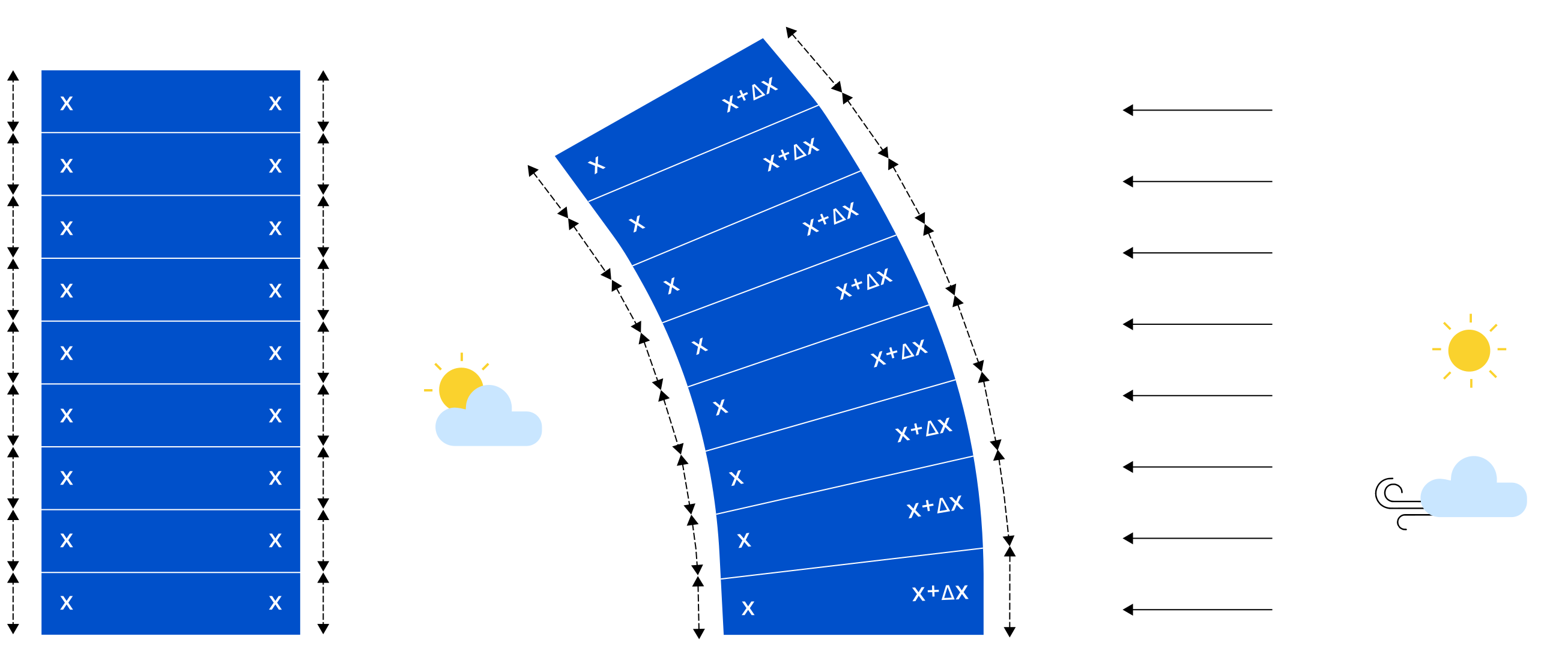
Figure 1. When a tower bends, the tilt at the top of the tower is larger than at the middle or toward the base.
But, as some customers have shared with me, in the real world such sites are not readily available everywhere. Sometimes trees can force us to mount an antenna higher in the mast, in other cases, no stable towers are available in the area, or towers suffer from the sunflower effect.
Wait a second, sunflowers? Come again please, wasn’t this blog about telecom towers and antennas?
Yes, you are still in the right place. As it turns out, sunflowers and telecom towers share an interesting property: they both track the sun’s movement (under the right conditions).
The sunflower effect
We have seen that in sunny regions, the sun and its trajectory impact the tilt of the tower and the antennas mounted on it. The tower tracks the sun’s motion, and we can say it behaves like a sunflower, as you can see in Figure 1. Monopole structures are more susceptible to this effect.
The origin of this phenomenon is in the fact that at any time of the day the sun only illuminates parts of the monopole while others are shadowed. This creates a temperature difference between both sides and results in unequal expansion on both sides of the tower. Once an area is no longer illuminated, it cools down and contracts again, while another area heats up and expands, resulting in a movement of the monopole.
Let’s now look at a concrete example. The figure shows the measured signal fade and antenna tilt for a real monopole near the coast of the Mediterranean. We can see that throughout the day the tilt changes, and the RSSI of the link is affected. We start the measuring at night, with no sun impact and no expansion on either side. In the morning, one side heats up, and the tower begins to tilt in one direction (away from the sun). In the afternoon and evening, the tilt slowly moves in another direction as the illuminated and shaded sides reverse. During the night, the tower goes back to its original position.
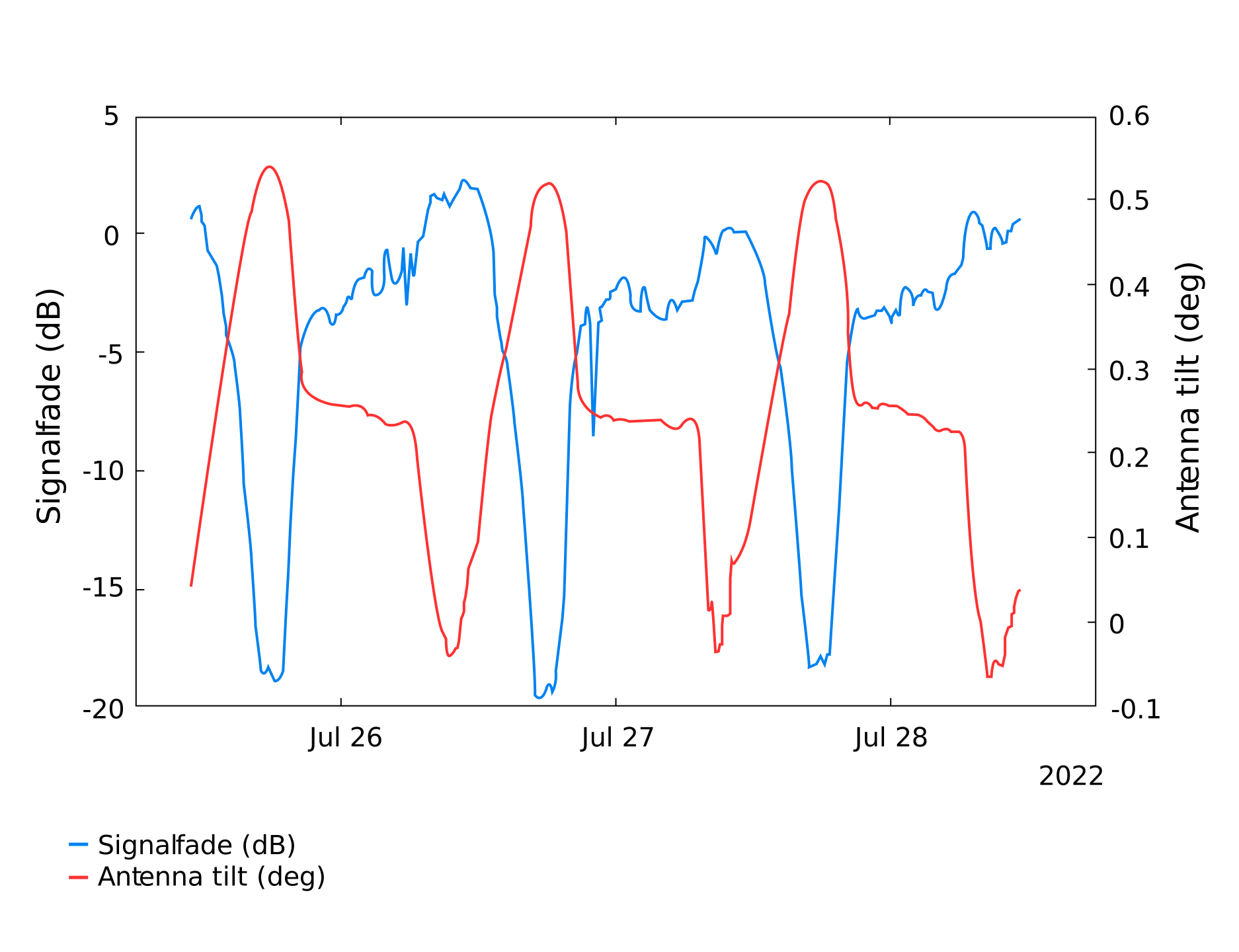
Figure 2. Tower tilt due to sunflower effect and impact on RSSI. When the antenna tilt is large, we get a large signal fade because the antenna beam is no longer pointing toward the far end of the link.
When looking at graphs like these, we also realized the impact of the time of day when the antenna is mounted and aligned, and that clear sky conditions don’t necessarily equate to “best possible conditions” when installing a high-gain antenna. If, for example, we were to install it during a time of large deformation, the link would have alignment problems throughout the rest of the day and only have a limited margin to cope with any (other) type of sway from the tower.
What happens when a deployment is exposed to the wind?
The wind is another force that can cause a deployment to become shaky. Although it also causes the tower to sway, its “fingerprint” is noticeably different. The movements are more rapid, with a smaller amplitude than solar-induced deformation.
From our data and talks with customers, we see that unstable deployments are most affected, while the availability of deployments done according to guidelines is not reduced by wind-induced sway (Microwave Outlook Report).
But wind events don’t happen in a vacuum. We have seen that the wind effect can also become prominent during sunny days. The sunflower effect causes initial deformation, and the wind adds a fast sway on top of that. The individual effects on their own may not be large enough to cause a noticeable link degradation, but when combined, problems can occur.
The solution: Sway compensation antennas
In the past, the only way to deploy pencil-beam antennas on problematic sites was to “invest in metal”. Such infrastructure upgrades are time-consuming and costly. But now, we have a new tool in the box: the sway compensation antennas.
What do they do, and how do they work?
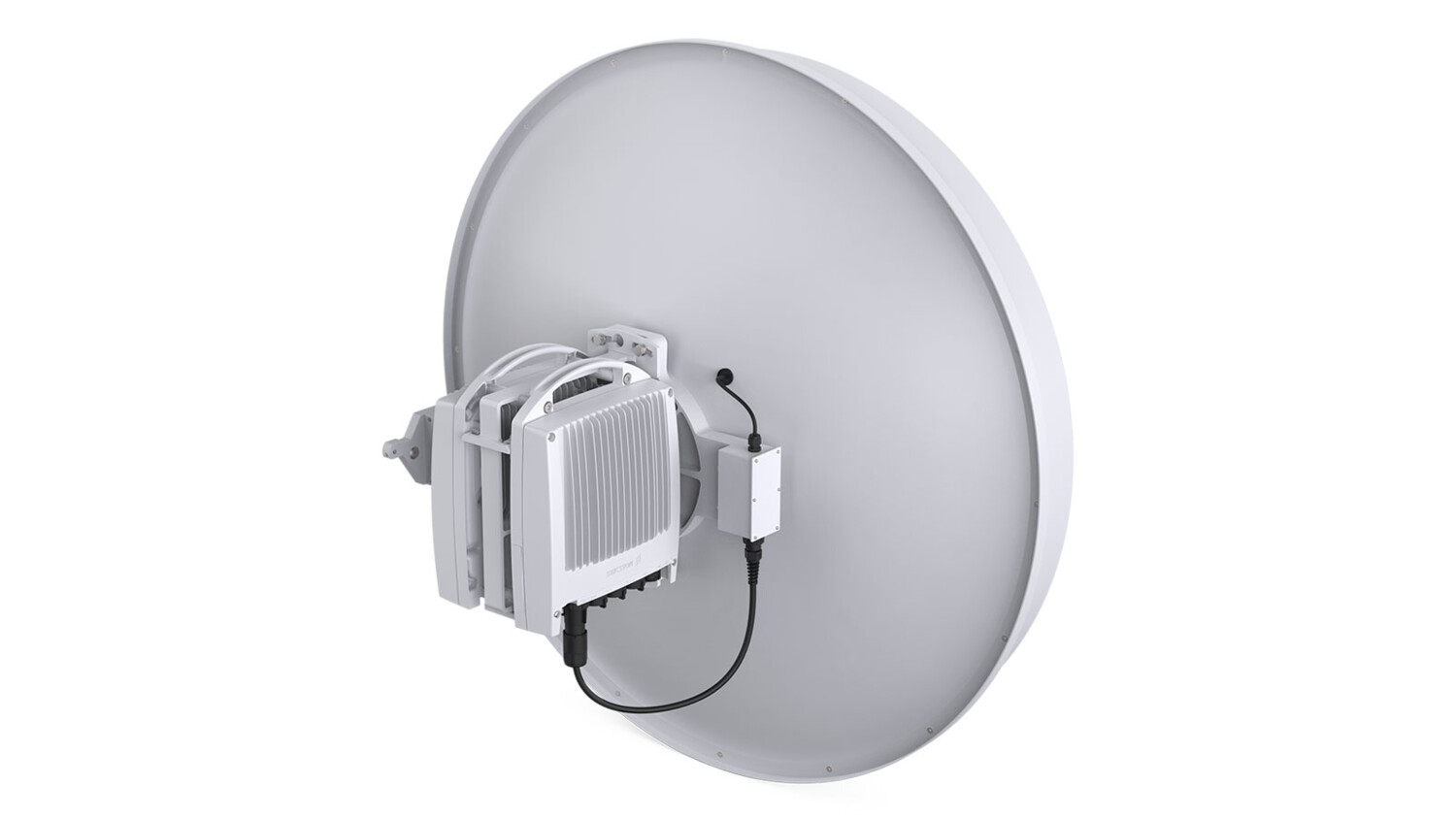
A sway compensation antenna has the ability to detect antenna tilt using motion sensor data and received signal strength. Consequently, it can adapt the direction of the main beam. When a tower starts to sway, this antenna will dynamically adapt the direction of the beam to keep it pointing toward the far end of the link.
If you wonder how large this improvement is, let’s have a look at the figure below. It shows the antenna gain toward the far end node of a 60 cm reflector (with and without sway compensation) versus the antenna tilt. First, look at the red curve, which is a regular reflector without sway compensation. The half-power beamwidth is about 0.5 degree, which means that when well-aligned, it can handle 0.25-degree misalignment in either direction with less than 3 dB reduction in gain. When the misalignment becomes larger, the link gain goes down fast due to the steep flanks of the beam. At 0.5 degree, the fade is ~15 dB, and at 1 degree, it is almost 30 dB! And this is for a perfectly aligned antenna. If there is a small initial misalignment, for example, 0.2 degree, and the sway is in the same direction as the misalignment, the power drop will be even more severe!
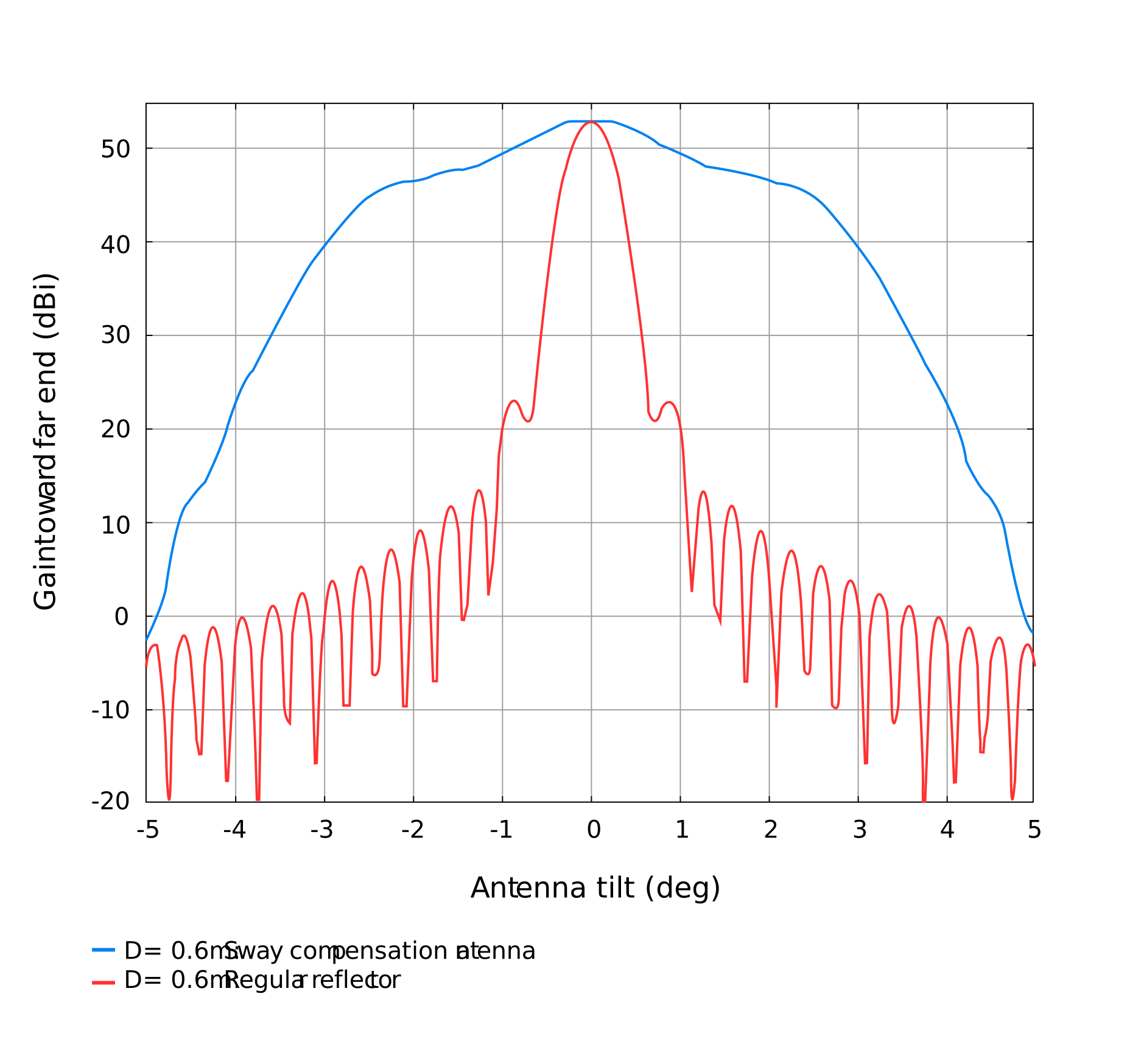
Figure 3. The gain of a regular reflector antenna toward the far end reduces very fast when the antenna is tilted due to tower sway. The sway compensation antenna keeps the beam stable toward the receiver and the gain stays high.
Now, if we look at the figure with the sway compensating antenna, we see that it has the same peak gain as a regular antenna, but when misalignment occurs, the fade is minimal because the beam stays aligned. At 0.5 dB, it is 10 dB better than the regular antenna, and at 1 degree it is even 25 dB better! Extreme misalignment of 2 degree would even give us a gain of 35 dB over a regular antenna!
Sway compensation antennas: a friend with benefits
When I first looked at plots like this, I realized that this is a solution to issues we experience today, but more importantly, it also gives us many more possibilities. It allows us to deploy on less-stable infrastructure, which saves costs and gives us more deployment options. It can improve initial alignment, thus improving the margin for sway. It enables the use of larger antennas with narrower and higher gain beams, allowing us to extend the hop length while keeping the high capacity.
The solution in practice: trial results
The proof of the pudding is in the eating. Let’s look at some results from the trial we did this summer. A customer reached out and told us they had a site that suffered from mast sway. The 6.7 km long E-band link was situated close to the Mediterranean Sea, and the monopole on one side of the link was exposed to both sun and wind. Such a deployment was challenging for the 60 cm reflector antenna they used, but it was right up the alley of a sway compensation antenna.
We could have simply swapped out the regular antenna for a steerable one, but we chose to deploy a parallel link equipped with sway compensation instead. That allowed us to evaluate the performance of the compensation and regular antenna during identical weather conditions. However, we did make the challenge a bit bigger for the new antenna. We installed it at the very top of the monopole at 28 m height, where the sway of the tower is the largest. If you remember the guidelines for mounting E-band antennas on a tower we talked about before, you can see that now we are breaking them. Big time!
How did it perform? Well, excellent. But don’t take my word for it. See it for yourself in the plot below. It shows the modulation or capacity the two links could maintain during the summer. From the first pie diagram, we can see why the operator experienced problems on this link: almost a quarter of the time, the signal quality is not high enough to run at maximal capacity.
Let’s now look at our parallel higher-up-in-the-mast link. We see a similar picture when the compensation is turned off (the sway compensation antenna behaves as a regular reflector antenna). And if you look carefully, you can see that it is even slightly worse because we have deployed it higher on the mast, resulting in more sway and deeper fades.
But then, when we turn on the sway compensation, the picture completely changes, and the benefit becomes clear. We remove the sway events from the link, keep the beam stable and focus on the far end of the link, and we are able to support the highest modulation most of the time. The periods where we see reduced capacity are caused by rain events on the >6 km long link.
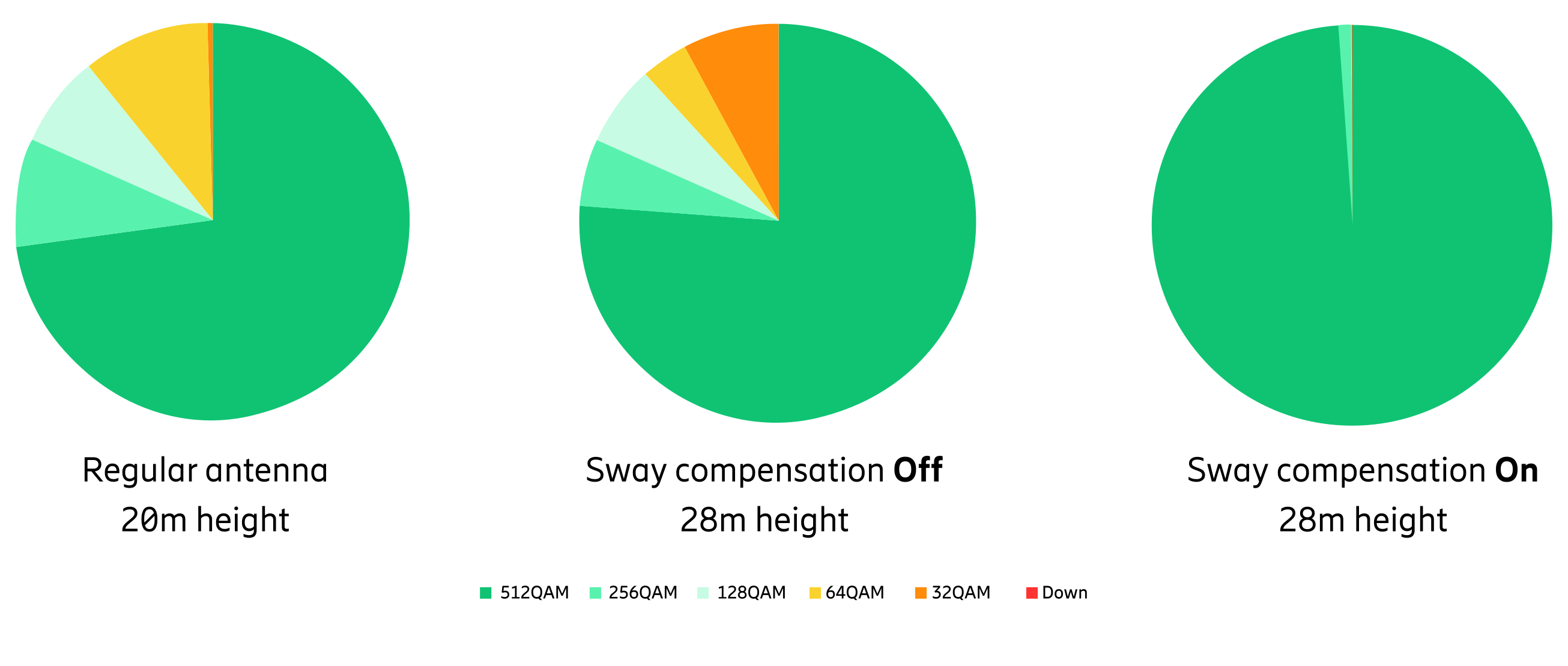
Figure 4. During the field trial, we compared the capacity that an E-band link on a tower with the sunflower effect can sustain with and without sway compensation. Without sway compensation, the higher position on the mast is worse than the lower position because it has more deflection. But when we turn on sway compensation, we see that the link can maintain the peak capacity most of the time.
Conclusion: what about E-band and mast sway?
When planning an E-band network, should you lie awake at night worrying about mast sway? Not really.
Most deployments do not suffer from sway, and high-gain antennas can be used to achieve high-capacity links. But some sites are sway sensitive, and then the sway compensation antenna makes a world of difference by effectively removing the negative impact of tower movement.
More than just removing a problem, we saw that the sway compensation antenna is a powerful new tool in the toolbox for cost-effective, high-capacity, and long-distance links. It relaxes the tower stability requirement, enables deployment of larger antennas, and boosts maximal link distance.
Related link
Explore 5G