










How to monetize the IMS as a booster of trusted answered calls rates?
- Voice remains an essential channel for enterprises to reach customers through outbound calls. However, consumers are increasingly hesitant to answer calls from unrecognized numbers due to the rising prevalence of fraud and automated calls, while AI-driven fraud employing voice deepfakes is becoming alarmingly common as well.
- The decline in answered call rates negatively impacts revenues for enterprises and, consequently, service providers. Find out how service providers can monetize their IMS to build consumer confidence and boost answered call rates.

Marketing Manager for Regulatory Solutions

Marketing Manager for Regulatory Solutions
Marketing Manager for Regulatory Solutions
The enterprise challenge for outbound calls
Cold calling is a common outbound marketing and sales tactic used by enterprises. It involves reaching out to potential customers who have not previously shown interest in the product or service offered. As these calls are unsolicited, the practice often faces increasing challenges due to growing consumer resistance and regulatory consent restrictions. Automated robocalls and fraud calls amplify the challenges because people are both annoyed and concerned about potential scams. The result is an increase in unanswered call rates. According to the State of the Call Report 2025 by Hiya, 80% of unidentified calls go unanswered.
How does the human brain process an incoming call?
When a consumer sees the number of an incoming call, several cognitive and emotional processes are activated in the brain. First, the brain engages pattern recognition and memory recall mechanisms to determine whether the number is familiar, utilizing the prefrontal cortex – a region associated with decision-making.
If the number is recognized, areas of the brain linked to emotions, such as the amygdala, may become active, triggering feelings like trust, excitement, or anxiety, depending on the past experiences associated with that number.
For unfamiliar numbers, the brain may activate caution or alert mechanisms tied to the fight-or-flight response – deciding whether to confront the threat (fight) or escape from it (flight). This step uses the anterior cingulate cortex, a brain region responsible for detecting conflicts and signaling uncertainty.

The flight decision effects
The “flight” decision often results in not answering the call. While it is fully acceptable not to answer fraudulent calls, as they are illegal, cold calls are legitimate calls driving the enterprises’ business. For enterprises, unanswered calls can mean lost deals and a loss of brand trust. A decline in business for enterprises means a decline for service providers as well. How can the rate of answered calls be increased by removing the trust barrier?
Branded calls – activate the “Open Sesame” effect to turn flight decisions into fight decisions
For enterprises to achieve higher answered call rates, consumer trust in answering calls must be strengthened. Do you remember the “Open Sesame” magical phrase from the story of Ali Baba and the Forty Thieves, used to open a sealed cave? What would be the equivalent of the “Open Sesame” method to unlock the consumer confidence in answering legitimate calls? The answer lies in increasing caller credibility.
Knowledge and data are fundamental to decision-making and influence. That is valid also for the consumer decision-making when receiving a call from an unrecognized number – you now, information is power! Consumers are more likely to answer calls from recognizable brands or familiar numbers. Branded calling enhances answer rates by legitimating the caller:
- Security – The calling number can be authenticated by different mechanisms, as, for example, Out of Band Authentication and STIR/SHAKEN (Secure Telephone Identity Revisited/ Signature-based Handling of Asserted information using toKENs). STIR/SHAKEN is preferred in markets where this standard is a regulatory requirement and Out of Band Authentication can be used in markets where STIR/SHAKEN is not a regulatory requirement. Security is an important area, and additional mechanisms will be considered in the security area over time.
Worth noting: The name STIR/SHAKEN comes from the way James Bond preferred his martini to be mixed – he liked it shaken, not stirred.
- Rich Call Data (RCD) – Additional data is exchanged during the call setup and displayed on the consumers’ device, to support the consumers’ decision-making process in favor of answering the calls. 3GPP and GSMA defined how such data can be structured and transmitted to provide enriched calling experiences.
Rich Call Data (RCD) can include a variety of information elements that enhance the basic call setup. Possible RCD data types include:
- Caller identification details: Caller name, number
- Call purpose or context: Reason for the call
- Multimedia content: Images, logos, or video snippets related to the caller or service
- Authentication/Verification Tokens: STIR/SHAKEN attestation tokens to verify caller identity
- Location information: Caller or service location to support context definition
- Call priority or urgency: Flags indicating emergencies or high-priority calls
- Supplementary data: Promotional messages, callback options, or interactive buttons
The exact data elements depend on the implementation, network capabilities, and privacy and regulatory constraints.
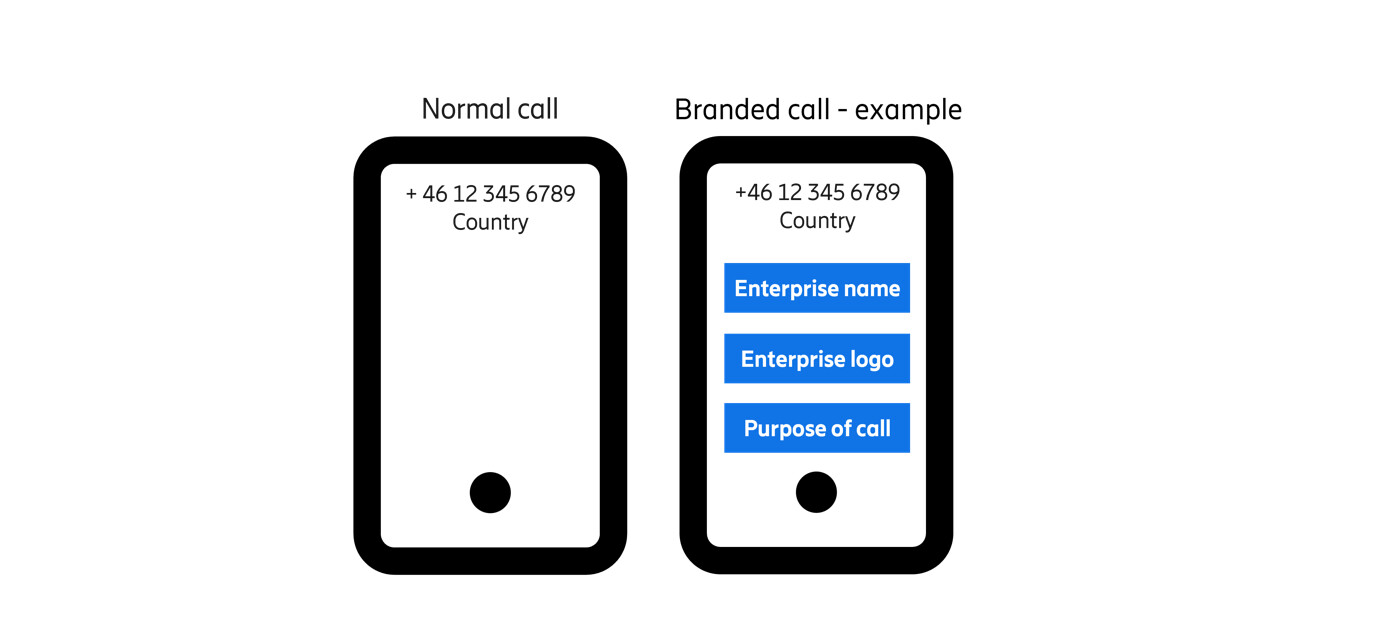
Live deployments prove that branded calls have higher probability to be answered than non-branded calls. This improves call-center efficiency while driving higher revenues for service providers.
Branded calls tend to have longer durations, as observed in live deployments. For example, consider a newspaper call center selling subscriptions. When a branded call reaches the consumer, they still have two options: answer it or not. The additional information displayed on the smartphone — who is calling and the call’s purpose — turns the choice into a reasoned one. If the consumer answers, it often indicates interest or at least curiosity about the subscription; this is reflected in the increased duration of branded calls compared with non-branded calls, giving the enterprise more time to present the offer.
The opposite outcome is also important: the consumer may choose not to answer based on the information shown while the phone is ringing, perhaps because the newspaper’s perspective doesn’t align with their interests. A deliberate decision not to answer is beneficial for both parties: enterprises spend time only with potential customers who are genuinely curious or interested, improving call-center efficiency, and consumers can make informed decisions without risking missed calls that they would have wanted to take.
The role of IMS for branded calls
The Ericsson Multimedia Telephony Application Server (MTAS) in IMS (IP Multimedia Subsystem) is a carrier-class application server for voice and multimedia services. It supports legacy telephony and future services, including multi-device applications and multimedia services, across multiple access networks such as fixed, mobile, and Wi-Fi. This capability embodies the primary mission of MTAS.
Furthermore, since MTAS is involved in every call, it has access to all call-related information necessary for processing calls. It also has the ability to gather additional calls information from dedicated server for the branded call logic (for verification and rich call data).
IMS gathers the authenticated information before the ringing phase of the call. As observed in live deployments, this is much more effective than gathering information during the ringing phase as it is done for application-based solutions.
MTAS contains crucial information related to the enterprises subscribed to Branded Call service, so the triggering of the service only happens for those subscribers. MTAS orchestrates the different parties to secure the RCD information is verified and presented to the called party.
Branded call market for enterprises is growing
Branded call deployments, initially started in the United States, are expanding worldwide for global reach. According to Juniper Research whitepaper Restoring Trust in Voice Calling with Branded Caller ID, the total number of branded calls is 9.6 billion in 2025.
Read more
Be inspired, restore trust. Built for enterprise.
The solution is versatile enough to support different network deployments, including non-STIR/SHAKEN markets. The branded call use case for enterprises can also be combined with the solutions for prevention of fraud, again monetizing IMS for the service providers. Read more about IMS and other monetization use cases: