










One step closer to zero-latency handovers on the path to 6G
- Layer 1/Layer 2 Triggered Mobility (LTM) in 5G Advanced reduces signaling overhead and interruption time to deliver faster, more reliable handovers and a smoother connection for people and equipment on the move.
- With 3GPP Release 19 and beyond, LTM is evolving into a foundation for 6G mobility, enabling predictive, AI-powered handovers and moving closer to the vision of zero-latency connectivity.

Master Researcher, Networks

Master Researcher, Standardization

Master Researcher, Standardization

Master Researcher, Networks
Master Researcher, Standardization
Master Researcher, Standardization
Master Researcher, Networks
Master Researcher, Standardization
Master Researcher, Standardization
From smoother video calls to uninterrupted streaming on the move, handover technology is evolving to keep pace with our highly connected lives. Advances in Layer 1 / Layer 2 (L1/L2) Triggered Mobility (LTM) are reshaping how networks handle handovers, creating the foundation for seamless mobility in 6G.
Mobile connectivity has come a long way since the early days of voice calls. Today, 5G Advanced is introducing new tools to make handovers – those critical moments when your device switches from one cell to another – faster, smarter and nearly invisible to the user. And as we move toward 6G, the goal is nothing less than uninterrupted, zero-latency mobility.
Since the introduction of L1/L2 Triggered Mobility (LTM) in 3GPP Release 18, networks can use lower-layer signaling to reduce signaling overhead and cut interruption times, resulting in almost seamless connectivity. This is possible because in LTM both measurements and handover signaling reuse paradigms from beam management procedures. In Release 19, LTM has been further improved with the support of additional functionalities for improved connection robustness, without giving up the short connection interruption time.
LTM as it exists today in 3GPP Releases 18 and 19 represents the early stages of what will be the foundational technology for mobility in 6G. Further evolution in 6G may include making LTM into a predictive and proactive mechanism, where a network can anticipate a user’s movement and prepare the handover well in advance, resulting in a "zero-latency handover". This achievement would make the concept of a connectivity interruption a thing of the past.
How LTM evolved from Release 18 to 19
The version of LTM specified for 5G Advanced in 3GPP Release 18 brings significant benefits, but there is room for further enhancements.
Perhaps most notably, the first version of LTM only supports intra-gNB mobility – that is, mobility between different parts of the same gNodeB (a 5G base station in a 5G network). This might occur, for example, as a user moves between different sectors or coverage areas served by the same base station.
Another limitation in Release 18 is that the execution of the LTM procedure (known as the LTM cell switch procedure) is based on periodic, semi-persistent or aperiodic L1 measurement reports with measurements on SSB beams and/or event-triggered L3 measurement reports. We indicate this as a limitation because such L1 measurement reports allow timely execution of the LTM cell switch procedure, but there are scenarios where this might lead to significant signaling overhead as large numbers of L1 measurement reports are typically exchanged between the user and the gNB, for example when a user is stationary or moving slowly.
To address these limitations, 3GPP Release 19 includes three key LTM enhancements:
- Support for the inter-gNB case, which is also known as inter-CU (Central Unit) LTM
- Event-triggered reporting based on L1 measurements
- Conditional LTM.
1) Inter-gNB LTM
Inter-gNB LTM enables extremely fast and seamless handovers between different gNBs, each of which can cover a relatively large area. This enhancement is crucial for ensuring a seamless user experience across a wide range of network deployments and for users that are moving in high-speed vehicles such as cars or trains. Supporting LTM for inter-gNB scenarios is fundamental to significantly increase the data rate and reduce the connectivity interruptions that are common with traditional L3 handovers. Inter-gNB LTM also improves load and resource balancing, and enhances overall spectral efficiency and user experience by allowing mobility from one gNB to neighboring gNB with available capacity.
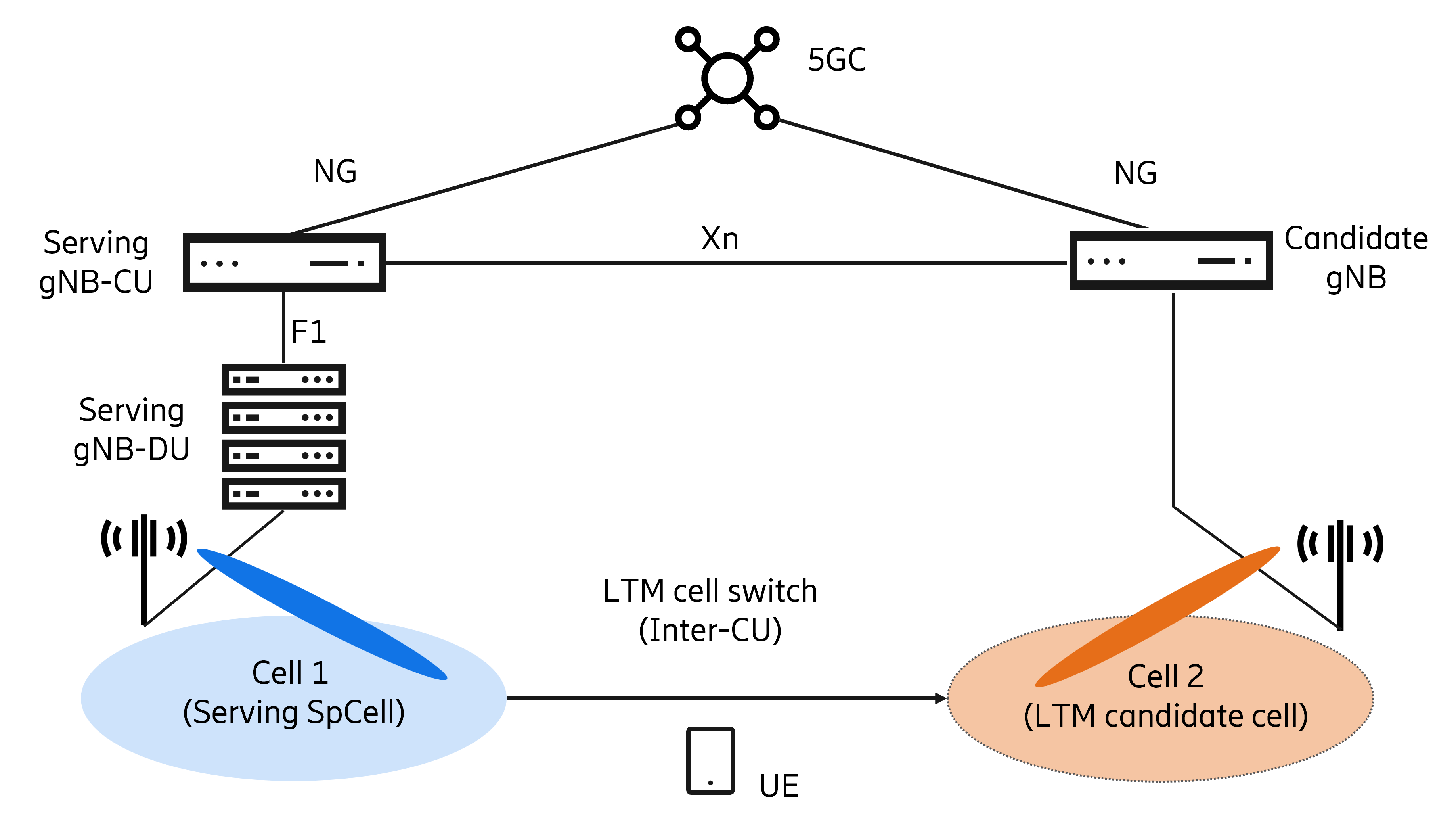
Figure 1. Example of inter-gNB LTM
2) Conditional LTM
Conditional LTM (CLTM) is a mobility enhancement that strategically blends the low latency and minimal interruption time of LTM with the resilience of a conditional handover (CHO). Rather than executing an LTM cell switch procedure based on an immediate indication from the network, it is the device that triggers the handover based on network configured conditional events. This unique approach allows for a device to still be able to receive handover instructions from the network in advance, but also to initiate the handover procedure itself if specific pre-defined conditions are met.
This enhancement is a critical improvement because it allows the device to make the final, on-the-spot decision to switch cells. This is possible because the device constantly monitors the signal quality of the LTM candidate cells and executes the handover automatically when the pre-configured conditions are fulfilled.
It is worth noting that, despite this greater autonomy, CLTM still benefits from the early synchronization and pre-configuration that are key components of LTM. This ensures a fast and seamless transition, while also mitigating the risk of handover failures that can occur when the network executes a handover procedure too late or when the actual handover command cannot reach the device due to factors such as poor radio conditions. As with LTM in Release 18, the journey to supporting conditional LTM starts with the intra-gNB scenario.
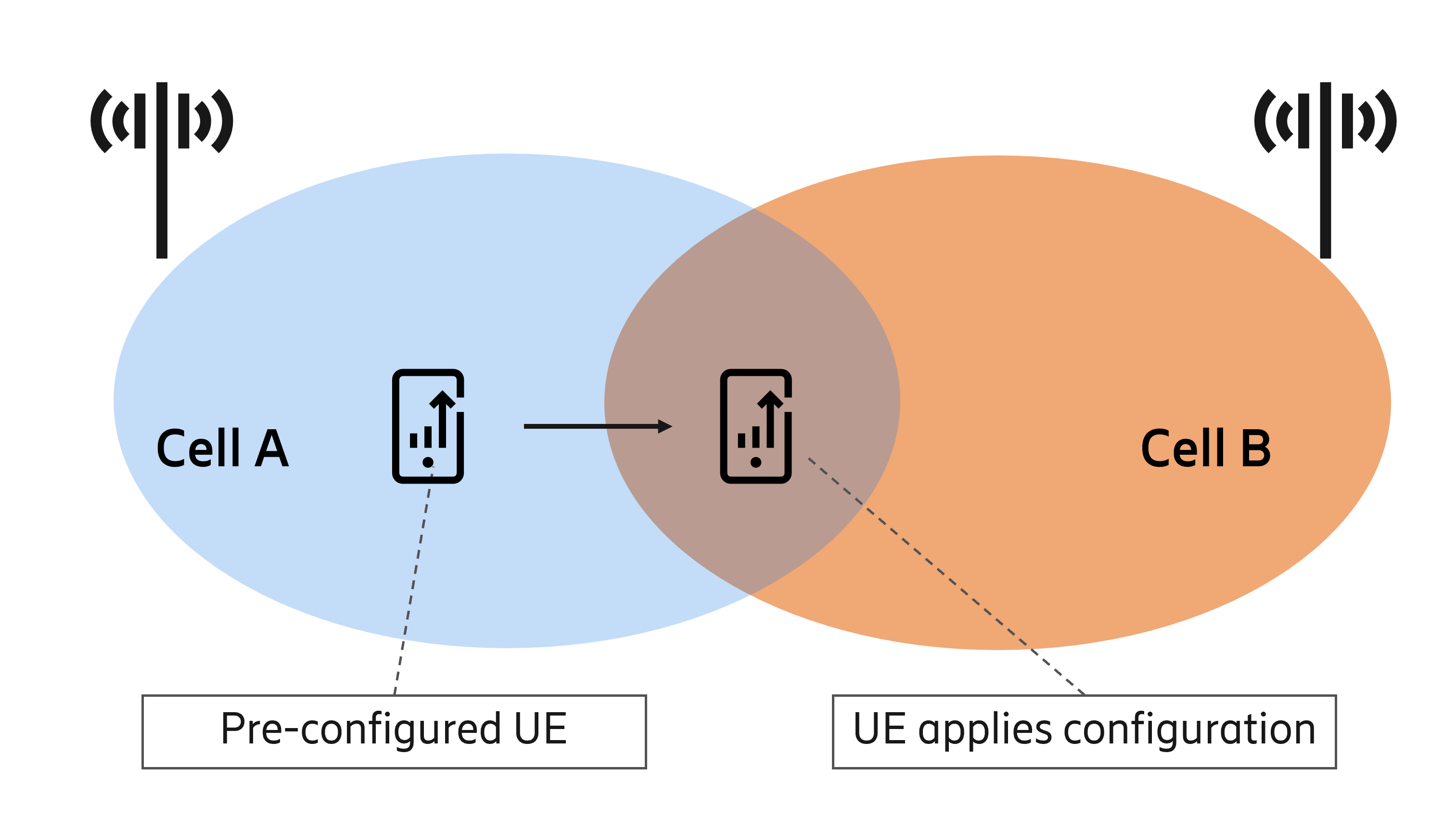
Figure 2. Example of conditional LTM
The device is pre-configured with a candidate configuration and associated execution conditions. When the execution conditions are fulfilled, the device applies the candidate cell configuration.
3) L1 measurements enhancements
3GPP Release 19 includes significant enhancements related to L1 measurements, particularly with respect to the reporting mechanism. Rather than sending continuous or periodic reports that can consume valuable network resources and device battery power, the device can be configured to only send such reports when a specific condition has been met, like when the device approaches the other cell. This highly efficient approach significantly reduces uplink signaling overhead, which not only improves overall network capacity but also helps to conserve the device’s battery life.
The addition of L1 measurements based on CSI-RS (Channel State Information – Reference Signal) is another enhancement introduced in 3GPP Release 19. Unlike the more basic measurements based on Synchronization Signal Block (SSB), CSI-RS measurements provide the network with a more detailed and accurate view of the radio channel. This enables the network to make more precise and intelligent handover decisions, which is particularly beneficial in complex network deployments where a clear understanding of the channel is critical for ensuring a seamless connection.
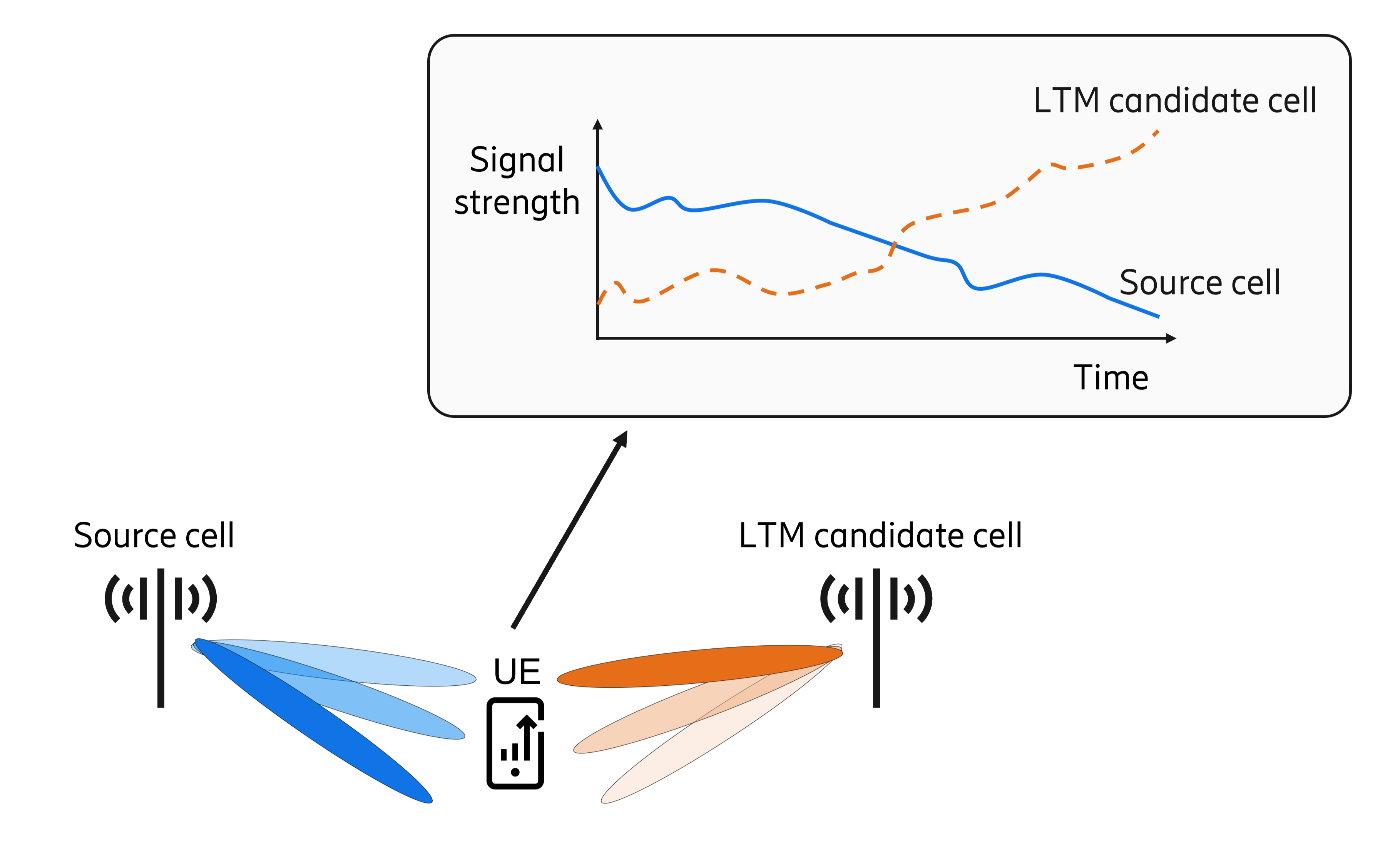
Figure 3. Example of UE performing measurements for the source cell and an LTM candidate cell
LTM as the foundation for mobility in 6G
The LTM features in 5G Advanced have already made significant progress toward providing seamless connectivity during handover. Looking ahead to 6G, LTM is expected to be a foundational technology for mobility with future LTM iterations supporting even more demanding mobility scenarios. While LTM is a reactive tool today, it will likely evolve to become a predictive tool in 6G. The integration of artificial intelligence (AI) and machine learning (ML) to anticipate a user’s movement will allow the network to predict where and when a handover is needed, proactively initiating the mobility process before any signal degradation occurs. The shift from a reactive to a predictive approach is fundamental to support a truly intelligent and responsive network.
LTM is also crucial for addressing the extreme mobility requirements of 6G. The low-latency and low-overhead nature of LTM is essential for these scenarios, as it ensures a continuous and reliable connection in situations where even an extra millisecond of interruption can be critical. Without the fundamental components of LTM, it would be impossible to deliver seamless service during mobility.
By exploiting the lightweight signaling used by the network in LTM to initiate a handover procedure, the handoff of the device between cells can be nearly instantaneous. This will be key to achieving the 6G vision of a “zero-latency handover”. LTM may also be further enhanced in 6G to enable seamless connectivity between diverse network types, such as terrestrial and non-terrestrial networks. The result will be a single, unbroken communication fabric where handovers are completely invisible to the user, ensuring a flawless and uninterrupted connection no matter the speed or environment.
A bridge from reactive to predictive networks
The identification of LTM as a foundation for handling mobility in 6G reveals a profound shift in thinking about how the handover procedure should be executed on both the network and UE sides. What began as a technical solution to make handovers faster is now expected to become a key enabler for a truly intelligent and seamless wireless experience, acting as a bridge from today’s reactive networks to tomorrow’s predictive ones. In 6G, mobility will no longer be a separate function, but rather an integrated part of the network’s intelligence. Enhancing LTM with AI/ML will enable a transition from a network that simply responds to a user’s movement to one that anticipates it, thereby enabling future 6G applications to operate flawlessly.
Read more
Learn more about LTM