










Unlock 5G Core potential: Why CSPs need a cloud operating model now
5G is no longer a promise — it’s a reality. 5G networks are live and CSPs are launching a range of new services. There are approximately 340 5G networks globally, and Ericsson powers over 50% of these. And yet, many core operations remain rooted in legacy practices that were never designed for the speed, agility, or opportunities that 5G offers.
To fully realize the potential of 5G — especially 5G standalone — CSPs must fundamentally rethink operational models for security, higher performance, business agility, and innovation.

Head of solution and portfolio, Core Networks

Product & Solution Marketing Manager, Core Networks & Managed Services
Head of solution and portfolio, Core Networks
Product & Solution Marketing Manager, Core Networks & Managed Services
Head of solution and portfolio, Core Networks
Product & Solution Marketing Manager, Core Networks & Managed Services
Transforming to cloud operating model – CSP insights from the field
Why CSPs need a cloud operating model
Thriving in the 5G era requires more than fast networks — it demands agility, automation, and the ability to evolve quickly. A cloud operating model provides this foundation, aligning operations with the dynamic pace of 5G.
5G is already critical to daily life, enabling services like mobile payments and digital transportation. As reliance grows, so does the need for stronger security. Open-source vulnerabilities are rising by about 25% each year, making frequent upgrades and a zero-trust architecture essential.
Ericsson’s analysis of 20 networks shows that many incidents stem from outdated software, poor dimensioning, or skipped best practices. To counter this, Ericsson is delivering frequent releases with security fixes, quality improvements, and new features.
By adopting a cloud operating model and regular upgrade cycles, CSPs can now build safer, more resilient networks. This approach also attracts digital-native talent who prefer modern, automated workflows over manual tasks.
With mobile broadband revenues flat, business agility and faster innovations are crucial. New services such as network slicing require operating models designed for speed and flexibility. These aren’t just operational improvements — they are strategic imperatives. A cloud operating model is the foundation for unlocking competitive advantage and realizing the full potential of 5G Core.
The four pillars of an effective cloud operating model
To realize the full value of a cloud operating model, CSPs must operationalize its principles through four interconnected pillars:
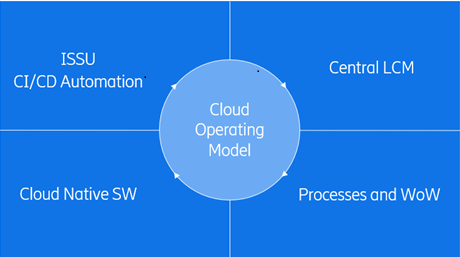
- Cloud Native software architecture based on Kubernetes and microservices is the foundation for faster deployment, in-service upgrades, higher resiliency, and optimized scalability. It also enables flexible scaling of resources, easier fault isolation, and quicker rollouts of new features, ensuring networks can adapt seamlessly to changing demands.
- ISSU and CI/CD automation enable seamless software evolution and uninterrupted service delivery, while automating updates and minimizing operational risk. For CSPs, this means shorter upgrade lead times, no traffic drains, and no downtime — maintaining redundancy without over-dimensioning. Ericsson automates the full upgrade process — from health checks and preparation to acceptance testing and monitoring — reducing operational risk. This approach lowers life-cycle management (LCM) costs and allows selective or all microservice upgrades, ensuring faster security patches and emergency fixes.
- Central LCM: Cloud-native transformation is complex and requires new skills and investment. Ericsson simplifies this with a delivery model called “Central LCM,” where we take responsibility for the full solution life cycle. This global model reduces complexity and ensures expertise is available anywhere, regardless of location.
- Processes and ways of working align people and practices with DevOps and agile principles, driving cultural and operational transformation across the organization. Ericsson Consulting Services has helped CSPs implement these changes to achieve measurable business outcomes.
Together, these pillars enable a 5G Core that is responsive, resilient, and continuously evolving, making autonomous networks an achievable goal.
While these four pillars define the foundation, their impact is best seen in the experiences of CSPs already adopting a cloud operating model.
What CSPs are saying: Insights from the field
Across many service providers, three consistent themes have emerged as critical drivers and enablers for adopting a cloud operating model:
- Increased speed and efficiency: Many CSPs are targeting a reduction of 40-70% in upgrade lead times. This frees up organizational capacity to focus on innovation and strategic initiatives.
- It’s all about quality and customer experience: Operators are seeing improved software quality with each release, which directly enhances network performance and allows for faster introduction of new features and services.
- Internal readiness is key: Success depends on the early involvement of operations teams, simplified governance, and adaptable operational processes. Service providers have combined their development/product teams and operations teams and created dev-ops organizations that can take end-to-end responsibility.
These insights reinforce that transformation isn’t only about tools and platforms. It’s about aligning people, processes, and priorities around a shared, agile operating model.
Cloud operating model in action: It’s already happening in the core
Automation and software-driven operations are no longer future aspirations — they are already transforming how CSPs operate 5G core networks today.
By using cloud operating model capabilities like In-Service Software Upgrades (ISSU), cloud-native pipelines, and automated testing, CSPs are realizing real-world outcomes:
- Over 20 CSPs have already upgraded their networks using ISSU, avoiding traffic drains and downtime, and significantly reducing upgrade lead times — in some cases by as much as 50%.
- Cloud pipelines give “first time right.” Automation makes networks more resilient, predictable, and less prone to manual errors or incidents.
- Automated testing reduces lab validation times by approximately 40%, accelerating the introduction of new features and services. Cloud core pipelines enable the automation of other operations processes. For example, disaster recovery automation can enable a 75% faster return to service and greater consistency under failure scenarios.
These examples demonstrate that the principles behind the cloud operating model — agility, resilience, automation, and observability — are already delivering value. They mark the early stages of a shift that will ultimately lead CSPs toward autonomous networks.
Looking ahead: Cloud operating model as a foundation for autonomous networks
As CSPs look to the next horizon, many are targeting autonomous network level 4 within a three- to five-year timeframe. Achieving this level of self-driving network capability demands more than incremental improvement — it requires a paradigm shift in how networks are operated.
The cloud operating model is not just a helpful tool along the way — it is a foundational building block. By embedding automation, agility, and software-driven evolution into core operations, CSPs can progressively adopt decision automation, self-healing capabilities, and intent-based orchestration.
This is not a distant aspiration. In the next two to three years, the cloud operating model will be the driving force behind increased autonomy across network domains. It transforms operations from reactive and manual to predictive and automated — a critical step toward level 4 autonomy.
Key recommendations for moving toward autonomous networks
Based on Ericsson’s field experience, we recommend three priority areas that CSPs should focus on to accelerate their transition toward autonomous networks.
- Autonomous networks vision: Define a clear North Star with business objectives that go beyond operational efficiency. Include goals such as stronger security, building a high-performing core to improve customer experience, and generating new revenue growth. Align stakeholders through clear communication to connect the organization with its bigger purpose.
- Evolve the organization and ways of working: Set a target operational model that integrates people, processes, and technology. Develop and execute a transformation plan with concrete milestones.
- Establish autonomous networks maturity model: Adopt In-Service Software Upgrades (ISSU) as a standard practice. Leverage vendor-provided automation capabilities and service delivery models, such as central LCM.
The journey to autonomous networks starts now, and the first step is embracing a true cloud operating model.