










When precision matters: Lessons from real-world 5G positioning use cases
- 5G Advanced positioning is revolutionizing safety, efficiency, and adaptability across industries—from high-risk industrial sites to smart factories and hospitals.
- Real-world projects show that the true value of 5G positioning lies in finding the right balance between precision and practicality to solve real challenges.

Strategic Product and Business Development Manager

Strategic Product and Business Development Manager
Strategic Product and Business Development Manager
Working with groundbreaking technologies like 5G positioning has shown extraordinary potential. I’ve had the privilege of being part of various projects that combine cutting-edge solutions with real-world challenges to create tangible impact. Today, I want to share insights from three very different yet equally compelling use cases—each offering unique lessons about safety, efficiency, and adaptability.
Ensuring safety in high-risk industrial sites
Safety in high-risk industrial sites is non-negotiable, and 5G Advanced positioning offers a unique solution to that challenge. In one project, we partnered with an organization that operates a network of complex industrial facilities characterized by zones with high potential hazards, such as areas near high-voltage cables or sites with regulated exposure to harmful levels of radiation. The goal was clear: integrate 5G positioning into existing safety protocols to enhance both worker safety and operational efficiency by replacing legacy dedicated protection systems.
Outdoors, workers and vehicles were equipped with receivers that tracked their movements in real time via Ericsson Network Location (ENL). This data powered dynamic safety measures, including alerts to prevent workers or cranes from entering exclusion zones or getting too close to hazards like high-voltage cables. The precision enabled by 5G positioning reduced not only risk but also the time and effort required to install traditional detectors and barriers.

Inside these industrial facilities, we extended the solution to include emergency response and safety monitoring. For example, the indoor 5G positioning system helped identify workers in areas of elevated radiation exposure, ensuring they remain within annual safety limits. Real-time location is invaluable during emergencies. It reduces response time by enabling the fast location of injured personnel—essential in scenarios where seconds can mean the difference between life and death.
However, the challenges were real. Thick walls and complex layouts in such facilities made radio coverage—and, in particular, precise positioning accuracy—difficult. Adapting the radio density to meet practical limitations without significantly compromising precision proved to be the key to striking the right balance between performance, cost, and complexity.
Optimizing operations in a smart manufacturing facility
In another exciting project, we turned our attention to optimizing logistics and material flow in a smart manufacturing facility—one known for its complexity and size. This facility operates more than a hundred mobile factory vehicles running on dozens of routes within a large network.
The real breakthrough wasn’t a complicated new system but simply improving existing tools with 5G Advanced positioning. Workers operated factory vehicles using tablets already integrated into the logistics framework. By using the 5G network, including ENL, we enabled these tablets to supply precise, real-time location data, allowing managers to make informed decisions about routing, fleet size, and operations. Future benefits will include avoiding material shortages on production lines, reducing fleet sizes, and simplifying operations without requiring major infrastructure upgrades.
What really stood out was adaptability. By enabling advanced positioning for 5G devices already present in the facility, we avoided the cost and difficulty of introducing new equipment. This approach demonstrated how precision and simplicity can work together to maximize efficiency.
Enhancing patient care with precise tracking
The final use case took me to a healthcare facility, where we are testing 5G-driven positioning to improve operational capabilities. Indoor precision and reliability are critical for tracking mobile resources such as hospital beds and expensive medical devices.
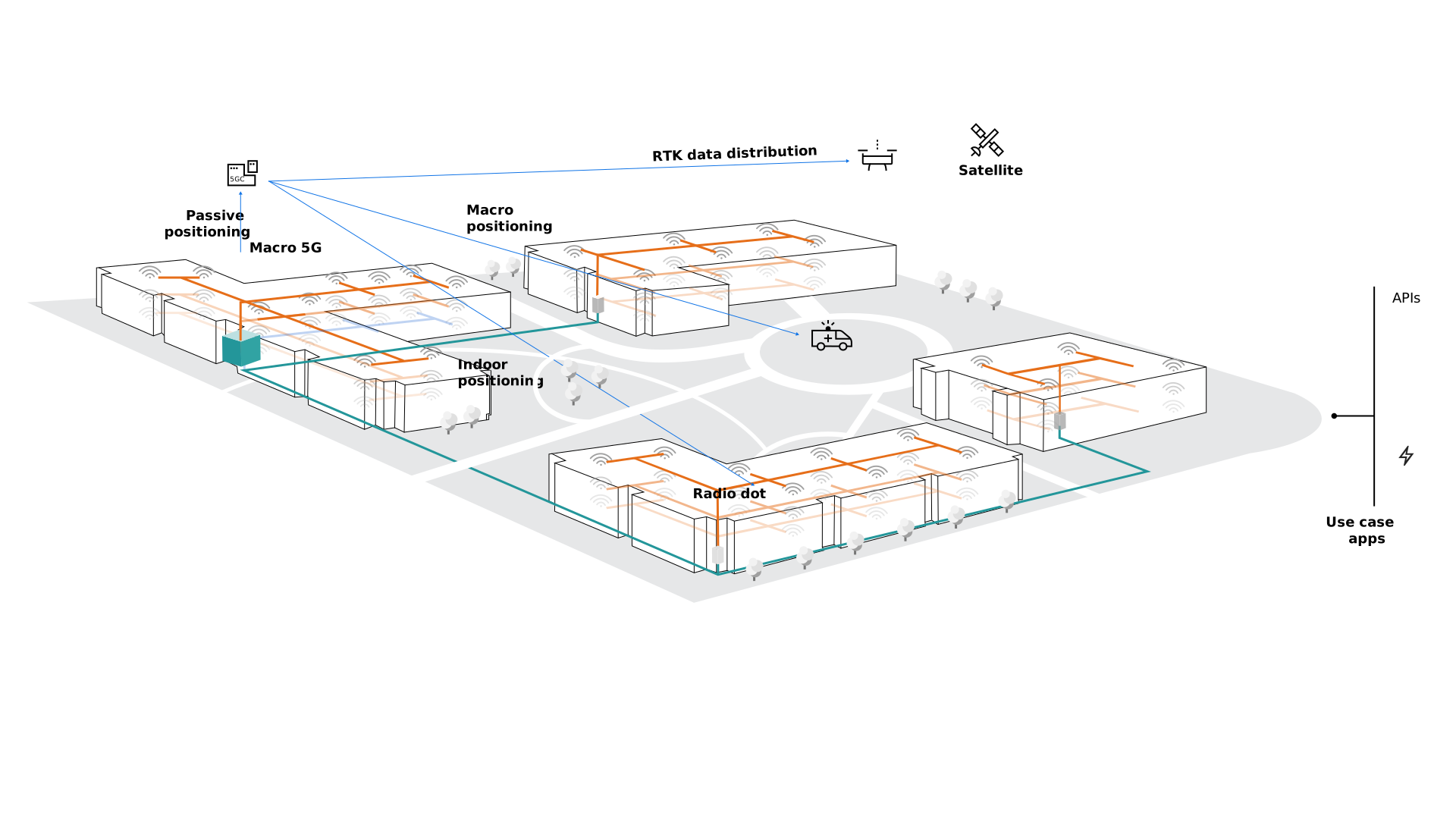
In multiple buildings and on multiple floors, we deployed a capable 5G radio network using radio dots connected to ENL—a system robust enough to monitor assets and individuals in real time, even in high-movement environments like busy wards. The positioning service could enable benefits for hospital staff like locating essential equipment quickly, improving efficiency, and response times.
Additional potential exists outside the hospital: 5G positioning enables extremely accurate tracking for ambulances, drones, and supply trucks. Whether transporting organs for transplant or delivering critical medicine, 5G positioning ensures every movement is tracked with great accuracy. Here we are also learning familiar lessons about balance. Achieving ideal accuracy in a moving, unpredictable environment is no small task. We are learning to focus on situational needs rather than pursuing perfect location accuracy everywhere. For instance, pinpointing the general section or room where an expensive medical equipment could be located can prove just as useful as placing it within the centimeter.
Lessons learned and key takeaways
Across these experiences—industrial safety, factory optimization, and hospital efficiency—one truth stands out: 5G positioning thrives where precision meets practicality. Each environment challenged us to adapt solutions to fit its unique requirements, whether that meant overcoming signal interference in thick industrial walls, using existing hardware to save costs, or tailoring accuracy to the demands of a busy hospital.
Certain themes connected these diverse trials:
- Finding balance: High accuracy can require a larger number of components, which isn’t always possible. Solutions had to prioritize real-world conditions, even at the expense of some hardware reduction, and reuse existing 5G infrastructure where feasible.
- Using existing tools: Building positioning capabilities into devices already used can save infrastructure costs and make integration easier, as demonstrated in the factory environment. All you need is a connected 5G device.
- Considering people: Ultimately, technology helps people—whether by keeping workers safe, helping factory staff avoid downtime, or empowering nurses to provide timely care. A user-centered approach drove the success of each project.
5G Advanced location services: the perfect combination
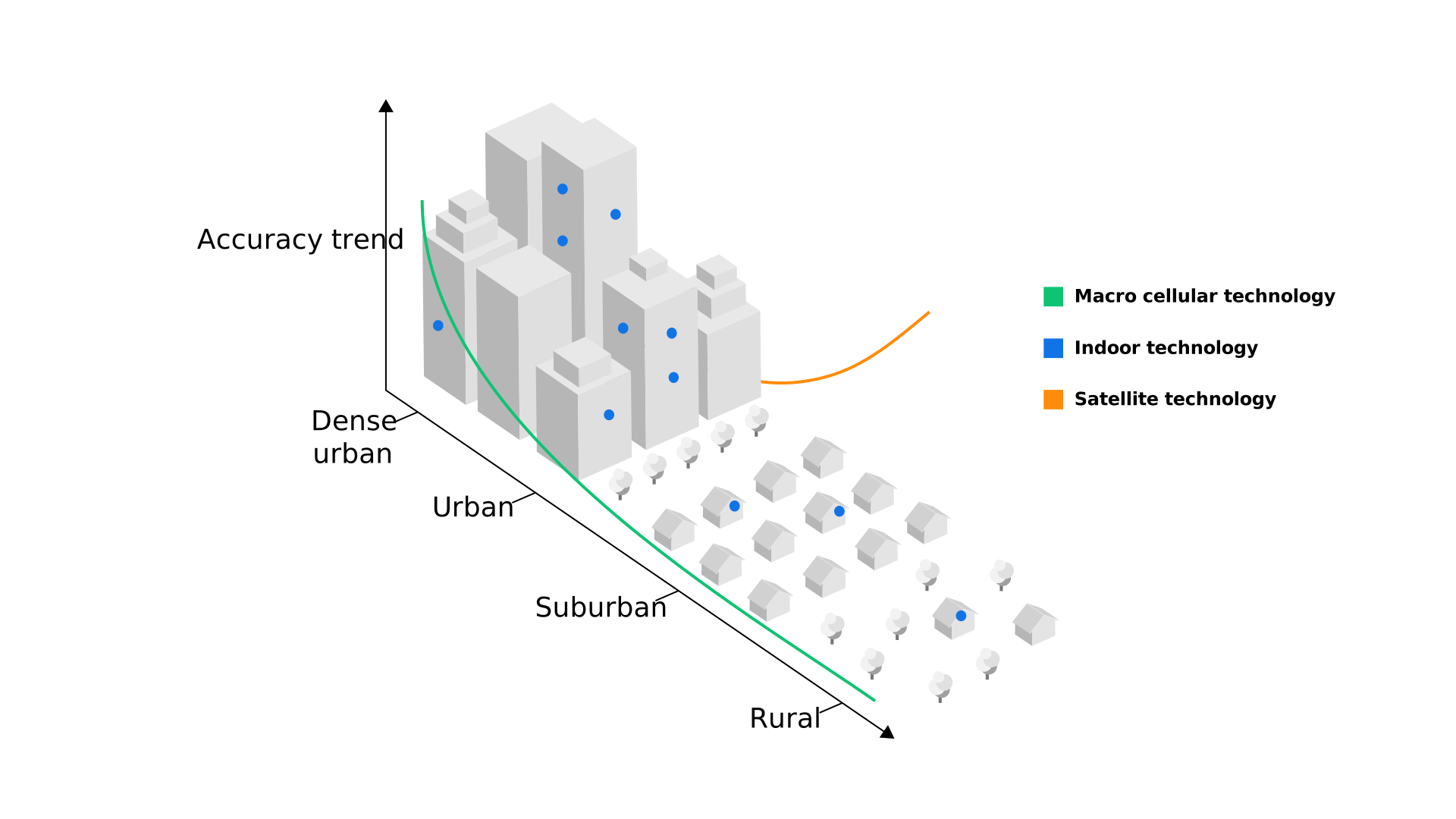
Today, satellite technology performs well in open sky but struggles in crowded urban environments and does not work indoors. On the other hand, macro cellular performs well in crowded areas and provides some degree of indoor service but struggles in rural areas where 5G cells are less densely deployed. Indoor positioning does not have a standard pattern—anywhere an indoor solution is deployed, it performs as per design requirements.
By combining the right technologies at the right time, it is possible to create a seamless location service. 5G Advanced location services include tools for any healthcare use case and provide seamless indoor-outdoor transitions using 5G or Redcap devices.
Reflecting on a transformative journey
Looking back, these projects taught me how powerful 5G network technologies can be when properly applied. Whether they prevent hazards, remove inefficiencies, or save lives, the promise of 5G positioning continues to push boundaries. Exploring what’s possible in this area has been humbling, but the horizon remains bright.
Read more
Discover how positioning services can be enabled in 5G networks for complex operations in your industry: 5G Advanced location services