









SDF, a new shared standard for describing IoT devices
- The new Semantic Definition Format (SDF) standard gives the IoT industry a shared language for describing what smart devices can do.
- The technology is already being used in commercial products, with the focus now shifting to broader industry adoption.

Expert, IoT standards and protocols

Senior Researcher, Cyber Physical Systems
Expert, IoT standards and protocols
Senior Researcher, Cyber Physical Systems
Expert, IoT standards and protocols
Senior Researcher, Cyber Physical Systems
Lack of interoperability is still one of the main challenges for building scalable IoT systems and solutions, especially as long-term efforts to standardize IoT data models have led to several established standards. Each comes with a separate ecosystem of support software, formats, and tools that are largely solving the same data model problem but are not compatible with each other. As a result, creating interoperability across different ecosystems requires significant integration effort.
Semantic Definition Format (RFC 9880), is a specification developed in the IETF standardization organization that addresses this problem by providing a common description format that facilitates interoperability across ecosystems. When models from different ecosystems can be described using a common format, automated data model translation and generating common APIs becomes possible. This enables building systems and applications that make use of devices from different ecosystems without extensive integration work.
When interoperating between ecosystems, only translation to and from SDF is needed, but the source ecosystem does not need to understand the internals of the target ecosystem, and vice versa. What's important to note here is that SDF does not replace any ecosystem's protocols or data formats. Instead, the intent is to use SDF to open up and interoperate between ecosystems.
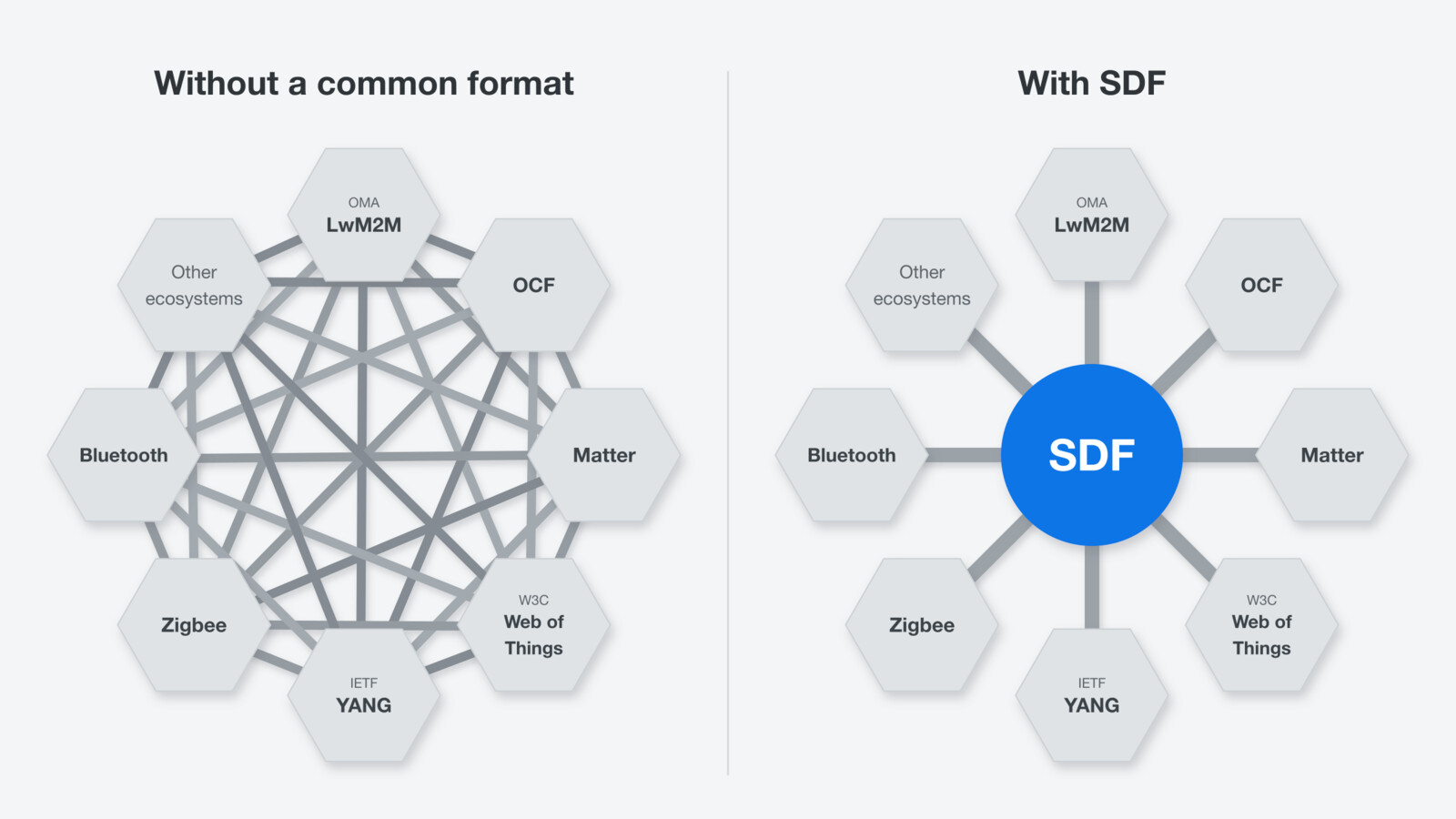
Figure 1 - Translating through SDF replaces pairwise mappings between ecosystems with a single mapping per ecosystem
From fragmented IoT ecosystems to a common standardized language
Back in 2020 we described how a group of IoT standards organizations came together under the One Data Model (OneDM) initiative to address the lack of interoperability across IoT ecosystems. The key idea was to develop a neutral format, the Semantic Definition Format (SDF), that could describe what IoT devices do in a way that any ecosystem could understand. At that time, the work to bring SDF to the IETF for formal standardization had just started.
In January 2026, that work reached a major milestone: SDF was published as RFC 9880, a Standards Track document by the IETF. At Ericsson, we co-authored the specification, and many of our colleagues contributed along the way, from co-chairing the IETF working group to building open-source tools for model translation and implementations of model utilization capabilities. The base specification is now stable and available for industry adoption, with early commercial deployments already operational.
What SDF looks like
SDF is a JSON-based format that describes Things – physical objects available for interaction over a network — in terms of their data and interaction models. At its core, SDF defines three interaction patterns:
- Properties capture state that can be read, written, or observed
- Actions model operations that can be invoked, with input and output data
- Events represent asynchronous occurrences that a device can report
These are grouped into Objects, which serve as the main reusable building blocks for model construction. For more complex devices, a composition mechanism is defined with which Things can be composed of Objects or other Things.
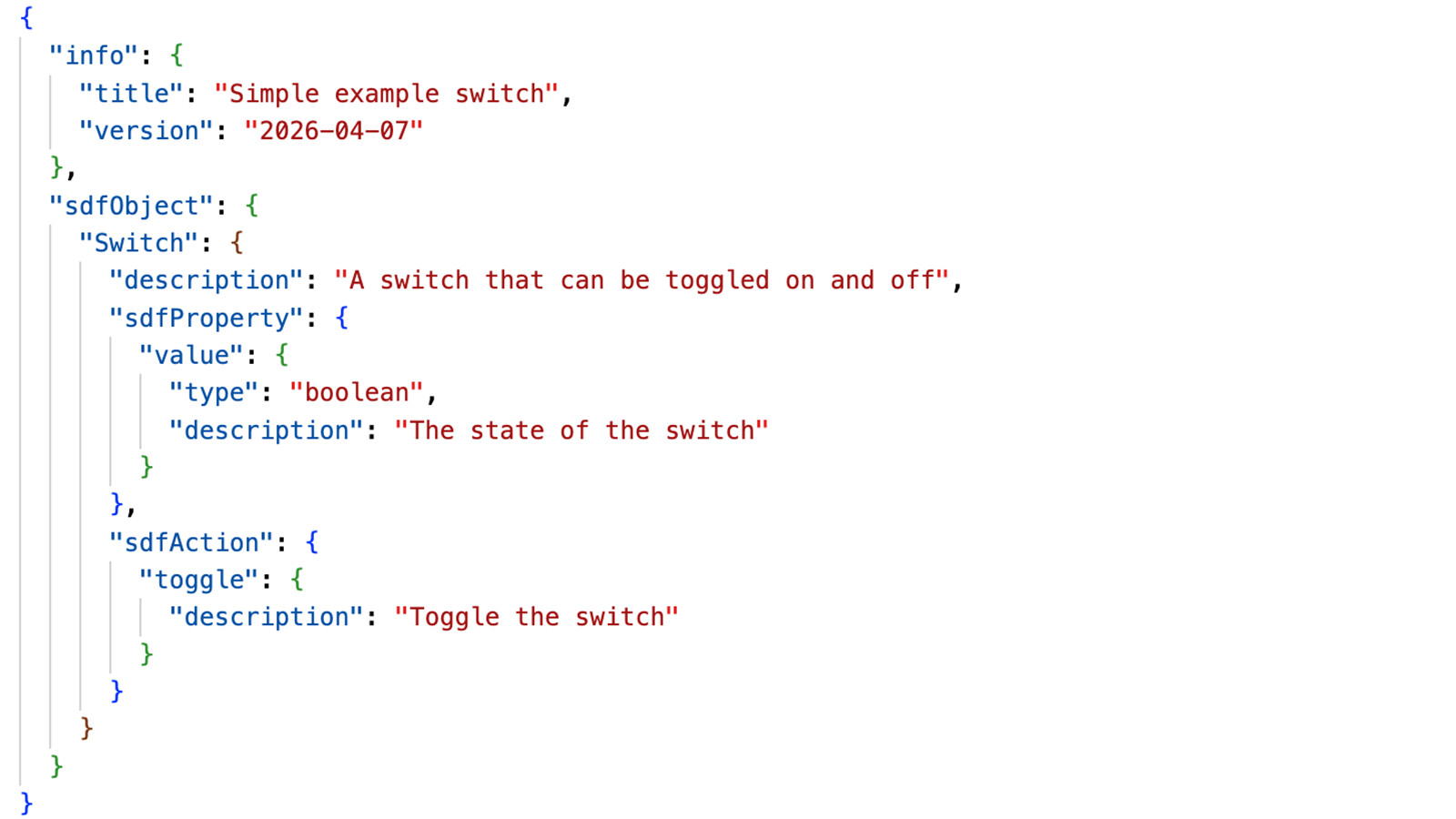
For example, a simple switch can be described as follows:
A switch-dimmer, on the other hand, can be modeled as a Thing composed of separate switch and dimmer Objects, each with their own properties and actions. This illustrates how SDF scales from simple devices to more complex ones through composition. The previous example could be extended with an sdfThing definition:
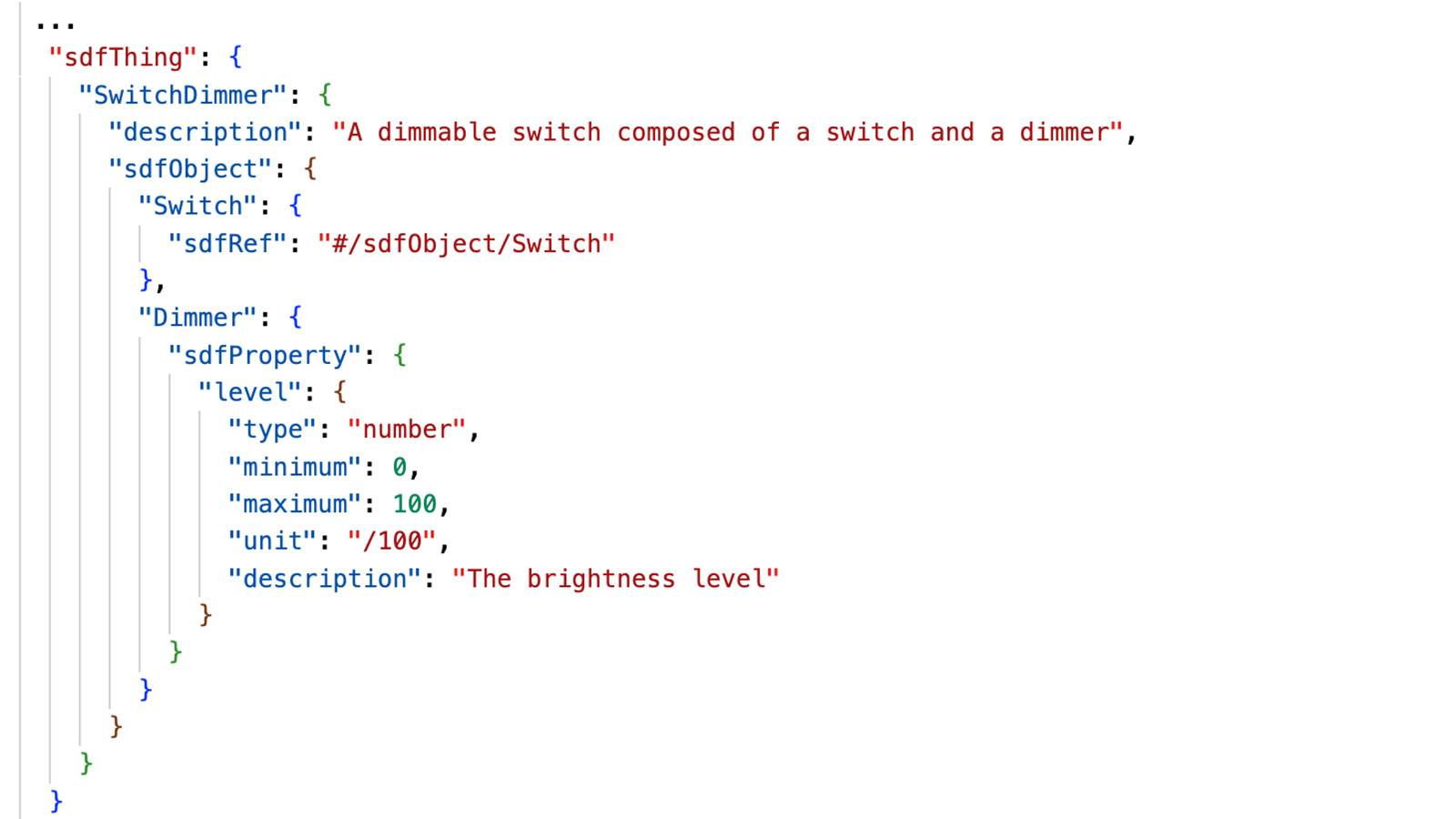
The format scales from simple sensors to complex devices while remaining easy to create and consume.
The models can be easily extended with more detailed information about the kind of data properties, events, and actions produce or consume. SDF supports reusable data type definitions, so common patterns like temperature ranges or status codes can be defined once and referenced across models. Typically, SDF documents also provide metadata, such as license and copyright information, and can use namespaces to avoid name conflicts across ecosystems.
From OneDM to RFC
The journey to RFC 9880 started in late 2018 when a group of industry experts and standards organizations came together to discuss the challenges facing IoT development. The consensus was clear: the biggest problem holding back progress was the lack of a common data model for IoT devices and applications. This led to the formation of the OneDM liaison group, bringing together experts from IoT standards organizations such as OMA, OCF, the Zigbee Alliance, and Bluetooth SIG, and companies such as Cisco, Google, Samsung, and Ericsson.
At Ericsson, we have been actively contributing since the early days of OneDM. This effort has driven several activities, including the creation of open-source tools to translate between OMA and SDF models, working with the OMA publishing Lightweight Machine to Machine (LwM2M) objects as SDF, and hosting one of the group's face-to-face meetings at our headquarters in Kista, Sweden. We have also been active in various OneDM- and SDF-related IETF activities, including hackathons as well as supporting the initiation of the ASDF Working Group in IETF in 2020.
In parallel with the SDF specification work, we engaged in OneDM with a variety of organizations to publish data and device models from different ecosystems using SDF. For example, OMA and OCF have published their models together with high-fidelity automated model translation implementations available as open source. OCF has also published their models using SDF in their IEC/ISO standards publication. Data model mapping and translation has also been implemented, for example, for the Matter, IETF YANG, and W3C Web of Things models.
After years of development and reviews, the specification was published as RFC 9880 at the end of January 2026, completing a multi-year standardization process. With the RFC now published, we have also updated our open-source OMA/SDF translation tools to align with the final specification.
Shipping SDF to products
While the specification was being finalized, the technology was already finding its way into products and deployments. The NIPC (Non-Internet-Connected Physical Components) specification, also developed at the ASDF working group, uses SDF for defining the interaction capabilities of IoT devices connected to a gateway. This provides a uniform description format for Zigbee and Bluetooth devices, among others.
The NIPC technology is implemented in some of the latest Cisco Wi-Fi access points. For example, in the two largest cruise ships in the world there are wireless access points that support NIPC. Next time you go for a cruise in the Caribbean, you might actually see SDF in action.
Looking ahead
With the base specification now stable, the focus shifts from fundamental technology development to addressing specific industry needs using the available building blocks and tools.
The IETF ASDF working group continues to be very active with several complementary specifications being developed. The NIPC specification, which is behind the deployments mentioned above, defines a RESTful API and a publish-subscribe interface for applications to interact with devices through a gateway. The SDF protocol mapping specification defines how to map SDF's abstract interaction models to specific protocols such as Bluetooth Low Energy and Zigbee — a bridge between SDF models and actual device communication.
Other working group drafts address SDF modeling for Digital Twins, describing actual device instances (as opposed to device types), augmenting SDF models with ecosystem-specific information, and extending SDF with information such as physical and contextual metadata. There are also new Ericsson-authored drafts on enhanced privacy for SDF proxy operations and using SDF for API translation between applications and devices.
Also the IRTF Thing-to-Thing Research Group (T2TRG) has been exploring related topics beyond the scope of the ASDF working group, for example, with experimental work exploring SDF-informed bridging between LwM2M and Matter ecosystems, extending SDF for AI agent interaction, and considerations on SDF model evolution with derivation and instantiation.
Building on the foundation
There are several areas where we see SDF having an impact going forward:
- Native model format for ecosystems. OMA is evaluating SDF as native format for LwM2M model descriptions, which would extend SDF usage beyond cross-ecosystem translation.
- Digital Twin systems. SDF can be used to describe device capabilities in a standardized way, facilitating building digital representations of physical environments with devices from multiple ecosystems.
- IoT device interaction for AI agents. SDF provides a machine-readable description of device capabilities that enable more automated interaction with the physical world.
- Uniform APIs for heterogeneous devices. Application developer platforms can use SDF to provide uniform APIs for IoT devices from different ecosystems, similar to what NIPC did for the gateways.
The work on OneDM and SDF has come a long way toward realizing the vision of IoT data interoperability. We now have a published IETF standard, deployments in commercial products, and ecosystems actively adopting the approach.
The building blocks are in place. Now it is time to use them to address the needs of the industry.
Read more
-
Explore more about IoT blog posts
-
Visit the Ericsson IoT website
-
Learn more about standardization