









Ambient IoT opportunities and limitations
- Ambient power-enabled devices are a new kind of IoT device that can harvest energy from their surroundings instead of relying on conventional batteries.
- In this blog post, we look at what passive Ambient IoT devices can realistically offer, including both their potential and their limitations.

Senior Researcher, Radio network monitoring and control

Principal Researcher, RAN massive IoT
Senior Researcher, Radio network monitoring and control
Principal Researcher, RAN massive IoT
Senior Researcher, Radio network monitoring and control
Principal Researcher, RAN massive IoT
As more everyday objects become connected, there is growing interest in Internet of Things (IoT) devices that are not only smaller, cheaper, and simpler but also easier to maintain and more practical to deploy at scale.
Ambient IoT introduces a cellular approach to very low-cost device connectivity in licensed spectrum. Think of it as a cellular counterpart to radio frequency identification (RFID)-like technology, extending inventory and identification use cases. Its main potential lies in enabling more automated and network-supported operation, especially in planned indoor environments such as factories, warehouses, and smart buildings where fixed infrastructure is available.
Compared to manual or semi-manual RFID operation, Ambient IoT can reduce operational effort and support more scalable inventory procedures when many devices need to be covered. However, its practical value depends on several factors, including the availability of Ambient IoT-capable infrastructure, the limited coverage range, deployment complexity, interference management, security constraints, and competition from existing technologies such as RFID, Bluetooth Low Energy (BLE), Narrowband IoT (NB IoT), and the IEEE Ambient Power Communication called IEEE Amp IoT.
What is Ambient IoT?
Ambient IoT is a specific solution for so-called zero-energy devices. Zero-energy devices are devices which do not have energy storage, like an internal battery, but can harvest energy from ambient sources; they are well suited for large-scale deployments where battery replacement or manual charging is not feasible.
3GPP, the main standardization body for cellular technologies, has specified Ambient IoT devices, for integration into cellular networks.
In Release 19, 3GPP focused on Ambient IoT Device 1, the simplest and least energy consuming type, with a peak power consumption of around 1 µW. These devices introduced as a cellular counterpart to RFID, to replace barcodes and enable wireless inventory while keeping power consumption and device cost very low. The focus of Release 19 is on passive devices, which do not generate their own uplink signal. Instead, they rely on backscattering, that is, reflection and modulation, of a radio signal from another source, the carrier wave.
In terms of complexity, Device 1 is roughly comparable to ultra high frequency (UHF) RFID, with an added requirement of energy storage. A small capacitor provides short term power for the device’s logic and processing. The expected commercial form factors include RFID-like tags, printable labels, stickers, smart labels, and small sensor tags attached to goods, tools, containers, packages, shelves, or equipment.
Besides the devices themselves, an Ambient IoT network also includes other important nodes that support communication and backscattering operation.
- Reader: The node that communicates with Ambient IoT devices and transmits or collects their data.
- Carrier wave transmitter (CWT): A node that provides the carrier wave to Ambient IoT devices and enables backscattering communication.
- Ambient IoT Function (AIoTF): A core network function node added to the 3GPP core network to support Ambient IoT.
Ambient IoT can be deployed in different ways depending on the network environment and where the devices are located. However, Rel-19 Ambient IoT is designed for indoor controlled environments such as factories, warehouses, or smart buildings, with no service coverage beyond these deployment areas.
Use cases
Ambient IoT fits many settings, including warehouses, smart factories, transportation and logistics, agriculture, retail, smart homes, and hospitals.
Use cases overlap, but they fall into four broad categories:
- Inventory management: Focuses on stock levels at mostly fixed locations, such as shelves or storage bins. Answers what tagged items are present in an area and how many units of type X are at location Y by aggregating tag responses into counts and stock status rather than reporting individual positions.
- Actuator control: An Ambient IoT device receives commands from the network and triggers physical action such as switching lights or signs, updating smart-shelf displays, or triggering alarms. The network sends a command, and the device executes it locally with very low energy use and complexity.
- Sensor data collection: Involves collecting physical measurements, such as temperature, humidity, or fill level, over time. The focus is on the current condition or measured value, producing time-series data.
- Asset tracking: Focuses on moving items, such as individual boxes, pallets, or tools. Answer where asset X is now, then use repeated updates to trace it along a logistics chain.
Rel-19 Ambient IoT targets dense, localized populations, with service requirement upper bounds of around 1.5 million devices per square kilometer for inventory type deployments.
All four use cases listed above are supported by Rel-19 Ambient IoT, but are always initiated by the network. That is, device-originated is not supported in Rel-19.
Comparing Ambient IoT and RFID technology
RFID and Ambient IoT Device 1 both aim for very low device cost, but they differ in spectrum usage and deployment. RFID typically operates in unlicensed spectrum and relies on often hand-held readers with manual or semi manual scanning. Given the high cost of mono static RFID readers, wherein the reader acts also as the CWT, total system cost can be significant.
Rel-19 Ambient IoT requires a cellular network with dedicated Ambient IoT-capable network support. Ambient IoT tags may not always be cheaper than RFID at the tag level. Still, Ambient IoT could enable more automated, scalable and real-time scanning when many devices must be covered by fixed infrastructure across a larger area. Achieving a similar service level with RFID using fixed mono-static readers would result in a higher overall system cost. In addition, service coverage is expected to be less reliable due to interference from other technologies operating in the same unlicensed frequency bands used by RFID.
In such scenarios, replacing manual RFID readers with network-supported Ambient IoT reader deployments could reduce operational effort and may be more practical, provided that the required Ambient IoT network infrastructure is available. However, these advantages should be viewed together with the practical limitations of Rel-19 Ambient IoT, especially the implementation and deployment challenges discussed in the next section.
Challenges and limitations in brief
Ambient IoT has many potential benefits but also challenges and limitations:
- Short coverage range of 15 meters: Comparable to that of RFID, but much shorter than the coverage distance of other cellular technologies such as NB-IoT. Dense reader deployments may be needed, raising cost and adding interference management complexity.
- New network nodes: Rel-19 Ambient IoT requires introducing new network nodes, which must coexist with conventional network nodes without causing operational problems or adding too much system complexity.
- Regulation: Regulatory frameworks consider only two types of equipment, base stations and terminal stations. The new CWT node must therefore comply with these regulations, but the exact category is still not clear.
- Positioning: Rudimentary support only, without a separate solution, which means that accuracy is on the level of maximum communication range of the reader, which is approximately 15 m.
- Indoor scope: Supported only in indoor scenarios and in specific locations, for example, a factory or a warehouse, so a device can typically only be located if it remains in that building.
- Uplink interference: Transmission and backscattering use the uplink spectrum, which can cause interference at the reader.
- No support for autonomous device-originated reporting: Only use cases within a network-initiated operation model are possible in Rel-19 Ambient IoT.
- Security: These devices are highly constrained in terms of power, memory, and processing capability; traditional security mechanisms may be too costly to implement directly. This means practical solutions are needed to balance lightweight security with reliable identification, authentication, and protection against misuse.
- Competition: Ambient IoT must find its place among other existing communication technologies. In some scenarios, alternatives such as RFID, BLE, the IEEE Ambient Power Communication, or other low-power wireless solutions such as NB-IoT may already be good enough or easier to deploy. This means that the value of Ambient IoT will depend not only on technical feasibility, but also on whether it offers a clear advantage in cost, scale, maintenance, or coverage for the intended use case.
Find more details on these limitations in the section Explaining the challenges and limitations of Rel-19 Ambient IoT.
How Ambient IoT works
Deployment scenarios and topology
As mentioned earlier, beyond the devices, the Ambient IoT network also includes other important nodes that support communication and backscatter operation, as shown in figure 1.
- The Reader: The node that communicates with Ambient IoT devices and transmits or collects data from them. In Rel-19, the Reader is an indoor NR base station (gNB).
- The Carrier Wave Transmitter (CWT): A node that provides the carrier wave to Ambient IoT devices and enables backscattering communication. In 3GPP, only the CWT functionality is specified. Whether CWTs are deployed as dedicated nodes or implemented by repurposing existing indoor gNBs is left to the network implementation. In Rel-19, the CWT transmits in the uplink spectrum and is subject to a maximum transmit power of 23 dBm.
- Ambient IoT Function (AIoTF): A core network function node added to the 3GPP core to support Ambient IoT. It handles service control, initiates inventory and command procedures, manages data routing, and ensures proper device management.
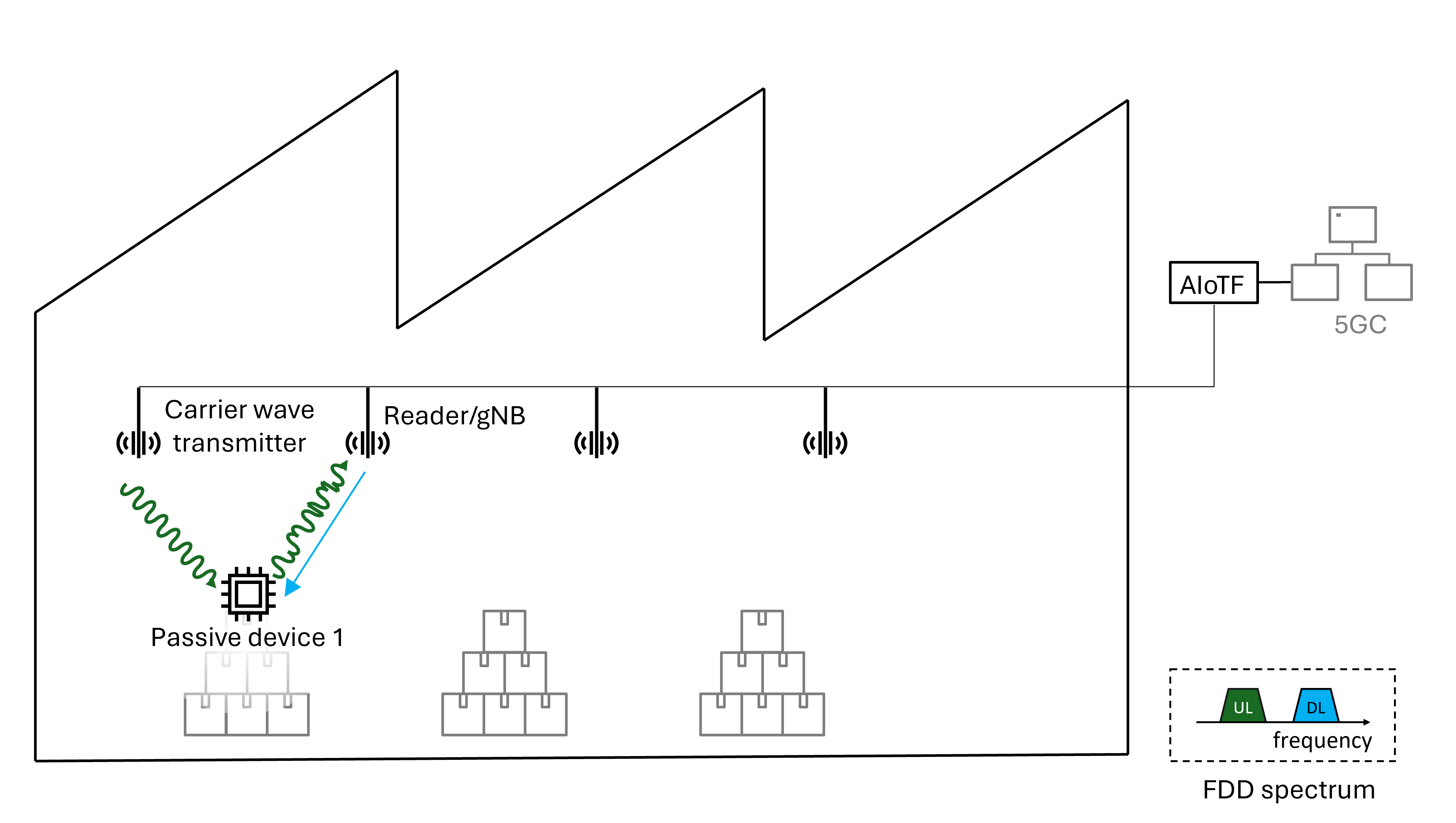
Figure 1: Illustration of Rel-19 Ambient IoT in the case where another indoor gNB acts as a carrier wave transmitter for signal generation and bi-static backscattering.
Rel-19 Ambient IoT targets dense, localized populations, with service-requirement upper bounds around 1.5 million devices per square kilometer for inventory-type deployments.
As shown in Figure 1, Rel-19 Ambient IoT is designed as an indoor solution, in which CWTs generate radio signals that are reflected and modulated (backscattered) by passive devices to transmit information. The reflected signals are then received and decoded by an indoor 5G NR base station, such as a micro base station. This setup is relevant for controlled environments such as factories, warehouses, or smart buildings. As a result, Ambient IoT services are limited to the coverage area of the indoor deployment and are not expected to provide service coverage outside these environments.
Rel-19 Ambient IoT operates in paired spectrum using frequency division duplex (FDD), and communication from the reader to the device uses downlink spectrum, while the CWT transmits the carrier wave in uplink spectrum. The reflected signal from the device is therefore also in the uplink spectrum, and a small frequency shift can be applied to reduce interference.
In the current Rel-19 device radio frequency (RF) specification rendering, TS 38.191 v19.3.0 lists NR bands n5, n8 and n28 for Ambient IoT operation, where n5 is located at 824–849 MHz UL / 869–894 MHz DL, n8 at 880–915 MHz UL / 925–960 MHz DL, and n28 at 703–748 MHz UL / 758–803 MHz DL.
Ambient IoT procedure
Inventory is always the initial procedure. The network addresses all, a subset, or a group of devices, and those within the reader’s coverage respond with their device identifier. For an identified device, the network has the option to also send a downlink command to the device, either containing a request for the device to act, a status update for the device, or a request to the device to send any data it has stored to the network.
In Rel-19 Ambient IoT, the communication process is centrally initiated by the AIoTF, which sends an inventory request to a reader, which will then broadcast a paging message to devices within its coverage area. The addressed devices respond, and the reader reports back the identified devices, with device location implicitly determined by the reader’s identity and coverage.
In contrast, in cellular networks such as 5G, the user equipment (UE) can initiate communication at any time to send data or requests, while the network continuously maintains a coarse knowledge of the UE’s location, allowing it to efficiently reach the UE for services such as calls or data delivery without needing to page all devices.
Ambient IoT payload sizes are generally tens to hundreds of bits, with a design target maximum message size of approximately 1000 bits, which is considerably smaller than for cellular networks.
Additionally, in Ambient IoT, cellular networks support a wider range of services and can perform more precise positioning, when required, by applying dedicated positioning methods after identifying the UE within the relevant cell area.
Explaining the challenges and limitations of Rel-19 Ambient IoT
Short coverage
One of the main practical limitations is its short coverage range. Based on Rel-19 studies, the coverage for these devices is only 15 meters. Although this coverage distance is comparable to RFID, it is still much smaller than cellular technologies such as NB-IoT, which can reach coverage on the scale of 40 kilometers or even up to 120 kilometers in an Ericsson network, as explained in the blog post Breaking new ground with NB-IoT in rural areas.
Due to this relatively limited range, supporting Ambient IoT devices may require a dense deployment of readers, which can increase deployment cost and create additional challenges such as interference management.
Deployment, implementation, and regulation issues
Deploying Rel-19 Ambient IoT requires introducing new network nodes: CWTs to support backscattering and device charging, upgrading existing indoor 5G base stations to be able to receive the backscattered signal from the Ambient IoT devices and to transmit in the downlink to them, and a new core network node (AIoTF) to connect this new radio access technology to the existing 3GPP 5G core network. One of the main challenges is that the new CWT node must coexist with conventional network nodes without causing operational problems or adding too much system complexity.
Regulatory frameworks, such as European regulations, typically consider only two types of equipment: base stations and terminal stations. The new CWT node must therefore comply with these regulations, but it is not yet clear how it should be categorized. However, in Rel-19, where the CWT transmits in the uplink spectrum, its transmission power needs to be restricted to UE-level output power, that is, a maximum transmit power of 23 dBm (200 mW).
Another challenge is interference in the uplink spectrum. Since the CWT transmits in the uplink spectrum and the device also backscatters in the uplink spectrum toward the reader, the CWT-to-reader link can be a source of interference when receiving the device-to-reader signal. This interference at the reader can vary significantly depending on the relative placement of the backscattering device and the CWT. Part of the interference can be mitigated by applying the small frequency shift considered for the device-to-reader signal and by scheduling transmission of the carrier wave signal.
For reasons such as interference handling and network energy saving, coordination between the CWT and the readers is required. At a minimum, only when the CWT is active is the reader instructed to receive the backscattered signal. However, the detailed operation of the CWT has not been standardized and is left to implementation.
Use case support limitations
As discussed in the use case section, Rel-19 Ambient IoT can address the use cases only within a network-initiated operation model. A device does not initiate communication on its own; instead, the network first performs an inventory procedure by addressing all devices, or a selected group of devices, within the reader coverage area. Devices that receive this request respond by sending their identifiers to the network. Once a device has been inventoried, the network may continue by sending a command, updating the device status, or requesting stored data. Therefore, even when the supported functionality maps to the four use case categories listed earlier, the interaction is always triggered by the network in Rel-19. Autonomous device-originated reporting is not supported.
Positioning
Ambient IoT supports positioning but at a rudimentary level without any separate solution. That is, a device’s position can be reported at the reader identifier level, effectively telling which network reader detected it. Compared to cellular network solutions, this corresponds to cell identifier positioning, and any claimed higher accuracy comes from the shorter coverage of Ambient IoT. That is, when the device has responded to the inventory request, it is concluded to be within 15 meters of the Ambient IoT reader which received the device’s response.
Cellular networks also typically have regulatory requirements to have coverage in more than 90 percent of populated areas, which means nationwide coverage is good, and most often the network can reach a device, for example, a smartphone, and locate which cell it is in. Rel-19 Ambient IoT is only supported in indoor scenarios and specific locations, for example, a factory or a warehouse, so a device can typically only be located if it remains in that building.
Security
Security is another important topic for Ambient IoT. Because these devices are highly constrained in terms of power, memory, and processing capability, implementing conventional 5G security features is often not practical. Instead, Ambient IoT uses lightweight security mechanisms that enable one-way authentication for inventory use cases and mutual authentication for command uses. However, practical challenges remain, particularly regarding secure storage and provisioning of authentication credentials in highly constrained devices such as Ambient IoT.
Competing with other communication technologies
Ambient IoT will also need to find its place among other existing communication technologies. In some scenarios, alternatives such as RFID, BLE, the IEEE Ambient Power Communication, or other low-power wireless solutions such as NB-IoT may already be good enough or easier to deploy. This means that the value of Ambient IoT depends not only on technical feasibility, but also on whether it offers a clear advantage in cost, scale, maintenance, or coverage for the intended use case.
Ambient IoT enhancements in Rel-20
3GPP continues the standardization of Ambient IoT in Rel-20 by extending the scope beyond the Rel-19 passive indoor solution. A key enhancement is support for more capable active devices that can generate their own uplink signal, which means they do not need a CWT node or backscattering. Another major enhancement in Rel-20 is support for device-originated reporting, enabling devices to autonomously initiate data transmission.
Rel-20 considers outdoor deployments, where active Ambient IoT devices communicate with outdoor macro base stations acting as readers (as shown in figure 2). For these outdoor scenarios, a coverage range of up to 500 m has been considered.
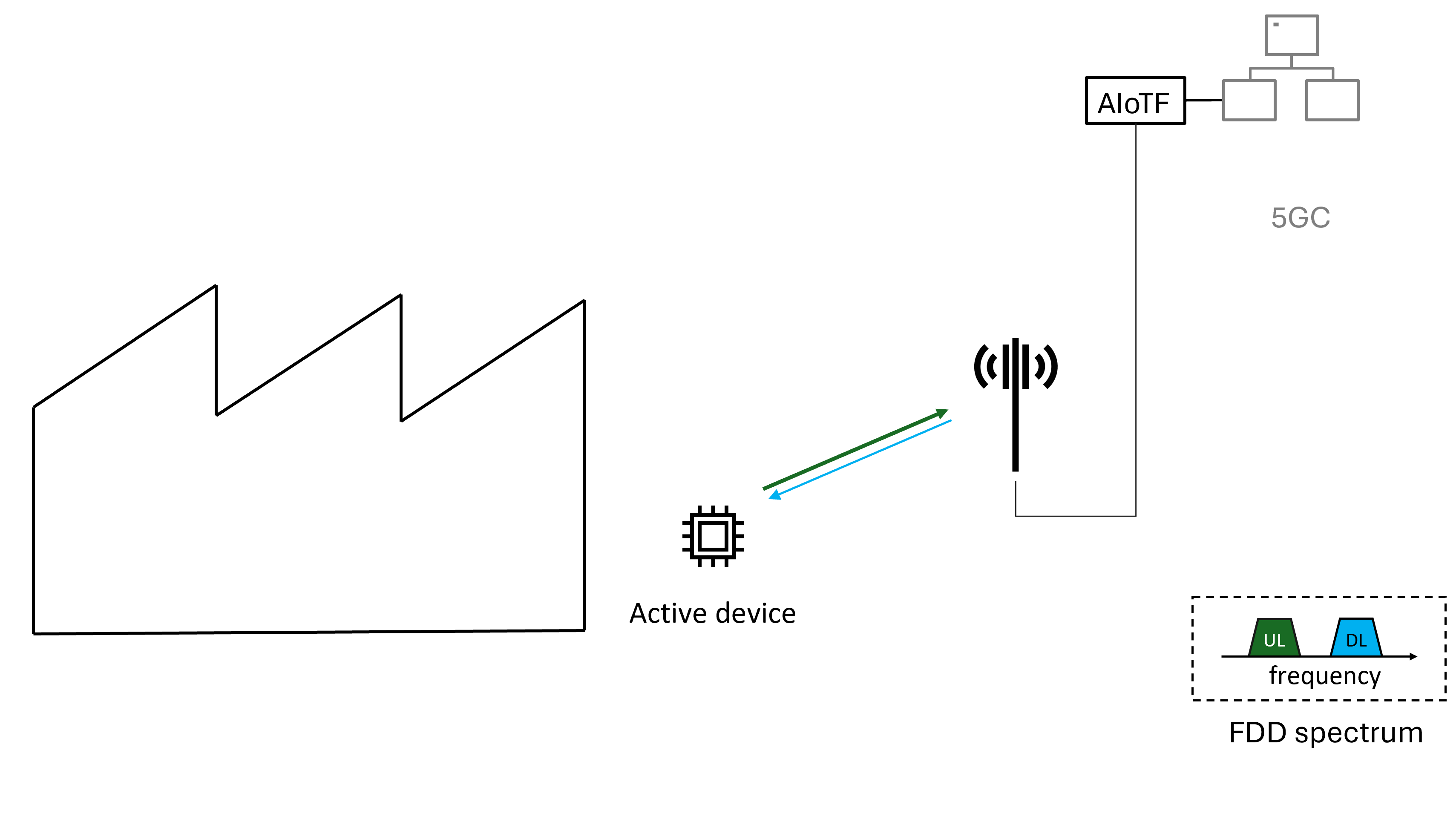
Figure 2: Illustration of Rel-20 outdoor Ambient IoT with active device.
In addition, Rel-20 includes indoor deployment scenarios where an intermediate UE can act as a reader, allowing Ambient IoT devices to communicate with the network without requiring a fixed reader deployment in every location. This deployment is shown in figure 3. In this scenario, active Ambient IoT devices (the so-called Type 2b devices) are expected to operate with a maximum coverage range of 40 m to the reader.
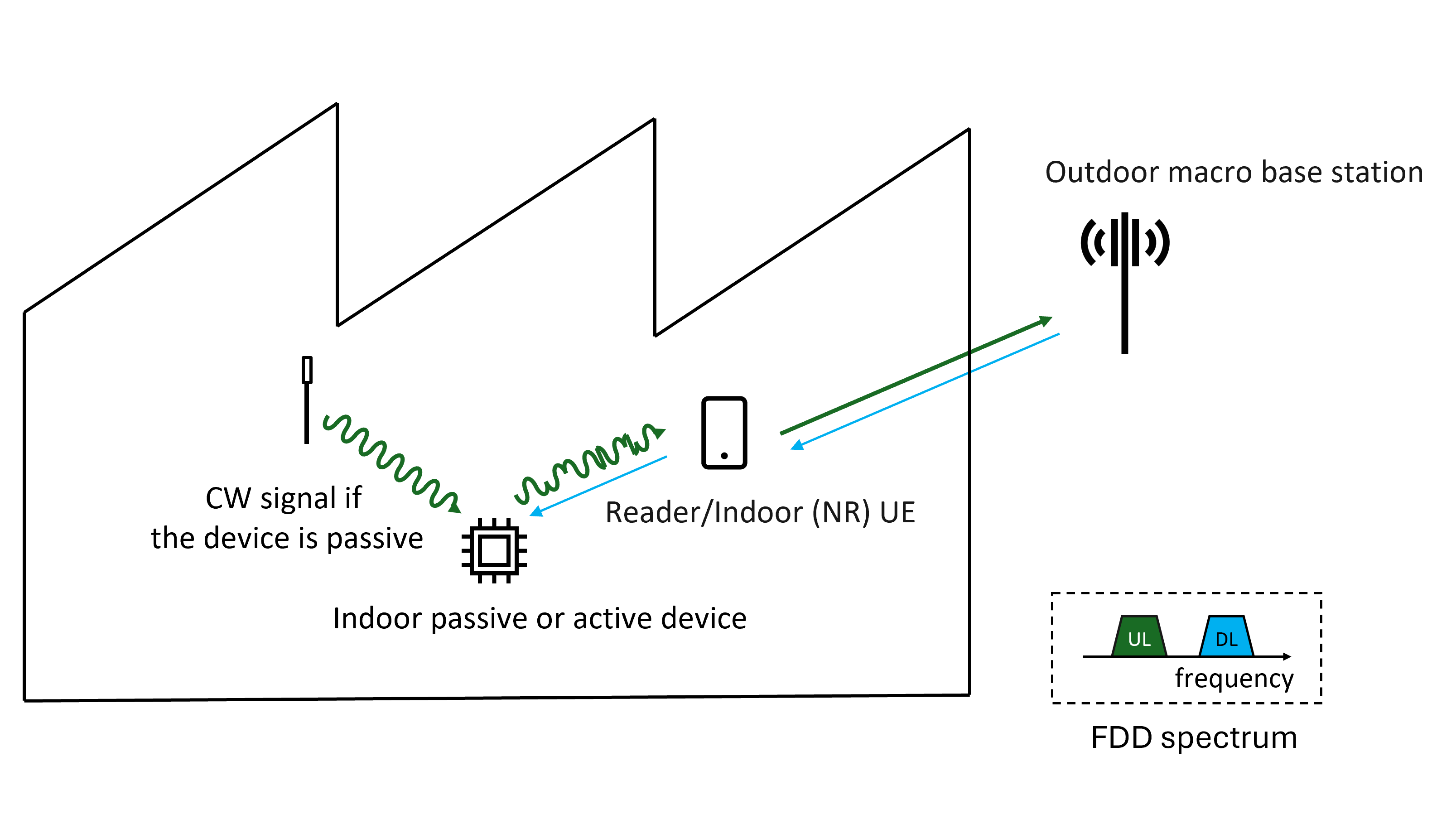
Figure 3: Illustration of Rel-20 indoor Ambient IoT where an NR UE acts as a reader
Conclusion and key takeaways
In summary, Rel-19 Ambient IoT introduces a very low-cost backscattering devices that operate in licensed spectrum and are supported by cellular networks. It can be seen as an alternative to RFID for inventory and identification use cases. Its main potential lies in enabling more automated and network-supported operation than traditional RFID systems, especially in planned indoor environments such as factories, warehouses, and smart buildings where fixed infrastructure is available.
Compared with manual or semi-manual RFID operation, Ambient IoT may reduce operational effort and support more scalable inventory procedures when many devices need to be covered. However, its practical value is limited by several factors, including the availability of Ambient IoT-capable infrastructure, the short coverage range, deployment complexity, interference management, security constraints, and competition from existing technologies such as RFID, BLE, IEEE Amp-IoT, and NB-IoT.