“Innovating at Scale” is an apt theme for this year’s World Economic Forum in Dalian. But in Northeast Asia, scale is not merely an ambition. It is becoming an economic necessity.
Across the region, demographic realities are turning into economic constraints. Ageing populations, shrinking workforces and persistent labor shortages are placing increasing pressure on manufacturing, logistics, transportation, healthcare and other physically-intensive sectors. Northeast Asia is not alone in facing this challenge – but it is among the first to confront it at scale.
There is no single answer to this challenge. Workforce redesign, policy reform, smarter immigration frameworks, automation and AI-assisted productivity will all play important roles.
But one conclusion is increasingly clear: Sustaining economic growth in the decades ahead will require a significant expansion of intelligent automation. Not because technology will replace people, but rather, because in many sectors, there simply will not be enough people to do the work.
AI is moving into physical AI
Much of the recent AI conversation has focused on Generative AI – foundation models, GPUs and the remarkable ability of machines to create, summarize, reason and interact.
Until now, enterprise AI had largely depended on fixed network infrastructure, fibre connections, wired ethernet and data centre interconnects. That infrastructure was built for a world where AI lived in server rooms and data centres, processing data that was brought to it. It worked well for that world. But that world is changing rapidly, and fixed networks have a fundamental limitation that no amount of investment can overcome: they only connect things that can be physically wired.
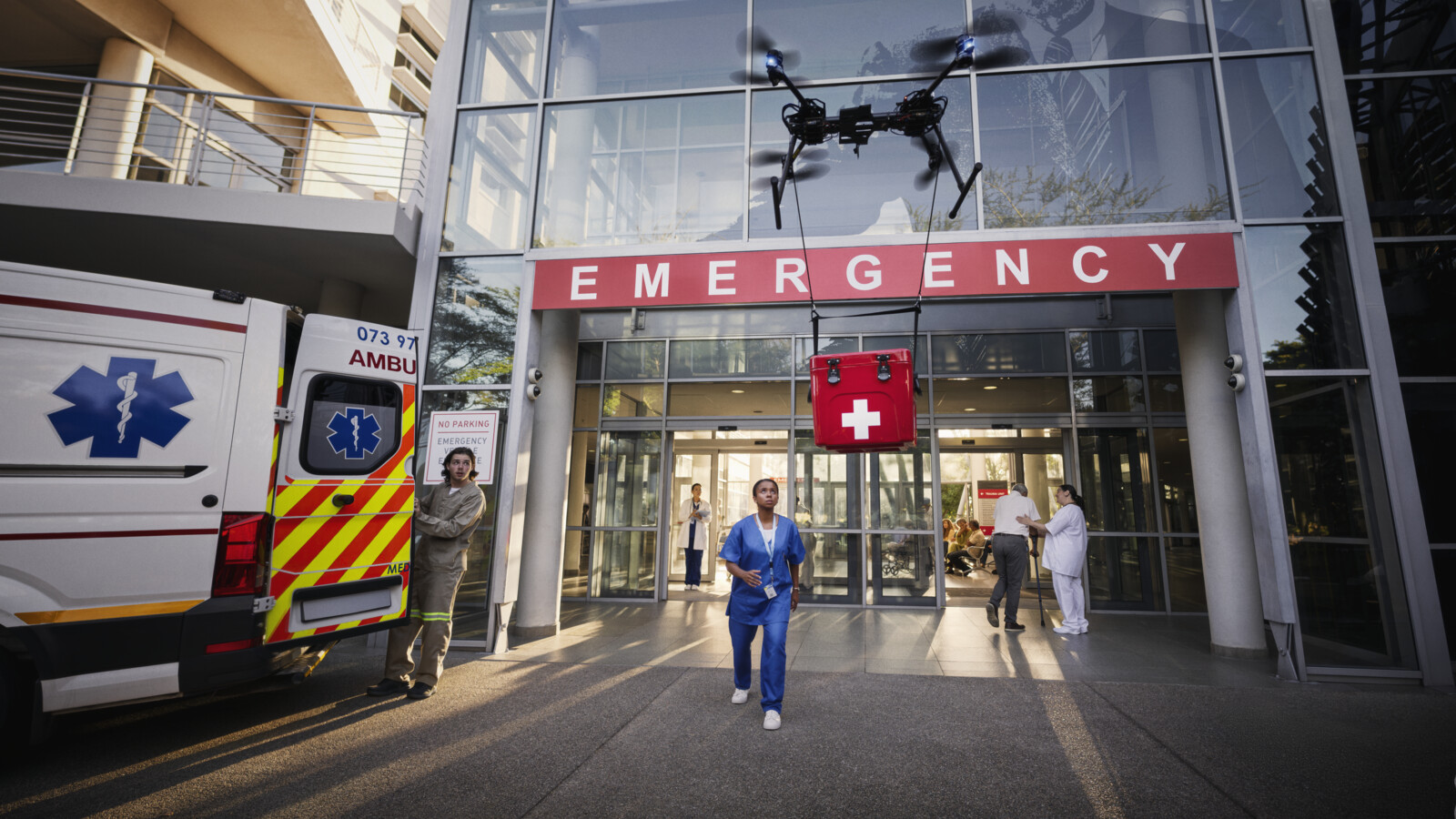
But that was only the beginning. The next major phase is physical AI. Intelligent robots supporting industrial production; autonomous systems optimizing transport and logistics; drones inspecting infrastructure; AI-powered wearables augmenting human capability; intelligent systems helping manage public safety, utilities and critical operations.
This is neither science fiction nor entirely new. Industrial automation has existed for decades. What is changing is the sophistication, autonomy, flexibility and scale of these systems. AI is enabling machines to operate in increasingly dynamic and unpredictable environments, rather than tightly controlled ones. That shift changes the infrastructure equation.
The architecture of physical AI
A common misconception is that physical AI means machines constantly relying on distant cloud systems to function. That would be poor engineering. Safety-critical systems must retain local intelligence. For example, an autonomous vehicle cannot depend on a round trip to a data centre to decide whether to brake. And a robot operating near humans cannot outsource every decision externally.
In other words, the future is not cloud-only AI. It is distributed intelligence, meaning some intelligence on the device itself, some at the telecom site, and some in a centralized cloud.
This architecture is not ideological – it is practical. These new AI systems operate differently. They interact continuously, learn collaboratively and act at machine timescales. Unleashing their full potential requires a new kind of wireless infrastructure designed to connect networks, the cloud, billions of devices and sensors, and hundreds of millions of homes and businesses.
The architecture reflects the realities of latency, resilience, economics, security and operational continuity.
But distributed intelligence creates a strategic requirement. The more intelligence becomes distributed, the more important a connective and intelligent fabric between those systems becomes. It allows intelligence to move efficiently to where value is created. The next opportunity is not just about helping to build AI; rather, it’s about defining how AI operates at scale. That is what the intelligent fabric enables: a universal framework designed so different AI systems can work together securely and with reliable performance, no matter where they are or who built them – simply the best network for AI everywhere.
Why connectivity becomes strategic
Connectivity has always mattered. Factories rely on wired infrastructure and enterprises depend on private networks. Wi-Fi will continue to play a critical role and fibre today remains indispensable.
But this is not about one technology replacing all others. It is about economic scale.
Physical AI will not remain confined to factory floors or office cubicles. It will extend into ports, airports, transport systems, energy infrastructure, emergency services, logistics corridors, urban environments and remote industrial operations.
Consider a modern automated port. Autonomous vehicles moving containers, AI-driven cranes, predictive maintenance systems, worker safety monitoring, customs coordination and real-time logistics orchestration may all operate simultaneously. Individual systems will maintain local intelligence, but the broader economic value comes from coordination across the entire ecosystem.
That coordination requires connectivity that is secure, resilient, programmable and pervasive. This is where connectivity becomes a strategic differentiator. Not because every workload runs on a mobile network, but rather because national-scale economic systems require infrastructure capable of connecting distributed intelligence across geography, organizational boundaries and moving environments. That is a fundamentally different requirement from enterprise networking inside a fixed facility.
The communications infrastructure built over previous decades was largely optimized around human usage: voice, messaging, browsing and streaming. Physical AI, on the other hand, requires more machine-to-machine coordination, greater uplink traffic from sensors, higher resilience, tighter latency in selected environments, and of course, greater security sensitivity. Physical AI creates fundamentally different traffic patterns and operational expectations from consumer connectivity.
Economic competitiveness will depend on infrastructure readiness
History offers a consistent lesson: Nations that invest early in enabling infrastructure often create disproportionate economic advantages. Just as railways accelerated industrial expansion and electricity transformed productivity, AI infrastructure will transform how we work and how we live on a day-to-day basis. The question is no longer whether physical AI will emerge. The real question is where it will scale fastest, and which economies will capture the most value from it.
Infrastructure readiness will be a decisive factor. If enterprises cannot rely on secure, scalable connectivity, deployments will slow. This, in turn, will impact innovation, with capital flowing to other areas, and ultimately, competitiveness weakening. In other words, this is not simply a technology discussion. It is an economic strategy discussion.
Why this matters now
Deploying 5G should not be viewed as the final destination. It is part of the foundation. The opportunity is not merely faster connectivity, but more intelligent infrastructure capable of supporting differentiated service levels, automation, edge integration and increasingly adaptive operations.
Future generations of connectivity will push this further, but infrastructure transitions take years and economic transitions often move faster. Waiting until demand is obvious is often the most expensive strategy.
The strategic divide
The AI debate understandably has been focused on models, semiconductors and hyperscale computing. These are critical. But intelligence alone does not transform economies. Deployment does. Operational integration does. And scale does. The winners in the AI economy will not simply be those with the best algorithms. They will be those capable of translating intelligence into real-world productivity at scale.
This requires infrastructure, but not just one type of infrastructure. It requires a coordinated digital foundation capable of connecting distributed intelligence across entire economies. That is why connectivity will define the winners in the AI economy.
This article also appears on the World Economic Forum’s website