






Inside the challenging engineering work powering Ericsson Radio with Nils Fredrikson
- Discover how radio algorithms developer Nils Fredrikson combines mathematics, software and hands-on lab work to solve some of the telecom industry's most complex challenges.
- Learn why engineers from diverse academic backgrounds can thrive in Ericsson Radio and help shape the future of connectivity.

Talent Marketing Content Specialist
Talent Marketing Content Specialist
Talent Marketing Content Specialist
For many engineers, university is filled with abstract mathematical concepts that feel far removed from the real world. Equations are written on whiteboards, theories are explored in textbooks and complex derivations can feel like they are solved purely for the sake of learning.
For Nils Fredrikson, one of the biggest surprises about joining Ericsson was discovering that those same concepts are being applied every day to solve real world connectivity challenges at global scale.
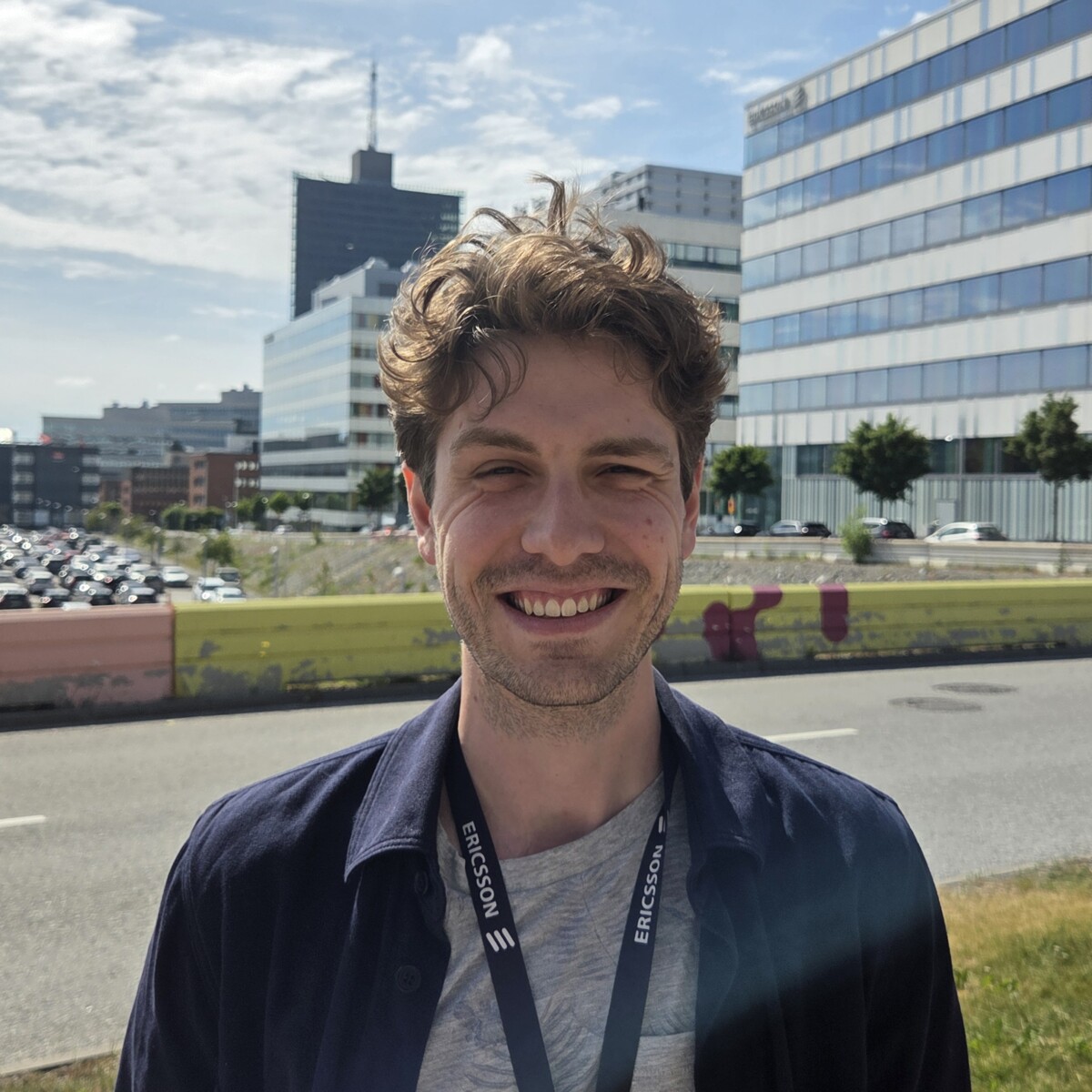
“We are actually working with mathematical derivatives,” Nils says. “Those things which a lot of people hate with maths, but I love it. I would not imagine that you actually did that in companies.”
Today, Nils works as an Algorithm Developer within Ericsson Radio, helping develop advanced signal processing solutions used inside mobile networks around the world. It is work that combines mathematics, software development, radio engineering and practical lab experimentation, often all within the same project. And even after years in the role, he still feels like he is still realizing the true depth of the field.
“I still feel like I just started. I have barely touched the surface.”
A career path that did not start in telecoms
Nils did not come from a traditional telecoms or electrical engineering background. His academic studies spanned applied mathematics, chemical engineering and physics, driven largely by curiosity and a broad interest in science.
“I have always had a passion for science, including physics, chemistry, mathematics. When I started university, I could not really make up my mind, so I ended up trying many different fields and courses.”
Over time, he became increasingly interested in mathematics, programming and modelling, which eventually opened the door to Ericsson. Nils first joined the company in 2019 as a consultant before later completing a master’s thesis project in collaboration with Chalmers University of Technology and Ericsson. At the time, he already viewed Ericsson as a highly technical company where software, mathematics and engineering came together in ways that appealed to him.
“I always had this image that Ericsson was a highly technical place. This mix of software development, mathematics and physics is what attracted me.”
But like many people outside the telecoms industry, he admits his understanding of Ericsson’s work was still limited before joining.
“I think people here in Sweden still ask, ‘Ericsson? They are the ones doing the phones, right?’”
It is a perception he now laughs about, knowing how much highly specialised engineering work happens behind the scenes inside Ericsson Radio.
Discovering the “sweet spot”
During his early years at Ericsson, Nils worked more heavily with software development, including operating systems and hardware drivers. But around three years ago, he transitioned into the world of radio algorithms and digital pre distortion, often shortened to DPD. That move changed everything.
“I think that step has been amazing actually. Right now, this is the sweet spot that I have been looking for for a long time.”
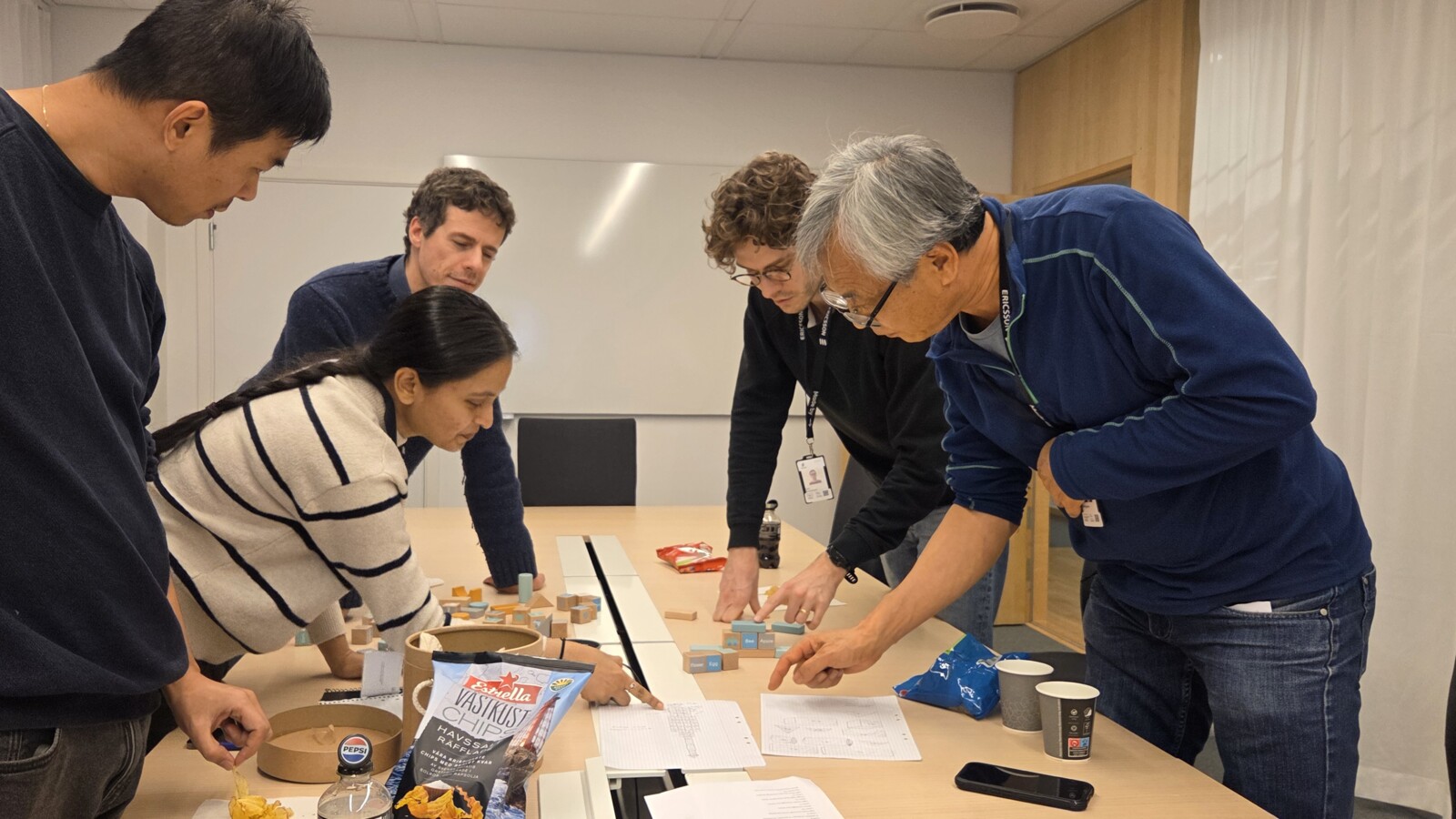
Nils and his team working together in the office
For Nils, the role brings together nearly every area that originally drew him toward engineering in the first place.
“This department has all of those things. Mathematics, physics, software, lab work. It is a very interesting technical place.”
Solving problems that impact billions
At the centre of the team’s work is digital pre distortion technology, a critical part of how Ericsson radios operate efficiently while maintaining high signal quality. In simple terms, power amplifiers inside radios naturally distort signals as they amplify them. Nils and his team develop algorithms that compensate for those unwanted effects before signals are transmitted.
“We try to learn how the signals going through our system look and build up this model in real time.”
The complexity behind that process is enormous. Projects often begin with theoretical modelling and mathematical analysis before moving into software simulations and eventually real hardware testing inside Ericsson labs. Teams analyse how signals behave, investigate performance issues and continuously optimise solutions to improve efficiency and reliability. One recent project relating to 6G involved researching entirely new signal types that could potentially support future network generations.
“It was kind of this bottom up project where we started by researching how the signals should look and define their characteristics.”
That work then moved between software and hardware repeatedly.
“You create signals in software, move that data into the lab and play it on real hardware amplifiers, then take the measurements back into the software world and do simulations. It is really this back and forth between theory and practical engineering.”
For Nils, that constant movement between theory and practical engineering is one of the most rewarding parts of the job.
The challenges are as deep as the technology
One thing that quickly became clear to Nils after joining the team was just how technically deep the work really is. Even after several years in the role, he says there are still huge areas of the field left to explore and understand.
“It is ridiculously complex. I was kind of surprised. It takes a long time before you become an expert in all things software and in the lab.”
Some of the complexity comes from the mathematics itself. Other challenges come from fitting solutions into existing products and systems already operating at massive scale.
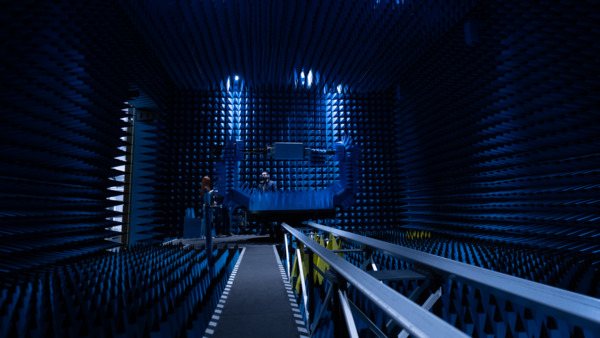
Wide shot of the inside of an Ericsson test chamber
“It is not just about finding a way to solve the problem. It is also about fitting the solution into some predefined structure. It’s challenging because no one has the full picture.”
That means engineers like Nils need both broad system level understanding and highly specialised technical expertise. In many cases, solving problems involves balancing research, experimentation and collaboration across different areas of expertise. Nils often starts by researching concepts independently before turning to senior colleagues for guidance when needed.
“You try for a while, and if it is not working, then you go to some senior and ask, ‘How does this work?’”
Learning from engineers with decades of experience
One aspect of the role Nils particularly values is the opportunity to work alongside highly experienced engineers who have spent decades developing radio technologies.
“The most senior guy has been here more than 40 years. He knows a thing or two. I am kind of new in the lab myself. This is kind of my weak spot”
For someone still expanding their knowledge in areas like lab testing and radio instrumentation, that support has been invaluable. At the same time, he knows newer engineers bring important strengths of their own, particularly around software development, programming and fresh ways of thinking.
“You should not underestimate what you bring with a fresh mind.”
That mix of experience and new perspectives creates an environment where continuous learning becomes part of everyday work. And with technologies like 5G Advanced and future network evolution already pushing the boundaries of radio engineering, the learning never really stops.
Engineering work that people experience every day
Although much of the work happens deep inside algorithms, hardware and simulations, the real world impact is huge. Nils points to spectrum sharing as one clear example. Poorly controlled signals can spread into neighbouring frequency bands, causing interference and reducing network performance. The work his team does helps operators use spectrum more efficiently while enabling higher data rates and more reliable connectivity.
“If we did not exist, we could not have as many different devices working at the same time.”
It is the kind of engineering most people never directly see, but experience constantly in everyday life through faster, more stable mobile connectivity.
“Those problems are real”
Looking ahead, what excites Nils most is knowing there is still so much left to learn. Before joining Ericsson, he assumed many of those problems existed only in universities or research papers. Now, he sees teams solving them every day.
“If there is one thing I would like to convey, it is that here at Ericsson Radio, we actually tackle those amazingly complex problems that you see in academia. They are real, and they are happening every day at Ericsson. That is truly fascinating.”
Explore opportunities at Ericsson
For engineers who are driven by curiosity, deep technical challenges and the chance to continuously expand their thinking, that environment is exactly what makes Ericsson Radio such a unique place to build a career.
Explore open opportunities across Ericsson Radio and beyond.