










From vision to value: Turning autonomous networks ambition into business results
- The convergence of AI, cloud-native architectures and differentiated connectivity capabilities is fundamentally reshaping how networks are built, operated and monetized.
- At DTW Ignite 2026, the fact that autonomy is no longer optional was clearer than ever.

Head of Marketing, OSS/BSS, Network Management and AI Cognitive software and services
Head of Marketing, OSS/BSS, Network Management and AI Cognitive software and services
Head of Marketing, OSS/BSS, Network Management and AI Cognitive software and services
In nearly every customer conversation I had during DTW Ignite 2026 – themed the future faster – one thing consistently came up: the need to accelerate the autonomous networks journey with a strong focus on generating business results. Whether the discussion starts from operational efficiency, growth, service innovation, or resilience, the conclusion is often the same – autonomy is no longer optional. It is a strategic priority.
During the event, this was also highlighted in keynotes and discussion panels, like the one led by Ericsson’s CTO, Erik Ekudden, and Ankur Kapoor, Chief Network Officer at T-Mobile, where they discussed not only the potential of autonomous networks in terms of efficiency, customer experience and market opportunity, but what are the main challenges and where we need to focus as an industry to overcome them.
It also clearly came across in the session, where IOH’s Chief Digital Officer, Sukhdeep Gill and Mats Karlsson, Head of OSS/BSS at Ericsson, explained how the two companies are co-creating the AI-native telco, enabling scalable growth through a unified digital platform.
The telecom industry is at a pivotal moment. The convergence of AI, cloud-native architectures and differentiated connectivity capabilities is fundamentally reshaping how networks are built, operated and monetized.
According to Ericsson Mobility Report, the number of commercially available offerings based on network slicing has surged to 84, signaling that differentiated connectivity is rapidly moving from early adoption to mainstream.
Autonomous networks are key in this innovation process, as the range of approaches in the market – from subscription-based consumer tiers and event-specific boosts to enterprise or SLA-backed services – reflects growing sophistication in how the industry is approaching monetization.
This is an outcome-based transformation – autonomous networks introduce a new operational paradigm in which intent-driven, AI-powered and AI-native systems continuously deliver outcomes aligned with business objectives, policies and guardrails – shifting operations from human execution to system-driven decision and action.
Communications Service Providers (CSPs) clearly see the potential benefits and have started their autonomy journey. And yet, despite strong intent, many operators still find it challenging to accelerate their journey or how to translate autonomy into relevant business outcomes.
The reasons are familiar. Networks are inherently complex, spanning multiple generations of technology, vendors, and operational models. Data is abundant but fragmented. Automation exists, but often in silos. And while the vision of a fully autonomous network is compelling, translating that vision into measurable, stepwise progress can feel daunting.
Bridging ambition and reality
Autonomous networks are not a single leap; they are a transformation journey. One that requires clarity of roadmap, alignment between business and technology, and the ability to operationalize intelligence at scale.
Operators are asking:
- How do we move beyond isolated automation toward end-to-end high-value-scenario based autonomy?
- How do we unify data and AI across domains?
- How do we ensure that automation delivers tangible business outcomes, not just technical efficiency?
What becomes clear is that accelerating this journey depends on two factors: a structured evolution path and a portfolio designed to operationalize it.
Ericsson’s perspective
At Ericsson, we see autonomous networks as an evolution grounded in real-world deployment and business results, not just aspirations. Our strategy focuses on helping customers progress across autonomy levels—systematically, securely, and with measurable business impact.
We are leading outcome-based autonomous networks transformation – our industry-leading Intelligent Automation Platform (EIAP) is used already by CSPs such as AT&T, Swisscom, Telstra, Vodafone and others for managing single and multi-vendor networks. Our rApp ecosystem is the largest in the industry with more than 100 members and more than 100 developed rApps.
In the last couple of years, several CSPs have already worked with Ericsson to achieve TMF-validated level 4 autonomy in different scenarios. The most recent, awarded during DTW, was NBN Co, who got Australia-first level 4 autonomy validation for service assurance, powered by Ericsson’s AI Intent-based Operations.
We address autonomy across these key dimensions:
- Intent-driven operations marks a paradigm shift: from manual configuration to outcome-based management.
- Openness and standardization are foundational – Ericsson drives alignment in TM Forum, 3GPP and O-RAN Alliance to ensure open, interoperable architectures and APIs
- AI, agentic AI and cognitive closed loops are at the core of Ericsson’s approach, enabling networks to sense, reason, and act autonomously – delivering measurable business outcomes and trusted, explainable operations.
- Security, trust, and explainability are embedded by design, with cross-domain validation, verification and guardrails to fulfill needed Zero Trust Architecture principles
But strategy alone is not enough. Execution depends on having the right portfolio—built to integrate, scale, and deliver value quickly.
The right approach to accelerate the journey
Ericsson is leading the autonomous networks transformation with proven Level 4 autonomy processes in live networks, the industry’s leading RAN automation platform and ecosystem, cloud-native core network and a full-stack portfolio spanning business, service, and resource layers – empowering CSPs to evolve toward AI-native operations with measurable business impact.
Our leadership was further strengthened at DTW in Copenhagen with the launch of:
- A major expansion of the Ericsson Intelligent Automation Platform (EIAP) to support core networks automation:
- Creates a unified RAN and Core network automation solution for CSP.
- Introduces the concept of, and ability to run new core-specific automation applications (cApps)
- A new data streaming capability in Ericsson Network Manager – Ericsson Stream Processing and Enrichment (ESPE) - to enable online low latency, and closed-loop automation
- New OSS/BSS Business Value Pathways to ensure CSPs meet autonomous networks operations goals, bringing together Ericsson unrivalled OSS/BSS software and services, AI and autonomous operations expertise to deliver successful business outcomes, such as:
- Faster data transformation: Replaces traditional batch pipelines with agile streaming-first architecture, delivering faster access to the right data, bringing better monetization opportunities.
- Zero-touch product launch: Applies AI and automation across the full product lifecycle to gain new revenue from products quickly and easily.
- Agentic AI service experience: Enables operations teams to predict, diagnose and resolve subscriber-impacting issues faster through AI-driven analytics.
- Agentic AI intelligent IT operations: Resolves operations issues faster with better accuracy.
These two launches are part of Ericsson’s business-wide support for Autonomous Network transformation and enhance our ability to support customers on their autonomy journey.
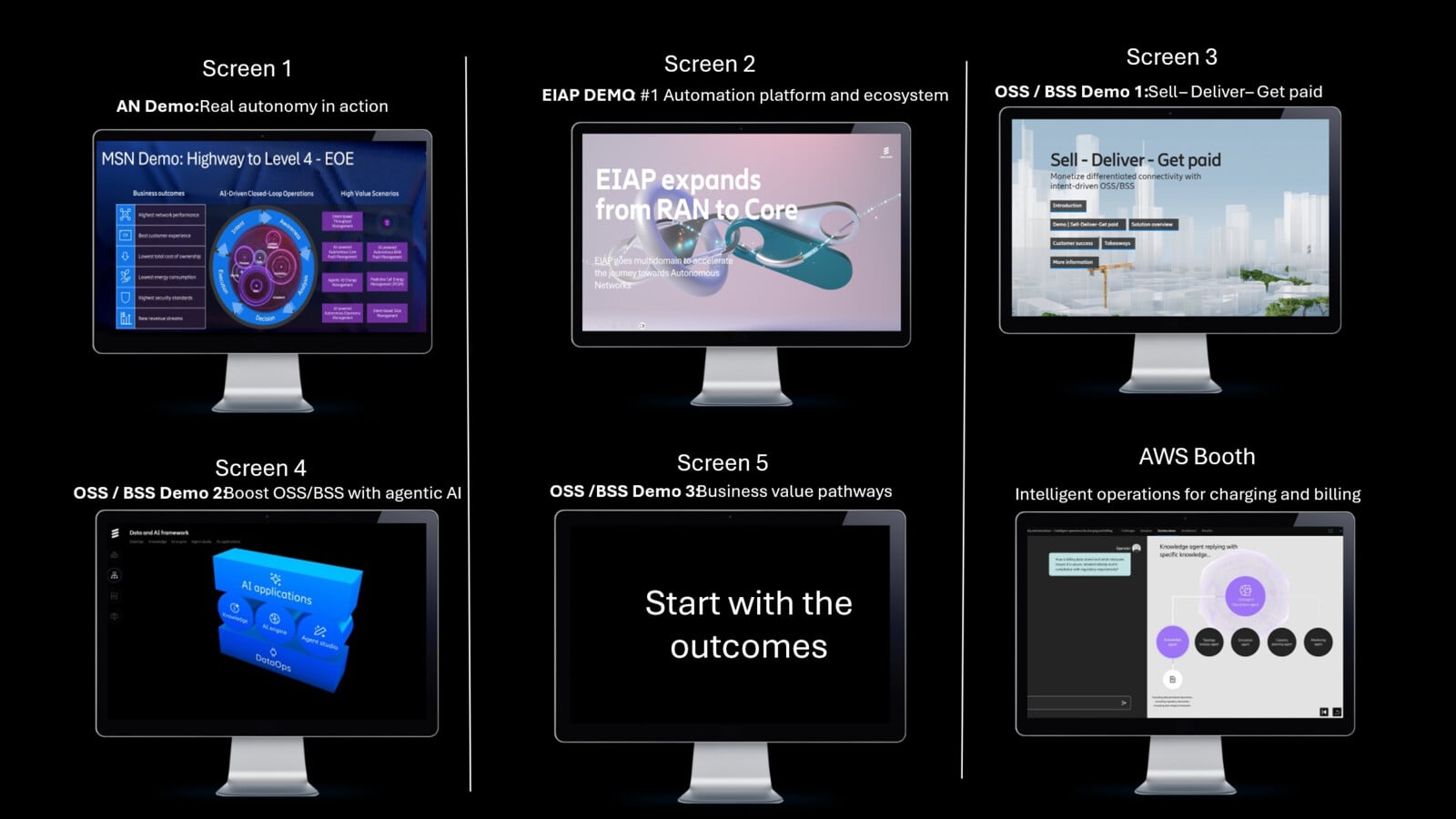
In addition to our product launches, this year we had 5 different demo pods to reinforce our leadership in this area. Our business builders were kept very busy, showing our customers real case studies, our new business value pathways, and how to sell, deliver and get paid with autonomous networks.
We also led the way in 3 catalysts and won two awards. Starting with the Showcase and storyline excellence award winning Business-aware GNN-healing networks catalyst which covered the topics of Autonomous networks and Customer Experience Management. This Moonshot Catalyst was empowering self-driving networks with graph AI and digital twins for predictive root cause analysis and Level 4 autonomy. Their solution unlocks the "zero-X" experience - zero wait, zero touch, zero.
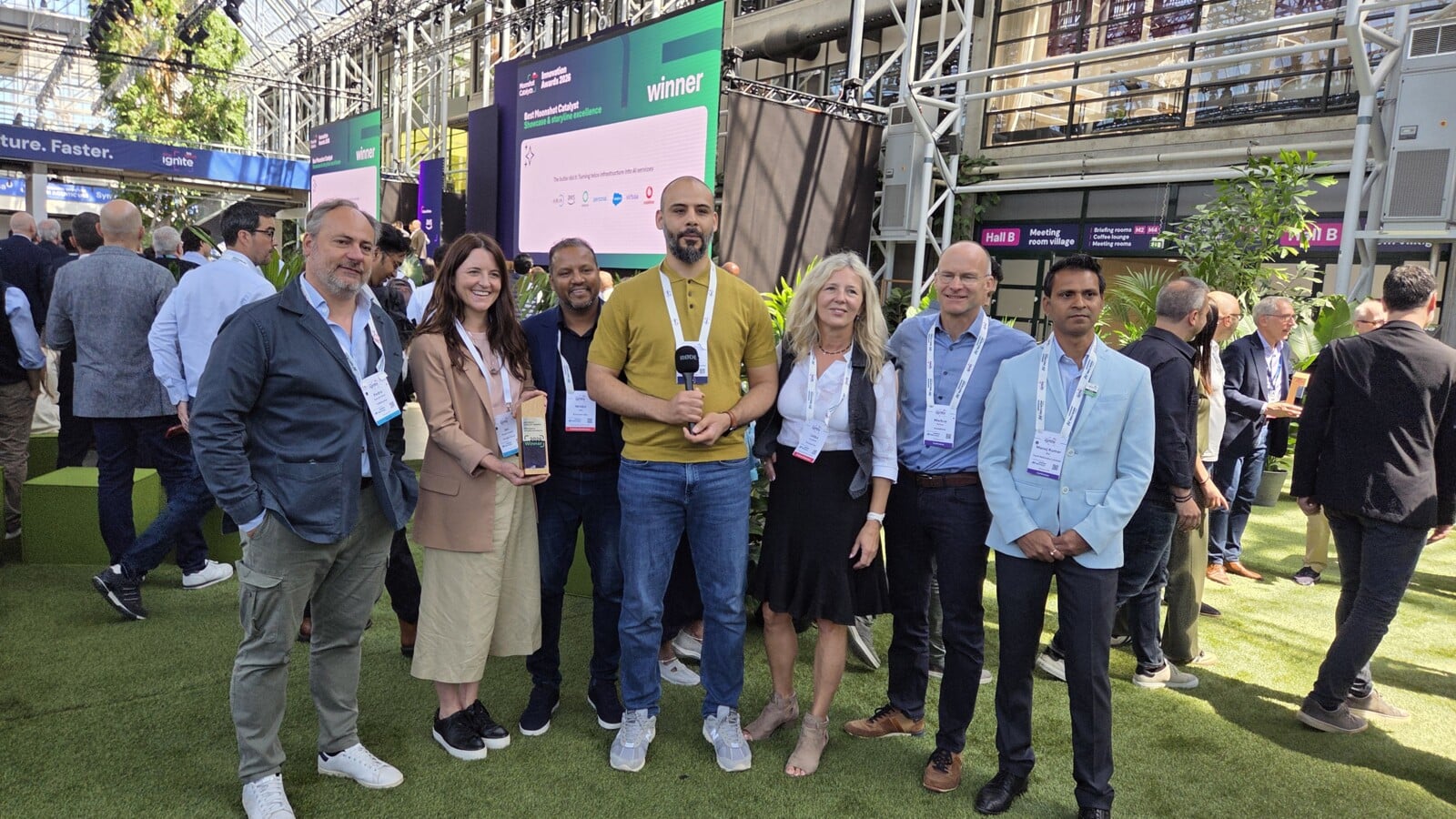
We also won the Attendees' choice with the Conflict management in intent-based networks - Phase II which covered the topics of autonomous networks, intent-based networking and resilience. This Moonshot Catalyst demonstrated how conflict between autonomous entities can be avoided, detected and resolved. We also participated in a third catalyst Telco AEGIS: Autonomous ecosystem for generative intelligence and security, which covered the topics of AI (Artificial Intelligence), autonomous networks and Open Digital Architecture (ODA). This Catalyst aimed to transform CSPs into resilient digital service providers - better equipped to protect customers, meet regulatory expectations, and sustain growth. It achieves this using intelligent telco security service orchestration of AI and automation with governance to protect, validate, and evolve telecom security.
All in all, we showed that we are ready to support our customers to manage complexity and turn intent into outcomes, enabling them to provide and monetize differentiated connectivity and network API services at scale.
It’s all about the business value
CSPs need a more holistic approach that can result in targeted and specified transformation outcomes for intent-based network autonomy, where the system plans, validates and runs the change without human intervention.
This is where the previously mentioned launch of our Business Value Pathways come into play. Built on Ericsson’s continuous OSS/BSS portfolio evolution and the market-leading AI and Automation capabilities from across the whole Ericsson portfolio of products and solutions, the Value Pathways, are pre-designed, integrated and proven operational and solution combinations to ensure expected outcomes are delivered.
At the same time, the Ericsson Intelligent Automation Platform is a key enabler of an open ecosystem for innovation within RAN and Core.
We all agree that autonomous network transformation needs to happen now, but the focus needs to be on outcomes and value – this is how we truly enable the creation and monetization of new services.
It is clear that autonomous networks are not only about managing complexity more efficiently, but about giving CSPs the operational foundation needed to launch, assure and monetize differentiated services at the speed the market demands.
Looking forward to continuing the industry conversation and hope to meet at Innovate Americas(October 6-7), Ericsson own OSS/BSS Summit (October 20-21) and Innovate Asia 17-19 November).