










Ericsson On-Demand delivers Roaming Breakout with 5x download speed boost
- Roaming Breakout proven under real-world conditions, aided by flexible cloud model for global deployment.
- Opportunities starts from improved customer experiences and extends further into consistent and predictable performance to physical AI devices.

Service Owner, Ericsson On-Demand

Solution Manager, Ericsson Singapore

Marketing Director, Core Networks & SaaS

Strategic Product Manager for Ericsson On-Demand at Ericsson
Service Owner, Ericsson On-Demand
Solution Manager, Ericsson Singapore
Marketing Director, Core Networks & SaaS
Strategic Product Manager for Ericsson On-Demand at Ericsson
Service Owner, Ericsson On-Demand
Solution Manager, Ericsson Singapore
Marketing Director, Core Networks & SaaS
Strategic Product Manager for Ericsson On-Demand at Ericsson
Ericsson has successfully demonstrated the technical feasibility and improved performance of Roaming Breakout (RBO), paving the way for the commercial rollout of the service as early as next year.
The field performance measurements were carried out in partnership with Philippine operator Smart Communications in August 2026, operating under real-world conditions. The results provide compelling evidence that the RBO service can vastly improve the mobile customer experience.
Traditional roaming is commonly home-routed, with traffic sent back through the subscriber’s home network even when they are abroad. As anyone who has used their phone overseas can testify, this can result in pages that are slow to load, video buffering and a frustrating lag on calls.
By deploying a core network closer to the user, RBO delivers an experience comparable to using a local travel SIM or even on par with the service they receive at home. In the field performance measurements, the roaming device was connected to a US Tier-1 network. Traffic was routed to a local Ericsson On-Demand core as an extension of Smart Philippines’ home network, rather than being routed back to the Philippines.
Our results from the field
The results speak for themselves and leave little doubt about the performance difference between Ericsson’s RBO service and traditional home routing.
In Ookla speed tests measuring round-trip performance, RBO delivered download speeds of 405 Mbps, compared with 75.8 Mbps using home routing –– more than five times the download speed. At the same time, latency fell from 632 milliseconds to 84 milliseconds, while upload speeds also rose from 27.4 Mbps to 37 Mbps.
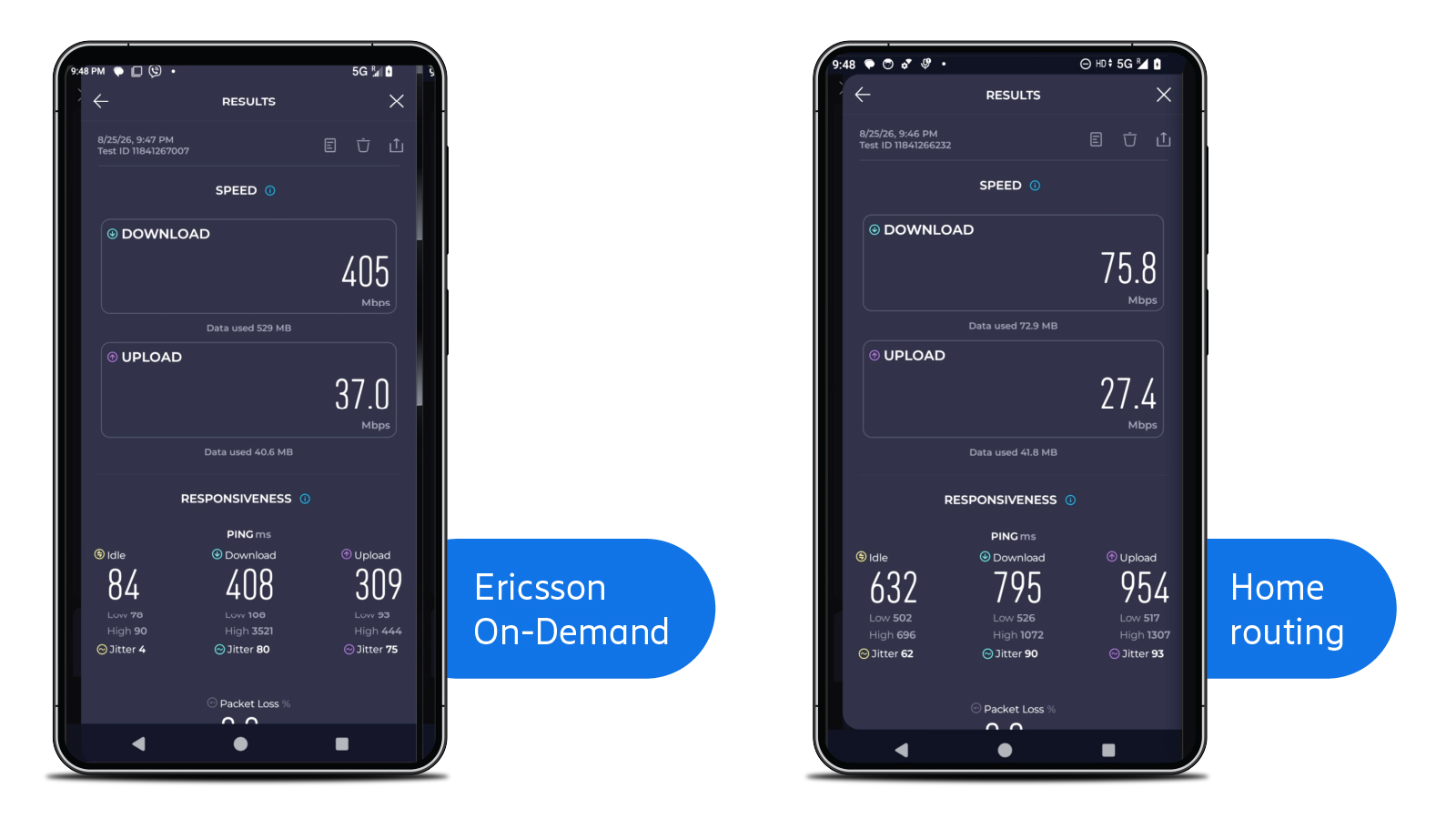
The headline result — download speed jumped from 75.8 Mbps to 405 Mbps.
The improvement extended well beyond headline speed-test figures. In 4K YouTube testing, RBO halved the average buffering time from 0.6 seconds with home routing to 0.3 seconds with RBO, while the drop rate fell from 14% to 7.7%.
The RBO connection recorded just one stalled sample, compared with 19 for home routing, meaning smoother video with far fewer interruptions.
| Speed (Avg/Min) | Buffer (Avg/Min) | Dropped/ Decoded | Drop rate | Stalled samples | |
|---|---|---|---|---|---|
| On-Demand/RBO | 33.0/14.3 Mbps | 0,3/0,2 s | 140/1819 | 7.7% | 1 |
| Home Routing | 11.7/9.7 Mbps | 0,6/0,6 s | 175/1251 | 14.0% | 19 |
RBO delivers half the buffering time with smoother viewing and fewer interruptions.
RBO was also faster across all five controlled web workloads, loading pages between 1.19 and 2.05 seconds, compared with 9.79 to 17.41 seconds using home routing. Put another way, traditional home-routed services took between eight and 12 times longer to complete the web workloads.
| Workload | On-Demand/RBO | Home routed | File size |
|---|---|---|---|
| Field Briefing | 1,34 s | 16,09 s | 1,76 MB |
| Image Gallery | 1,19 s | 9,79 s | 3,52 MB |
| Long-form Feature | 1,47 s | 14,67 s | 5,28 MB |
| Data Story | 1,91 s | 15,06 s | 7,04 MB |
| Archive Collection | 2,05 s | 17,41 s | 8,80 MB |
Web pages appeared in a fraction of the time.
The benefits for consumers, enterprises and CSPs
For consumers, this means a roaming experience much closer to using their mobile service at home, whether they are making a call, watching video, or browsing the web. In the side-by-side video-call test we carried out, the RBO call started several seconds faster and maintained visibly better picture quality than the home-routed call.
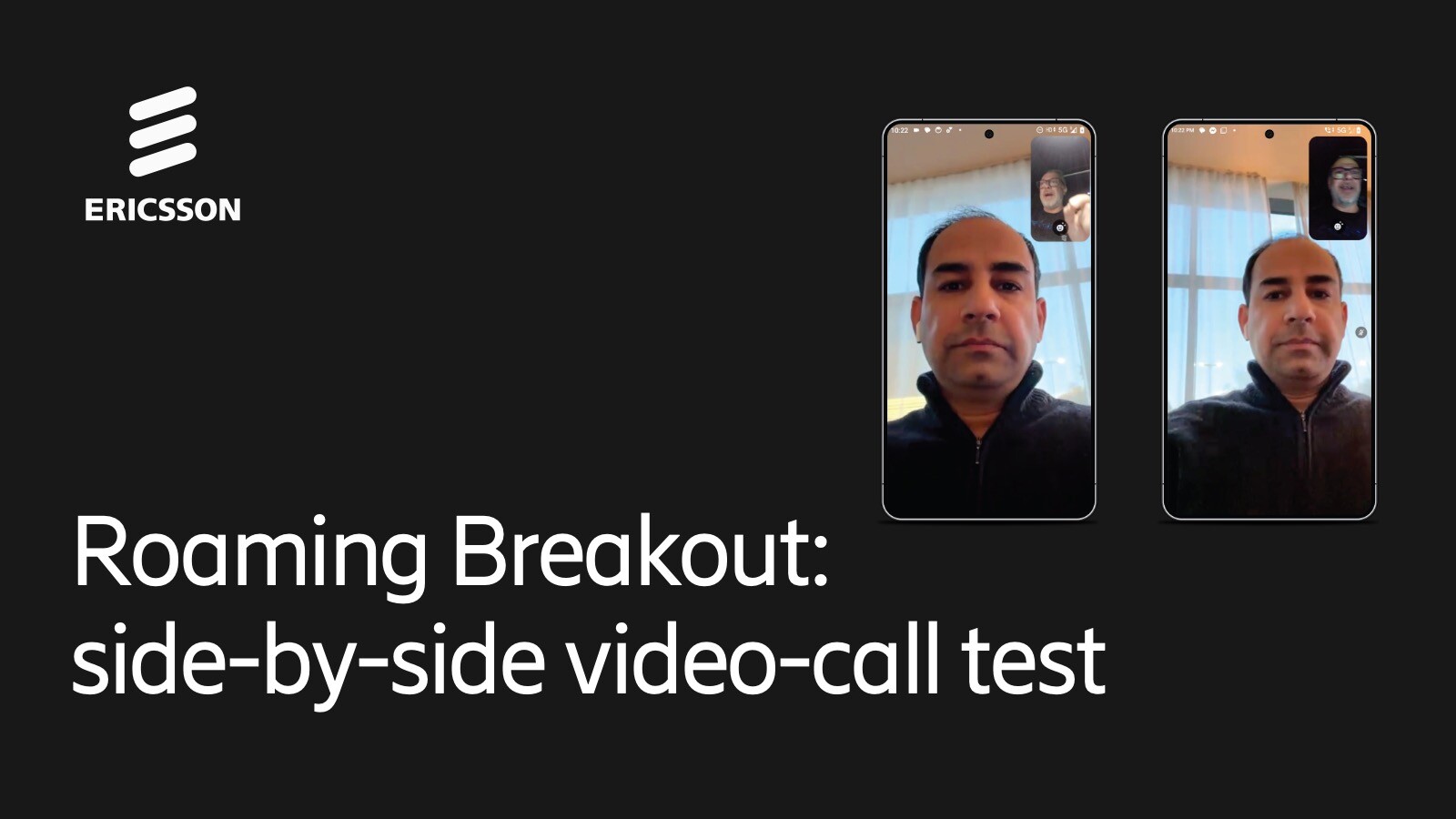
Side by side, the RBO call (left) was a far superior consumer experience.
For enterprises, RBO provides more consistent global connectivity for applications such as connected vehicles and logistics tracking, without businesses having to arrange separate connectivity agreements in every region.
And for Communications Service Providers (CSPs), it offers a way to improve the roaming experience, defend valuable business from travel-SIM providers, and potentially create premium services for consumers and enterprises who are willing to pay for local-quality performance while abroad.
A global cloud delivery model built for roaming demand
In collaboration with Smart Communications, we’ve demonstrated RBO’s performance under real-world conditions. But that’s only half the story. CSPs also need a commercially practical way to deploy it in different markets.
The traditional approach to RBO requires a CSP to secure space in an overseas data center, install network equipment, arrange international connectivity, and build enough capacity to meet peak demand – and that’s before they even connect their first customer.
With Ericsson On-Demand, CSPs can deploy the user plane in the visited country, while they can keep the rest of their core network in their home country. Its integrated IPX service then enables each cloud region with high-speed, low-latency access to visited mobile networks. And by using Google Cloud’s global AI infrastructure footprint, our solution gives operators a choice of locations in which to deploy that capacity.
Ericsson On-Demand’s RBO service provides a low-latency, high-throughput experience with optimized connectivity to services and AI in the public cloud and is a testament to the partnership between Ericsson and Google Cloud, with joint innovation and customer value creation in focus.
Bringing RBO to commercial reality
CSPs have been interested in RBO for years, but the cost and complexity of building network infrastructure in multiple overseas markets have been a major obstacle. Ericsson On-Demand removes that barrier. With self-service, simplicity and end-to-end packaged into a true SaaS offering, Ericsson On-Demand allow a CSP to provision a secure core network overseas within the hour – that’s a game changer when paired with its integrated IPX services.
The SaaS model comes with the major advantage of a pay-as-you-grow model that also reflects the seasonal nature of roaming. Demand can rise sharply during holidays and major events before tailing off again during quieter times of the year, which means CSPs can increase or reduce their usage as demand changes and only pay for the capacity they need.
On every metric measured, Ericsson’s RBO outperformed traditional home routing — from download speed and latency to video streaming and web loading.
Ericsson has demonstrated what can be achieved in real-world conditions with Ericsson On-Demand. The next step is to deploy RBO with selected CSPs ahead of full commercial availability in early 2027.
To find out more about RBO, contact your Ericsson representative or complete the contact form below.
Fill out the formAbout our performance results
All measurements were completed by Ericsson using Smart Philippines SIM and eSIMs on a test APN. Performance was measured using standard tools and applications.
Real-world performance can vary based on the network conditions of the visited network.
All measurements were performed side by side in a short period to ensure consistent results between devices.
Ookla speed test results were performed from a UE in Kansas to an Ookla server in Northern Virginia, routed as follows
- RBO: UE (Kansas) -> RBO core (Ashburn us-east4) -> Ookla server (Virginia)
- Home routed: UE (Kansas) -> Smart Core Network (Philippines) -> Ookla server (Northern Virginia). Note: test measured round-trip performance. One-way latency was recorded at approximately 50% of the round-trip duration.
YouTube performance tests were measured to the nearest Google CDN from the Core network in Ashburn us-east4 (RBO), and the Smart network in the Philippines (Home routed).
Video call testing was performed using two concurrent Facebook Messenger calls on two side by side phones, where call setup is performed via a centralized Meta server and the video call is a direct Peer-to-Peer data stream.
Read more
- Ericsson On-Demand: Liberate your Core. Free your business.
- Turning the world's container fleet into a live data intelligence platform
- CSPs’ opportunity to innovate with core network as a service
- Ericsson demonstrates 5G Core SaaS milestone at MWC 2026
- Ericsson and Google Cloud team up to deliver carrier-grade 5G core as-a-service built with AI at the foundation