










Autonomous drones flying under the mobile network connectivity
Mobile network coverage and intelligence can allow safer long-distant flights for autonomous drones allowing them going further than they ever have before. Together with Vodafone, we have successfully tested safe sky corridors for drones allowing flights Beyond Visual Line of Sight (BVLOS). This is a huge step for advanced connected drones use cases that will benefit society and businesses.
Highlights
Commercial drone applications are becoming increasingly common, with recent forecasts indicating that drones represent a $100 billion market opportunity over the coming years [1]. Drones have the potential to transform everyday tasks such as parcel delivery, medical supply delivery, remote and large-scale infrastructure monitoring, surveillance and more. They can serve multiple segments as industries, retailers, emergency services and smart cities to name some.
However, to release the full revenue potential, we must dare to take drones beyond pilots and deep into unmanned territories.
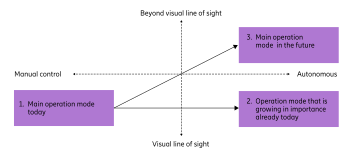
The potential of drone technology will only truly be unleashed when both technological capabilities and regulations allow for autonomous operation beyond visual line of sight.

Watch this video about an innovative partnership between Ericsson and Vodafone to unlock the potential of drones.
Johan Wibergh - Vodafone Group’s Chief Technology Officer
The challenge
Lack of visibility of the drone to ensure safe flight pathways
One of the main challenges for a broader usage of drones is how to keep it functional and accurate Beyond Visual Line of Sight (BVLOS), when the drone operator is no longer able to see the device. Navigating the drone safely is crucial,
It presents a major safety challenge for regulators around the world including both safety on the ground (to prevent drones from falling to earth and injuring people and/or damaging property) and safety in the air (to prevent mid-air collisions).
Due to visual limitations, drones cannot be controlled from more than 3-5 km distant. Current regulations also limit low-altitude operations (below 400ft or 120m) to the visual line of sight of a human pilot who is always in control of the drone. Nonetheless, many enterprises in a wide variety of industries are currently exploring the potential of autonomous drone activity – that is, both beyond visual line of sight and without the direct control of a pilot. However, the solutions should also allow for a remote pilot to monitor and take control of the drone at any time in case problems occur during flight.
Safe connection to the mobile network
Drones must be protected from unauthorized users and malicious attacks. A remote-controlled drone in the wrong hands can cause serious damages to people and assets. Therefore, it is critical to protect the connectivity to the drone and the services utilizing it all over the network, from the controlling system to the network access points being used.
Moreover, in many countries the authorities require mechanisms to uniquely identify each drone and eventually its operators as well. This identification needs to be secure and tamper resistant.
High quality video from the drone at all times
Another important aspect to consider is that a high-quality video streaming from the drone camera should always be possible, independently of the distance between the drone and the pilot and the application receiving the video. The application/pilot should also be able to control the video quality settings applying HQ video only when needed avoiding overloading the network unnecessarily.
The solution
In this proof-of-concept the following solutions were used:
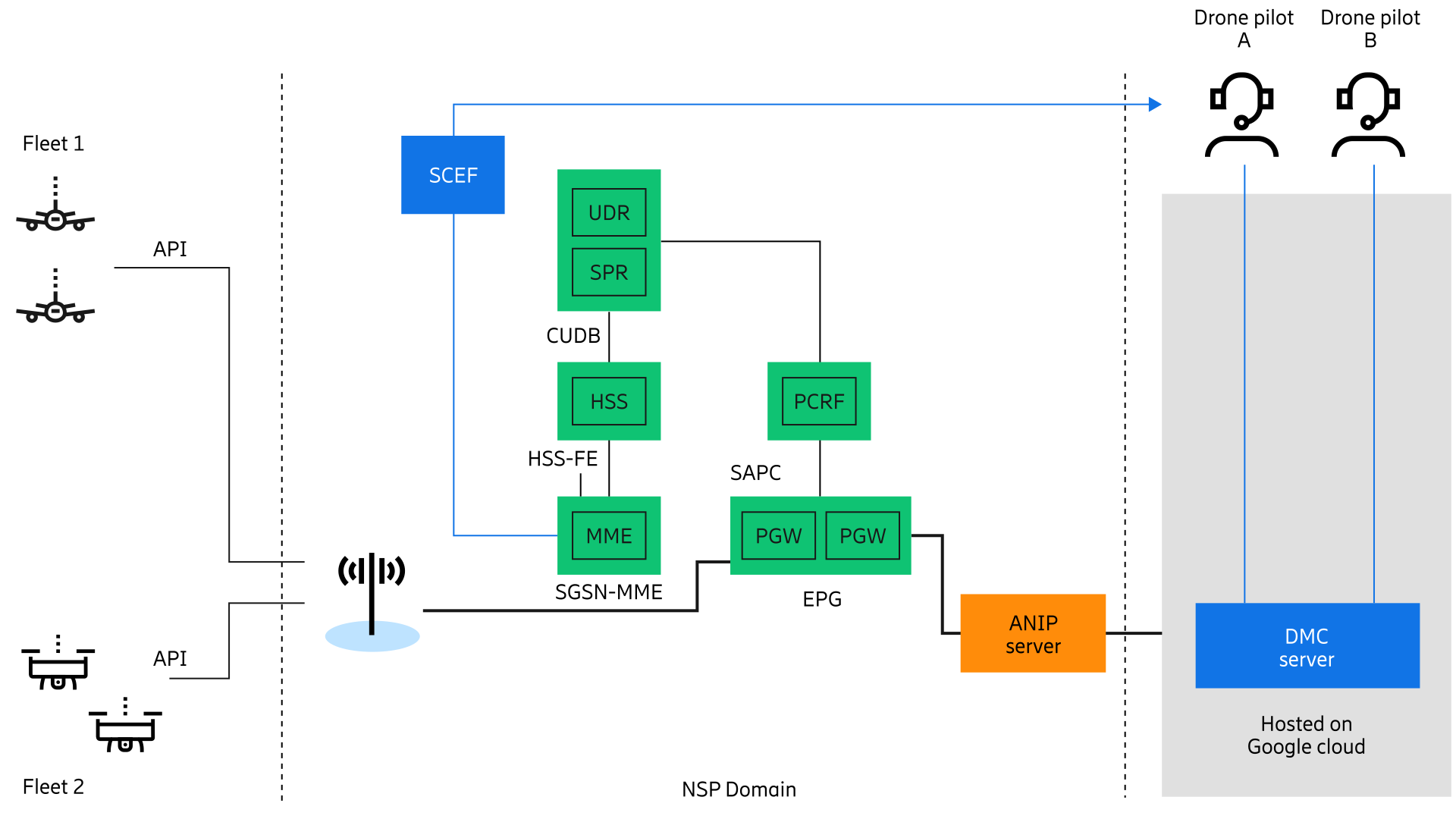
Drone Mission Control (DMC): a cloud-based platform for drone fleet operations developed by allowing certain number of drone pilots to log in, plan and fly the connected drones from anywhere. The DMC automatically calculate optimum routes that can then be accepted or adjusted by the pilot before the flight. It also allows granular permissions where an inspection expert can, for instance, have control over the drone camera while the pilot flies the drone.
Ericsson Application Network Interaction Protocol (ANIP): enables the collaboration between the application service provider (ASP) and the network service provider (NSP). It is a side-band protocol that allows the exchange of information between the client/server ap and the Ericsson packet gateway (EPG). The ANIP offers a second level of authorization to authorize the drone on top of the network level authentication and authorization
Ericsson Service Capability Exposure Functions (SCEF): enables the exposure of core network data between the NSP and DMC. In the scope of this trial SCEF was used to provide also the policy enforcement, to control the quality-of-service (QoS) for video streaming by exposing QoS API.
Policy and Charging Rules Function (PCRF): was used to determine policy rules in real-time for QoS control and to provide user traffic handling and QoS at the Gateway.
Other elements in the mobile core network as the Centralized User Database Consolidation (CUDB), Home Subscriber Server (HSS), and Serving GPRS Support Node-Mobility Management Entity (SGSN-MME) where used to provide other mobile network control plane capabilities such as authentication/authorization of the drones to connect to the mobile network, mobility management, charging, etc.
The benefits
With less human operation, drones can reduce time and costs as well as enhance data analytics, which will enable companies to better comprehend and predict operating performance.
New use cases are emerging, like geo-fencing, network-based geo-location estimates, weather inputs – so the drone can literally avoid adverse weather conditions, inventory and fleet management. The accuracy and reach that drones are capable of will make sometimes risky activities safer, such as site inspections.
One case that will truly transform society will be medication delivery, based on demand and need, as opposed to capability. No longer relying on reach, vital medicine can be delivered via mobile networks and drones. In uncertain times, use cases like this have never been so important. Taking drones beyond the line of sight, entrusting them with intelligent ability to ensure a reliable and secure delivery, is truly amazing.
Erik Ekudden, Senior Vice President, CTO and Head of Group Function Technology of Ericsson
Explore Ericsson's Network exposure solutions and use cases
Blog post: The challenges of taking drones over the horizon
Blog post: Network exposure and the case for connected drones
Vodafone news release: Vodafone and Ericsson trial establishes automated flight paths for connected drones