Port uses private 5G to advance vision for sustainability and more efficient operations
UK site’s private 5G use cases include emission monitoring, access control, and remote-controlled equipment
Learn how one of the UK’s major seaports is driving new levels of safety, efficiency and environmental sustainability with a site-wide private 5G network.
Background and challenges
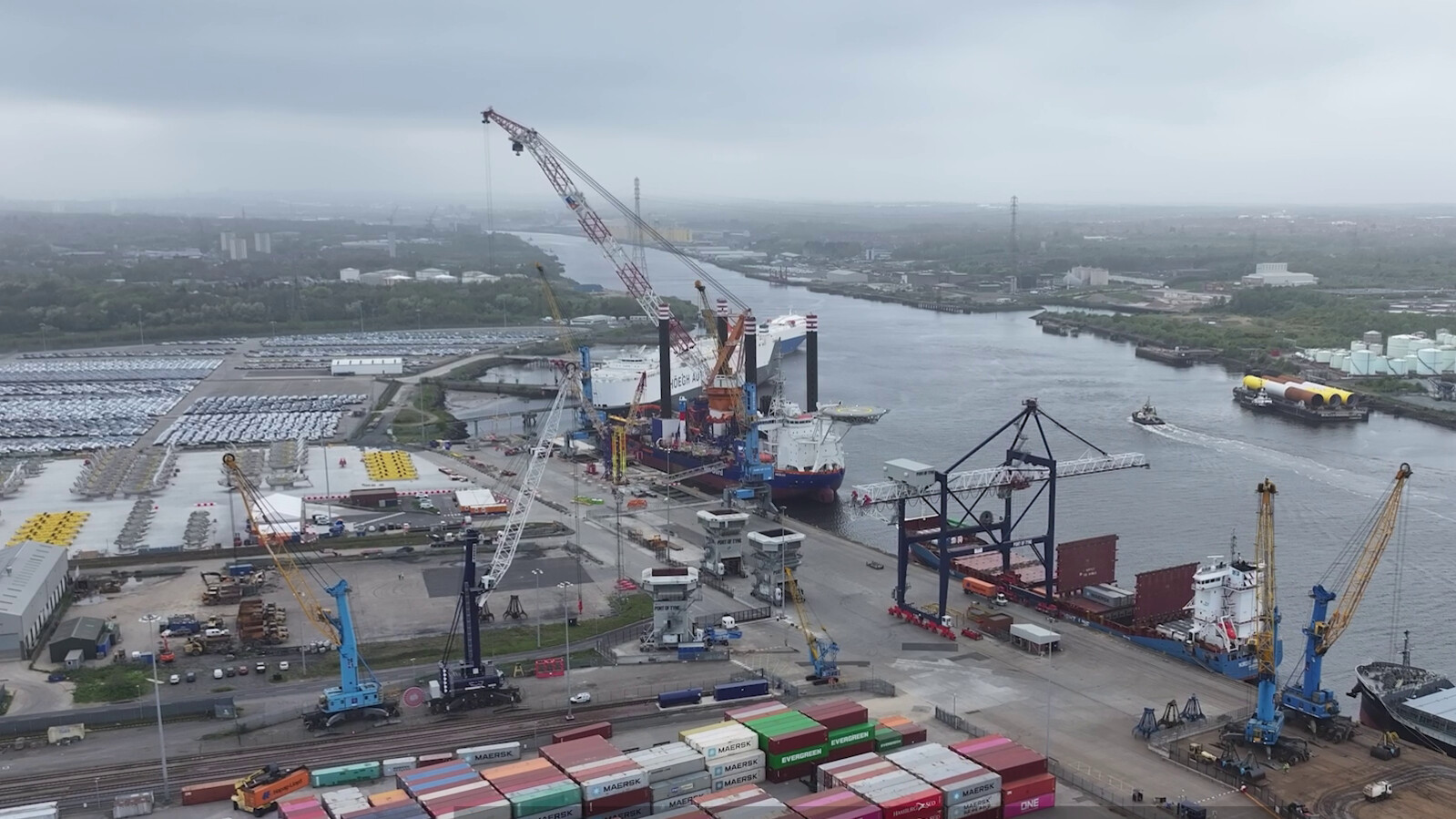
The Port of Tyne helps lead its industry with digital technology projects that support changing customer needs and advance its decarbonization strategy. Several years ago, the port’s frequent adjustments included:
Reconfiguring the physical site multiple times per year. This included trenching through concrete to lay cable, which was costly, inflexible and not feasible for a dynamic port environment.
Connecting actively moving assets like vehicles. Use cases such as autonomous vehicles and automated container inspection are only possible with fast, reliable wireless connectivity.
Extending network connectivity to far reaches of the site. Port of Tyne’s site extends across both sides of the River Tyne, which is difficult to connect using traditional network technologies.
The port and its growing list of mobile devices and applications needed reliable wireless connectivity and high performance across the entire site.
“Wireless connectivity is really important for the port because of the size of the estate and because of the amount of construction that we do. We're always moving things around and wireless connectivity gives us the flexibility to connect wherever we are across the whole estate,” said Tamsin Warren, Head of Technology and Transformation at Port of Tyne.
However, Wi-Fi wouldn’t be able to provide the reliable performance that the port’s many digital projects called for — especially from a mobility perspective. The port is filled with metal, concrete, steel, and other encumbrances that are challenging for radio frequencies.
The solution
With comprehensive support from BT, the Port of Tyne deployed Ericsson Private 5G for high-performance wireless connectivity. The solution supports daily operations across a complex 620-acre site and more than 3km of berths (dock space for mooring vessels).
Private 5G supports a broad set of uses, including:
Live container scanning
Personal protective equipment (PPE) monitoring
Restricted-area detection
AI-enabled road-condition analysis
Emission monitoring
High-security access control using video and sensors
Drones for stock control and infrastructure inspection
The port also has been working with Caterpillar to connect the CatCommand system, enabling remote-controlled shovels that reduce the need for workers to enter potentially hazardous ship holds.
“After a full year of operating on private 5G, we’ve seen firsthand how reliable wireless connectivity strengthens our day-to-day operations. From safety-critical activities to logistical environments, the network has given us consistent, real-time visibility across our whole site. It’s helping our teams to work more safely and make better decisions with the live data to move us forward to becoming one of the UK’s smartest and greenest ports.” — Tamsin Warren, Head of Technology and Transformation, Port of Tyne
“By combining BT spectrum with Ericsson’s dual 4G and 5G infrastructure, the port has a dependable platform for the technologies it relies on today, as well as those it plans to adopt in the future,” said Brian Jackson, Director of Surveillance & Smart Solutions for BT.
Results
Improved wireless coverage and reliability
Within the first year after deployment, the private 5G was providing a high level of dependability for the port and its rapidly expanding list of digital applications.
“The private 5G network at the Port of Tyne has been incredibly reliable. We've never come across any situations where the services, or endpoint devices, have had any kind of connectivity issues,” said John Goy of BT.
Flexibility and scalability for future innovation
Port of Tyne’s foundational high-performance wireless network supports not only today’s use cases, but provides ample bandwidth to enable other innovations that the company decides to on-board — helping the organization strengthen safety, boost operational efficiency, and improve sustainability.
“Private 5G creates the opportunity for us to lead the way to be a sustainable and digital green port for the future.” — Tamsin Warren, Head of Technology and Transformation, Port of Tyne
You seem to be using an old web browser. To experience www.ericsson.com in the best way, please upgrade to another browser e.g., Edge Chromium, Google Chrome or Firefox.