Skip navigation
Previous searches
    Suggested searches
      Man talking on phone on platform-Network optimization

      KDDI boosts uplink with live AI-powered RAN optimization rApps

      Delivering the best connectivity experience with AI and automation

      KDDI tackled growing uplink traffic demands by using AI to optimize performance across a complex live 4G and 5G network. The deployment delivered measurable gains, improving 4G uplink throughput by 9.6% and 5G throughput by 3.1% while maintaining network stability. The trial advanced KDDI’s journey toward Autonomous Networks Level 4 and validated an open Ericsson Intelligent Automation Platform (EIAP) ecosystem supporting Ericsson and third-party rApps. Discover KDDI’s journey in achieving these results.

      First

      global live deployment of the AI driven Uplink Interference Optimizer (UIO) rApp

      First

      Ericsson Intelligent Automation Platform (EIAP) live use in Japan

      Background

      KDDI is relentlessly focused on delivering high-quality connectivity experiences in Japan, which is one of the world’s most advanced mobile markets. As its 4G and 5G networks continue to evolve, rapid site growth, diverse frequency bands and technologies, and the limits of manual optimization have increased pressure on uplink performance, especially under real traffic conditions.

      To address this, KDDI is using AI-driven automation to improve live uplink performance. With SMO providing the automation foundation and rApps running on EIAP, KDDI can respond more dynamically to real network conditions and scale performance improvements across its dense 4G and 5G footprint.

      The challenge

      Demand for uplink traffic is increasing, driven by AI workloads, live video streaming, and low-latency services. For users, especially in dense live 4G and 5G networks, the uplink interference limits throughput and efficiency, degrading the user experience. For operators, the uplink interference also leads to underutilization of their spectrum capacity. 

      KDDI needed a solution to resolve the following challenges at scale and at higher levels of autonomy.

      • User experience: Uplink interference constrained throughput and spectral efficiency under real traffic conditions, affecting both 4G and 5G user experience.
      • Scale and stability challenge: Optimization needed to work across a large, multi-technology, multi-band live cluster without compromising network stability under load.
      • Autonomy and openness challenge: The approach needed to demonstrate progress toward higher autonomous network levels while operating within a standards-aligned, open ecosystem.

      “Highly reliable, low latency uplink performance is a critical foundation for Physical AI use cases, which Japan has identified as a priority area in its semiconductor and digital industry strategy’’ 

      Hiroaki Ando,
      President and Representative Director, Ericsson Japan

      Hiroaki Ando

      Solution

      Ericsson and KDDI executed a large scale field trial in a production network with an AI driven Uplink Interference Optimizer (UIO) rApp, running on the Ericsson Intelligent Automation Platform (EIAP).

      The deployment covered a multi technology, multi band cluster of approximately 1,500 5G cells and 1,300 4G cells. The UIO rApp selectively optimized the necessary cells for uplink improvements without compromising network stability

      How does the UIO rApp work?

      The UL Interference Optimizer uses AI to learn from different configurations, environments, neighboring cells, etc. When a cell impacted by uplink (UL) interference is detected, the optimizer automatically recommends optimum UL power control parameters to resolve the issue.

      The trial also integrated an rApp from FYRA, an EIAP ecosystem member based in Japan. This validated EIAP compliance with the R1 standard and demonstrated support for both Ericsson and non Ericsson rApps in an open ecosystem.

      Results

      User experience

      • Uplink throughput gains: Delivered a 9.6% average improvement in 4G uplink throughput and a 3.1% improvement in 5G, supporting a better end-user experience.
      • Improved signal quality: A 27% improvement in 5G Signal-to-Interference-plus-Noise Ratio (SINR), enabling higher uplink modulation and spectral efficiency across 4G and 5G. 

      Scale and stability

      • With robust AI model performance underload, performance was sustained despite 10% higher uplink traffic, with no compromise to network stability.

      Autonomy and openness

      • Progress toward autonomy: The UIO rApp was assessed at Level 3.86 autonomy for uplink optimization, marking a concrete step toward Autonomous Networks Level 4. The rApp also reached General Availability (GA) during the trial.
      • Open ecosystem validation: The successful integration of an rApp from FYRA, an EIAP ecosystem member based in Japan, validated EIAP compliance with the R1 standard and demonstrated support for both Ericsson and non-Ericsson rApps.

      “The successful field trial with KDDI confirmed the readiness of the UIO rApp, running on the EIAP, plays a key role in achieving Autonomous Networks Level 4 (AN L4) live operation’’
       
      Jean-Christophe Laneri, 
      Head of Cognitive Network Solutions at Ericsson

      Jean-Christophe Laneri

      The UIO rApp has been assessed as enabling Level 3.86 autonomy for uplink optimization, using an adaptation of the TM Forum’s ANLET methodology. This highlights the role of the application and AI-driven uplink optimization as a high value and achievable use case that is accelerating KDDI’s journey to Level 4 network autonomy and beyond.

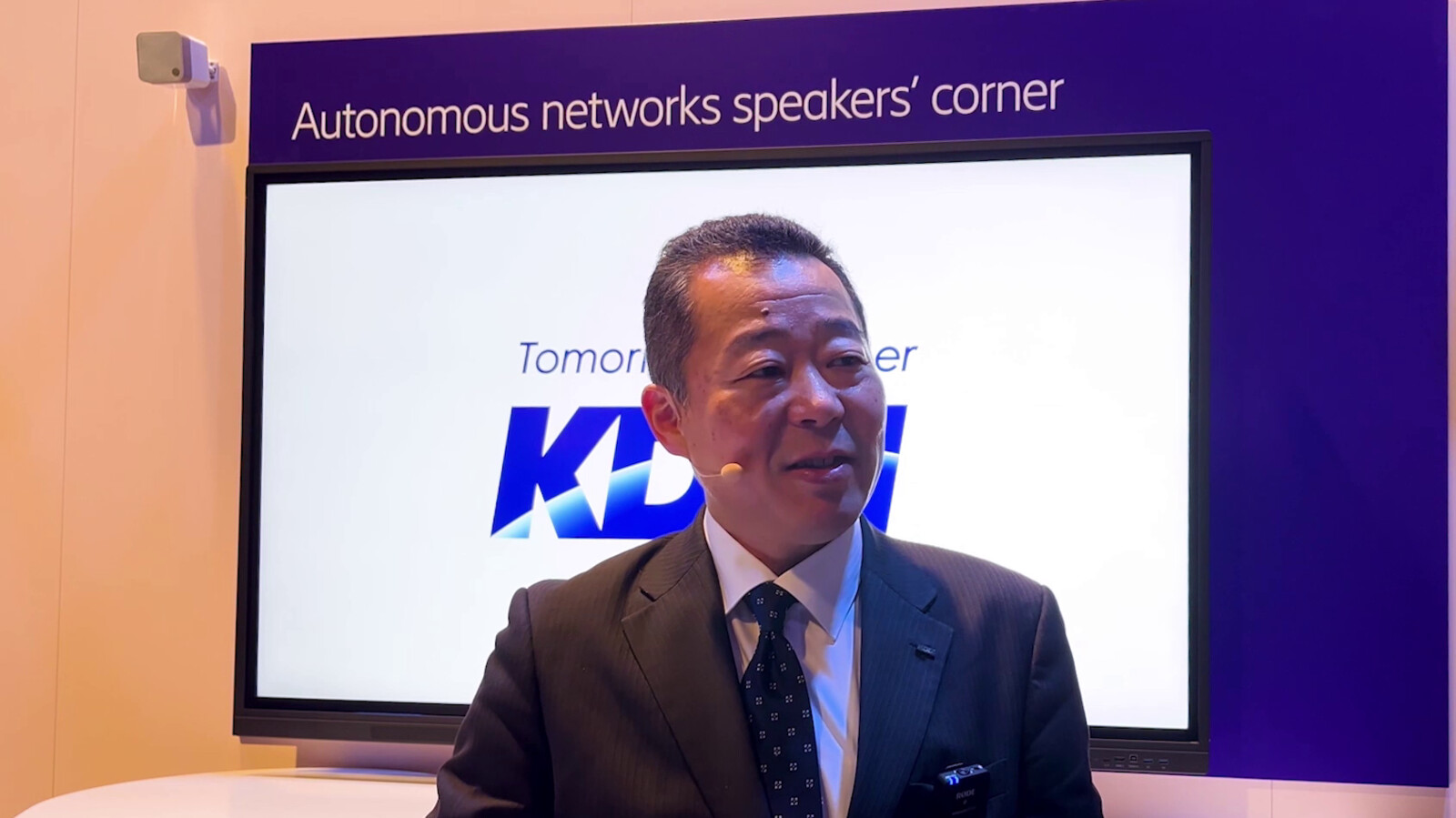
      Watch the interview with Mr. Furuhata, Chief Network Office, KDDI, at MWC 2026

      Related content