










Assessing the impact of cognitive rApps in achieving autonomous networks Level 4
- Network autonomy is a paradigm shift in realizing the industry’s vision of cognitive systems that detect, analyze, optimize, and solve issues with zero human intervention.
- For the resource operations layer, Service Management and Orchestration (SMO) platforms and rApps are the heart of this transformation, driving operational intelligence, customer experince and network performance improvement.
- The adaptation of the TM Forum assessment methodology explained in this blog is a best practice for a foundational and standardized approach to measure how AI capabilities, specifically rApps, contribute to autonomous networks realization at scale.

rApps Strategic Product Manager in Cognitive Network Solutions

Principal Consultant

Product Marketing Manager in Business Area of Cloud Software and Service at Ericsson

Domain rApps Strategic Product Manager

rApps Strategic Product Manager in Cognitive Network Solutions
Principal Consultant
Product Marketing Manager in Business Area of Cloud Software and Service at Ericsson
Domain rApps Strategic Product Manager
rApps Strategic Product Manager in Cognitive Network Solutions
Principal Consultant
Product Marketing Manager in Business Area of Cloud Software and Service at Ericsson
Domain rApps Strategic Product Manager
The Road to Autonomy
First, let’s establish the context. The journey toward autonomous networks (ANs) has become a focal point for enabling operational efficiency, network performance improvement, seamless scalability, and customer satisfaction.
Think of ANs as networks that largely run on their own, fine-tuning operations and problem-solving with minimal human input. It's the vision the telecom industry has been working toward, guided by the TM Forum since 2019.
TM Forum has laid out a clear roadmap for this evolution, breaking it down into six maturity levels from L0 to L5:
- L0 – Manual operations: Everything is human-led.
- L1 – Assisted operations: Tools help, but humans make all the calls.
- L2 – Partial autonomy: Some processes are automated with pre-set rules, but people still steer.
- L3 – Conditional autonomy: AI starts to take charge, continuously learning how to improve.
- L4 – High autonomy: Certain scenarios are almost fully automated and closed-loop control comes into play.
- L5 – Full autonomy: No human intervention – the ultimate goal (though we’re not quite there yet).
These levels provide a structured way for Communication Service Providers (CSPs) to evolve their networks step-by-step, from human-driven operations today to future-ready, fully autonomous systems.
SMO and rApps: realizing network autonomy at scale
If network autonomy is the destination, it’s important to understand how to reach there. Legacy automation systems. Like Self-Organizing Networks (SON), were not built for a future of AI, intent, and cross-domain autonomy. That is why new architecture that is secure and scalable is needed. Service Management and Orchestration (SMO) architecture is the right answer for this on the resource operations layer, with scalable, secure and open interfaces orchestrating data and processes to achieve intent-driven network operations.
Ericsson Intelligent Automation Platform (EIAP) is the industry leading implementation of SMO, enabling multi-vendor cross-domain autonomy. It contains all the elements needed for cognitive automation and includes components like policy orchestration tools Ericsson Intelligent Controller (EIC), Ericsson Network Manager (ENM) and Ericsson Orchestrator (EO) and on top comes the real star of the show: Cognitive rApps.
The EIAP holds the leading open rApps ecosystem. These modular, AI-powered software applications sit on top of SMO platforms, automating key functions like fault resolution, energy management, and optimization. Essentially, rApps enable networks to operate on their own. Modular in design, they can be created for various network scenarios, which makes them a cornerstone of advancing toward higher AN maturity.
Valuing rApps: Assessing Their Role in Autonomous Networks Transformation
Now, let’s move to a simple but crucial question: How much value do rApps bring to the journey toward network autonomy?
To figure this out, we leaned on TMF’s ANLET (Autonomous Network Level Evaluation Tools) – a methodology designed to evaluate how well processes or systems support autonomous capabilities.
Ericsson proposes an adaptation of the ANLET methodology to measure how rApps contribute to maturity levels, mapping them across the five scoring principles according to TMF GB1059.
- Intent: What needs to happen?
- Awareness: Understanding what’s happening in the network.
- Analysis: Finding issues or optimization opportunities.
- Decision: Picking the best solution.
- Execution: Making the solution happen in real-time.
This methodology provides a framework to assess the maturity scores for individual rApps and their overall impact on networks, detailing how they perform specific tasks and where improvements are needed.
“Ericsson has been a strong contributor in developing the AN Level Evaluation Tools within TM Forum’s Autonomous Networks collaboration program. Extending ANLET to assess how rApps contribute to autonomy levels across high‑value RAN scenarios is potentially very useful. Evolving Ericsson’s approach into an industry agreed standard would be valuable, as we are seeing demand from our CSP members for validation of solutions that can improve their AN Levels.”
George Glass, Chief Technology Officer, TM Forum
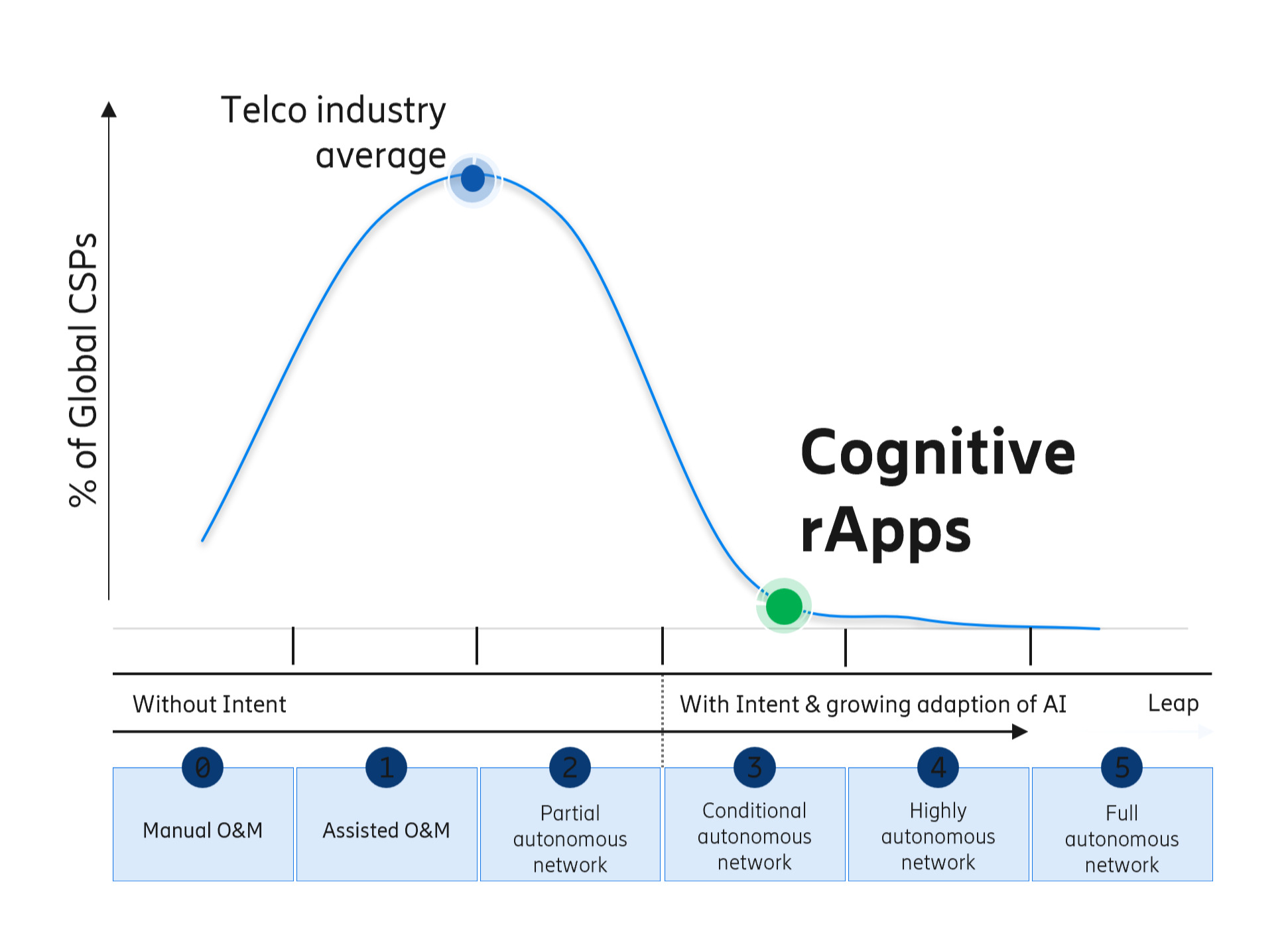
Cognitive rApps significantly advances CSPs AN maturity level
A few more words about ANLET and how we’re adapting it
ANLET is a powerful diagnostic tool for Communications Service Providers. By applying it to rApps, they gain visibility into where their networks sit on the autonomy spectrum and allow them to jump-start the journey with scalable and secure solutions. Some standout benefits include:
- Spotting gaps that inhibit automation and intelligence.
- Establishing clear baselines to measure progress during transformation.
- Strategically targeting higher AN maturity levels.
To make ANLET fit for software evaluation, we added some new dimensions, like considering combinations of rApps across operational chains (what we call “chaining”). This adjustment allowed us to measure the end-to-end contribution of multiple systems working together to close processes like issue detection and resolution.
Another tweak was introducing pro-rata scoring. Let’s say two rApps contribute 60% and 40% to a specific step like awareness. We separated and scored those contributions before combining them. This prevented any overlaps and ensured realistic scoring that doesn’t overshoot the evaluation score and challenge us in building more advanced capability in the future.
Results: How autonomous are Ericsson’s Cognitive rApps according to ANLET?
Ericsson’s assessment didn’t just try to answer "how autonomous" each rApp is. It also aimed to show how much customer value they bring.
This is what we found:
- Some rApps scored close to 4.0 on a maturity scale, demonstrating strong readiness for deployment in advanced autonomy scenarios.
TM Forum ANLET methodology adaptation
| Ericsson rApps | 2026 | 2027 | 2028 | |
|---|---|---|---|---|
| Detection | Cell Anomaly Detector | |||
| Uplink Anomaly Detector | ||||
| Root cause | Anomaly Root-Cause Explainer | |||
| Propose | Anomaly General Optimizer | |||
| Uplink Interference Optimizer | ||||
| RET Cell Shaper | ||||
| AAS Cell Shaper |
rApps contribution to AN maturity level
What does this mean in practice? Here are few examples:
The chain of Cell Anomaly Detector, Anomaly Root Cause Explainer and Anomaly General Optimzer: this chain transforms the RAN quality optimization process moving from the conventional worst-cell hunting processes to network-scale issue detection, root cause analysis and change recommendations. Testing these rApps in the field has shown significant levels of network efficiency improvement, up to 60% reduction in cells with performance issues, +10% improvement in cell throughout, and +6% uplink spectrum efficiency.
AAS Cell Shaper rApp: This rApp dynamically optimizes Massive MIMO beam forming configurations, adapting them to user traffic profile, spatial and geographical distribution with cell-tailored configuration decided by the AI algorithm among exponentially growing permutations. This rApp delivers improved user experince in uplink and downlink throughput and efficient spectrum utilization between 4%-8%.
Instant Outage Mitigation rApp: This rApp identifies problems in the network before they escalate, resolving faults quickly and preserving traffic flow. By keeping disruptions to a minimum, it helps maintain service quality and ensures that users experience fewer interruptions, even during unexpected network events.
From evaluation to real-world deployment: ANLAV certification for live deployments
While ANLET offers a diagnostic snapshot of where a network or application, such as rApps, stands in terms of maturity and alignment with autonomous operation requirements, ANLAV is the subsequent step.
ANLAV (Autonomous Network Level Assessment Validation) certification goes beyond diagnostic assessments. It validates that the network components or applications are ready for deployment in actual, live network environments.
While we can look at ANLET as preparation, ANLAV is the field test.
After addressing gaps identified in ANLET, ANLAV ensures that these solutions are integrated, tested, and certified for live operation. It involves rigorous validation processes designed to confirm operational performance, lifecycle integrity, and compliance with TM Forum standards.
Achieving ANLAV certification for CSP processes that leverage EIAP will do more than validate the value of rApps — it will accelerate their adoption across 5G advanced networks. This phase focuses on integrating rApps into live environments, transforming network optimization and operations processes, stress-testing performance under live conditions, and ensuring robust, end-to-end network security.
CSPs: time to jump-start your AN journey without the hype!
Ericsson’s Cognitive rApps are accelerating the shift toward efficient and best-performing autonomous networks. By aligning technology innovation with TM Forum methodologies, we’re giving service providers a structured way to transform operations while delivering real business outcomes. Powered by field proven performance gains and a clear, standards based evaluation framework, these rApps enable CSPs to adopt autonomy with confidence. This is how the industry moves from experimentation to real, scalable, autonomous network transformation.