Building the UK’s best mobile network

The merger of Vodafone UK and Three UK created VodafoneThree—and a unique opportunity to transform the UK’s mobile infrastructure. To realize this ambition, VodafoneThree partnered with Ericsson to design and execute a large scale network integration program that could deliver immediate customer benefits while preparing the network for a fully optimized 5G Standalone (SA) future.
At the center of this transformation is Ericsson’s deployment of Multi Operator Core Network (MOCN), enabling VodafoneThree to rapidly improve coverage, capacity, and performance for millions of customers—without waiting for full physical network consolidation.
Why: Delivering early Impact while managing merger complexity
Integrating two national mobile networks is technically and operationally complex. VodafoneThree needed to unlock the value of combined spectrum assets quickly, while carefully managing risk across live networks, multi vendor environments, and regulatory constraints.
Ericsson worked closely with VodafoneThree to address this challenge with a pragmatic, phased approach. The goal was clear: deliver immediate, customer visible improvements at national scale, while maintaining service continuity and building a solid foundation for long term network simplification and 5G SA evolution.
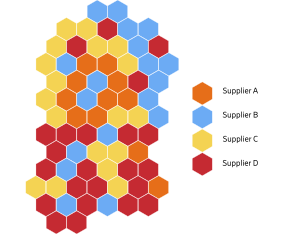
Illustrative diagram of multi-vendor site boarder (Pepper-pot)
"Working closely with Ericsson, and thanks to the continued efforts of our teams across VodafoneThree, we've completed a hugely complex network improvement programme that is already delivering real-world impact for our customers."
Iain Milligan (Network Development & Infrastructure Director, VodafoneThree)

What: A phased MOCN strategy designed and led by Ericsson
Ericsson designed and delivered a two phase MOCN program that balanced speed, stability, and long term performance.
Phase 1: Easy MOCN
In the first phase, Ericsson enabled MOCN on priority sites using existing RAN hardware and each operator’s pre merger spectrum holdings. This avoided the need for immediate site upgrades and allowed VodafoneThree to move fast.
Ericsson led the end to end network design, site selection, and integration, deliberately pepper potting deployments across the UK to validate interoperability, mobility, and operational processes across vendors and network grids. This phase delivered rapid improvements in 4G and 5G coverage and capacity for millions of users.
Phase 2: Full MOCN
In the second phase, Ericsson is supporting VodafoneThree’s transition to a fully consolidated shared RAN. Following targeted hardware and transmission upgrades, spectrum is progressively harmonized and stacked to unlock deeper carrier aggregation, improved spectral efficiency, and higher overall performance.
This phase simplifies the network architecture and optimizes it for 5G SA, creating a resilient, future ready platform for advanced services.

How: Ericsson’s deployment at national scale
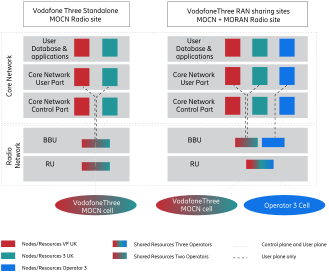
Illustrative diagram of MOCN and MORAN architecture
Deploying MOCN across a national footprint requires more than technology—it demands execution discipline. Ericsson applied its global experience in large scale, multi operator network integration to manage complexity and minimize risk.
Key elements of Ericsson’s delivery approach included rigorous lab and field validation, KPI driven release gates, rollback planning, and cross functional governance spanning radio, core, transport, and operations. By coordinating spectrum strategy, multi vendor interoperability, and live network changes, Ericsson ensured that performance gains were delivered safely and consistently at scale.
Results: Measurable improvements for millions of customers
Ericsson’s MOCN deployment delivered immediate, measurable impact. By November 2025, more than 21 million VodafoneThree customers across over 8,000 sites were automatically connecting to the strongest available network signal—at no additional cost. Many gained access to improved 4G and 5G services where coverage had previously been limited, alongside faster speeds and increased capacity.
The shared network also drove strong traffic growth across both legacy networks and contributed to reduced reliance on 2G and 3G, supporting VodafoneThree’s broader network modernization goals.
Together, VodafoneThree and Ericsson demonstrated that a disciplined, phased MOCN strategy can turn merger complexity into rapid customer value, while building a simplified, high performance national network ready for the next generation of connectivity.
| LTE - 3UK Grid - MOCN Downlink Data Volume Total Data Growth: 13.75% Vodafone Contribution: 10.56% |
LTE - VF Grid - MOCN Downlink Data Volume Total Data Growth: 34.53% 3UK Contribution: 22.42% |
| 5GNR - 3UK Grid - MOCN Downlink Data Volume Total Data Growth: 8.11% Vodafone Contribution: 3.67% |
5GNR - VF Grid - MOCN Downlink Data Volume Total Data Growth: 40.06% 3UK Contribution: 25.27% |
"Bringing our networks together marks a major milestone for VodafoneThree. The result is a single, intelligently orchestrated platform that delivers measurable improvements in performance, reliability and efficiency. Now, up to 28.6 million customers are experiencing higher speeds for everyday browsing and streaming, as well as improved coverage and reliability when using 4G and 5G.
Through this process, we have also successfully removed 16,500 sq km of not spots – areas that previously had little or no mobile coverage – enabling more customers in more places access to reliable connectivity."
Nicola Binucci (Network Design, Planning and Optimisation Director, VodafoneThree)