




Skip navigation
Previous searches
    Suggested searches

      Ericsson Adaptive Inventory by Appledore Research

      This solution profile of Ericsson Adaptive Inventory (EAI) updates Appledore’s 2023 profile. Over the past three years, the role of inventory has changed enough to justify a fresh look at both the product and Ericsson’s market position, as well as what operators should expect from a modern inventory platform.

      Report
      OCT 9, 2026

      Executive summary

      Accurate inventory is the foundation of network automation. Without a timely and reliable view of what the network contains and can deliver, removing human intervention from operational processes is almost impossible. That argument still holds. What has changed is its importance. 

      Operator networks have continued to move from semi-static hardware functions, where change was measured in years, to increasingly software-defined, dynamically connected environments where change is measured in minutes and hours. Legacy operational systems, built for the old era, are now active barriers to managing this complexity. The hope placed in cross-domain orchestration, real time discovery, and, more recently, AI-based agents is well-founded, but all of these require a reliable reference for their decision-making. That reference is the network inventory. Without it, orchestration is brittle, and AI risks making decisions that are incomplete. 

      Inventory has taken on renewed importance. AI not only increases the value of good inventory; it also makes the cost of poor inventory harder to hide. At the same time, the emergence of GenAI is prompting some operators to reconsider building their own solutions, a temptation that Appledore views as the fastest route back to the failed OSS transformation projects of the past. Inventory is more than a database. The ontological knowledge embedded in a mature inventory platform (the understanding of how network entities, their attributes, and their relationships fit together across vendors, domains, and the full network lifecycle) is not easily replicated. It is accumulated through years of multi-CSP, multi-vendor experience, and is precisely what AI needs to distinguish insight from hallucination.

      Ericsson Adaptive Inventory continues to evolve. Appledore will outline what has matured, what is genuinely new, and how it measures up against the demands that the AI and autonomous network era is now placing on inventory platforms.

      Ericsson Adaptive Inventory

      Commissioned by Ericsson

      Ericsson Adaptive Inventory: where we are now

      Appledore last profiled Ericsson Adaptive Inventory in 2023. Since then, the evolution to a fully cloud-native architecture (started in 2021) has been completed. New cloud-native capabilities are released on a regular basis. Ericsson Adaptive Inventory provides customers with infrastructure flexibility in supporting both public and private data centers and providing a choice of vendors for the underlying inventory database (Oracle and EBD) at a time when licensing costs for those 
      components have been a significant operational concern. 

      What has not changed is the core architectural approach. The federation layer, design-and-assign capability, and lifecycle state management introduced with Ericsson Adaptive Inventory in 2015 remain essentially consistent. Ericsson frames this continuity as deliberate: stability in the core model reduces integration risk for customers managing complex operational environments over 
      long timeframes.  

      Ericsson now positions Ericsson Adaptive Inventory as an inventory transformation product. Architecturally rebuilt from the ground up since 2015, fully cloud-native, compliant with open standards (TMF, 3GPP, ETSI), and central to Ericsson's wider autonomous networks proposition.  

      Ericsson's headline features for Ericsson Adaptive Inventory are: 

      • Vendor neutrality and technology agnostic - Ericsson Adaptive Inventory works across network domains regardless of equipment supplier.
      • Multi-domain coverage - a single platform spanning physical, transport, IP, fixed, and mobile network layers.
      • AI-assisted capabilities - including advanced planning, capacity planning, capacity forecasting and digital twin support. 
      • A unified inventory providing a single, objective, real-time view of the network as the foundation for automation and AI.
      • Federation capability - the ability to federate and consolidate legacy systems into Ericsson Adaptive Inventory without requiring a single forklift replacement.
      • 80+ customer deployments in 35+ countries across mobile, fixed, converged, cable, and enterprise operators.

      Architecture and core capabilities

      Ericsson Adaptive Inventory is Ericsson's cloud-native network inventory platform, and a component of Ericsson's wider OSS reference architecture. It is independent of Ericsson’s network technology and supports multi-vendor, multi-domain, multi-layer networks. Ericsson Adaptive Inventory manages the full network lifecycle from:

      • Plan to Deploy
      • Order to Service
      • Trouble to Resolution   

      Ericsson Adaptive Inventory is designed to sit at the center of an operator's operational processes regardless of the underlying network equipment or technology mix. Its core capabilities include unified hybrid network inventory, capacity management, impact analysis, discovery and reconciliation, hybrid service automation, and work order management.

      Part of a wider autonomy platform

      Ericsson Adaptive Inventory is central to Ericsson's autonomous networks proposition. Appledore observed at Ericsson OSS/BSS Summit 2025 that the widely agreed ingredients for autonomous networks are intent; orchestration (encompassing both fulfilment and assurance loops); real-time inventory; closed-loop automation; and abstraction. Ericsson Adaptive Inventory is positioned as the real-time inventory layer on which the others depend. 

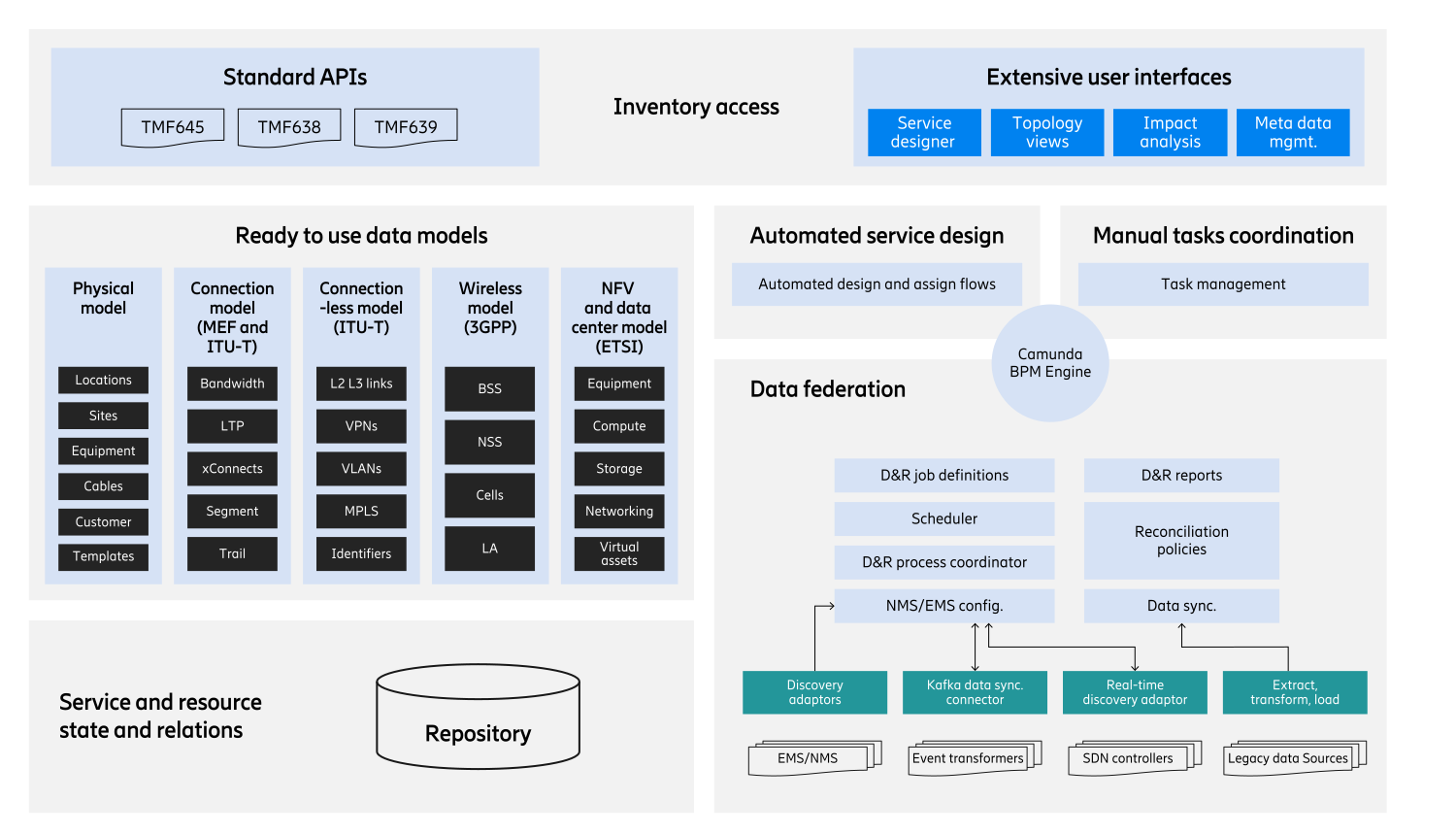
      Ericsson Adaptive Inventory framework

      Figure 1: Ericsson Adaptive Inventory framework
      Data accuracy

      Discovery and reconciliation are integrated capabilities within Ericsson Adaptive Inventory, enabling continuous comparison of the network's designed state against its actual deployed state. Ericsson Adaptive Inventory's strict data model acts as a guardrail, preventing planners from entering incomplete or inconsistent data, which both surfaces pre-existing data quality issues during migration and prevents regression after the initial data cleanse. 

      The data quality enforcement role is well evidenced in customer deployments, as seen in both MBNL’s and Telia’s case studies below. Operators report that Ericsson Adaptive Inventory's strictness, while demanding to implement against, is precisely the mechanism through which data quality is maintained over time. 

      Full network lifecycle support

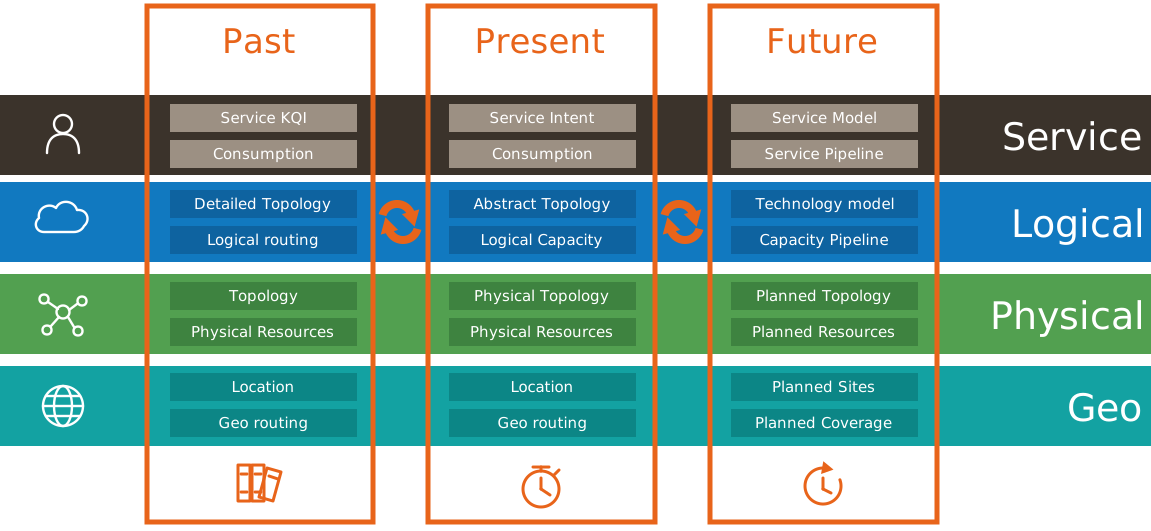
      Ericsson Adaptive Inventory's lifecycle state management, spanning planned, in-service, and archived views, means it can reflect not just the current state of the network but its history and future intent. This aligns with Appledore’s view of the key characteristics of a network inventory over the network lifecycle.


      Appledore Research – Inventory management

      Source: Appledore Research – Inventory management

      The Digital Twin Value Pack

      The Digital Twin Value Pack is the most significant new capability in Ericsson Adaptive Inventory. It introduces AI/ML-powered planning and simulation as a layer above the unified inventory, supporting use cases that previous rules-based capacity management could not support. 

      As laid out in Appledore’s recent digital twin research, accurate, unified inventory is the data foundation on which credible simulation and autonomous decision-making must be built. It is what gives an inventory platform a natural claim to be the starting point for any serious digital twin program. The Digital Twin Value Pack extends Ericsson Adaptive Inventory's role from being a record of what exists in the operational network to supporting simulation of what could happen, using the 
      same trusted data model as the operational system. This avoids the common failure mode of digital twins built on separate, manually maintained datasets that diverge from operational reality.

      There are important caveats. The quality of any simulation is contingent on the accuracy of the underlying inventory data. As customer deployments demonstrate, achieving and maintaining that data quality is a substantial and ongoing program, not a one-time task. Operators who have not yet completed an inventory transformation will find the digital twin's value limited until the data foundation is in place.  

      The digital twin narrative has given Ericsson Adaptive Inventory a stronger and more coherent strategic identity. It shifts the product conversation away from legacy replacement towards ongoing business relevance: faster automation, better operational visibility, and stronger decision support. More fundamentally, it repositions inventory from a passive system of record to an active, continuously reconciled model of the network. Whether the market recognizes Ericsson Adaptive 
      Inventory in those terms will depend as much on deployment maturity within individual operators as on the product capability itself.

      MBNL case study

      MBNL, Mobile Broadband Network Limited, operates a shared network infrastructure for two UK mobile network operators. MBNL’s role is to manage various access technologies including Radio access networks, leased-lines, microwave, and managed service providers.  

      The day-to-day operations of this environment created network complexity and scheduling issues when trying to manage the lifecycle of the transport and the cell sites. MBNL’s existing inventory solution was based on an off-the-shelf product, which was heavily customized but was failing to deliver for MBNL, and more importantly, for the mobile network. MBNL’s operation problems included: 

      • An inability to manage the scale, volume, and complexity of MBNL’s network
      • Data accuracy issues across the transport and site data
      • Lack of a Configuration Management Database (CMDB) and network baseline – there was no way to check what was in the network against what was designed to be in the network.
      • Work order data and scheduling conflicts – multiple concurrent work orders running with different field contractors with an inability to reconcile conflicts
      • Managing data segregation – competition with regulations and prevention of exposing sensitive information between competitors.  
      • Ensuring that the mobile network operators MBNL serves can access what they need to access and only what they should access for their operations 

      “We had a complex network and the only tool that we could find that would do what we needed it to do for the environment we were working in was Ericsson Adaptive Inventory. It provided all the data segregation we needed, the complex network provision that we needed, the work orders, data and transmission network engineering work orders that we needed and inventory control that we did not possess before”

      - Pete Norris, Head of Transmission, MBNL 

      MBNL chose Ericsson Adaptive Inventory (EAI) to replace its existing inventory and work order management solution.  Ericsson Adaptive Inventory allowed MBNL to:

      • Support a multi-vendor, multi-supplier ecosystem, based on work order management and inventory product capability out of the box, without extensive customization.
      • It provided strong data governance that would improve data accuracy.  
      • It allowed MBNL to provide clear boundaries for what could be seen by 
        customers/shareholders, suppliers and MSPs. In particular, it supported “guardrails” that supported concurrent changes by customers and suppliers without exposing competitive intelligence. 
      • It enabled network change in parallel, with access to network data segregated to meet competition-law constraints.

      The transformation project, delivered jointly by MBNL and Ericsson, allowed MBNL to benefit from Ericsson’s large scale, inventory transformation expertise. The goals of the transformation program focused on three key areas: 

      For successful delivery, what decisions get made, by whom and using what data, needed to be understood. The project focused on how to prevent conflicting changes without blocking parallel work on the network from both MNO customers. 

      The data that was consolidated onto the Ericsson Adaptive Inventory platform was sourced from 13 legacy systems totaling 150 million attributes. This data needed to be consolidated and corrected to create a dependable, accurate single view that prevent compounding inaccuracies over time.

      with Ericsson Adaptive Inventory providing enhanced data integrity and the new system of record, processes touching inventory data were simplified allowing MBNL to retire the 13 legacy systems 

      The result is an improved operational reality for MBNL, with Ericsson Adaptive Inventory acting as a control plane for transport network change. Work orders no longer block other customers’ work orders with parallel delivery the norm. Inventory accuracy has improved to the point where data can drive automated decisions. Data segregation is in place to allow MBNL customers to have a complete view of their network without visibility into their competitors’ network. Inventory is no longer a limiting constraint and has become a native capability of the MBNL operating model and business.

      TELIA case study

      “The network is the most important asset in a telco, and having a stable platform is key to maintaining this. Ericsson is a good partner for this” 

      -  Kaj Pinner, Head of Inventories, Telia IT

      Telia is a major Nordic telco operating across multiple countries through a group of regional Operating Companies (OpCos). Its fixed network inventory landscape before transformation with Ericsson was like most tier-1 operators: siloed systems, country-specific tools, and, in some cases, manual and paper records. 

      The existing inventory solution had accrued significant technical debt across four interconnected problem areas:

      Platform stability

      The core inventory platform was running multiple versions behind its supported release. The accumulation of technical debt had reached a point where the system 
      was effectively quarantined. Patching was too risky, routine maintenance risked breaking the application entirely, and a meaningful upgrade path no longer existed. The only viable options were to upgrade or replace. 

      Data inconsistencies

      Data quality was sufficient for manual operations but fundamentally insufficient for automation. Incorrect or incomplete records meant that where a computer system should make a decision automatically, a human expert still had to intervene to determine which source was correct. This created a dependency on specialist knowledge to keep operations running in real time. 

      No viable path to zero-touch automation

      The ambition to automate fiber rollout and service delivery required given the competitive fiber build environment in Sweden was directly blocked by data integrity issues. Automation demanded clean, consistent, trusted data, which the existing inventory solution could not provide. 

      A recurring consolidation challenge

      Telia's growth through the acquisition of smaller fiber operators meant new suppliers, new data sources, and new legacy tools were being continuously absorbed into an already fragile environment. Each acquisition increased the number of siloed systems, compounding the existing issues with the inventory system in place. 

      Ericsson Adaptive Inventory became the target platform for Telia Sweden's "One View" program, with its TM Forum-aligned OSS architecture. The goal of the program was a single, high-accuracy inventory that could serve impact analysis, ticketing, assurance, and zero-touch automation across Telia’s fixed network. 

      Ericsson Adaptive Inventory’s strict data model and native governance capabilities made it the right fit for Telia's requirements, with data accuracy and integrity achieved by product design, rather than through customization by the inventory supplier – something previous inventory solutions suffered from. 

      “Ericsson Adaptive Inventory’s quite strict data integrity prevented low-quality records from being carried forward, which was necessary to support zero-touch ambitions.” 

      - Kaj Pinner, Head of Inventories, Telia IT 

      The project was delivered jointly by Telia and Ericsson. While the deployment in Sweden required significant upfront investment, it established a repeatable rollout model that has paid dividends since. Subsequent deployments across operating companies have been faster and smoother, with configurations reused to a high degree. 

      The outcome is a highly stable, governed inventory foundation with improved data integrity, reduced regression from automated change flows, and a platform capable of scaling zero-touch automation ambitions across the group. Where prior approaches created recurring dependency on specialist development for every new hardware or configuration change, Ericsson Adaptive Inventory gives Telia direct control, with fast turnaround for technology and service updates.  

      Importantly, this fixed-network foundation also provides a path to broader multi-domain inventory convergence. Telia is already using it as the basis for extending coverage into wireless domains, including RAN resources, with discovery work underway alongside Ericsson. This gives Telia greater visibility across network resources and reduces the risk of creating new silos as additional technologies are brought into scope. Over time, that more unified inventory model should strengthen assurance, planning, and automation across countries, domains, and network layers.

      Summary

      Ericsson Adaptive Inventory has strengthened its position since Appledore’s 2023 report. The completion of the cloud-native transition, the addition of the Digital Twin Value Pack, and the evolution as an established inventory transformation platform all represent real progress. The product's role in Ericsson's autonomous networks proposition is well-defined and coherent. 

      The digital twin narrative gives Ericsson Adaptive Inventory a more compelling strategic identity. It repositions inventory from a passive system of record to the active, continuously reconciled model of the network that autonomous network operations will require. That framing is correct and aligns with Appledore's own research.

      Qualifications to this positive picture remain structural rather than technical. The gap between the product's current state and the state of the deployed base is real: the operational benefits of the cloud-native architecture are not uniformly available across the customer base. The Digital Twin Value Pack is a capability in early deployment, not a mature product, and its value is directly contingent on data quality levels that many operators have not yet achieved. Closed-loop agentic automation remains a future state.

      None of these qualifications undermines the direction of travel. Ericsson's roadmap is a realistic reflection of where the market is. The inventory-first architecture is the right one. Whether the market recognizes Ericsson Adaptive Inventory in those terms will depend as much on deployment maturity at individual operators as on product capability — but the product is, in 2026, a credible vehicle for the autonomous network ambition it is positioned to support.

      About the author

      Francis Haysom

      Dr. Francis Haysom has over 25 years of experience in telecommunications and software, leading OSS transformation programs for major service providers and holding leadership roles at Cramer Systems, Telcordia, and Ericsson.

      A recognized expert in inventory, fulfillment, and model-based orchestration, he holds a PhD from the University of Bath and a BSc in Engineering Science from the University of Exeter.

      Will Haysom

      William Haysom is a Data Analyst at Appledore, responsible for the company’s Market Tracker and analysis of CSP technology deployments, including AIOps, network automation, 5G, OSS/BSS, and cloud solutions.

      Based in the UK, he specializes in economic research, financial modelling, and data analysis, and holds a BA in Economics and Politics from the University of Leeds.

      Suggested content