










The Bordeaux University Hospital, Bouygues Telecom Business and Ericsson: Pioneers of the "smart hospital" in France
- English
- Français
To support the profound transformation of French hospitals and healthcare facilities and to better facilitate their digital transition, Bouygues Telecom Business and Bordeaux University Hospital (CHU) have developed the 5MART HO5PITAL project.
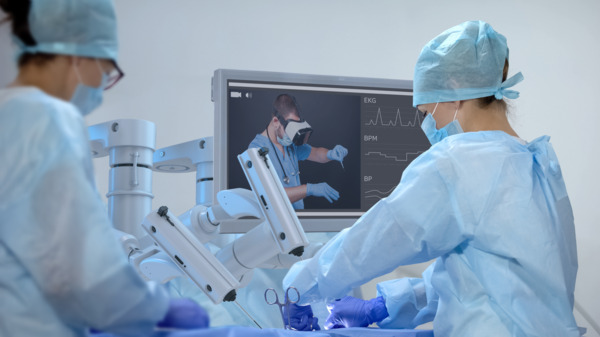
Winner of the Connecting Europe Facility (CEF) call for projects last November, the project aims to bring 5G connectivity to a large part of the Bordeaux University Hospital buildings and improve the quality of care and patient pathways, as well as strengthen the resilience and security of the infrastructure. This initiative also seeks to improve the quality of care and patient pathways, while strengthening the resilience and security of the hospital's infrastructure.
The 5G network as a driver for connected hospitals
The acceleration of the digitalization of healthcare institutions, often referred to as the "smart hospital," is driven by several converging dynamics: digital transformation, technological innovation, organizational restructuring, and the networking of local stakeholders.
These institutions are looking for connectivity solutions that allow them to take full advantage of the benefits of a public and private network (fast speeds, low latency, increased security, data confidentiality) but also, in combination with specific equipment, to develop AI applications, data sharing, and new visualization and interaction techniques. All this while improving the experience of patients and caregivers thanks to multi-operator 5G coverage within the hospital.
To address these challenges, Bouygues Telecom Business and Bordeaux University Hospital have partnered to develop the 5MART HO5PITAL project, based on Bouygues Telecom’s 5G network, ranked as the #1 provider for fixed and mobile Internet performance in metropolitan France.
The envisioned solution will utilize Bouygues Telecom's various frequency bands and the network slicing capabilities of its 5G SA (standalone) network. It will also integrate an Edge Computing infrastructure deployed within the hospital to accelerate the rollout of applications. This solution will allow the same infrastructure to provide both public connections for patients and healthcare staff and private connections for specific hospital uses. Furthermore, Bouygues Telecom Business will handle the core network management, relieving the hospital of maintenance and supervision tasks, while optimizing costs.
From indoor connectivity to revolutionary use cases improving care quality
For Bordeaux University Hospital, robust mobile coverage within the hospital is critical for both patients and healthcare professionals. The initial phase of the project will focus on providing 5G coverage to the various hospital buildings (18 in total) starting in the second half of 2026.
Subsequently, and from 2027 onwards, the deployed solution will support around ten use cases across various themes to improve:
- The experience of patients and healthcare professionals,
- The quality of care,
- The safety and security,
- The performance, resilience, and training.
Among the first use cases planned for deployment are connected ambulances, enabling immediate treatment with remote medical expertise; 3D modeling in surgery for procedure preparation or educational purposes; and connected glasses in surgery for visual assistance during operations.
Ericsson: a strategic partner for the project
To successfully implement this project, Bouygues Telecom Business relies on Ericsson, its long-standing technology partner.
To meet the confidentiality and resilience requirements of the CHU, the project involves deploying specific 5G equipment, called Local Packet Gateways (LPG), within the hospital premises. These devices will be duplicated and located in different places (geographical redundancy) to ensure uninterrupted operation. They will be connected to Bouygues Telecom's 5G core network, provided by Ericsson. This setup offers a dual advantage: the CHU will benefit from a dedicated private network with guaranteed resources while also providing access to Bouygues Telecom's public network.
The solution will also include highly precise geolocation functions enabled by the Ericsson Network Location (ENL) platform. This geolocation technology works outdoors via Ericsson's standalone 5G coverage and indoors through the DOT system, allowing exact localization of equipment and devices used by staff.
The 5MART HO5PITAL project is designed to span three years, with the first buildings covered by 5G in 2026 and the initial use cases launched in 2027.
Vincent-Nicolas Delpech, General Director of Bordeaux University Hospital, says: “5G is a major strategic lever for the development of tomorrow’s hospital applications, directly benefiting both our patients and professionals. Bordeaux University Hospital aims to be a pioneer in this field and is delighted with the European Commission's support for this technological advancement. To make this project a success, we chose Bouygues Telecom Business for its recognized expertise in supporting public institutions with connectivity and for the solid partnership established over the past two years, proven through several successful initial use cases.”
François Treuil, Director of Bouygues Telecom's Enterprise Division, says: “Bouygues Telecom Business is committed to supporting hospitals in addressing tomorrow's technological challenges. The specificities of the hybrid private 5G network are essential for environments hosting both public and private users, such as hospitals or airports. This project aims to demonstrate the socio-economic and environmental impact of 5G to drive large-scale deployments across Europe in various business verticals.”
Christian Leon, Head of Ericsson West Europe, says: “We are proud to contribute to the 5MART HO5PITAL project to ensure reliable, secure, and ultra-low latency connectivity, essential for critical hospital functions such as telemedicine, remote assistance, or real-time data sharing. By participating in this pioneering project, Ericsson reaffirms its commitment to advancing the healthcare sector by offering innovative digital infrastructures that enhance the quality of care and improve patient experiences.”
About the CHU of Bordeaux:
A cornerstone in the hospital, academic, and scientific landscape, the CHU (University Hospital Center) of Bordeaux excels in healthcare, training, teaching, and research at the highest levels. As both a referral center and a hub of innovation, it provides highly specialized care across all medical and surgical short-stay disciplines, supported by cutting-edge technical facilities.
As the largest employer in Nouvelle-Aquitaine, with more than 15,700 professionals, including 1,600 doctors, the CHU of Bordeaux operates across four hospital sites — Pellegrin and Saint-André in Bordeaux, Haut-Lévêque, and Xavier-Arnozan in Pessac. These sites are home to numerous centers of excellence in care, education, and research. Research plays a pivotal role in its institutional mission, with nearly 2,800 ongoing projects involving around 18,000 patients. The CHU hosts two university hospital institutes (IHU) — Liryc, dedicated to cardiac rhythm disorders, and VBHI, focused on cerebral vascular health — as well as four RHUs, further solidifying its national and international position in healthcare innovation.
The CHU of Bordeaux is currently undertaking an ambitious €1.4 billion rehabilitation and construction program for the New CHU. This investment aims to modernize its infrastructure, incorporate cutting-edge technologies, and enhance care, working conditions, and accommodations. Each year, the CHU serves over one million patients through more than 300,000 hospital stays, 810,000 outpatient consultations, and approximately 140,000 emergency visits.
About Bouygues Telecom's Business Division:
The Business Division of Bouygues Telecom caters to companies and public administrations, offering its services through two brands: Bouygues Telecom Business and Bouygues Telecom Pro. The division supports and fosters growth for over 104,000 clients, including 70% of companies in the CAC 40 index, by expanding high-speed broadband in France and facilitating the adoption of new practices such as unified communications, intelligent networks, and enterprise mobility services. It also assists in the transformation of clients' digital infrastructures.
With its robust 4G and 5G networks, IT integration services, MoveToCloud solutions, and a network of expert partners, the division ensures clients have access to top-tier technology, empowering them to address their business challenges effectively.
About Ericsson:
Ericsson’s high-performing, programmable networks provide connectivity for billions of people every day. For 150 years, we’ve been pioneers in creating technology for communication. We offer mobile communication and connectivity solutions for service providers and enterprises. Together with our customers and partners, we make the digital world of tomorrow a reality.
About the European Interconnection Mechanism (EIM):
The digital component of the European Interconnection Mechanism (EIM) is a European Commission program managed by the European Health and Digital Agency (HaDEA). Its goal is to finance digital infrastructure projects, including deploying advanced 5G connectivity in the healthcare sector, enhancing public safety, and implementing advanced technical solutions that make cities like Bordeaux smarter and more sustainable. These use cases serve as valuable examples, offering insights not only for our region but also for similar initiatives aiming to replicate this model across Europe.