
Mobile broadband (MBB) traffic in today’s mobile networks is downlink (DL) centric because most people primarily use their smartphones for video streaming, consuming social media content and surfing the web, which all involve downloading large amounts of data and sending little in the uplink (UL).
About 90 percent of the data traffic in most networks is in the DL direction, and therefore many communication service providers (CSPs) focus their attention on DL network performance, carefully maintaining enough DL capacity in their networks to minimize churn. However, many of the new services beyond best-effort MBB that are on the horizon [1][2] are expected to have more demanding UL requirements. Examples of such new services include GenAI (generative artificial intelligence) apps [3][4], conversational video/video conferencing [5], live broadcasting and augmented/mixed/virtual-reality use cases. With this in mind, it is important to consider how UL performance and capacity can be improved using existing sites in order to minimize costs and investments initially and allow for a gradual introduction of new UL-demanding services that can increase network revenues.
The throughput that is achievable on a radio link depends on its bandwidth and its signal-to-noise ratio – that is, the ratio between the power of the desired signal and the power of the noise and interference.
The dependency, described by the Shannon-Hartley theorem, is such that when the received power is low, the throughput depends mainly on the received power and not on bandwidth (the link is power-limited).
When the received power is high, the throughput depends mainly on the bandwidth (the link is bandwidth-limited).
For the uplink and for cell-edge users, the former situation is typically valid – the link is power-limited.
Uplink versus downlink fundamentals
The majority of network traffic is generated indoors, where people spend most of their time. Research shows that the average person typically spends 90 percent of their time indoors and up to 80 percent of all data is consumed there [6]. When planning for new services that are people-centric, it can be assumed that these numbers will remain roughly the same in the future. In light of these facts, mobile networks address indoor traffic via outdoor-to-indoor propagation in the DL and vice versa in the UL, as shown in Figure 1. As a consequence, the UL performance is coverage-limited because smartphones have limited output power (typically 200mW) compared with radio base stations, which use significantly more power (80-400W) to send data in the DL.
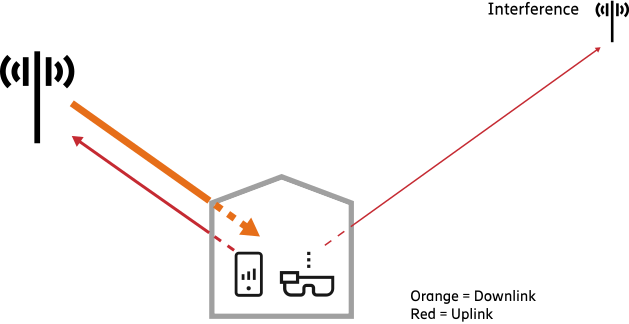
Figure 1: Simple representation of downlink (orange) and uplink (red) signal strength indoors, showing the impact of both interference and distance to the base station
During these situations, the smartphone will concentrate its limited power on a bandwidth that is smaller than the typical frequency carrier bandwidths. The available carrier bandwidth is normally not a limiting factor; the large pathloss between the smartphone and the serving site is the issue. Natural shielding from building structures and walls means that the UL interference generated from users to neighbor radio base stations will be small when users are indoors. As a result, the appropriate techniques for improving UL performance differ from those commonly used to improve DL performance.
In the DL, the conventional strategy to boost performance is to increase bandwidth, power and the number of signal layers while also taking action to minimize interference, which is a more significant issue in the DL. To achieve a general UL improvement that benefits most network users, the most important action is to improve UL coverage by reducing the loss between the users and the radio base stations. This action should be taken before considering others such as increasing the carrier bandwidths or the number of layers. The idea of improving UL performance by increasing the output power of smartphones is not as straightforward as it might seem due to the impact on talk/usage/standby times, battery size limitations and electromagnetic field considerations.
Network coverage has a frequency dependency, especially for locations that involve outdoor-to-indoor transmission through walls and diffraction propagation. Low-band frequency division duplex (FDD) frequencies (<1GHz) often have better coverage than mid-band time division duplex (TDD) frequencies (2-4GHz) in practice. In between these groups of frequencies, there are mid-band FDD frequencies (around 2GHz) that are a good complement, especially for the UL with full duplex compared with TDD, which shares the frequency carrier for both the UL and DL with a bias favoring the latter. The use of FDD bands therefore provides better UL performance in many indoor cases where users’ smartphones operate at the maximum output power and large carrier bandwidths are not beneficial.
Overview of key uplink coverage and capacity solutions
Because the relationship between coverage and capacity is strong, if coverage or signal quality level improves for users in challenging locations (deep indoors, for example) throughout the network, capacity will also improve. Assume, for example, that all users in a network want to send the same amount of data. If the received UL signal quality level improves for users located deep indoors, they will be able to send their data at a higher speed than they could have done before the coverage improved. This enhancement enables them to complete the UL data transfer more quickly, thereby freeing up time and radio resources for other users, which implies increased capacity.
Figure 2 presents UL coverage and capacity solutions, assuming a common deployment baseline where sites are equipped with interference rejection combining (IRC) and four receiving branches for mid-band FDD. The solutions are divided into three categories based on the cost or investment required to implement the solutions in the network. Software features are solutions that can be deployed by upgrading to newer, more advanced SW or by using specific features supported by the smartphones that require support on the network side. Site improvement solutions are actions that require a visit to the sites to change or modify hardware (HW) such as radios and antennas at the sites, which is more costly than upgrading SW. Site densification improves coverage and performance by adding new radio sites to the network. This is the last resort because building new sites is the costliest solution and requires the largest investment by the CSP.
Capacity and coverage improvements required to scale beyond a handful of users/sectorsTypical baseline: IRC in uplink, 4 RX on mid-band FDD |
||
|
Software features
|
Site improvement solutions
|
Uplink-driven site densification (where needed)
|
| -------- Increased solution cost --------> | ||
Figure 2: Overview of the three categories of UL capacity- and coverage-enhancing solutions
Software features
Software features that enable UL-quality-aware carrier selection and mobility will play a key role in enhancing UL capacity and coverage. This is because the best-serving cell carrier is typically different for the UL and the DL due to the difference in the UL versus DL bandwidth and power, as well as frequency band coverage (lower-frequency FDD bands provide higher UL coverage than higher-frequency TDD bands, for example). In 5G, this can be realized by selecting a primary cell that prioritizes both DL and UL metrics (as opposed to only DL ones) for services that require more UL. For 6G, one promising idea is to decouple UL and DL carrier selection to maximize performance by configuring a device with a low-frequency band carrier in the UL and a high-frequency band (wideband) carrier in the DL [7].
Another important UL SW solution is a feature called Uplink Coordinated Multi-Point (UL-CoMP) in which the desired signal from a single user can be received using multiple radio antennas. This type of coordination can enhance the UL performance for users in cell border regions by improving the received signal quality.
Device-dependent features such as UL carrier aggregation (CA), UL single-user multiple-input, multiple-output (SU-MIMO) and UL transmission (TX) switching also have a significant impact on UL performance. These features have already been enabled on the network side and can be utilized by smartphones.
UL CA uses more than one frequency carrier in the UL. By combining multiple frequency bands, it improves the user experience for devices that are in the overlapping coverage of these bands. There is ecosystem support for aggregating FDD+FDD, FDD+TDD and TDD+TDD bands.
UL SU-MIMO sends data using two signal streams in the UL. It is supported for both FDD and TDD bands and can double throughput when the device is in good UL coverage. Device availability for two layers in the UL is increasing in the market.
UL TX switching switches UL transmissions between FDD and TDD bands. This enables a 2 TX device to transmit two layers in the UL on TDD during the TDD UL slot, then dynamically switch the TX chain to FDD during the TDD DL slot to provide high throughput. Dynamic waveform switching enables the base station to dynamically switch between cyclic prefix Orthogonal Frequency Division Multiplexing (OFDM) and discrete Fourier transform-spread OFDM for UL transmissions to optimize performance.
With these three device-dependent features, users in good UL SINR (signal-to-interference-plus-noise ratio) regions will get a UL performance boost, but the benefit decreases when the user equipment (UE) moves further away from the cell center. When the coverage is good, UL multi-user MIMO (MU-MIMO) – which serves multiple users with the same radio resources using Massive MIMO (M-MIMO) and full IRC [8] – will improve UL capacity.
The use of high-power UE – that is, UE with a higher output power (>23dBm) – is another possibility. This option has been available for mid-band TDD (2-4GHz) for some time and has also been defined for some FDD frequency bands. It is important to note, however, that the overall network capacity benefit of this approach is limited because it can only improve UL performance (coverage) for users who have smartphones that support it (high-power UE). To date, it has been challenging to motivate smartphone vendors to implement high-power support for FDD bands.
Site improvement solutions
Site improvement solutions include changing and upgrading radios and/or antennas at the sites. To improve the received UL signal quality, it is beneficial to use a larger receiving antenna area at the site, which requires more radio receiving branches (R) to achieve the best overall performance in practice. In the DL, the number of transmission branches (T) can differ from the UL because it is typically possible to use more power in the radio. For low-FDD bands, this usually means going from radios with, for example, 2-4R to 4-8R-capable radio solutions. For mid-FDD bands, an upgrade from 4R to 8R may be sufficient. A radio with 4T8R, for example, is an attractive solution that can reuse existing multi-band antennas, thereby minimizing site impact. 32TR M-MIMO can be used to improve both UL and DL performance. In the long term, even larger antennas and a higher number of branches can be considered for FDD.
An important observation from current CSP deployments is that FDD bands are not uniformly deployed between sites in many networks. The number of deployed FDD bands often differs from site to site, and the low FDD bands with the best coverage properties are often not as densely deployed. There are a few explanations for this:
- variance in traffic demand per site
- optimization of each site to meet its specific traffic demand based on current DL needs
- more power is available in the DL
- tendency to prefer wider frequency carriers over narrower FDD bands in the lower band regions.
There is therefore an opportunity to use currently undeployed FDD bands to improve UL performance, addressing coverage deep indoors as well as capacity. An extra bonus from such an action is the possibility to extend TDD DL coverage using FDD-TDD carrier aggregation [9]. TDD radios are often deployed on every site in TDD deployment areas, however, which may not match the deployment density of the low FDD bands that would be needed to fully exploit the TDD coverage extension benefits.
Another site improvement solution is the deployment of advanced passive antennas that provide UL-boosting capabilities [10]. These antennas improve UL performance by reducing passive intermodulation (PIM) distortions caused by objects close to the site or defects inside the antenna. An industry-first field trial with a large European CSP demonstrated a 29 percent increase in average UL user throughput along with 2dB improved UL coverage thanks to better PIM performance of the antenna [11]. Additionally, higher antenna beam efficiency, by improving signal quality through focusing more energy into the target cell/sector and reducing interference into neighbor cells/sectors, enhances the level of signal received over the received interference and thus further improves UL performance [12].
Site densification
Site densification improves the received UL signal by adding new sites where existing UL coverage is poor. The appropriate solution for a particular case will depend on the characteristics of the area with poor coverage. A large area with many residential buildings and/or many shops and restaurants would likely warrant the deployment of a new macro site. The UL needs of a busy street lined with shops, restaurants and a few smaller residential buildings could likely be met by a new street site. Indoor solutions should be considered when a larger footprint building such as a skyscraper, arena, train station, hospital or airport is identified as having poor UL coverage. When choosing the location of new sites, care should be taken to maximize improvement and the offloading of existing sites nearby.
While DL needs will continue to be the main trigger for adding new sites for the foreseeable future, it is essential to widen the scope and consider both existing and emerging UL needs in the decision-making process. One way to do this is to deploy both FDD and TDD frequency bands at new installations to ensure both UL and DL performance. TDD often has a DL-heavy pattern, which means that a complementary FDD carrier can be important for the UL, even for indoor deployments.
Proof points for different modernization options
Through network simulations, it is possible to demonstrate the UL performance benefits of different modernization options using FDD radios and antennas. In our analysis, we used a model of a US network deployment in a San Franscisco urban area with low-rise buildings. The model is based on the deployment of multiple FDD and TDD frequency bands at the sites: 2x30MHz low-band FDD using 2T2R radios, 2x40MHz mid-band FDD using 4T4R radios and 1x150MHz mid-band TDD with 64T64R M-MIMO radios. In the model, the inter-site distance was approximately 700 meters.
Figure 3 presents our results. UL cell-edge user speed (fifth-percentile users) performance is presented as a function of traffic demand in the network. The impact of the evolution of mid-band FDD (1-3GHz) radios and antennas is shown on the left and the evolution of low-band FDD (<1GHz) radios and antennas on the right.
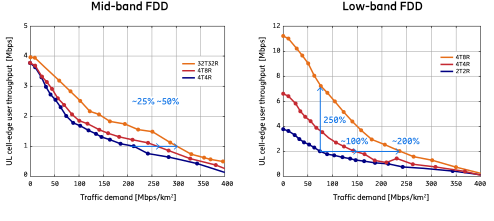
Figure 3: Uplink cell-edge user throughput (fifth-percentile users) performance as a function of traffic demand in the network based on simulations of a US urban area with low-rise buildings
In the first case we evaluated, the mid-band FDD radios were changed from commonly deployed 4T4R to 4T8R and 32T32R M-MIMO. The graph on the left side of Figure 3 shows that the throughput performance improves as more advanced radios are deployed. Targeting 1Mbps in the UL for cell-edge users, 4T8R can serve about 25 percent more traffic, while the advanced 32T32R can support about 50 percent more capacity at the same performance level. The use of new mid-band FDD radios helps in offloading the low-band FDD so that there are more resources for the most demanding users. The improvement in median UL user throughput at high traffic load (300Mbps/km²) was in the order of 10 percent for 4T8R and 25 percent for 32T32R (not shown). In addition, there are DL performance gains with the latter radio solution.
The second case, illustrated on the right side of Figure 3, focuses on the low-band FDD radios, assuming a change from 2T2R radios to 4T4R and even 4T8R. Given that a larger antenna configuration can be deployed, the capacity gain with more upgraded low-band FDD radios and antennas can be up to 100/200 percent (4R/8R) when 2Mbps is required at the UL cell edge. For a fixed traffic load, the cell-edge user throughput increases significantly – from 2 to 7Mbps at 75Mbps/km², for example – which enables improved or new services. Users closer to the sites will also see improvements – for example, median UL user throughput rose 10-20 percent at 200Mbps/km². Low-band FDD improvements generally provide better coverage, which results in better UL cell-edge throughput and higher UL capacity compared with improving mid-band FDD. This is because the worst-served and most demanding users rely on low-band FDD. A larger antenna footprint may be needed for low-band FDD, however, which can be a drawback.
It should be noted that the radio and antenna evolutions we have presented here do not increase UL peak rates, and the median UL throughput improvements are smaller than what is seen at the cell edge. UL CA and TX switching are good tools that can be used in a complementary fashion to enhance the UL peak rates. For example, by switching between two-layer transmission for TDD and two-layer transmission for FDD, 3GPP (3rd Generation Partnership Project) Release 17 UL TX Switching can be used to increase UL peak throughput. The increase in peak rate will be up to 70 percent higher than it is with Release 15 2CC (two component carrier) UL carrier aggregation (CA) when using 100MHz TDD and 20MHz FDD carriers. UL TX switching is more beneficial for users with good channel condition for both FDD and TDD.
Network evolution recommendations
The first logical step for CSPs that want to improve UL performance is to evolve and improve existing sites with SW features, as well as new radio and antenna HW.
This approach minimizes the number of new sites to be deployed, while simultaneously creating a positive spiral and enabling a first wave of services with slightly increased UL needs.
In the near term, the focus should start to shift toward upgrading to new advanced FDD radios and antennas at existing sites and increasing the deployment density of FDD bands for general UL performance benefits. FDD enhancements will be an important preparation for 6G, with the likely use of new higher and broader carrier frequency bands such as centimeter wave [13], with even more pronounced differences between UL and DL coverage and higher performance expectations in general.
Conclusion
Uplink (UL) performance is critical for video conferencing and live broadcasting as well as for emerging services like GenAI (generative artificial intelligence) apps and augmented/mixed/virtual-reality use cases that are key drivers of differentiated connectivity and 5G monetization. Current networks are optimized for downlink, however, which means that UL enhancements are needed to open up new revenue streams. Improving the UL requires reducing pathloss and enhancing signal quality, not just increasing bandwidth or power, which is challenging in the UL for smartphones and other small-form-factor devices. Our research shows that UL performance can be enhanced using a combination of radio access network software features and radio/antenna improvements, deployed at existing macro sites. Focusing on solutions that use frequency division duplex minimizes the need for costly site densification.
Acknowledgements
The authors would like to thank Reza Dehghani and Salar Alipour for their contributions to this article.
Further reading



References
Authors

Fredric Kronestedt

Tsao-Tsen Chen

Amareet Kaur