








5G is supercharging sports technology, events and entertainment
- English
- 繁體中文
A hybrid 5G public and private network provides high-quality 5G connectivity, improving fan experience and race operations, all with distinct requirements.
Key insights
Each year, 12 international teams race in SailGP, a global racing competition that spans multiple grands prix held across various locations worldwide. The event creates an even playing field for competitors, with each team racing on an identical high-performance F50 catamaran and having access to the same race data. This means it’s the skill and split-second responses made by the athletes that make the difference between victory and defeat. To support those decisions, each team requires access to real-time data and statistical feedback instantaneously, despite their F50s reaching speeds of up to 100 km per hour over open waters. Beyond the racing itself, operations must also run seamlessly on the land: security, retail outlets and the fan engagement and experience from live broadcast to Wi-Fi must all be managed.

This article was written in collaboration with SailGP, a global racing championship.
Connectivity in challenging environments
There are several main challenges facing the SailGP championship network operations team building the 5G private network and operating the hybrid 5G private public network. These include the harsh marine environment and the very limited timeframe for build and delivery, with just one day to test the systems on the water prior to racing. Another notable challenge is gaining licensed spectrum – as SailGP takes place in many global locations, different channels are required in different regions. This means the setup cannot simply be replicated between locations.
5G is the ideal solution, offering coverage and allowing IP-based technology to be easily deployed. Once the private 5G is deployed and functioning, the 5G system cleanly resolves a lot of on-site challenges, such as: enlargement of the internal networks without extensive cabling; on-water usage for both the internal services like telemetry, communications and video but also internet access for teams using their own services; and services for the guests, including VIPs on chaser boats or other guests on viewing platforms.
To ensure a smooth build within the limited time on-site pre-event, it is critical to have radio frequency designs in place three months before the event, based on the in-country licensed spectrum availability for that specific event. Once on-site, it is essential all equipment is available on-site for day one of setup, to ensure the network can be built in a timely manner. This is supported by having hardware that is both compact and easy to handle, with a managed design. The design is supported by two or three template configuration formats that can be applied with minimum deployment time, as well as system functionality checks carried out on site to measure and analyze performance.
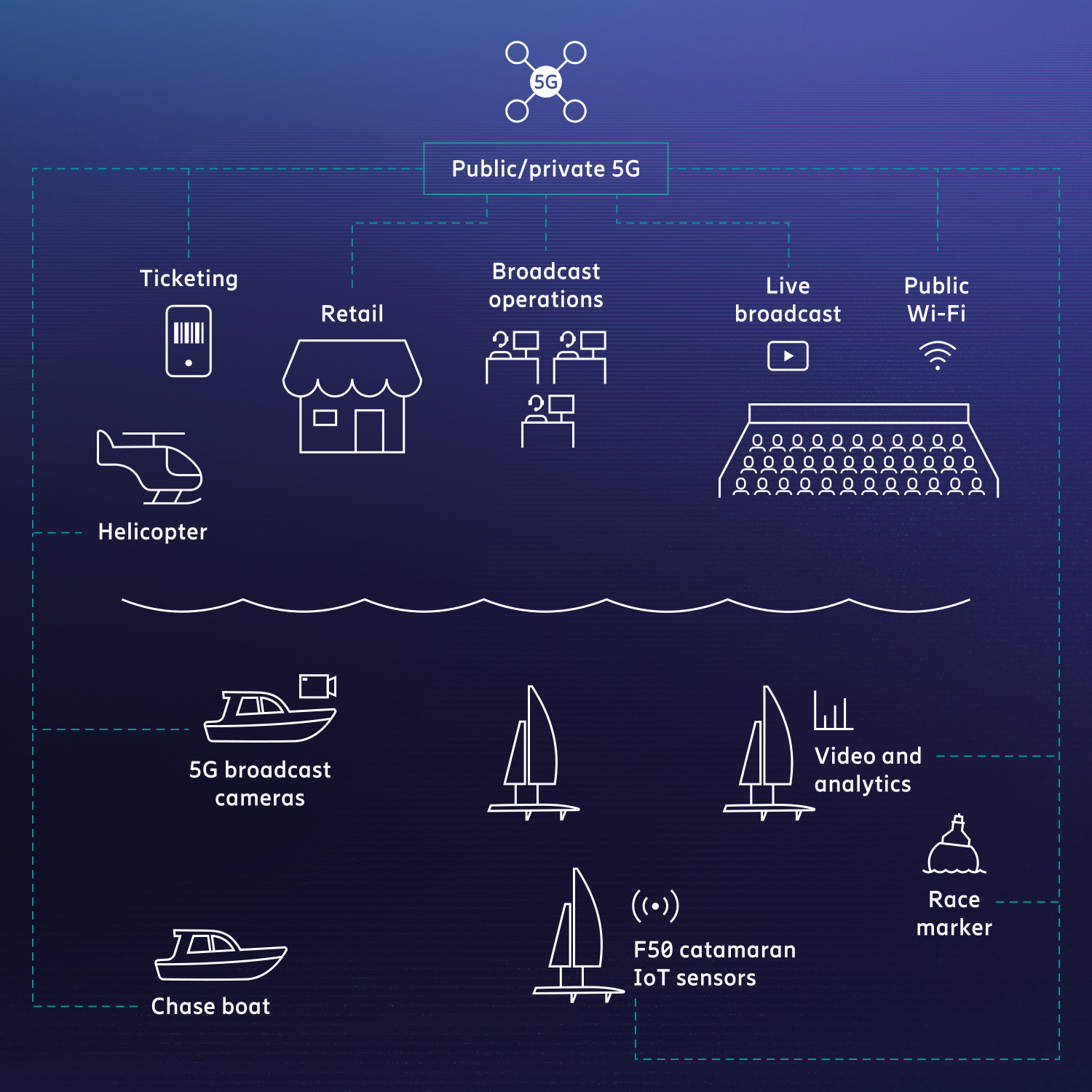
Figure 20: Public/private 5G at SailGP events
5G has been deployed at SailGP events in Dubai and Abu Dhabi, UAE; Auckland, New Zealand; Sydney, Australia; Los Angeles, San Francisco and New York, US; Portsmouth, UK; Sassnitz, Germany; Saint-Tropez, France; Geneva, Switzerland; and Cádiz, Spain.
Flexibility between private and public 5G networks
Local service providers have had varying roles in the deployment across the different venues. In some markets, they have helped with spectrum applications and advice on which bands to use. In other markets, leading service providers have played a bigger role in the event connectivity through network slicing and prioritizing their network SIMs as part of commercial agreements.
Resilient connectivity is essential for these events, therefore the solution is built so that the private and public networks are both used consistently. All critical assets have a minimum of two, but often three, modems onboard. If there are three modems, then one will always be connected to the public network and configured with failover for increased resilience.
The ability to offer SailGP a network slice is becoming more frequent, as the local service providers look to develop this service as a commercial offering. Having slicing alongside private 5G is the optimum and desired setup for SailGP events, as this enables the use of private 5G for landing data locally, and then a dedicated slice for cloud-based traffic and shared data-exchange functionality.
Scaling and trialing multiple cases
Each SailGP event, like any other major event, has many areas that are dependent on reliable and stable connectivity for retail, ticketing and live broadcasts. Beyond a typical event setup there are specific requirements for the in-water aspects of these events. There are IoT sensors, video and analytics from the F50 catamarans that generate billions of data points. The racecourse itself is laid out with connected markers that can be adjusted based on wind direction.
There are additional vessels on the water for broadcast cameras, support boats and guest VIP chase boats. Finally, there are helicopters in the skies above the race capturing footage and monitoring events.
Meeting distinct requirements
Across most deployments, the focus has been on ensuring both network reliability and high uplink capacity, with average data throughput around 150 Mbps. Given the short time available for setup and testing, results have naturally varied across locations and use cases. Shore-to-ship connectivity has delivered consistently strong performance, while ship-to-shore links have proven more challenging due to the fast-moving platforms, diverse installation methods and highly reflective over-water environment. Achieving stable sub-40 ms latency requires further fine-tuning and optimization – something limited by the brief on-water testing window. The experience gained this season, however, will guide more refined, site-specific deployment strategies for future events.
While specific private 5G outcomes for each case are still being meticulously tracked, it is crucial to understand the sheer scale of data involved: a single SailGP event day generates 53 billion data requests. This immense volume underscores the absolute necessity of leveraging advanced technology to effectively harness this data, thereby empowering the teams, the league and the fans, with unparalleled insights and experiences.
Connecting helicopters has brought unique challenges, as the setup needs to take place outside of the private 5G network coverage area. During the Emirates Great Britain Sail Grand Prix in Portsmouth, UK, SailGP were able to work with BT to provide a 30 km transit route with connectivity on the public network, allowing the helicopter to switch seamlessly between the public and private network. This same route also provided connectivity between remote control centers and the event location.
The role of collaboration across the ecosystem was also demonstrated during the Portsmouth event where SailGP worked with BT and Sony to use a 5G network slice on the public network as the connectivity layer to support broadcast-quality video, delivering the low latency and high bandwidth required for delay-sensitive video encoders.
The season ahead
SailGP’s first year being supported by 5G at events has been an evolutionary period of testing and learning, offering invaluable insights into 5G’s potential to revolutionize the races’ operations. This journey has not only illuminated how this technology can empower the league, but has also highlighted key developments within the ecosystem that are enabling boundaries to be pushed and the full potential of 5G to be realized in this harsh environment. Following the trials and looking ahead, the aim is to gradually implement 5G across all identified use cases in future seasons, and combine the benefits of private 5G and network slicing on the public network.