The evolution of AI-enabled XR in mobile networks
- English
- 繁體中文
AI is expanding into mobile experiences, with smartglasses and other wearables emerging as new complementary user interfaces that extend digital interactions. 5G already provides the capabilities needed for early AI and XR services, while 6G is being designed to scale data-intensive and AI-driven experiences as uptake grows.
Key insights
While mobile interactions today are largely smartphone-based and user-initiated, “heads-up” extensions enabled by smart glasses and wearables are expected to become more common. These experiences enable continuous, AI-driven interactions and increase demands on mobile networks.
Use cases such as “see-what-I-see” sharing and multi-modal AI assistants are expected to drive an increase in uplink traffic over time.
Cellular AR can already be enabled using 5G-connected devices, while 6G is expected to efficiently scale AI-driven XR as adoption grows.
From user-initiated interactions to continuous, AI-driven experiences
Mobile user experiences have traditionally involved opening an app GUI on a smartphone, performing specific actions, consuming content and then disengaging. AI is increasingly acting as an intermediary between users and digital services, enabling more natural, continuous interactions through voice, vision and gestures. Over time, AI has the potential to become an integral part of user interfaces, particularly as smartphones are complemented by smartglasses and other wearables that support “heads-up” experiences. In this model, agentic AI systems can understand context and intent, and coordinate actions across multiple user devices, supported jointly by cloud or edge compute resources.

This article was written in collaboration with Qualcomm Technologies, Inc., a leading technology company that innovates to deliver intelligent computing everywhere.
Emerging inflection points in consumer XR adoption
Consumer XR adoption is at an early stage, but momentum is building as market scale, device readiness, and AI capabilities begin to align. Smartglasses account for a growing share of XR shipments, driven by sleeker form factors, integrated displays, advances in optical technologies and multi-hour battery life.
AR is emerging as an everyday companion wearable within a multi-device smartphone ecosystem. In the near term, AR devices are typically wirelessly tethered to a smartphone or compute puck, while longer-term evolution includes standalone cellular-enabled glasses. Form-factor constraints are expected to limit antenna configurations, while interoperability with other connected wearables can augment connectivity and capability.
Advances in multimodal and generative AI enable persistent, context-aware agents that see, hear and reason over time, as well as increasing the utility of consumer AR devices. However, adoption will also depend on design and consumer expectations in relation to always-available sensing.
Consumer AI and AR use cases
Unlike traditional mobile applications, AI-driven XR experiences are characterized by larger uplink data generation as AI agents gather data while operating across devices. Application behavior is shaped by sampled sensing – varying with capture settings and user intent – and by opportunistic data transmission. To reduce radio energy consumption, data is often transmitted or received in short bursts using power-optimized mechanisms such as discontinuous transmission and reception via sleep-wake cycles, rather than a continuous stream. As a result, instantaneous uplink rates depend on available network capacity rather than fixed data rates.
Over time, even moderate daily usage can accumulate into substantial data volumes. For example, an AI recall application[1] capturing a few compressed frames per second (around 1–3 FPS at 720p) for one hour a day can generate as much as tens of gigabytes of uplink data per month, depending on compression efficiency, frame encoding and data retention policies.
Figure 22: Changing consumer behaviors
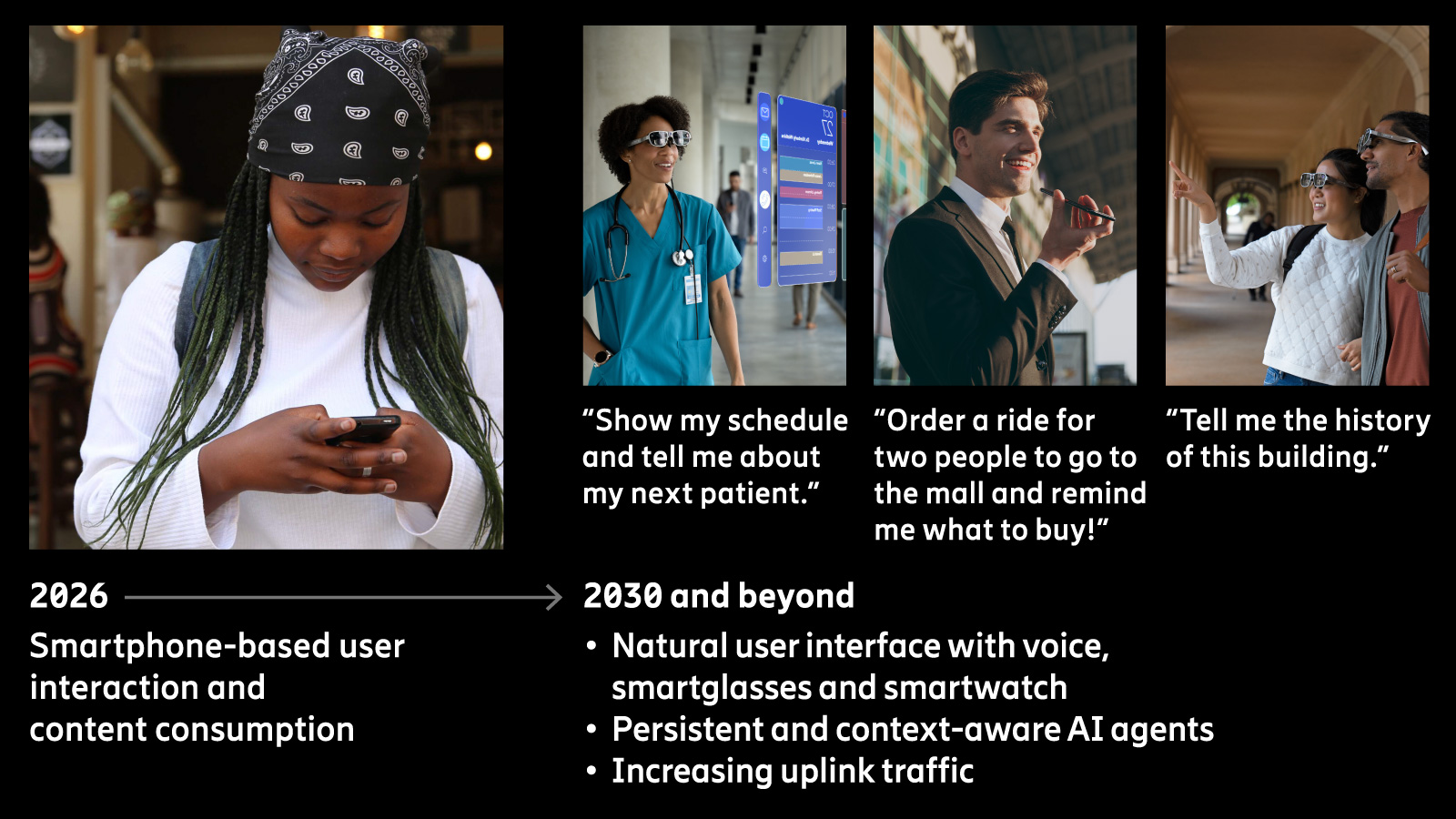
Consumers are ready and waiting to adopt AR applications
AR applications that have demonstrated consumer interest, and may evolve into mainstream experiences, include:
- Turn-by-turn navigation – which involves smartglasses intermittently capturing location data and compressed video at a few Mbps (10–15 FPS, 480–1080p resolution) in the uplink, and receiving AR guidance overlays in the downlink.
- “See-what-I-see” sharing – which enables first-person audio and video streaming during activities such as sports, concerts or other recreational activities. Typical consumer implementations require a few Mbps, assuming 480–720p video at low frame rates and power-optimized modes. More demanding use cases – such as higher frame rates, higher resolution, creator-focused experiences or future higher fidelity implementations – may require rates of 10 Mbps or higher.
- Live AI conversations and avatar-based communication are evolving toward real-time 3D representations of speakers, objects and environments. While today’s avatar-driven interactions tolerate standard voice/video call latencies, richer 3D communication is governed by motion-to-render-to-photon latency. With visual compute and network transport consuming much of that budget, the wireless link should deliver around 30 ms or less to ensure smooth, natural interactions.
- Interactive shopping – which allows users to visualize products in different scenarios or try on clothing digitally, with uplink traffic consisting of intermittent image or video capture and downlink traffic dominated by rendered assets, textures and overlays.
Today, uplink data rates for these applications are typically a few Mbps, reflecting current device capabilities, compression efficiency and the practical constraints of today’s networks, including varying capacity and coverage. As rollout of more capable 5G standalone networks accelerates and AR adoption broadens alongside improving device capabilities, richer applications are expected to emerge, contributing progressively to overall uplink traffic growth in mobile networks. From a network dimensioning perspective, even a representative uplink demand of 10 Mbps per user with around 30 ms latency can significantly impact cell capacity; for example, in a dense urban environment with 100 MHz of FR1 spectrum, typical TDD deployments, and a high proportion of indoor users, fewer than 5 simultaneous users per cell could be supported at this performance level.
Enterprise and industrial AR use cases
There is growing interest in XR for enterprise and industrial environments, where mobility, reliability, security and deterministic performance are critical. In factories, warehouses, construction sites and large indoor/outdoor facilities, mobile private networks offer clear advantages over Wi-Fi in terms of coverage, scalability and predictable quality of service (QoS) – especially for latency and jitter-sensitive AR workloads.
In the near term, we expect AR devices in industrial settings to be paired with a cellular-capable companion compute device for mobility and coverage, with architectures potentially evolving toward more standalone cellular-enabled devices over time. Key use cases include:
- Remote assistance and hands-free operations, where field technicians receive step-by-step AR overlays aligned with the equipment in the downlink while a remote expert or AI assistant remains engaged by “seeing what the technician sees” via uplink video.
- Upskilling and training, where manufacturing workers on complex assembly lines use AR guidance and real-time feedback delivered in the downlink, supported by uplink video and sensor data capturing actions and task execution.
- Enterprise and holographic collaboration, where distributed teams interact with shared, photorealistic 3D models and realistic avatars with the downlink delivering rendered viewpoints and the uplink carrying geometry, pose and interaction updates.
These industrial use cases may require uplink data rates of 1–25 Mbps, driven by high-quality video, gestures, pose and geometry updates. Applications involving high-quality 3D rendering, such as training and holographic collaboration, also require data rates of several tens of Mbps. To maintain stable overlays and interaction fidelity, low wireless latencies below 30 ms and tight jitter control (around 5–10 ms) are often required.
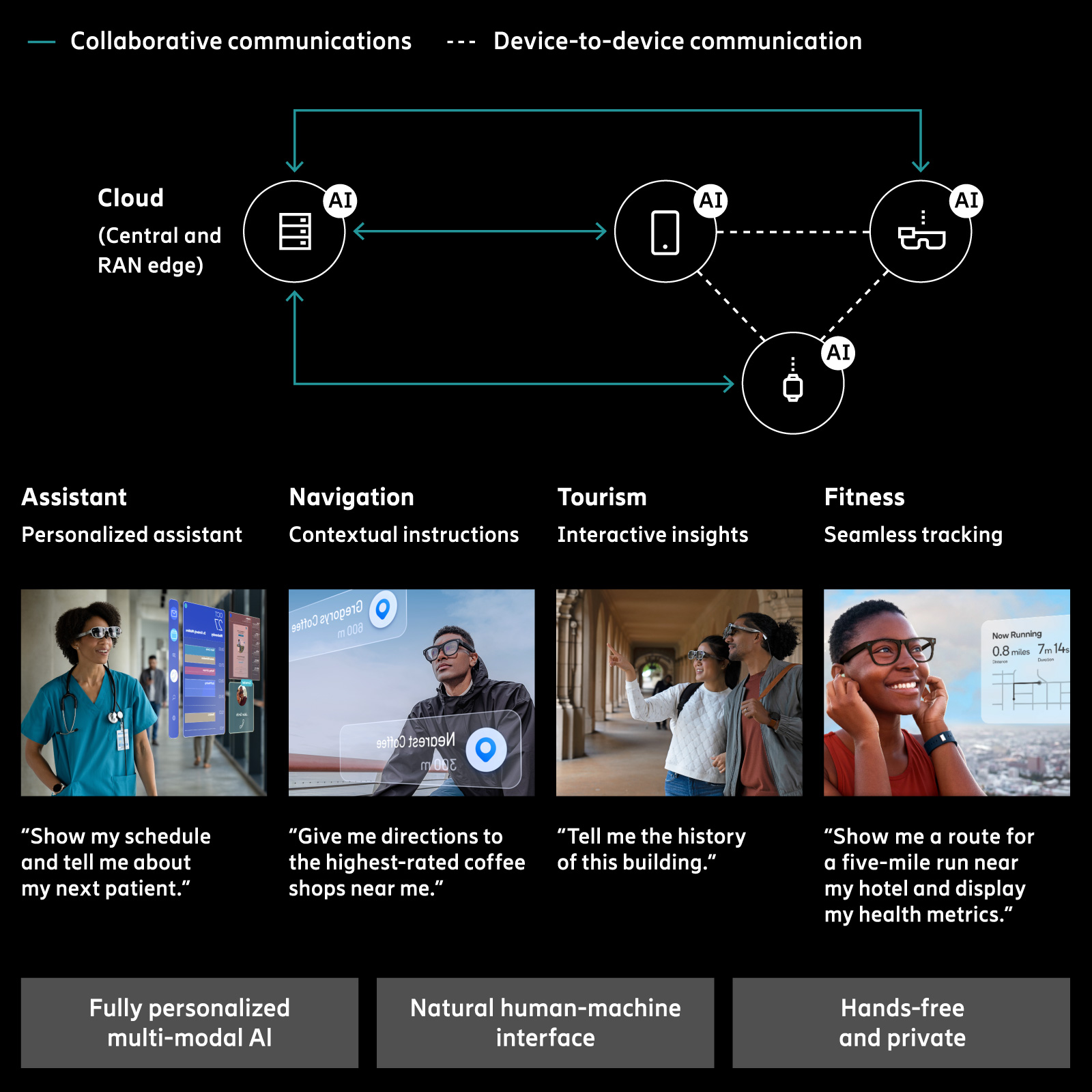
Figure 23: Multi-device collaborative communications, distributed compute and AI
Scaling AI-driven XR in the 6G era
The XR device industry is expected to experience strong growth from 2026 through 2030, with glasses contributing a significant share. AR glasses tethered to 5G smartphones are already being deployed in today’s networks, with glasses based on 5G reduced capability (RedCap) expected to emerge in the near future, helping address the thermal and battery constraints of wearable form factors. Continued evolution of 5G, including 5G Advanced, is expected to deliver targeted improvements in power efficiency, latency and mobility. Key enhancements include smarter sleep cycles, application-aware IP-packet grouping (PDU Set), network congestion feedback to applications (L4S) and faster handovers, which are all defined within 3GPP standards.
As personal AI devices (such as AR glasses), pendants and neural bands (including EEG headbands and EMG wristbands) coexist with smartphones, and new physical AI categories such as robots and autonomous systems emerge, mobile networks will need to support growing volumes of user- and device-generated data for interaction, training and access to capable AI models.
To address this, 6G is being designed to scale such AI-driven services through improved uplink performance, wider bandwidths and more energy-efficient systems operation. Additional spectrum in the upper mid-band (FR3), combined with advanced antenna techniques such as Giga-MIMO, is expected to enable capacity overlays on existing cellular infrastructure without requiring cell-densification. Lower power, 6G-capable AR glasses and wearables are also expected to be considered from the onset as a native design category.
Evolving mobile networks can benefit from architectures that natively support multi-device experiences, distributed compute, and context- or intent-aware communication. These capabilities will be increasingly important as intelligence and perception are distributed across personal AI devices and network resources.
Multi-device collaborative communications can improve wearable performance by mitigating inherent device constraints such as a limited number of antennas, bandwidth, thermal headroom and battery capacity. For example, by enabling complementary communication paths through a companion device, the system can improve robustness to head and body shadowing and improve reliability, coverage and latency.
Distributed computing further complements this approach by allowing workloads such as rendering, perception and interference modeling to run either on-device or be offloaded to edge or cloud resources. When network conditions are favorable, offloading can provide access to larger models and higher-fidelity experiences while reducing device power consumption, though it increases network demand and sensitivity to latency and congestion. When connectivity degrades, workloads can shift back to on-device execution to preserve responsiveness, albeit with higher local power consumption.
Context-aware or intent-aware communications can also leverage on-device intelligence to infer application type and user experience in real time, enabling adaptive behavior that better matches current communication needs. Devices can derive application and user-experience context by classifying traffic flows with on-device AI, observing hardware and software signatures, and leveraging proximity to application logic. By coupling traffic characterization with user equipment and network adaptation, context-aware communication can more effectively balance device power consumption, network efficiency, and user experience.
Scaling XR with 6G to enable a “heads-up” transformation of life and work
Personal AI wearables and XR services are expected to evolve gradually from a niche category into a more common workload for future mobile networks. As 6G becomes the dominant mobile access technology, it will help to scale such services through continued improvements in connectivity, system efficiency and architectural flexibility. Together with ongoing 5G Advanced evolution in the near term, these capabilities can support XR growth across the consumer, enterprise and industrial domains, enabling a future where digital and physical experiences are seamlessly integrated throughout the day.
Realizing the full potential of 6G and beyond will require sustained ecosystem collaboration, anchored by technology creators and spanning device OEMs, infrastructure vendors, cloud and edge providers, service providers and application developers.