




Skip navigation
Previous searches
    Suggested searches
      ""

      AI, cloud and mobile form the foundation of enterprise digital transformation

      Mobility powers AI-driven enterprise transformation

      Service providers can help enterprises realize the full value of AI-led digital transformation. Mobile networks provide the real-time foundational capabilities enterprises need to scale AI securely and reliably.

      Research shows that enterprises increasingly view AI as essential for digital transformation, however, only a minority have scaled it across their organizations.

      While AI is a driver of digital transformation, it cannot succeed without the support of robust mobile networks and cloud capabilities.

      Service providers offering solutions that help enterprises realize the full value of AI-led digital transformation have the opportunity to generate new revenues by transitioning from connectivity enablers to strategic partners.

      AI cannot succeed in isolation

      Enterprises now require greater agility, scalability and mobility to support distributed operations and real-time data processing. AI is rapidly becoming the engine of this transformation, but success depends on a modern digital foundation where mobile, cloud and AI together automate core operational tasks and free capacity for innovation and growth. This will create reusable capabilities that scale across use cases to improve efficiency, enhance experiences and accelerate innovation. Research commissioned by Ericsson[1] confirms that AI is viewed as essential for digital transformation, and its full value can be realized only when underpinned by robust mobile and cloud capabilities. However, it also reveals an execution gap: While almost 9 in 10 organizations see AI as critical, only a minority have successfully scaled it across their operations.

      AI ambitions exceed enterprises’ digital readiness

      In our study, 37 percent of enterprises report accelerating their digital transformation with positive momentum. AI is no longer confined to IT – it is now embedded across business functions, increasingly running core operational tasks. Yet, a critical gap exists. While 88 percent of enterprises expect their AI solutions to depend on real-time data, adoption of the enabling technologies remains low: Only 8 percent have fully scaled AI across multiple business areas or adopted cloud-based technologies and solutions, while just 18 percent have widely adopted cellular technologies and solutions that provide secure, reliable, real-time mobile connectivity.

      This disconnect between AI ambition and technology adoption represents a clear opportunity. Service providers are well positioned to close the gap – by offering solutions that deliver the secure, always-on enterprise connectivity that AI-driven operations demand.

      Figure 24: Enterprise technology adoption

      AI

      Only 8% have fully scaled Al

      Cloud

      Only 8% have full cloud adoption

      Mobile

      Only 18% have wide mobile adoption

      Base: 100 decision-makers across 5 industry segments in large companies in North America, Europe and Asia.

      Mobility: Powering enterprise AI

      Enterprises increasingly rely on distributed data sources – mobile devices, industrial sensors, vehicles and field equipment – to feed analytics and models that inform operations, customer engagement and new services. AI platforms, data lakes and analytics engines are often distributed across cloud, on-prem and the edge, and the demands of these use cases reshape enterprises’ network requirements. Mobile connectivity enables seamless data flow and unified workflows, evolving mobility from a basic utility into an imperative, strategic asset that underpins safety, productivity and new revenue streams.

      Realizing value from AI requires the alignment of network services with business processes and measurable outcomes. This represents a pragmatic opportunity for service providers; to move from being pure infrastructure vendors, to become strategic partners, by packaging connectivity, edge compute, security and managed services for enterprises as part of their AI roadmaps to meet specific transformation objectives.

      Mobile connectivity and cloud provide the real-time foundational capabilities enterprises require to scale AI securely and reliably. On the mobile side, enterprises in this study rank security (78 percent), reliability (72 percent) and bandwidth (67 percent) as the top enablers, highlighting the need for protected, dependable, high-throughput data flows. Mobile delivers the real-time connectivity that AI depends on. Of the surveyed enterprises, 80 percent have plans to increase their mobile investments.

      Moreover, 75 percent identified 5 use case categories where they believe AI will have a significant business impact:

      • Tracking and monitoring – continuous sensor and location telemetry for assets, goods and customers, needing scalable connectivity and edge processing.
      • Connected operations – remote control, autonomous mobile robots (AMRs) and industrial control requiring private networks, low-latency edge compute and secure orchestration.
      • Enterprise collaboration – real-time, secure Unified Communication and interoperable workspaces needing QoS, managed end points.
      • Customer engagement – omnichannel, video and conversational AI with edge inference.
      • Digital devices – kiosks, wearables and vehicles requiring device lifecycle, SIM/eSIM and security.

      Figure 25: How mobile connectivity is foundational for scaling enterprise AI

      Mobile connectivity adoption today
      AI advances digital transformation

      AI’s significance in advancing digital transformation in recent years was rated

      6.7/10


      AI’s expected importance for advancing digital transformation over the next 2–3 years was rated

      7.9/10

      Mobile as an enabler for AI

      36%

      of enterprises consider mobile solutions to have a large/fundamental impact on the ability to enable and scale AI across multiple use cases.

      Mobile investments will increase

      80%

      of enterprises plan to increase their mobile investments, with 37% of them increasing by more than 20%.

      Note: Survey of over 100 CxOs, senior decision makers and managers across 5 industry segments in large companies in North America, Europe and Asia.

      Why mobile connectivity matters most

      Although AI attracts headlines and cloud receives significant architectural attention, it is the mobile part of the foundation that ultimately determines whether enterprise AI-led digital transformation will be successful. Global coverage, multi-operator support and adherence to global standards ensure AI workloads scale instantly across locations and business units without bottlenecks.

      First, mobile networks provide the reach and coverage needed to connect distributed operations. A single enterprise may span multiple locations and include mobile fleets, each with different performance, security and regulatory requirements. 5G, private networks and wireless WAN (WWAN) can be tailored per site and per use case, while being managed as part of a unified enterprise architecture.

      Second, 5G’s inherent low latency, high reliability and robust security make it possible to deploy AI and automation in scenarios where delays or outages are unacceptable, such as safety-critical environments, high-value production lines or real-time customer interactions. This is particularly relevant as new applications, including AI computer vision, AR-assisted operations and physical AI (which enables machines to perceive and interact with the physical world in real time) will drive rapid uplink growth, placing new demands on mobile networks that were historically optimized for downlink.

      Third, mobile networks are increasingly becoming programmable platforms. With 5G standalone and network APIs, service providers can expose differentiated connectivity characteristics – such as assured throughput, low jitter or location awareness – directly to enterprise developers and ISVs. This enables them to design AI-powered applications that dynamically request the network performance they need. Network-powered solutions that combat fraud are the first use cases to come to market for service providers‘ monetization, as this is an urgent enterprise digital transformation need.

      From connectivity provider to strategic AI partner

      Our research highlights that enterprises increasingly see mobility, AI and cloud as the foundation for digital transformation, and plan to step up investments in mobile-enabled initiatives over the coming years. At the same time, many organizations struggle to move beyond isolated AI proofs of concept, citing gaps in connectivity, data readiness and operational integration as major barriers. This highlights that service providers could evolve their role to provide not only high-performance public 5G, but become orchestrators of the AI–mobile–cloud digital foundation for enterprises, for example as a managed service provider delivering outcomes instead of only connectivity. If they evolve their networks towards AI-native, cloud-native architectures that can handle the complexity of AI workloads, service providers can help enterprises unlock the full value of AI-led digital transformation.

      As AI use cases are increasingly adopted, and enterprises demand more agility and intelligence, the importance of getting the mobile foundation right will only increase. Therefore, service providers need to evolve networks into AI- and cloud-ready platforms, build differentiated enterprise offerings around private and public 5G, and position mobile connectivity as the backbone of AI-driven digital transformation.

      Ericsson Mobility Calculator

      Explore the relationship between the usage of various app types and monthly traffic per subscription with our interactive Mobility Calculator tool.

      Explore the calculator

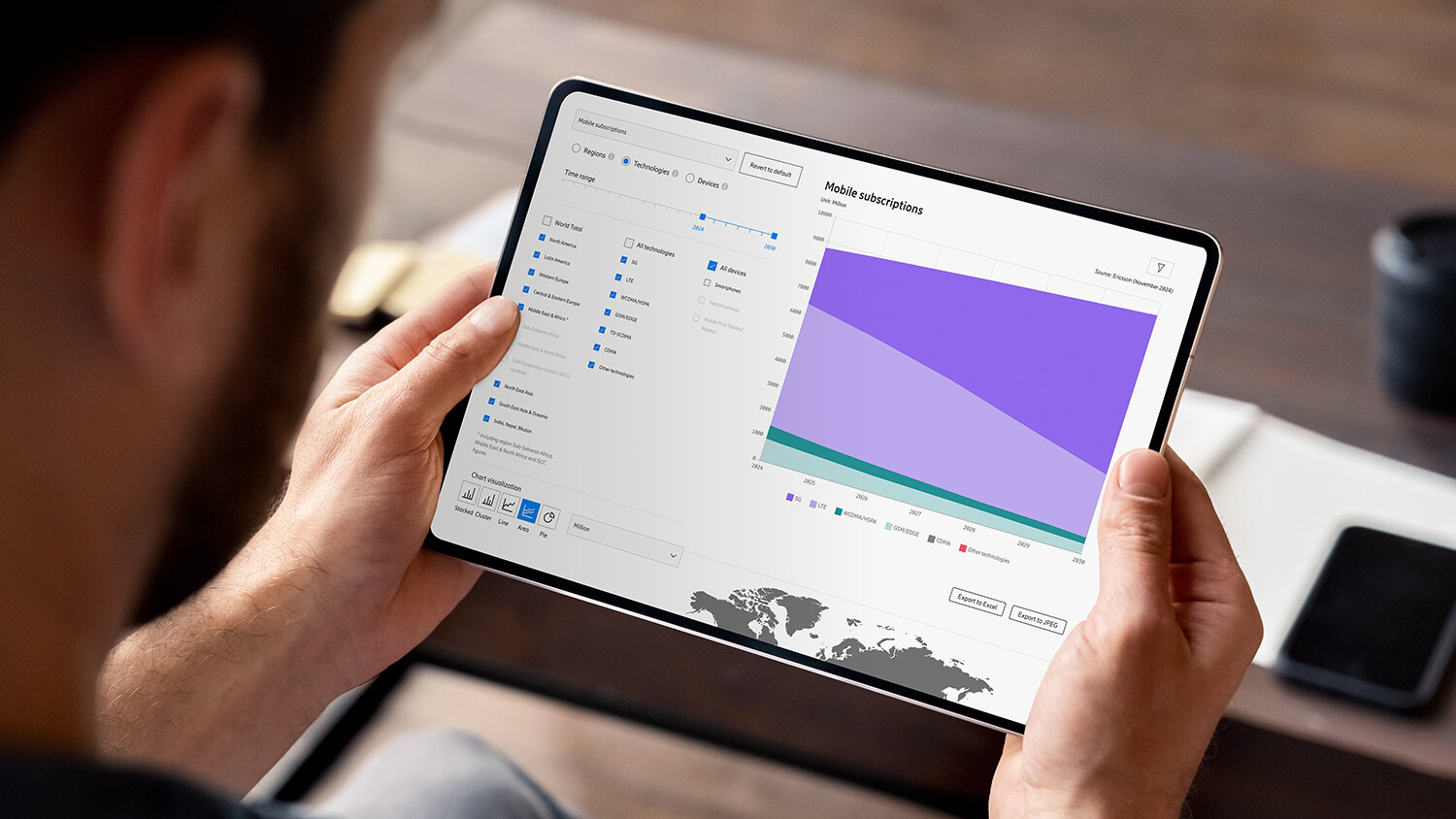
      Ericsson Mobility Visualizer

      With our Mobility Visualizer tool, you can examine the forecast data that underpins the Ericsson Mobility Report in our interactive web application.

      Discover the data

      Articles

      Discover the Ericsson Mobility Report articles where we discuss trends, case studies, service provider opportunities, and the past, present and future of connectivity.

      Discover the articles

      Ericsson Mobility Report

      Our forecasts are based on past and current data, validated with extensive network measurements. Discover the latest figures for 5G, IoT, fixed wireless access and more.

      Explore now
      Subscribe to receive Ericsson Mobility Report updates

      Get the latest Ericsson Mobility Reports and quarterly updates – the moment they are published!

      The face of mobile communications is changing faster than ever. Stay up to speed with projections and analyses of the latest trends in the mobile industry, including subscriptions, mobile data traffic and population coverage.

      Subscribe now to get the full reports and quarterly updates sent directly to your inbox.

      Subscribe now

      References

      1
      The research findings draw on insights from surveys and interviews with over 100 enterprise chief officers (CxOs), senior decision-makers and managers across five industry segments in large companies in North America, Europe and Asia. Source: Arthur D Little, Ericsson.