




Skip navigation
""

Service providers embracing and scaling differentiated connectivity

Global momentum in commercial differentiated connectivity services

Available in English 日本語 繁體中文

New offerings that leverage 5G standalone (SA) capabilities, such as network slicing, have progressed from limited pilots and niche experiments to fully launched commercial services.

Key insights

Commercial differentiated connectivity services are accelerating worldwide, with strong growth in both scale and diversity of offerings.

Europe stands out with the highest number of commercial cases, reflecting increased market maturity and adoption.  

Marketing innovations – such as in-the-moment offers – can significantly outperform traditional channels.  

The ability for service providers to differentiate connectivity services – for example, by providing latency guarantees, priority services, security enhancements, immersive experiences, or connectivity targeting specific situations and locations or app categories – is changing with the introduction of 5G SA.

A broad review of the global service provider landscape reveals a striking shift in the pace and scale of commercial service offering launches that are based on differentiated connectivity. In the latest study, covering over 300 service providers across 134 markets, a significantly higher number of launches was found compared to previous studies.

The findings point to a market transitioning from proof-of-concept trials to commercial services that serve real customers in diverse contexts. This shift has been driven by advances in network capabilities and greater confidence among service providers, with an increasing willingness to explore new monetization models beyond traditional data and speed tiers. The extent of engagement is notable, with many service providers now active in several categories simultaneously. This demonstrates scalability, market validation and confidence in the commercial viability of service offerings based on differentiated connectivity. Out of 118 such offerings, 55 percent are commercially available.

Traditional data plans continue to evolve

In the context of traditional data plan offerings, about 99 percent of surveyed service providers offer some form of data bucket plan. Meanwhile, around 58 percent provide one or more unlimited data packages to their users. Regional differences are notable, with unlimited offerings most prevalent in Western Europe, where about 86 percent of service providers include unlimited options in their plans.

There has been a constant growth in the number of service providers in recent years offering device-based plans, mainly driven by smartwatches.

More service providers are deploying 5G networks that can support reduced capability (RedCap), and new categories of RedCap devices are expected to enter the market (beyond today’s available broadband devices such as dongles and routers, surveillance cameras and smartwatches). Meanwhile, a range of new consumer and enterprise service offerings are expected to emerge. Commercial broadband services using RedCap devices have been launched by one service provider in the US and by two service providers in the Asia-Pacific region.

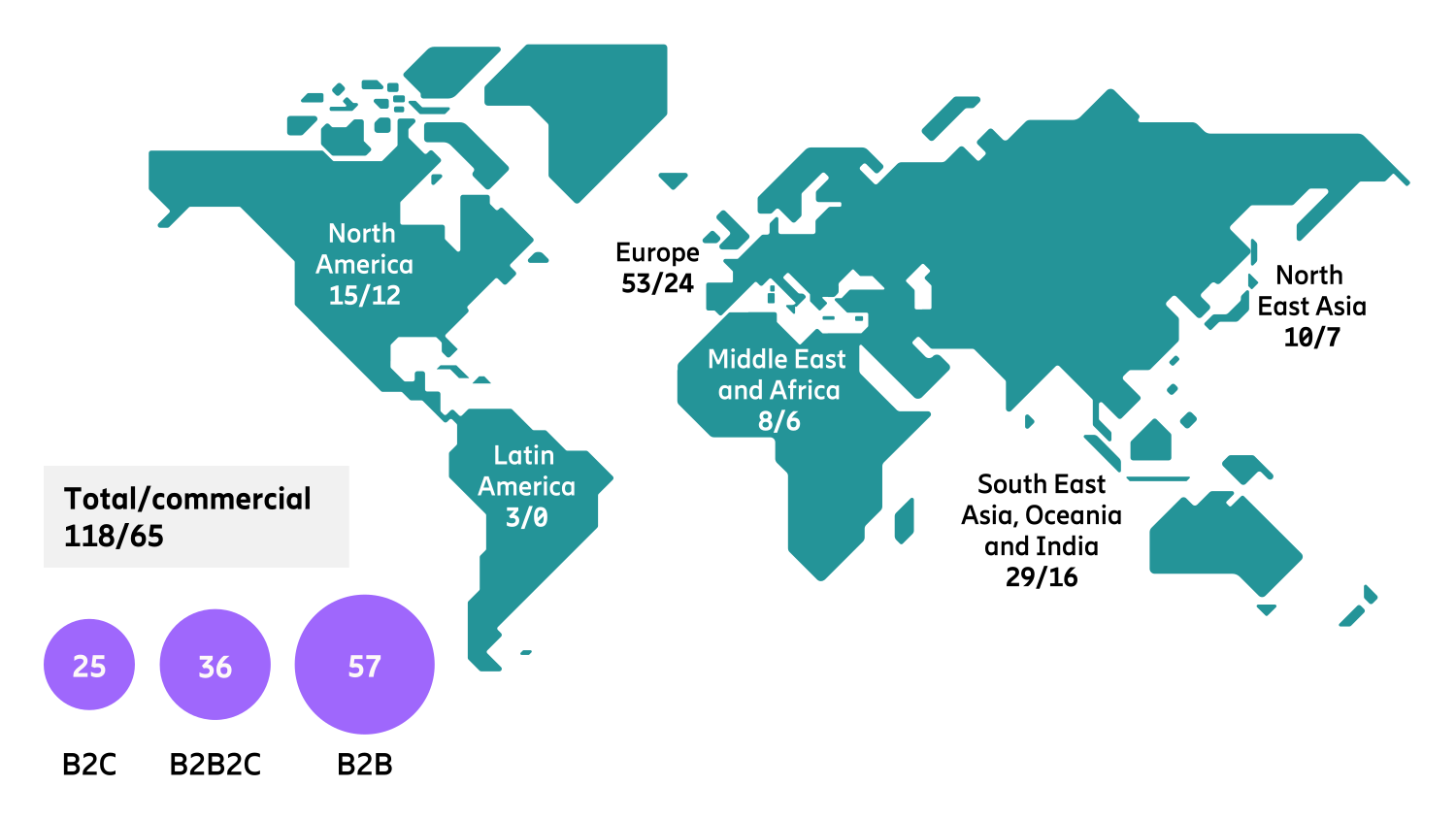
Figure 15: Global instances of network slicing
Global instances of network slicing
Infographic showing that there are 118 cases of network slicing globally, with 65 of these being commercial cases. Of the 118 total cases, 25 of these are business-to-consumer, 36 are business-to-business-to-consumer, and 57 are business-to-business. A world map gives regional details: in North America, there are 15 total and 12 commercial cases; in Latin America, there are 3 total and 0 commercial; in the Middle East and Africa, there are 8 total and 6 commercial; in South East Asia, Oceania and India, there are 29 total and 16 commercial; in North East Asia, there are 10 total and 7 commercial.

Commercialization of differentiated connectivity

Out of 79 service providers with commercially deployed 5G SA, there are 118 documented cases, from 56 service providers, of network slicing being used for some type of differentiated connectivity offering. Of these, 65 are commercially available either as a subscription service, an add-on package, or in the B2B and B2B2C space as a packaged, deployment-ready service. In the B2C sphere, application or situation-focused services such as video conferencing, gaming, event-specific packages and premium fixed wireless broadband subscriptions make up around 55 percent of all offerings. In the B2B area, vertical markets like public safety, transport and logistics, defense and general enterprise use cases dominate.

In the parts of Europe where service providers have deployed 5G SA, they are increasingly active. The region accounts for 45 percent of all network slicing-related activities globally, including trials, proofs-of-concept and commercial offerings. Proportionally, there are more tests and trials in Europe than in other regions such as Asia-Pacific and North America. Out of all commercial offerings globally, 37 and 36 percent are in Europe and Asia-Pacific, respectively. North America constitutes 18 percent of the offerings, with just one service provider accounting for three-quarters of all deployments in the region.

65

Of the network slicing use cases found, 65 are commercial offerings.

Learning to communicate benefits

One recurring challenge identified by service providers, particularly in the consumer market, is how to explain new offers in terms that resonate with their customers. Selling “more gigabytes” or “faster speeds” is familiar territory – but telling the story of latency guarantees for gamers, uninterrupted HD streaming at live events, or priority service for emergency communications requires a more benefits-led approach. Customers respond more strongly when the offer is tied clearly to their personal experience, a specific app or situational need.

Speed, bandwidth, general performance or stability improvements are still being highlighted as user benefits in 86 of the cases based on network slicing. There are some new areas being highlighted, however, like latency (48 percent) or improved experiences when using a specific service or app (38 percent). In many cases, multiple benefits are communicated and combined to enhance the value proposition.

The word “guarantee” has seldom been used in marketing by service providers, but 22 cases express some form of performance guarantee. These could be guarantees for a maximum latency for gamers, minimum bandwidth on Fixed Wireless Access (FWA) or when using video conferencing, or for businesses buying a “productivity slice” with the mobile private network (MPN/VPN) solution. As described in a previous article, delivering a proposition at just the right moment can be very important. A striking example involves a service provider that utilized a direct in-app promotional strategy (displaying a pop-up within a partner app) that generated 95 percent of its sales for a specific package, making it 20 times more efficient than any other channel. Many offers blended benefits, combining speed, priority and security messages to enhance perceived value.

Scaling success stories

The number of service providers deploying 5G SA and starting to use network slicing to create differentiated connectivity offerings is increasing at pace. Meanwhile, service providers that were first to introduce differentiated connectivity, some as early as 2022, have now scaled up their deployments and started to broaden their reach. Across the 65 commercial offerings based on network slicing, half of them are offered by only six service providers. Two of the service providers have 17 of the commercial offers combined, including both B2C and B2B segments. This scale-up indicates that the initial launch phase has been successful enough to justify expansion. The variety of current business models – from guaranteed service tiers for broadcasters to secure connectivity for defense applications – shows both the adaptability of the approach with differentiated connectivity offerings and the market’s appetite for specialized solutions.

Momentum is real and global

The data from the study paints a positive picture: Differentiated connectivity is no longer a speculative field, it is a growing commercial reality across regions and sectors. The fact that Europe is catching up fast, the scale of multi-segment engagement among service providers, and the proven impact of innovative marketing all point toward a market entering a new phase.

The challenge may no longer be whether these services can be launched, but how best to communicate their unique benefits to users, transforming technical capabilities into experiences and outcomes that customers truly value and are willing to purchase.

Next steps

Ericsson Mobility Calculator

Explore the relationship between the usage of various app types and monthly traffic per subscription with our interactive Mobility Calculator tool.

Explore the calculator

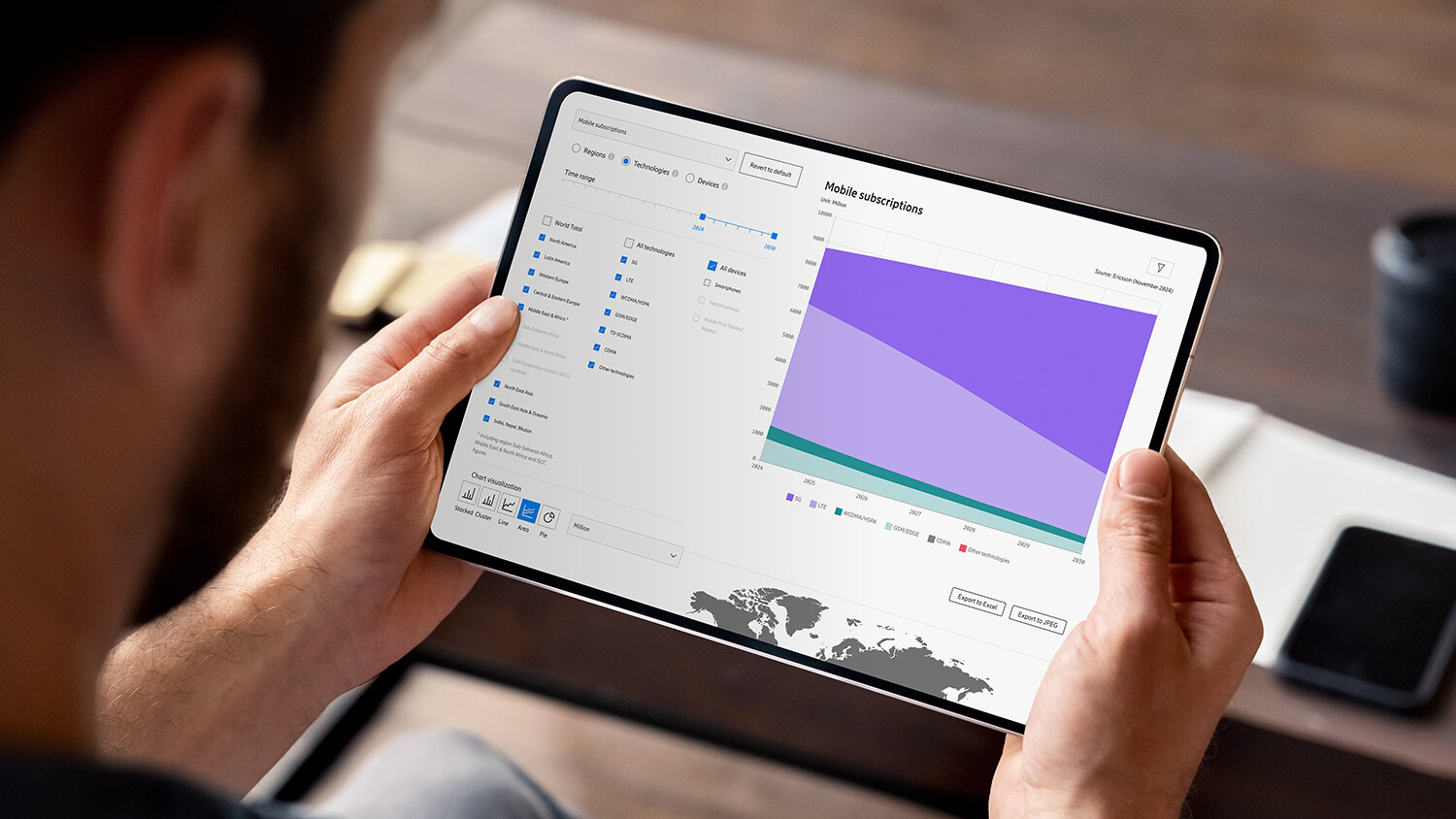
Ericsson Mobility Visualizer

With our Mobility Visualizer tool, you can examine the forecast data that underpins the Ericsson Mobility Report in our interactive web application.

Discover the data

Articles

Discover the Ericsson Mobility Report articles where we discuss trends, case studies, service provider opportunities, and the past, present and future of connectivity.

Discover the articles

Ericsson Mobility Report

Our forecasts are based on past and current data, validated with extensive network measurements. Discover the latest figures for 5G, IoT, fixed wireless access and more.

Explore now
Subscribe to receive Ericsson Mobility Report updates

Get the latest Ericsson Mobility Reports and quarterly updates – the moment they are published!

The face of mobile communications is changing faster than ever. Stay up to speed with projections and analyses of the latest trends in the mobile industry, including subscriptions, mobile data traffic and population coverage.

Subscribe now to get the full reports and quarterly updates sent directly to your inbox.

Subscribe now