










Why one millisecond spectrum sharing matters to boost user throughput



Do you want to listen to this blog post instead of reading it? Play the blog cast.
Can a weatherperson get it right?
I am amused when I hear that the weather forecast calls for a 50 percent chance of rain. Afterall, what does a 50 percent chance of rain really mean? Will it rain for the first half of the day only, or the second half of the day only, or will the rain alternate every other hour? Will the rain cover half the city only, or is there a 50 percent chance that it could rain all day, or not at all? Someone who lives in London knows that it can rain in the morning, and be sunny in the early afternoon, and rain again in the late afternoon, and then be sunny again in the evening.
Those of us who live in rainy climates like Stockholm would like to know instantly, in real time, when it will rain, always knowing exactly when to have an umbrella ready!
When it rains, we also often wonder, how long it will rain. If the winds are moving fast, the rain shower may be short and intense, but if the winds are moving slowly, the duration of the storm could be longer. There is also the movement and change of the different weather fronts and other factors that affect the weather. These different factors leave us wondering if we will see a short, strong, rain shower, or a longer, and less intense drizzle.
Rain patterns and radio transmissions are more alike than expected
The changes that occur within the 4G and 5G radio environment are similar to our rain analogy in that the user traffic requirements and radio conditions are never static – in fact, in the radio domain, they are constantly changing every millisecond. Therefore, spectrum sharing between 4G and 5G will also benefit when supported in an instant, and real-time manner. For example, when a wireless user is in good radio conditions, the user can often be served with a higher data rate for a shorter duration of time in the same way that a strong, rain shower will release its rain quickly. Conversely, when the user is in bad radio conditions, the user may need to hold radio resources for a longer time period in the same way that a slow drizzle will need more time to release its rain.
The art of sharing spectrum
Service providers seeking to add 5G to their existing 4G networks need to do so in a way that maximizes equipment reuse while minimizing service disruptions to existing mobility services. Ericsson Spectrum Sharing enables service providers to launch 5G quickly within existing 4G bands. When sharing spectrum, measuring the radio channel conditions and allocating the use of radio resources, in real-time, is vital. In a real-world radio environment, where both the radio signals and the 4G-5G traffic mix are constantly changing, instant, real-time channel measurements coupled with instant radio resource allocations increases spectral efficiency and network capacity.
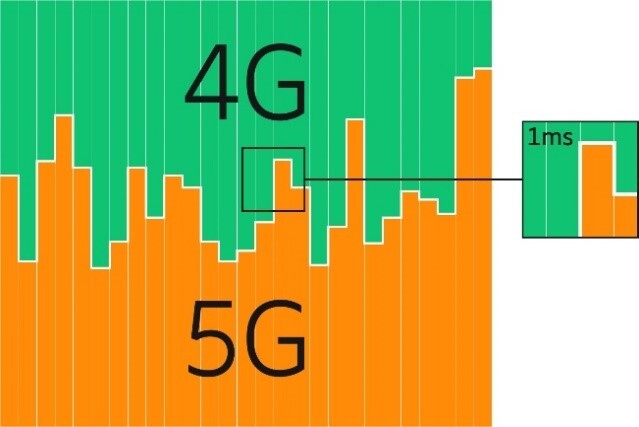
Within 4G and 5G, radio resources are organized into physical resource blocks (PRBs) which are transmitted within 1ms transmission time intervals (TTIs). A 20MHz spectrum block will support 100 PRBs within a 1ms TTI.
Ericsson Spectrum Sharing is designed to share 4G and 5G PRBs in real-time, within each TTI. This means measuring the traffic needs and allocating a different mix of PRB radio resources instantly, every 1ms.
To share spectrum, the network must measure the radio channel conditions, and then must determine how many PRB resources to allocate to 4G and 5G based upon traffic load, device types, the 4G and 5G traffic mix, and the quality of the 4G and 5G radio signals.
To maximize spectral efficiency, Ericsson Spectrum Sharing will schedule – within each TTI - more PRB resources to 4G when the 4G radio conditions are more favorable, and more PRB resources to 5G when the 5G radio conditions are more favorable, enabling each technology to support the maximum amount of traffic with the best data throughput possible. Because the radio channel and traffic conditions will be changing every millisecond, PRB resource optimization is best achieved when the channel measurements and the resource allocation decisions are made on an instant, 1ms basis.
Does sharing spectrum on a 1 millisecond basis really make a difference?
Some might suggest that sharing and allocating spectrum on a 10ms, 50ms or 100ms basis is adequate. However, doing so would mean that the radio channel measurements and radio resource allocation decisions are made by the network either 10ms, 50ms, or 100ms before the spectrum sharing event occurs – that is, 10, 50 or 100 times earlier in time before the physical allocation of the PRB radio resources are made and the 4G and 5G radio resources are transmitted over the radio waves.
Making the radio resource allocation decision early, provides the radio signal with 10ms to 100ms to change before being transmitted – and it will change.
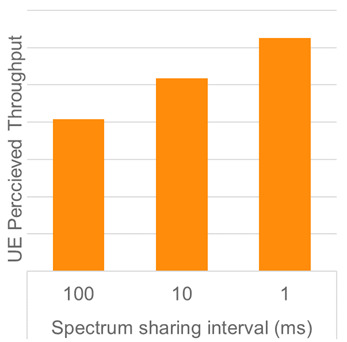
This significantly increases the likelihood of the 4G and 5G PRB resource allocation being less than optimal. With such an early resource allocation prediction, it will be likely that the network will either allocate more 4G resources, or more 5G resources than are necessary, leading to lost capacity and less efficiency. In the radio world, 100ms can be an eternity with respect to the number of times the radio signal quality can change.
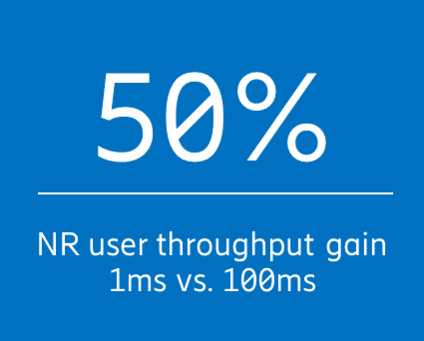
Our modeling of real-world 5G networks – complete with cell loading and dynamic radio conditions - shows that the New Radio (NR) user throughput gain with the Ericsson Spectrum Sharing allocation being determined instantly, every 1ms is up to 20 percent higher than the spectrum sharing gain on a 10ms basis, and 50 percent higher than the spectrum sharing gain on a 100ms basis. Therefore, in conclusion, when sharing scare and valuable spectrum resources between 4G, and 5G, service providers should request solutions that support instant, 1ms spectrum sharing.
Ericsson Spectrum Sharing is commercially deployed in customer networks
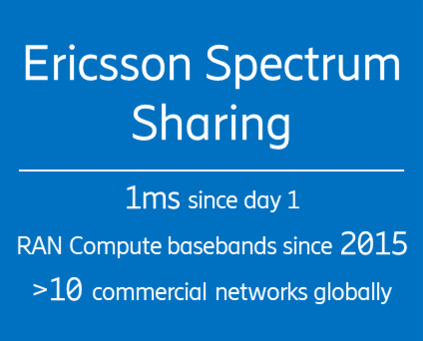
Service providers are benefiting from Ericsson’s 1ms spectrum sharing capabilities as they roll out their 5G networks. As the original, award winning, pioneer in developing 5G spectrum sharing technology, Ericsson Spectrum Sharing has supported the sharing of spectrum commercially between 4G and 5G on a 1ms basis since day 1, on all of our RAN Compute basebands as part of the Ericsson Radio System portfolio.
In addition, Ericsson Spectrum Sharing supports the simultaneous mixed-mode operation of 4G and 5G on the same RAN Compute baseband module and radio, enabling full hardware reuse. To date, Ericsson Spectrum Sharing has already been commercially deployed on a 1ms basis in more than 10 networks – with more to come - enabling service providers to rapidly deploy 5G, swiftly bringing the benefits of 5G to their subscribers.
In conclusion, with the instant and real-time qualities of Ericsson Spectrum Sharing, instead of running from the rain, you might find yourself happily “Singin’ in the Rain”, like Gene Kelly in the 1952 movie classic by the same name. And when the rain clears, you might even see a rainbow.

Find out more about Ericsson Spectrum Sharing
Explore our 5G Access key offerings
CTO GLOMO Award
Read the 5G networks software blog series
The significance of the 5G Uplink Booster to the new normal
Contemplating coverage: To extend, or not to extend? That is the question