









The future of commuting? The key is in connectivity

Strategic Marketing Director for AI

Strategic Marketing Director for AI
Strategic Marketing Director for AI
Anyone can relate to the feeling of wasting precious hours every week in a car or a train. Then the COVID-19 crisis hit, and a large percentage of the world stopped commuting. Streets and trains were suddenly empty. Six months later, the world is slowly attempting to regain a sense of normalcy, and people are relearning something that was a significant part of their daily routine – the commute.
Yes, there’s still uncertainty regarding urban mobility in the near future. We’ve witnessed much of society adapting to the new normal and a large percentage have been fortunate to be able to work from home and maintain a sense of progress. Some of that will remain, and many of us will probably prefer things to stay that way. However, as we learned from our recent study undertaken amidst the pandemic to understand consumer behavior during the COVID-19 crisis, 80 percent of consumers think it’s likely they will return to their usual commute after the crisis, even if only one in four definitely wants to go back to their usual commute. Therefore, the large majority expects to eventually return to their normal routines, whether they like it or not.
Ericsson ConsumerLab has conducted a study on the commuting experience in 16 major cities around the world. We have created a unique benchmark to show the benefits of mobile broadband connectivity for a better commuting experience and understand what consumers really want in the future in terms of safety, convenience and entertainment.
It is very inspiring to see how some people make the most of their time when they transition between home and work. Knowing what consumers value during their daily commute can be used to influence positive changes and adapt the commuting experience in the future. The deep knowledge acquired can also prepare us for the moment when we can safely return to schools and workplaces.
Explore the Connected Commuter Dashboard
Take a closer look at the consumer research behind our ConsumerLab study ‘Augmenting the daily commute’ with our interactive Connected Commuter dashboard.
Not just moving from point A to B
One in four survey respondents reported being ‘highly satisfied’ with their daily commutes and were actively shaping their experience. We examined the habits of these ‘Savvy Commuters’ to learn what they were doing to gain enjoyment from their trips. They all exhibited three main trends:
Habits of Savvy Commuters
Savvy Commuters are very flexible in the way they use their commute. Half of them reported regularly engaging in three or more activities on a regular basis, while unsatisfied commuters felt more limited to one of two things they could do on the go. And the activities vary depending on the method of transport. For example, car drivers listen to music or the news, use navigation apps and take calls (all activities that keeps their hands and eyes unrestricted for drivers). Public transit users favored activities like video games, catching up on social media or reading an eBook.
Savvy Commuters are digitally engaged not only for entertainment and productivity, but to also maintain control over the aspects of their trip. They embrace flexibility to avoid congestion and delays, and will change their transport mode from the train to the bus, or change their route. More than 80 percent of commuters have a smartphone with them, but Savvy Commuters use them the most, with 65 percent saying they ‘always’ use it when they are on the go. And we see this trend with any portable device. Many commuters do carry devices with them, but those who are savvy used them the most.
Creating mental space
Mental space proved to be a critical aspect of commuting satisfaction. While it’s easy to imagine that someone in a car would feel like they have adequate physical space, the limitations become more evident in crowded or noisy shared transport modes.
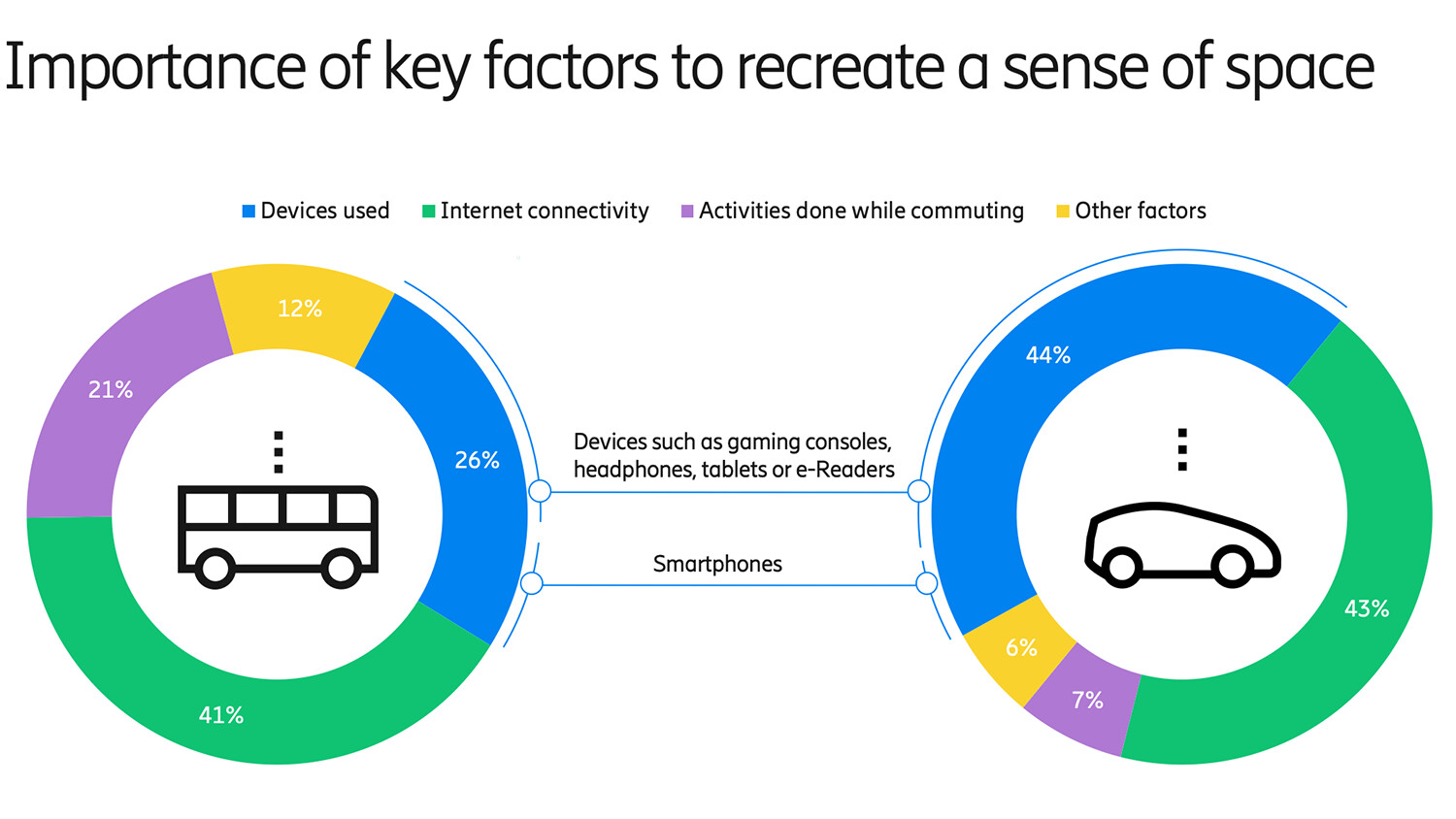
Those who reported taking crowded public transit revealed they were able to gain a sense of mental space with the help of engaging with their digital devices. In fact, the actual activities done during the commute are secondary in creating a sense of space. Tech and connectivity also play a role in ensuring the transport mode they take is not exposing them to undue risk of infection—for example, by providing information on crowded buses—and helps in providing personal safety and peace of mind.
Using a regression model, we compared the relative importance of factors influencing the sense of good personal space while commuting. The analysis shows that internet connectivity and the devices used are the most important factors to improving the satisfaction level in terms of mental space. It turns out, with just a podcast and a pair of headphones, commuters can create a sense of mental space, which in turn enhances their experience.
A connected commuter is a happy commuter
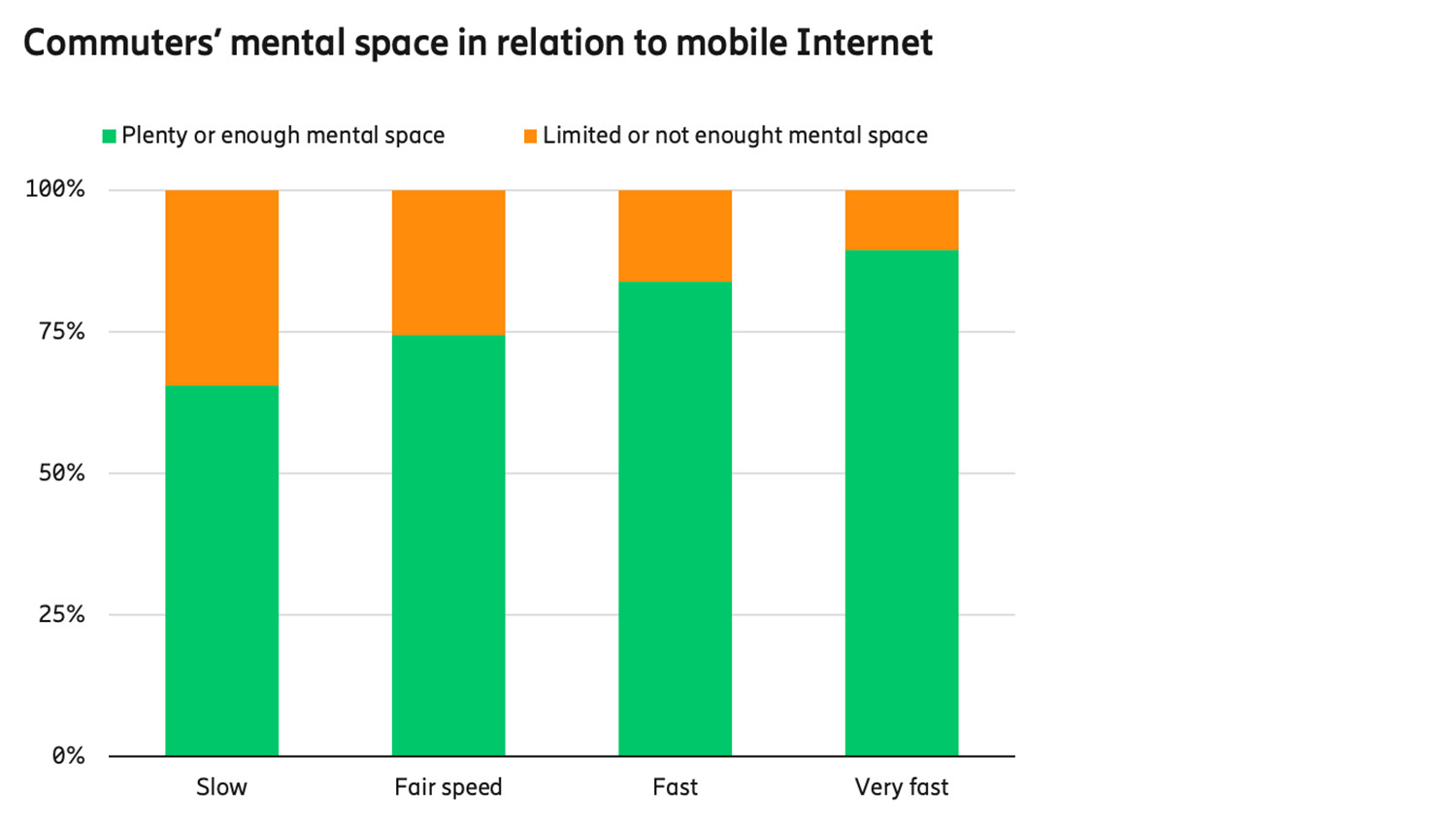
Our survey findings also revealed another interesting connection: the ability to create mental space among commuters was directly tied to the speed and reliability of their mobile broadband connection. This makes sense, as the spinning beach ball or “buffering” message can quickly make a commuter aware of how crowded their subway carriage is and the fact that it has stopped for a delay.
The same goes for those in cars. Losing signal with navigation or making the ride in silence is enough to remind someone they’ve not moved much in the last 20 minutes. These statistics just go to show how much we rely on our connected devices to enhance our experiences. In fact, more than 36 percent of our respondents said they’d happily endure a longer trip in exchange for an improved commuting experience.
Commuters have shown higher digital engagement over the last few years. People are increasingly favoring video content and gaming over audio and social media during their commute. We see a 4-fold increase in commuters watching video content in Shanghai and how gaming has doubled in New York and Shangaghi over the last five years.
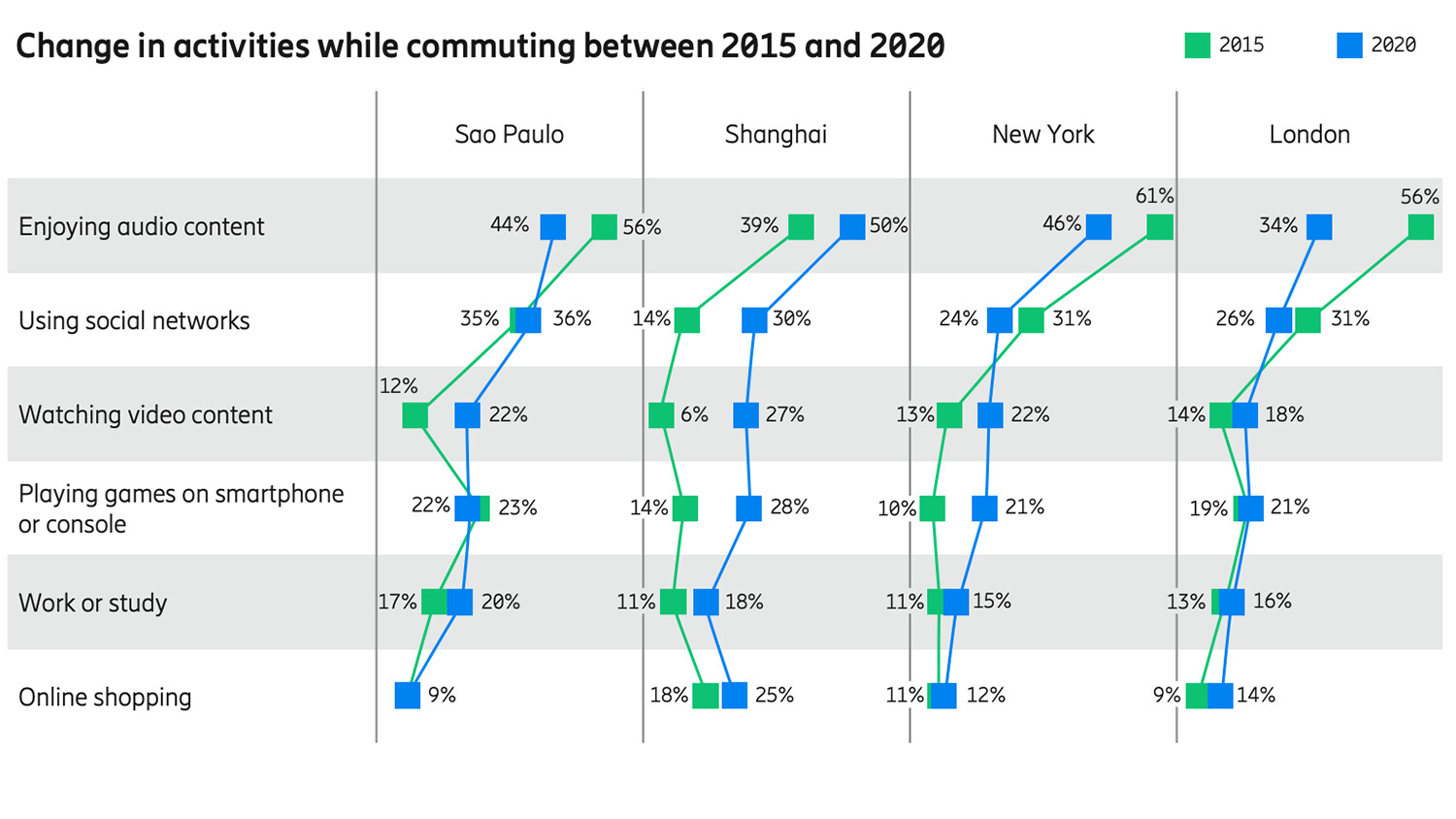
The possibility to reuse commuting time and enjoy mental space are also being considered in 5G rollouts as important factors in driving commuting satisfaction. An example of this is the Ericsson 5G Radio Dot deployment on the Shenyang subway, which aimed to meet the increasing data needs from customers, particularly in high-quality uninterrupted video and streaming traffic.
Driving forward
Even if we are living under exceptional circumstances, regular trips to work, school, social events, grocery shopping, or even the trip to the post office to pick up online purchases will likely remain in our lifetime. Normal life, or as normal as we can get, will resume. More than one in three (34 percent) respondents said they will ‘probably’ go back to their normal commute and one in four said ‘definitely.’ Only 16 percent did not expect to return to their regular routine.
While working from home will remain the new normal for some, for others the rat race will march on. For those who return to the office, technology will likely continue to increase its impact on their enjoyment and safety during their trip, which is why we must shape the future with the end user in mind. Ultimately, 4G and 5G will be necessary to accommodate the surge of data consumption during commuting hours and provide people with the ability to create a better experience for themselves.
To learn more about what people want in order to increase their commuting satisfaction, and the roles connected technology will play, read our report: Augmenting the Daily Commute.
Want to know more?
Explore the interative Connected Commuter Dashboard to discover more of our extensive consumer research, representative of 130 million smartphone users worldwide.
Read our blog post, How tech can help us create a better world: a fresh perspective.
Read Indoor connectivity for the office of the future - Ericsson