










Reality check: How can BSS support the smart manufacturing journey?

Solution Marketing OSS/BSS
Solution Marketing OSS/BSS
Solution Marketing OSS/BSS
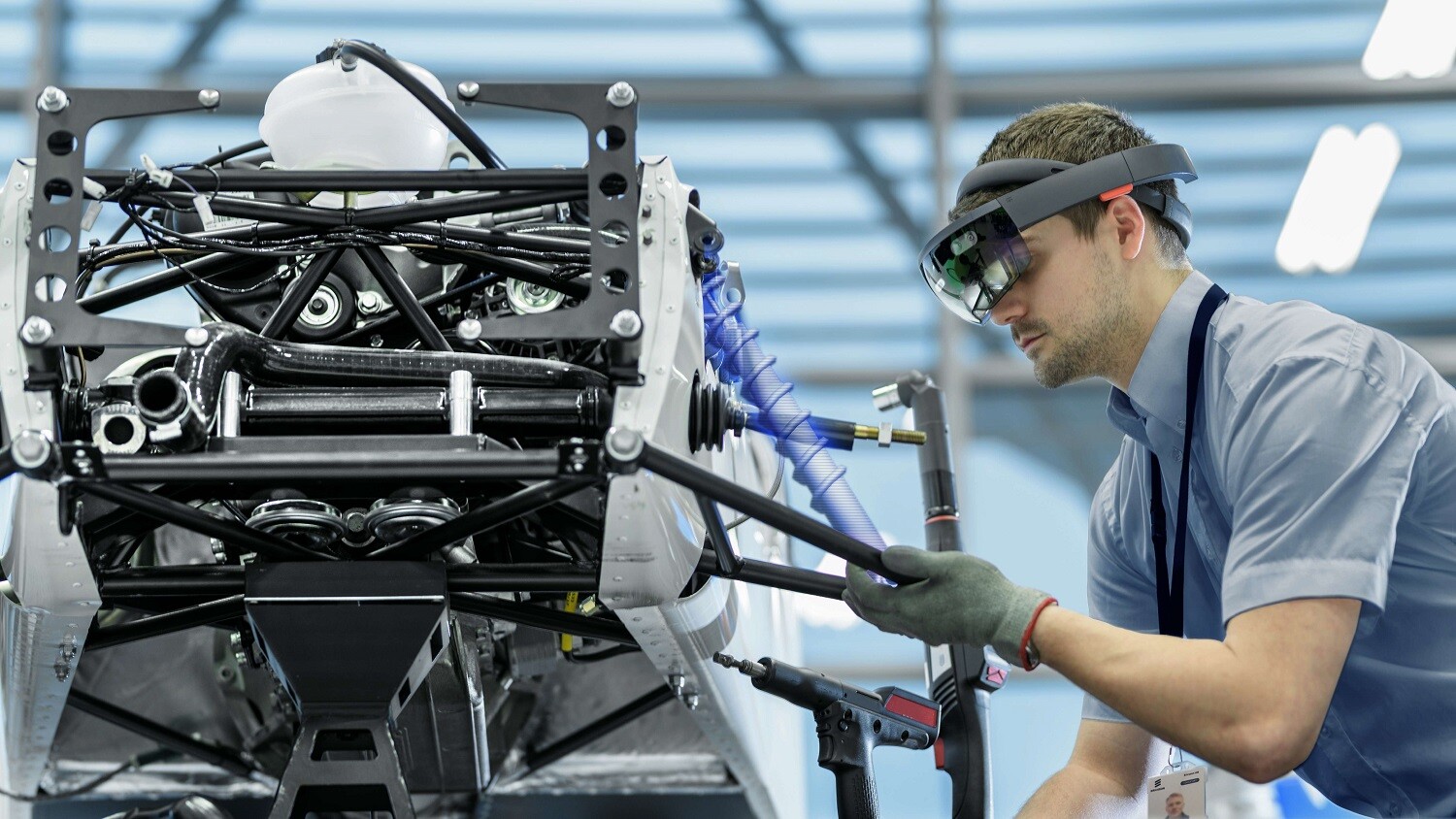
Smart factory solutions modernize factory floor operations by leveraging the Internet of Things (IoT), automation, artificial intelligence (AI) and augmented reality (AR) – technologies enabled by the speed and latency of 5G. 5G dramatically improves the AR experience for many use cases, including diagnostics and remote maintenance.

There is so much more to say on this topic, download our eBrief: Full steam ahead for Industry 4.0: Exploring BSS for smart factories
Complex machinery on the production floor frequently requires specialized labor on demand. Diagnostics and maintenance in factories are constrained by the availability and cost of on-site expertise. Smart factories are starting to deploy AR technologies for quality inspection and diagnosis. 5G-enabled AR can provide virtual guidance from experts to troubleshoot and repair equipment remotely. AR headsets and cameras can share audio, video and instructions in real-time for fast, precise support from remote experts. This will decrease labor and travel costs, while boosting equipment uptime and work efficiency.
According to a study by Ericsson and Arthur D. Little, ‘Network slicing: Top 10 use cases to target’ the smart factory market size is expected to grow from USD 165 billion in 2019 to USD 250 billion by 2024.
AR for worker support in factories: USD 1 billion addressable slicing revenue for CSPs by 2025
A newly published eBrief, ‘Full steam ahead for Industry 4.0: Exploring BSS for smart factories,’ investigates the use of AR solutions in smart factories: with a use case detailing an associated business model and the requirements from BSS. The use case centers on a solution that enables on-site cameras to transfer images and videos. It examines how AR technologies can be used to support technicians on the factory floor, increase work efficiency and reduce work interruptions (see Figure 1).
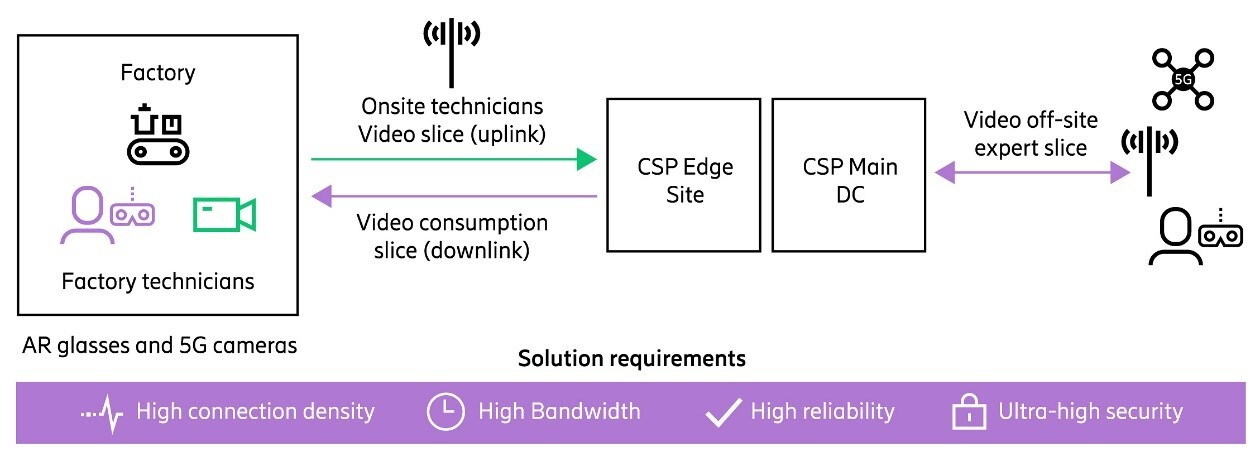
Figure 1: Use case flow - AR for inspection and remote support in smart factories
Source: Ericsson
This use case centers on a solution that enables on-site cameras to transfer images and videos. Network slicing guarantees reliable, high throughput and ultra-high security streaming for high density device connectivity to an edge deployment site near the factory where data will be processed and managed. Repair instructions can be rapidly transmitted and visualized, allowing off-site experts to provide real time support.
The CSP acts as a service enabler to the enterprise working together with partners, to provision network slice, platform, cloud, network exposure and data management capabilities. These include:
- Virtual 5G private network with help of network slice
- Service Level Agreement (SLA) management
- Network and management functions exposure
- Cloud platform
- Support services
- eSIM management

Source: Getting creative with 5G business models
BSS must be tightly integrated with OSS and core network
End-to-end coverage is achieved by integrating capabilities from multiple domains encompassing technical, operational and business aspects for consistent and complete solution implementation.
We identified the most important end-to-end capabilities needed to allow AR inspection and remote support in this smart factory use case and we also mapped specific focus areas and the value-chain positioning of CSPs (Table 1). The purpose of value-chain positioning can also help guide CSPs on their 5G evolution journey. For each focus area, we have mapped and described the enabling BSS capabilities.
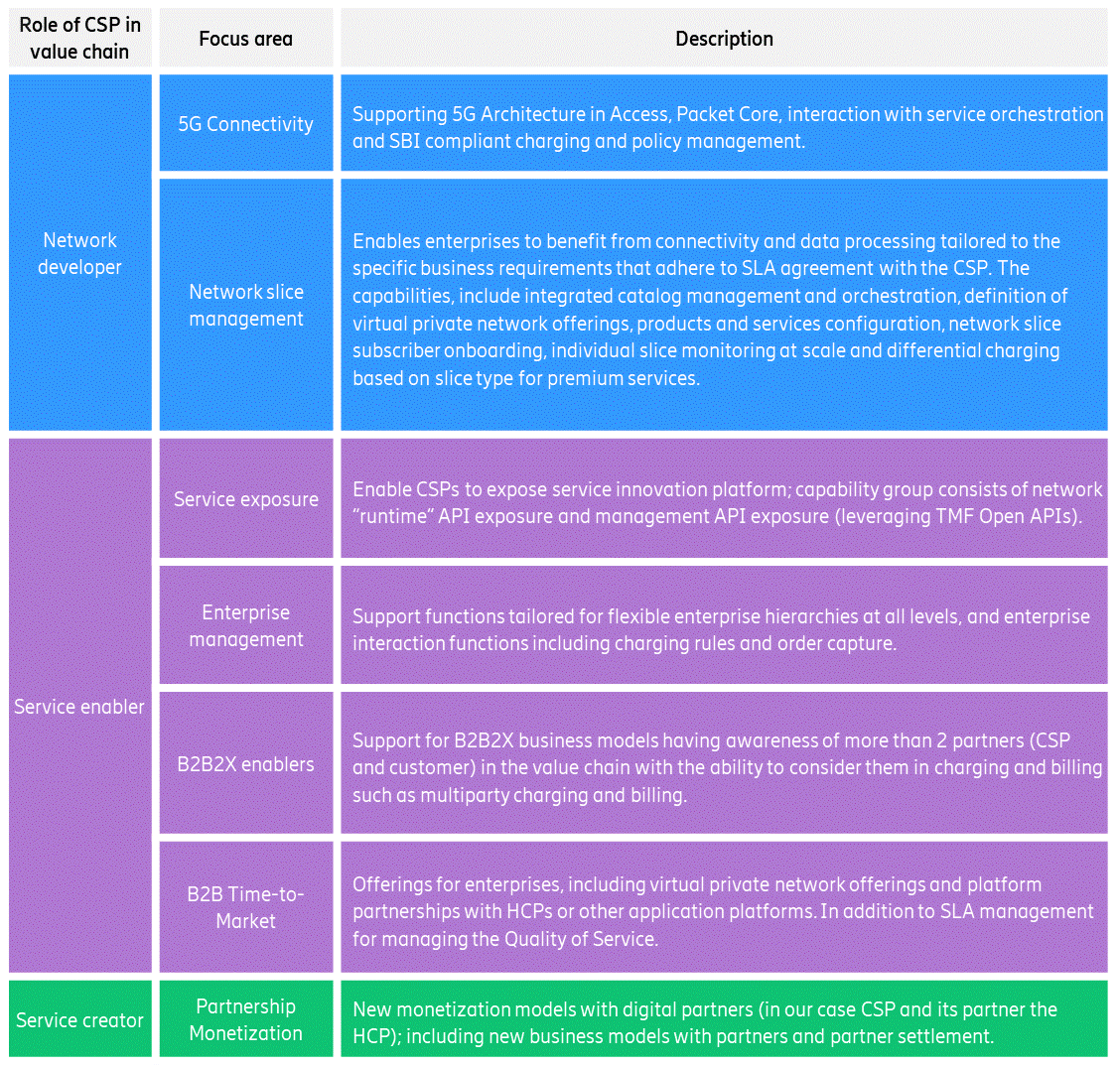
Table 1: End to End Capabilities descriptions
Source: Full steam ahead for Industry 4.0: Exploring BSS for smart factories
The BSS capabilities are described in detail, along with touch points on OSS and core network domains in our eBrief “Full steam ahead for Industry 4.0: Exploring BSS for smart factories”.
What are the key takeaways for deploying the right use case?
The right set of stakeholders must be aligned: A diverse and complex stakeholder ecosystem needs to be set in place. Alignment is essential to go from proof of concept to production, which means meeting with a broader set of stakeholders across information technology (IT) and operational technology (OT) domains. All of this requires the CSP to offer services beyond telecom. For the AR for inspection and remote support in smart factories use case, we have defined an engagement model depicting the position of the CSP in the value chain as a service enabler, the interaction of various stakeholders and how the end-to-end service will be fulfilled for customers.
Prove the business case: In addition, the enterprise needs to prioritize its business cases. While manufacturers are looking to reduce costs by automating and digitalizing their factories, they will not invest in unproven solutions when it comes to live production. Therefore, they should calculate their ROI to effectively quantify the financial gains they can expect by implementing a 5G use case.

Source: The Smart Manufacturing Value Calculator - Ericsson
End-to-end capability coverage must be enabled: When deploying use cases, the CSP should present solutions enabled by capabilities from multiple domains – BSS, OSS and network – to cover the technical, operational and business aspects of the industry. The all-important end-to-end coverage is only reached by integrating features from BSS, OSS and network domains, enabling consistent and complete capability implementation across these domains. In this study, we have identified the most important end-to-end capabilities from across the BSS, OSS and network, which are also available in our Ericsson Digital Services portfolio. We then mapped the end-to-end capability framework to our use case and presented its BSS enabling capabilities.
BSS is in a natural transition and will evolve further to enable smart manufacturing
New use cases are being deployed that require the role of the CSP to expand and offer more sophisticated 5G services to enterprises. The AR for diagnostic and remote support use case demands multiple BSS capabilities, especially: 5G charging and billing, enterprise offer management, partner monetization through new business models, revenue sharing schemes, network slicing, service-level agreement (SLA) management, partner platform management and exposure capabilities. These all integrate with OSS and network capabilities to enable an end-to-end solution.
For AR services, BSS systems must be able to onboard AR devices to a network slice and apply differential charges based on the network slice type, thereby providing a high reliability and secure service to the enterprise. In the AR use case, the CSP is serving a network slice for a mission-critical application enabling staff to put industrial devices back into operation as quickly as possible. The availability and reliability of the service is crucial. Therefore, SLAs are configured with service level specifications, objectives, consequences and penalties. Soon, CSPs will be able to deploy more BSS capabilities to enable more services such as value-added services, including software, applications, and licenses. In the case of AR, CSPs could acquire or develop their own AR platform and thereby integrate the whole solution.
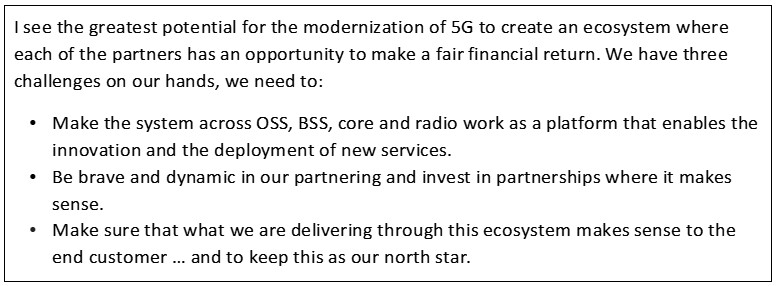
Source: Jan Karlsson, Senior VP, Head of Business Area Digital Services, Ericsson – Keynote at TM Forum DTWS
Learn more
- For more insight on AR for smart factories use case, please refer to Full steam ahead for Industry 4.0: Exploring BSS for smart factories
- For more insight on Augmented Reality use cases in 5G stadiums, please refer to Bringing the heat to stadiums: Monetizing on 5G immersive experience
- For more insight on 5G use cases and their business models, please refer to Getting creative with 5G business models
- For more insight on TMF recent survey for BSS Enterprise monetization, please refer to the TM Forum report: Is BSS ready to monetize enterprise 5G?
- For more insight on the Ericsson and Arthur D. Little report, please refer to Network slicing: Top 10 use cases to target
- For more insight on the Ericsson sessions in World Transformation series in 2022, please refer to Keynote at TM Forum DTWS
- For more info on The Smart Manufacturing Value Calculator of Ericsson, please refer to Measure productivity in manufacturing - ROI Calculator - Ericsson
- Read more about Digital BSS for the 5G era in telecom BSS