









Realizing Time-Critical Communication with 5G

Head of Commercial Intelligence & Analytics

6G Portfolio Strategy, Business Area Networks
Head of Commercial Intelligence & Analytics
6G Portfolio Strategy, Business Area Networks
Head of Commercial Intelligence & Analytics
6G Portfolio Strategy, Business Area Networks
Time-Critical Communication enables high reliability1 and consistent low-latency (so-called bounded latency) connectivity on a large scale – in both wide and local coverage areas, leveraging any 5G frequency band.
Time-Critical Communication is fundamentally different from enhanced mobile broadband (eMBB), which optimizes data rates but does not consistently deliver low latency. The concept of Time-Critical Communication is similar to what is known in the industry as Ultra-reliable and Low Latency Communication (URLLC), which aims at securing data delivery within specific latency bounds (X ms) with the desired reliability level (Y percent). Depending on the user requirements, X ranges from tens of milliseconds to 1 millisecond latency and Y ranges from 99 percent to 99.999 percent reliability.
Having established the initial 5G rollout, many emerging use cases are time-critical in nature and demand highly reliable and consistent low-latency connectivity. As such, Time-Critical Communication will play a major role in the next wave of 5G-driven innovations for consumers, enterprises, governments, and public institutions. Some of the key drivers and benefits of these innovative applications would include sustainability, improved quality of life, efficiency, productivity, and safety.
The majority of time-critical applications can be classified into the following four categories [1].
- Real-time media, which is about production and consumption of media in real-time
- Remote control, which refers to humans controlling machines and equipment remotely
- Industrial control, which includes real-time control of industrial automation systems
- Mobility automation, which is about enabling automated control loops for vehicles and mobile robots
Each category includes use cases with a broad range of requirements – from consistent low latency of tens of milliseconds down to single-digit milliseconds, as illustrated in Figure 1. Some of the use cases have additional challenges such as high uplink bit rates and extreme requirements on service availability. Some applications are rate-adaptive meaning that an application can adjust its bit rate in order to fulfil a certain latency target [2].

Figure 1: Time-critical use case categories
Let us take two examples:
Real-time media
Extended reality (XR) technologies – including anything from virtual reality (VR), to mixed reality (MR), augmented reality (AR) and haptics – have enormous potential to transform both industry and society. Until recently, however, widespread adoption has been hindered by heat generation issues as well as by the limited processing power, storage and battery life of small form factor head-mounted displays (HMDs). These challenges can be addressed by offloading most of the XR processing to the mobile network edge. In fact, our internal studies show that offloading can reduce device energy consumption by up to seven times.
However, offloading the XR processing requires consistent low latency communication between the device and the mobile network. This is provided by Time-Critical Communication. XR connectivity requirements depend on the level of functionality split between the device and the mobile network, as well as on the targeted quality of experience, leading to a wide range of bit rates and bounded latency requirements [3]. The table below shows the 5G connectivity requirements for cloud AR and VR based on ecosystem developments, including the 3GPP.
| Use cases | DL bitrates (Mbps) | UL bitrates (Mbps) | One-way latency (ms) | Frame realibility (%) |
|---|---|---|---|---|
| VR | 30-100 | < 2 | 5-20 | ≥ 99 |
| AR | 2-60 | 2-20 | 5-50 | ≥ 99 |
The cloud XR application ecosystem is developing rapidly. Limited commercial deployments are expected in 2022. We expect ~5-50ms consistent low latency connectivity requirements can be addressed by 5G ecosystem in a wide range of deployment scenarios in next 2-3 years, helping the XR use cases to take off.
Industrial control
Manufacturing industries are exploring 5G for advanced industrial automation. Compared to wired communication, which is the norm for industrial automation today, 5G connectivity offers significant benefits in terms of mobility, security, flexibility, cost-cutting and digitalization [4].
In transitioning to 5G, workers’ safety is a critical issue on the factory floor. There are safety-related components in automated systems that communicate with each other to ensure safe operations. To communicate wirelessly, high reliability and low latency connectivity are crucial.
One common example is a safety light curtain defining a safety zone around a machine, whereby any object or human interrupting the light curtain triggers a safety stop in the machine [5]. The minimum distance between the machine and the light curtain is determined by the maximum speed of the objects or humans moving around the machine’s vicinity and the total reaction time of the machine. This reaction time is composed of intrinsic latencies of the industrial application, such as the reaction time of the sensors and the time it takes to bring the machine to a complete halt, as well as the latency of the communication channel.
The safety light curtain application can be set up such that the latency requirement of the connectivity is in the range of around 20ms to 1ms. The shorter the latency of the connectivity, the smaller the safety zone required around the machine and the more efficient the use of factory floor space.
We expect 5G networks to deliver consistent low latency down to ~5ms with high reliability in next 2-3 years in local area dedicated/private networks for industry campuses.
Time-Critical Communication opens up new revenue opportunities for service providers
Time-Critical Communication has tremendous potential for opening up new revenue opportunities for CSPs via both public and private 5G networks.
Firstly, Time-Critical Communication represents a major differentiation between 5G and non-cellular technologies such as Wi-Fi and Land Mobile Radio (LMR), as well as the previous generation of cellular systems like LTE, GSM or GSM-R. This differentiation stems from the fact that, for many time-critical wide-area coverage use cases, cellular connectivity is the only viable option. Additionally, for time-critical use cases with short-range connectivity needs, 5G outperforms wired connectivity both in terms of flexibility and cost efficiency – and outperforms Wi-Fi in terms of reliability, flexibility, and security.
CSPs can seize market opportunities presented by Time-Critical Communication via two complementary network deployment approaches, depending on use case requirements in terms of consistent (i.e., bounded) low latency, service availability2 and coverage area:
- Public network infrastructure: CSPs can provide software upgrades for time-critical services with moderate bounded latency (~50ms-20ms) and service availability requirements - reusing the existing network infrastructure to enable time-critical communications. This will enable CSPs to monetize public networks beyond enhanced mobile broadband (eMBB) services by generating revenue from high-value, time-critical services for both consumers and enterprises. Examples include AR, remote control, cloud gaming, and automotive use cases.
- Dedicated/private network infrastructure: In contrast with general public networks, CSPs can deploy dedicated 5G infrastructure for enterprises or government (public) agencies for use cases with extremely high requirements or service availability and/or bounded latency (~20ms-1ms). This can be deployed either as an isolated network or as an extension to the existing public network. The dedicated infrastructure can be deployed either in a local area such as a factory, a port or a mine, or in a confined wide area along a rail track, highway, or a city center, depending on the users’ radio coverage needs.
Major time-critical use cases relevant for each deployment scenario are shown in Figure 2 below.
| General Public Networks | Wide-area Dedicated Networks | Local Dedicated Networks |
|
Major use cases
|
Major use cases:
|
Major use cases:
|
| Key verticals: Entertainment, Automotive, Transportation, Logistics, Public Safety, Utilities, Construction, Forestry, Healthcare, Media production, Agriculture, Airports | Key verticals: Railways, Public Safety, Utilities, Peacekeeping & Defense | Key verticals: Manufacturing, Process industries, Warehousing, Mining, Ports, Airports, Energy Utilities, Offshore, Entertainment, Education, Healthcare, Peacekeeping |
|---|
Figure 2: Major use cases relevant for the three deployment scenarios
Technical challenges have prevented time-critical applications from scaling
Ericsson has identified six major causes of latency and interruption in mobile networks, which hinders realization of time-critical applications at a reasonable scale – both in terms of volume and diversity of deployment scenarios:
- Congestion
- Radio environment
- Mobility
- Standards and protocols
- Power saving
- Network topology
5G, together with Time-Critical Communication, can address these sources of latency and interruptions in efficient coexistence with eMBB. Time-Critical Communication has a large toolbox which includes both Ericsson’s innovation and 3GPP standardized features for URLLC, shown in Figure 3 below. Further details can be found in [3].
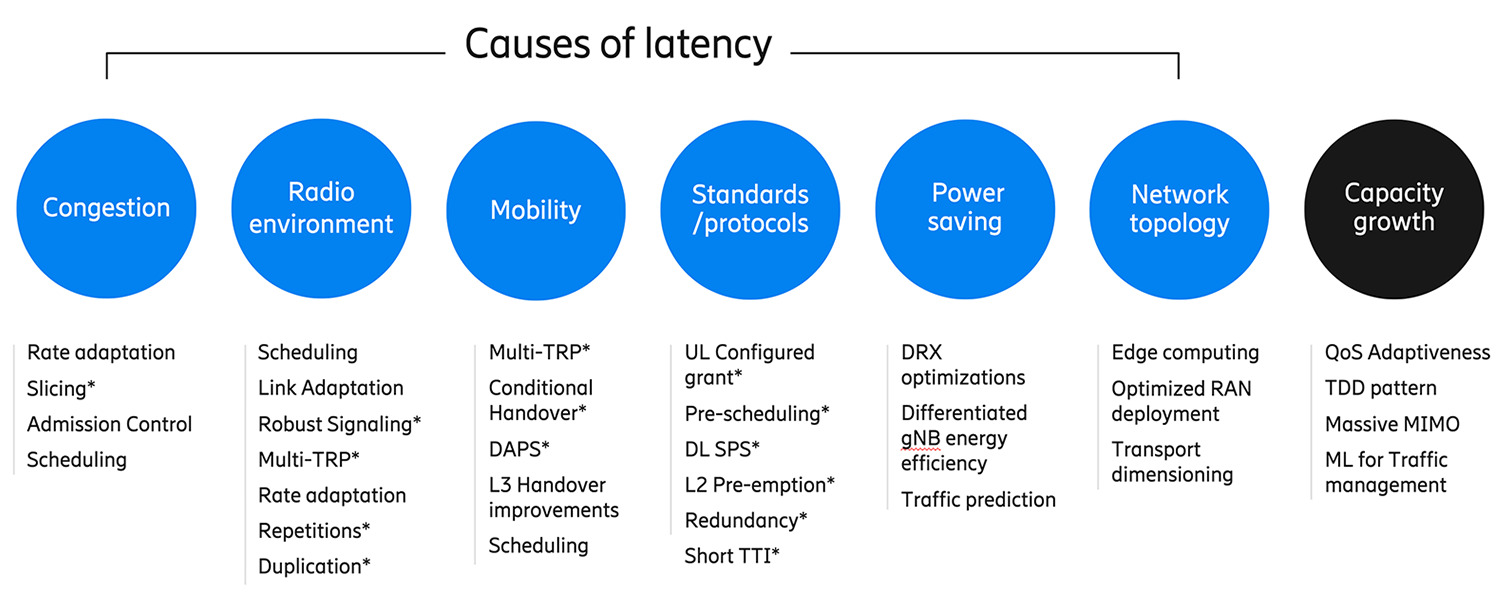
Note: *3GPP Standardized features
How Ericsson supports and drives the ecosystem to realize Time-Critical Communication
As many of the time-critical applications are new, there have been many unanswered questions within the ecosystem, regarding both end-user requirements and the technical capabilities to addressing the connectivity needs of these emerging applications. To address these challenges, as well as to build confidence in 5G, Ericsson has led 100+ industry collaborations involving industry players from various sectors. These have enabled us to trial 5G for innovative applications and thereby develop broad and deep understanding over time.
Ericsson, as a global leader in 5G networks, has a holistic view of emerging time-critical applications and is in a pole position to drive the next wave of innovation through Time-Critical Communication. To enable the demanding time-critical applications to scale, all components (networks, devices, and applications) must step up. As end-to-end co-development is crucial, Ericsson is working in close collaboration with the 5G ecosystem to realize time-critical use cases at scale, in a systematic and cost-effective way.
References:
- Critical IoT connectivity: Ideal for time-critical communications
- XR and 5G: Extended reality at scale with time-critical communication
- Boosting smart manufacturing with 5G wireless connectivity
- 5G URLLC achieving industrial automation
1Reliability is defined as the success rate of data delivery within the time constraint required by the targeted service, according to 3GPP [3GPP TS 22.261].
2Service availability is defined as the success rate of delivering a service according to an agreed Quality-of-Service (QoS) in a specific area, according to 3GPP [3GPP 22.104].
Read more
Discover how private networks deliver secure, reliable and tailored connectivity for enterprise and industrial environments.