










Behind the scenes of the Ericsson Mobility Report: 10 years of industry leading insights
- English
- Français

Part 1 – the name
“Patrik, I have a small project for you. Can you put together a report with the latest data and forecasts that we have on traffic and subscribers, which we can publish externally?”
These were the words from my boss in late August 2011 which kicked off the work that eventually led to the creation of the Ericsson Mobility Report. For some time, we had discussed the fact that although we tracked a lot of data related to traffic and subscription uptake for mobile broadband, it wasn’t well known internally and definitely not externally. Measurements and forecasts were used to support R&D and strategic planning departments.
This meant that marketing and sales had difficulty finding the internally produced forecasts, leading to reliance on external sources instead. To make things worse, competitors – some of which didn’t even sell mobile infrastructure equipment – were perceived to have more knowledge about market development than Ericsson, the worldwide leader in delivering mobile systems.
This had to change, so we set high ambitions for the first report, which was to “establish Ericsson as the key source for industry insights” and to become “a must-have publication for operators and analysts worldwide”.
But as in all projects, there wasn’t a straight line to success. Organizational issues, as well as just getting hold of the relevant data and figuring out what to include created challenges.
“Why should we reveal this data?”, “Aren’t we just giving away insights for free?”, “Do we really need another report?” and, ”People don’t read pdfs any longer” were just some of the objections we heard.
And then there was the name of the report…
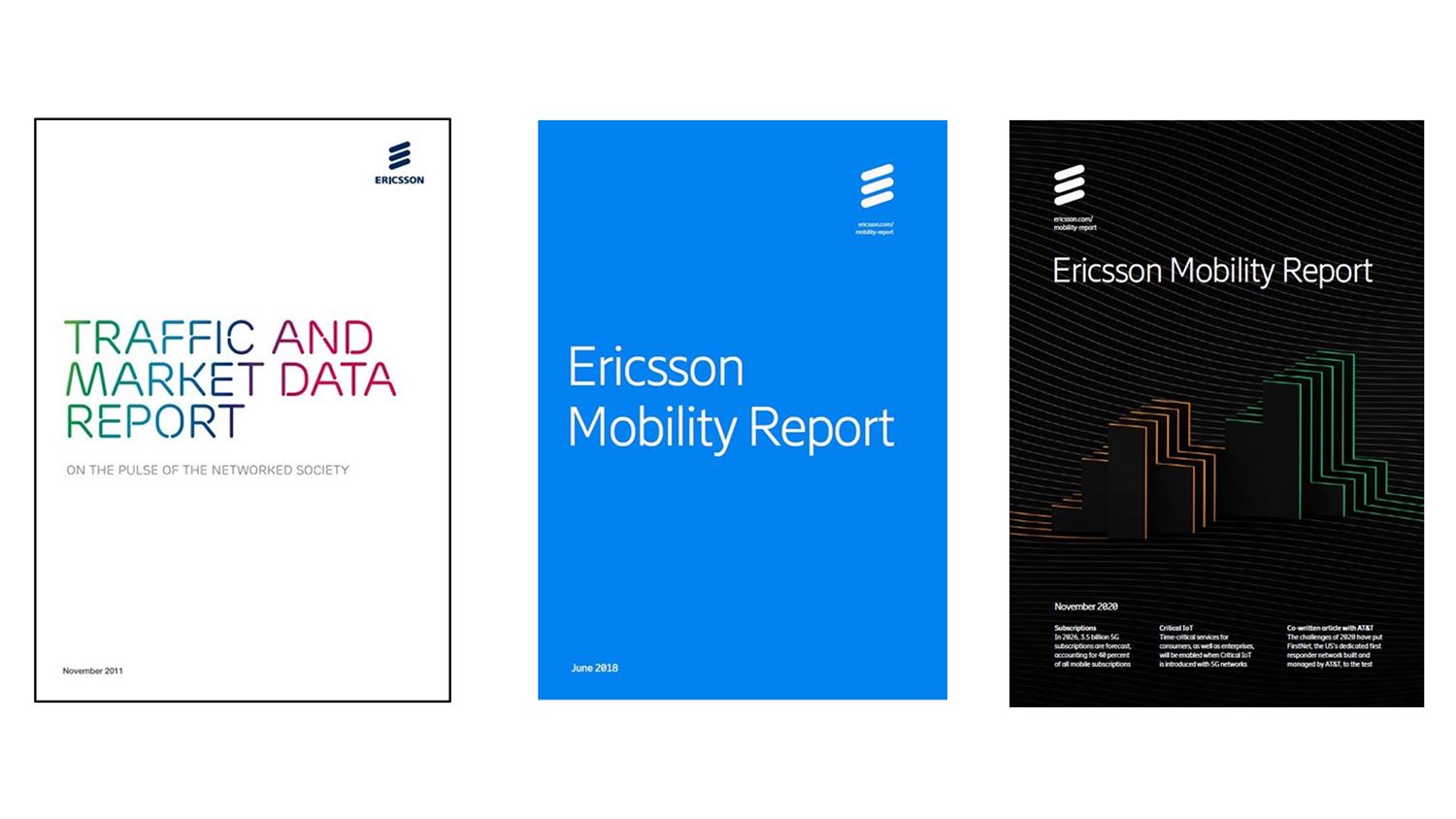
How the Ericsson Mobility Report has changed over the years.
Little did I think this would be one of the most challenging issues with the publication. At the time, I was working in our Networks organization, so naturally we thought we should call it the “Networks Market Report”. But that didn’t work, as it was supposed to cover more than the Business Unit Networks priorities. After much discussion, I realized that the only way to get this report out of the door was to find a very generic name that didn’t really point in any direction and that we could agree on. The “Traffic and Market Data Report” was born.
It was first released on November 7, 2011, just in time for the Ericsson capital markets day. It captured a lot of interest both from analysts and media from the start.
But the name was still a problem. Our executives never remembered the name of the report and it was called all kinds of things in the beginning. For the June 2012 edition, we tried to simplify things by calling it the “Traffic and Market Report” instead. That did little to help make the name memorable.
Even though the name of the report caused some confusion, the content itself was appreciated enough by our executives, media, analysts and customers to facilitate the spread of the report.
Sometimes you need external help to untangle the knot, and this time it came from an unexpected direction. Our CEO at the time was invited to Bloomberg to talk about market development just as we had released the report. The reporter asked, more as a matter of fact “So, this mobility report of yours, what does it say about the market development?”
As a result, the rebranded Ericsson Mobility Report was published for the first time in November 2012.

10 years of the Ericsson Mobility Report
Read more about the history of the Ericsson Mobility Report
Click herePart 2 – the number
In 2010, Ericsson started communicating a vision of 50 billion connections by 2020. Never before had such a simple statement been able to set the scene for the industry in the powerful way that vision did. It was immediately followed by many other similar statements from other companies and organizations, but the message was clear – in the future, everything that would benefit from being connected will be connected.
But it was a vision, not a forecast… and it’s that part that was quickly forgotten…
During 2014, we had started to report on machine-to-machine (M2M) communication take-up in cellular networks in the Ericsson Mobility Report. But our analysis of available data which was related to M2M suggested that there was quite a gap between the forecast of cellular connected devices and the number of 50 billion. We also received more and more questions both internally and externally on the topic of Internet of Things (IoT).
With our own ambitions for IoT, it became evident that we needed to start reporting on all connected devices in the Ericsson Mobility Report to display our market understanding in this segment as well.
We had done the analysis; we had the numbers and we aimed to publish the first forecast in June 2015. At the time, our forecast stretched to 2020 – and it pointed to 26 billion connected devices, far lower than what had previously been stated.
Could we publish this? What would the market reaction be?
We got the go-ahead just one day before our planned launch day, after intense discussions with the executive leaders discussing pros and cons of releasing the new number.
To this day I am still proud of this moment. It was never a discussion about compromising the forecast data, only about when and how to release it.
The market did not react. Some comments were made in the media, but soon after many other organizations followed suit and also revised their numbers. The Ericsson Mobility Report had once again taken a thought leadership position.
We are still on our way to reach that 50 billion mark. It’s still a vision, but I hope it will soon turn into a forecast.
Part 3 – the narrative
“Your customers don’t care about you, your products, your services…they care about themselves, their wants and their needs. Content marketing is about creating interesting information your customers are passionate about, so they actually pay attention to you.”
This quote comes from Joe Pulizzi, an author, podcaster, marketing speaker and entrepreneur, maybe best known for launching the Content Marketing Institute. In quite a frank way, it captures the core of what we always tried to do in the Ericsson Mobility Report.
It has never been about marketing Ericsson’s products and solutions, but rather creating interesting insights for our customers and everyone who wants to understand this industry better.
But that’s easier said than done… What turns a good story into an insight?
It all comes down to the data. The story always lies in the data.
Over the years, we’ve had countless proposals for the Ericsson Mobility Report to cover a certain topic. It can be about new technologies, processes or methods that would be beneficial and shed some light from a business or solution perspective. But we’ve only ever included these kinds of article topics when there has been interesting data available that supports a story. Cover a topic without any data points to back it up, and at best, you get opinions, not insights.
So far, we’ve written around 90 multi-page articles covering a wide range of topics. All of them include data that backs up the insights. Since 2016, we’ve also often collaborated with a service provider to further enrich the insights presented.
We have a few key principles we adhere to:
- Content should be based on primary data from proprietary sources, complemented by external sources when applicable.
- Quality is never compromised. Scope can be adjusted during the writing process.
- It should have an industry report focus.
- Content should be easily understood by our readers with clear and straightforward language, free of wordiness, clichés, and jargon.
- Tone of voice should be fact-oriented, observant yet engaging.
I met Joe Pulizzi at a content marketing conference in 2016. After I presented the work we do for the report, he came to me and said: “You guys are already doing all the right things.”
Hopefully, we can continue to earn our readers’ attention.
Explore more
Here’s everything you need to know about 10 years of the Ericsson Mobility Report.
Join us on November 30 for the launch of the latest Ericsson Mobility Report. Subscribe now to get it directly to your inbox the moment it is published.
Read all the previous Ericsson Mobility Reports, here.